
Wildfire Smoke and Skin Reactions: Why Fire Season Triggers Rashes, Eczema Flares, and Breakouts, and How Indoor Air Helps
September 2, 2026
By Michelle Wan · Reviewed by David Clark, Licensed HVAC Technician · Published September 2, 2026 ·
Can Wildfire Smoke Cause a Rash?
Yes. Wildfire smoke is linked to rashes, itching, and eczema flares, and the flare tends to show up the same week as the smoke. In a 2021 JAMA Dermatology study of the Camp Fire, clinics 175 miles from the burn saw pediatric eczema visits run 1.49 times the non-fire rate, and 89% of adults seen for itch had no prior eczema diagnosis.
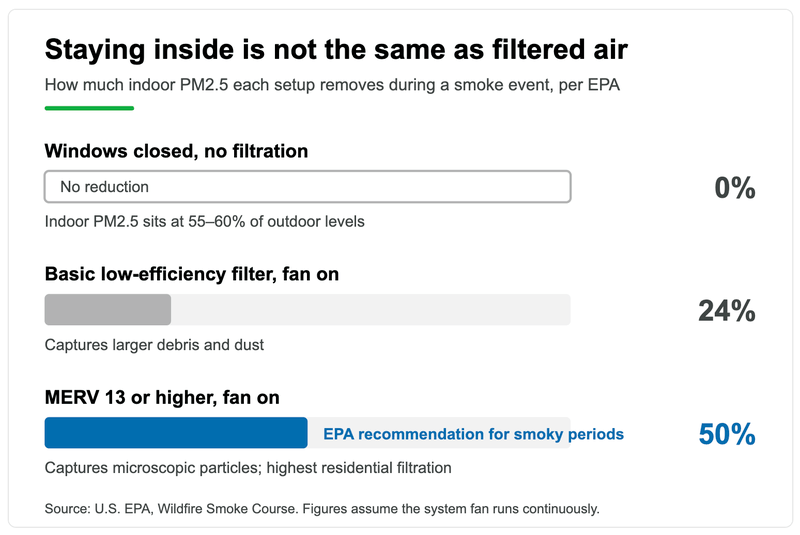
Staying inside only goes so far. With windows closed and nothing filtering, EPA data puts indoor PM2.5 at 55–60% of outdoor levels. EPA recommends MERV 13 or higher during smoky periods, which captures microscopic particles and is the highest level of residential filtration.
Ready to move up? Shop MERV 13 air filters — made in the USA, 600+ sizes, factory-direct.
Not sure which filter fits your system? Answer 3 quick questions and we will match you to your size and MERV.
TL;DR
Wildfire smoke irritates skin, and the research backs it up. During the 2018 Camp Fire, dermatology clinics 175 miles away saw eczema and itch visits climb sharply. Most adults who turned up for itch had never been diagnosed with eczema. PM2.5, the fine particles in smoke, weakens the skin barrier and drives inflammation. Filtering the air inside your home is the part of the fix most people skip.
Key Takeaways
Wildfire smoke is linked to measurable skin problems. In a JAMA Dermatology study of 8,049 clinic visits, pediatric eczema visits ran 1.49x the non-fire rate during the Camp Fire, and pediatric itch visits 1.82x (Fadadu et al., 2021).
You don't need to live near the fire. Those clinics sat 175 miles from the burn.
You don't need a history of eczema. 89% of adults seen for itch during the Camp Fire had no prior diagnosis, up from 59% and 51% in the comparison years.
PM2.5 damages the skin barrier directly. Fine particles suppress filaggrin, the protein skin needs to hold moisture, so smoke-season skin feels dry and reactive.
Staying indoors only helps if the indoor air is filtered. With windows closed and no air cleaner running, indoor PM2.5 sits at 55–60% of outdoor levels. EPA recommends MERV 13 or higher during smoky periods.
Can Wildfire Smoke Actually Cause a Rash?
Yes. Wildfire smoke is associated with rashes, itching, and eczema flares, and the effect turns up the same week as the smoke. The clearest evidence is a 2021 JAMA Dermatology study of the 2018 Camp Fire: 8,049 clinic visits, 4,147 patients, at a UC San Francisco health system 175 miles from the flames.
Adjusted for temperature, humidity, age, and clinic volume, pediatric eczema visits ran 1.49 times the non-fire rate, adult eczema visits 1.15 times, and pediatric itch visits 1.82 times. The dose response held: every 10 µg/m³ rise in weekly PM2.5 brought a 7.7% increase in pediatric itch visits. [1]
What surprises most people is who it happened to. Not just existing patients: 89% of the adults seen for itch during the Camp Fire had no prior eczema diagnosis, against 59% and 51% in the two comparison years. [1] Ordinary skin reacted too.
Maria Wei, MD, PhD, the UCSF dermatologist who was senior author on the study, calls skin "a very excellent physical barrier that separates us and protects us from the environment". In atopic dermatitis, she notes, that barrier never works quite properly, even on days when no rash is visible. [2]
Here is the part we think gets lost. The study is almost always reported with one takeaway attached: stay indoors. We read it differently. When people 175 miles away react, and most have no skin condition at all, the finding stops being about how close you live. It becomes a question about the air they were already breathing inside.
What Wildfire Smoke Does to Your Skin Barrier
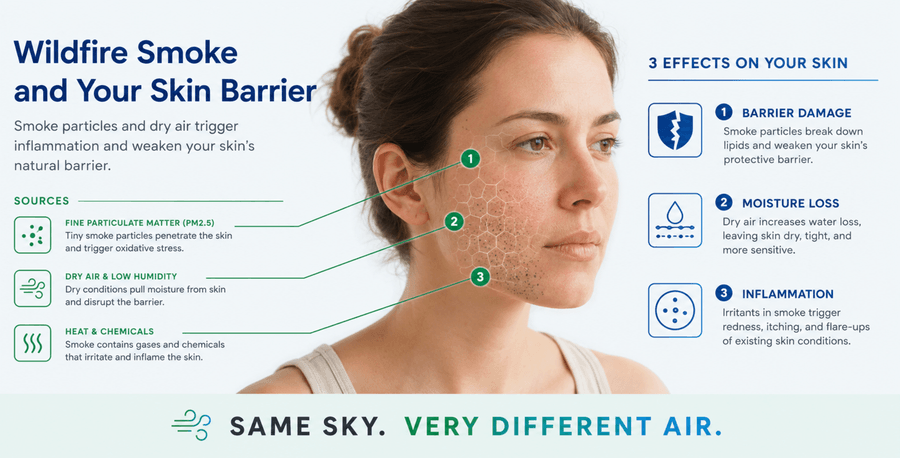
Wildfire smoke reaches your skin as PM2.5, particles under 2.5 micrometers across and roughly 30 times thinner than a human hair. They settle on the surface, generate reactive oxygen species, and switch on inflammation. The result is a weakened barrier that reacts to things it would normally shrug off.
The pathway is documented. PM2.5 carries polycyclic aromatic hydrocarbons, which activate the aryl hydrocarbon receptor (AhR) in skin cells and suppress two proteins your skin depends on to hold water: filaggrin and loricrin. It shows up in people, not just in culture: volunteers who moved from low-pollution Denver to high-pollution Seoul showed a clear drop in filaggrin breakdown products. [3]
Low filaggrin is the same barrier defect that defines atopic dermatitis, which gives you the through-line: smoke does not invent a new skin disease. It pushes your barrier toward the state eczema-prone skin already lives in.
Oil changes too. Pollution raises sebum while oxidizing squalene, one of its main lipids, and oxidized squalene is comedogenic. Pores clog. A 2026 review in Skin Health and Disease found a 10 µg/m³ rise in PM2.5 came with a 1.71% increase in acne clinic visits across 120,842 outpatient visits. [4]
The Four Skin Reactions People Report During Smoke Events
Filterbuy built this table because we could not find one. Dermatology sources explain the mechanisms. Air-quality sources explain the filtration. The two rarely sit on the same page. Four patterns cover most smoke-season complaints, and each has an indoor-air lever skin-care advice skips.
Original framework, built by Filterbuy from the dermatology literature cited below plus EPA indoor-exposure guidance. Timing ranges are general patterns, not diagnostic.
Is It the Smoke, or Is It Something Else?
Nothing here diagnoses a rash. Only a clinician can. But most people land here already blaming a new detergent, and there is a better way to think it through. These checks follow from the research above: smoke effects track air quality, peak the same week, and hit uncovered skin.
Line it up against the AQI, not the calendar. Smoke-linked flares appeared the same week pollution spiked, not a month later.
Check where it landed. Face, neck, and hands were exposed. A rash only under clothing points elsewhere.
Ask who else is itchy. If someone else in the house is scratching too, suspicion shifts to the shared environment, not your face wash.
Watch what happens when the air clears. A product reaction pays no attention to the AQI. A smoke-linked flare tends to ease as the air does.
Be honest about what else changed. New detergent, product, or medication that same week? Still your first suspect, with smoke possibly stacked on top.
If three or more of these point at the air, start by treating the air.
What to Do During a Smoke Event
Simplify your skin routine, then fix your indoor air. During a smoke event, cut your regimen back to cleansing and moisturizing, pause anything that thins the barrier, and stop adding particles indoors. Most people manage the skin half and skip the air half, which is why the flare returns.
Rinse off particles when you come in with a gentle cleanser. Harsh foaming washes make a compromised barrier worse.
Pause the actives and moisturize more. Retinoids, acids, and scrubs thin a barrier already under load. Ceramide moisturizers rebuild the lipid layer smoke disrupts.
Don't add indoor pollution. EPA advises against candles, gas or wood stoves, aerosols, and frying or broiling. Vacuuming stirs settled particles back up.
The Step Most People Miss: Filtering Your Indoor Air
Indoor air during a smoke event is not clean air. With windows shut and no air cleaner running, EPA data puts indoor PM2.5 at 55–60% of outdoor levels, and in some homes at 100%. That is why "stay inside" is incomplete on its own. Your skin still meets smoke particles indoors; there are simply fewer of them. Filtration is what closes the rest of the gap. [5]
Source: U.S. Environmental Protection Agency, Wildfire Smoke Course: Strategies to Reduce Exposure Indoors. Reduction figures assume the system fan runs continuously.
That gap is why this guide exists. Filterbuy is a U.S. air filter manufacturer: over a decade of American production, 600+ sizes, factory-direct. So we will be plain about where filters help and where they stop. Filtration is the difference between sheltering indoors and sheltering in clean air. It is not a treatment, and no filter replaces a dermatologist.
Three things separate a filter that works from one that sits there.
Switch the thermostat fan from "Auto" to "On." A filter only cleans air that passes through it, and on "Auto" the system runs only while heating or cooling.
Check the filter far more often. Smoke loads a filter fast. Replace it when it looks dark brown or black, not on schedule.
Confirm your system can handle MERV 13. Most modern systems can, per EPA, if the filter is changed often. With older equipment or narrow ductwork, ask an HVAC professional first.
One honest limit: no fiber filter removes smoke's gases. MERV 13 captures particles, not carbon monoxide, formaldehyde, or the other VOCs in smoke. Particles are the exposure that matters for skin, but know where the boundary sits.
If You Cannot Get a Filter in Time
Buy nothing tonight and still cut the particle load. Air cleaners go scarce or expensive exactly when smoke arrives, EPA notes, so the agency tested the workaround: a box fan with a MERV 13 filter taped to the back. [6]
Add a cardboard shroud. Costs nothing, raised clean air delivery 40% in EPA testing.
Thicker beats thinner. A 4-inch MERV 13 with a shroud more than doubled a bare 1-inch filter. A four-filter Corsi-Rosenthal box did better still.
Use a box fan made in 2012 or later with a UL or ETL mark. Nothing caught fire in Underwriters Laboratories testing, but newer fans add thermal cutoffs.
Check the filter daily. EPA found these builds almost useless once the filter loads. Swap it as soon as it darkens or smells of smoke.
Build instructions and safety notes: EPA research on DIY air cleaners. Filterbuy sells filters, so worth saying plainly: this is here because it works, and because EPA recommends it when shelves are empty.
Related: keeping wildfire smoke out of your house, MERV 13 vs HEPA for smoke, and what to do during an air quality alert.
Supporting Statistics
Three figures put this in context.
All three figures verified against the primary source on August 20, 2026. EPA is a U.S. federal agency; the American Lung Association and AAFA are U.S. nonprofit health organizations.
Sources: EPA Report on the Environment: Indoor Air Quality · American Lung Association, State of the Air 2026 key findings · AAFA, Atopic Dermatitis in America.
When to See a Clinician
See a healthcare provider if a rash is spreading, blistering, weeping, or comes with a fever. Same if a flare stops responding to your usual treatment, or if itching is costing you sleep. A smoke event does not rule out infection, a drug reaction, or contact allergy. If you live with a chronic skin condition, ask your dermatologist for a fire-season plan before it starts.
Frequently Asked Questions
Does Wildfire Smoke Cause Eczema, or Just Make It Worse?
Both. Smoke worsens diagnosed eczema and produces eczema-like symptoms in people with no history of it. Among Camp Fire itch patients, 89% had no prior diagnosis.
Are Children Affected More Than Adults?
Yes. Camp Fire associations were larger for children: pediatric eczema visits ran 1.49 times the non-fire rate against 1.15 for adults. Keep young skin covered outdoors and prioritise the bedroom for filtered air.
Do I Need MERV 13, or Is MERV 11 Enough?
EPA recommends MERV 13 or higher during smoky periods. MERV 11 is a fallback if your system cannot handle the airflow resistance.
Glossary
PM2.5: Particulate matter 2.5 micrometers in diameter or smaller. The dominant pollutant in wildfire smoke and the fraction most associated with health effects.
Atopic dermatitis (eczema): A chronic inflammatory skin condition marked by dry, itchy patches and an impaired skin barrier.
Filaggrin: A protein that helps the skin barrier retain water. Reduced filaggrin is a hallmark of atopic dermatitis and is suppressed by PM2.5.
Aryl hydrocarbon receptor (AhR): A receptor in skin cells that detects pollutants carried on PM2.5, triggering inflammatory and barrier-disrupting responses.
MERV: Minimum Efficiency Reporting Value, a 1–16 scale rating how well an air filter captures airborne particles. Higher numbers capture smaller particles.
CADR: Clean Air Delivery Rate, a measure of how much filtered air an air cleaner delivers. Higher is faster.
AQI: Air Quality Index, the EPA's 0–500 scale for outdoor air quality, color-coded by health-risk category.
Call to Action
Fire season is predictable. Your filter shouldn't be an afterthought.
Check your area on the live USA AQI map, track plumes on the live wildfire smoke map, then find your MERV 13 filter size. Filterbuy filters are made in the USA in 600+ sizes and ship free, factory-direct. Set up auto-delivery and it is one less thing before fire season.
Sources
[1] Fadadu RP, Grimes B, Jewell NP, et al. Association of Wildfire Air Pollution and Health Care Use for Atopic Dermatitis and Itch. JAMA Dermatology, 2021;157(6):658–666
[2] University of California, San Francisco. First of Its Kind Study Links Wildfire Smoke to Skin Disease (April 21, 2021)
[3] Kim BE, Kim J, Goleva E, et al. Particulate matter causes skin barrier dysfunction. JCI Insight, 2021;6(5):e145185
[4] Okeah IR, Afzal UM, Ali FR. Impact of environmental pollution on acne: a systematic review. Skin Health and Disease, 2026;6(1):12–19
[5] U.S. Environmental Protection Agency. Wildfire Smoke Course: Strategies to Reduce Exposure Indoors
[6] U.S. Environmental Protection Agency. Report on the Environment: Indoor Air Quality
[7] American Lung Association. State of the Air 2026 Key Findings
[8] Asthma and Allergy Foundation of America. Atopic Dermatitis in America
[9] U.S. Environmental Protection Agency. Research on DIY Air Cleaners to Reduce Wildfire Smoke Indoors