Shop by
September 10, 2026

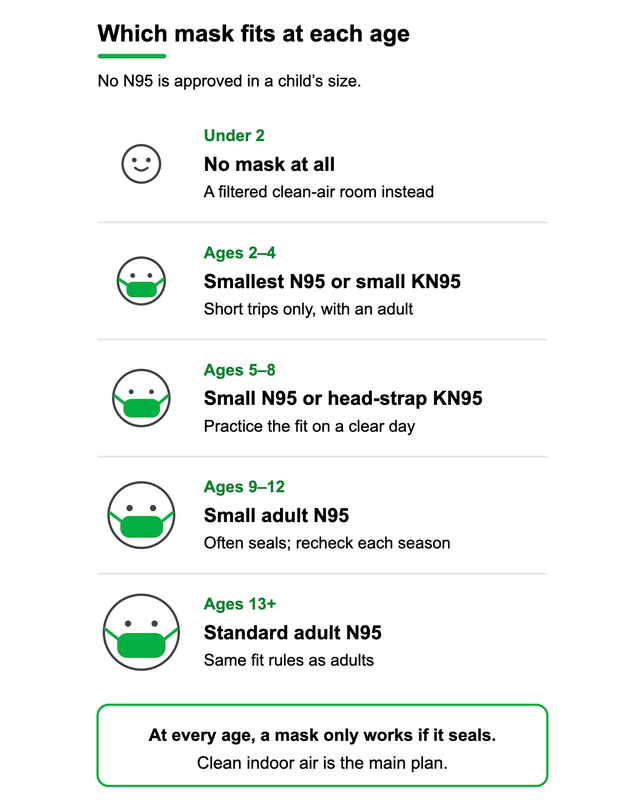
There’s no N95 made for kids, so children 2 and up should wear the smallest N95 or KN95 that truly seals, and only for short trips outside. Babies under 2 shouldn’t wear a mask at all.
Fit matters more than the rating. A mask that leaks at the edges protects about as well as no mask. At every age, the EPA’s main advice is to clean the air indoors rather than rely on masks.
Getting your home ready for smoke season? Take the quick wildfire prep quiz below.
Setting up the indoor side? The EPA recommends a MERV 13 or higher filter during smoke events.
Answer a few quick questions to get your home ready for wildfire smoke.
No respirator is certified for children. NIOSH, the federal institute that approves N95s, has never approved one in a child's size, so anything sold as a "kids' N95" is either a small adult respirator or an uncertified import. Children aged 2 and up can wear a small N95 or KN95 on short trips outdoors, provided it genuinely seals, while children under 2 should not wear one at all. At every age, cleaner indoor air and a calmer afternoon do more to cut a child's total smoke exposure than any mask will. Filterbuy builds air filters for a living, so what follows shows you the numbers rather than asking you to take our word for it.
NIOSH has never approved a respirator sized for children. The CDC notes that smaller imported models were designed and tested for adults in workplaces, not kids.
Age 2 is the floor. CDC guidance and the EPA/AAP/PEHSU factsheet both set the minimum age for mask use at 2.
A leak erases the rating. The EPA states that a poorly fitting respirator can leave roughly the same exposure as wearing nothing.
Cloth masks, surgical masks, bandanas, and wet washcloths do not filter wildfire smoke. They lack the electrostatic media and the face seal PM2.5 requires.
Children inhale more air per pound of body weight than adults. The EPA cites that, plus still-growing lungs, as why children face higher risk.
Filtration beats masking for kids on the numbers, and it keeps working on a sleeping toddler who would never keep anything on their face.
Exertion multiplies the dose more than any mask reduces it. Washington State DOH puts a child at high-intensity play at over 8x the air they breathe at rest, which makes calling the game worth more than any respirator.
No. NIOSH has not approved any respirator in a children's size. It certifies respirators for adult workers on job sites, and its testing assumes an adult face. The CDC says so plainly, noting that NIOSH Approved respirators do not come in sizes suitable for very young children, and that the smaller international models on the market were designed for adult workplace use.
So a package promising a kids' N95 is really one of two things, either a small adult model that happens to fit a bigger child or an uncertified import borrowing the name.
The part worth naming out loud is that federal guidance is not unanimous. The EPA's children's health page, updated May 2026, tells parents not to rely on masks at all and says even N95s are not made to fit children. The CDC and the American Academy of Pediatrics take a softer line: kids 2 and up can wear one, and a well-fitted N95 beats a medical mask.
Those two positions are closer together than they look, because each answers a different question. The EPA is answering the strategic one, should masks be your plan for a child, and the answer is no. The CDC and AAP are answering the tactical one, whether a well-fitted respirator beats nothing when your child has to be outside in smoke, and the answer is yes, so long as it seals. Read together, they produce the rule this guide runs on, which is that a mask is a bridge rather than a shelter.
Fit, not filtration rating, decides whether a child's mask does anything at all. Use the table below to set expectations, then verify with the seal check that follows, since faces vary enormously inside any age bracket. For the ratings themselves, see how N95, KN95, and P100 respirators compare.
There is a reason a filter company is the one telling you this. A rating describes the media, never the installation, and Filterbuy has been cutting filter frames in four U.S. factories since 2013, long enough for one lesson to become unmissable on the production floor. Air is lazy. It takes the easiest route available, so an open gap will beat 95%-efficient media every single time, and Filterbuy production data puts that failure threshold at an eighth of an inch. The same physics works against a respirator on a small face, which is why the column that matters most below is not the mask but the seal.
Faces vary widely within any age range. Verify the seal every time, and recheck each fire season as your child grows.
Two buying notes matter more than the brand on the box. Choose head straps over ear loops, because the EPA is direct that ear-loop masks aren't built to seal. And choose a size that clears the eyes: the CDC advises nose-to-chin coverage without blocking vision, since a mask a child can't see past is one they'll move.
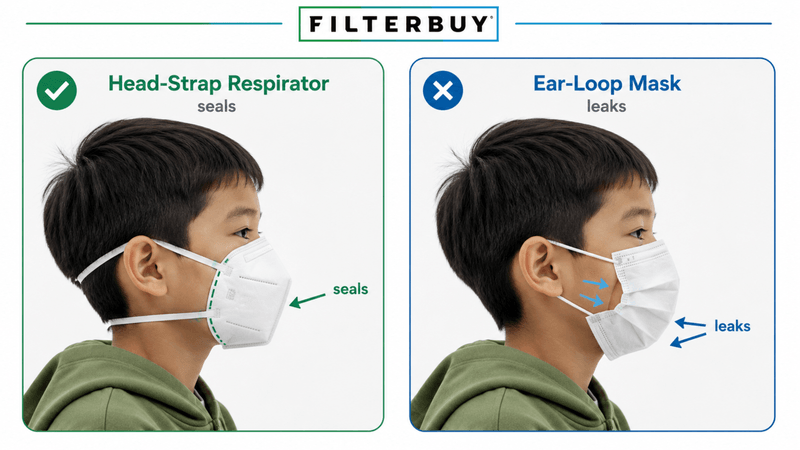
A respirator that leaks protects about as well as no respirator at all, according to the EPA, and the gap responsible is usually one you would never think to look for. Run this check every time, and make it a game rather than an inspection.
Fit it. Position it over the nose and under the chin. Mold the nose wire with two fingers, not one.
Blow out the candles. Have your child exhale hard, like blowing out birthday candles. Cup your hands around the edges and feel for escaping air. Air at the cheeks or nose bridge means a leak.
Suck it in. Have them inhale deeply. The mask should visibly pull toward the face and hold. If it doesn't move, air is coming in around the edges.
Ask. The AAP offers the clearest rule here: a child can safely use a mask if they can tell you about a problem with it. If it's uncomfortable or hard to breathe, take it off.
This check comes from the EPA/AAP/PEHSU factsheet (EPA-452/F-24-001), revised by six pediatric clinicians including Catherine Karr, MD, PhD, FAAP. It adds a step most parents skip: practice the mask on a clear-air day, and use it only for short necessary trips.
I went looking for a product answer to “which mask fits my kid” and there isn't one. Nobody makes it. What I did not expect was that the answer would come off our own factory floor: a filter fails because of a gap, and a child's mask fails because of a gap. Same physics, different frame. So this guide does what I could not find anywhere else. Age by age, what will actually seal, and where the honest answer is the room rather than the mask.
Michelle Wan, Brand Manager and Air Quality Writer, Filterbuy
Ask their pediatrician first, and ask before fire season rather than during one. A respirator makes breathing measurably harder, and the EPA advises anyone with a heart or lung condition to check with a doctor before using one. That produces the hardest trade-off on this page, because the child most at risk from wildfire smoke is often the one least able to tolerate the device that filters it.
Two details compound it. Wearing a respirator in heat or during activity raises the risk of heat-related illness, which matters in a season where smoke and heat arrive together. And the EPA guidance written for doctors is blunt about sequence, telling them that respirators should come only after the more effective measures, meaning staying indoors, reducing activity, and running filtration. For a child with asthma, that ordering is not cautious. It is the plan.
Three things worth doing before the smoke arrives if your child has asthma: raise respirator use at a routine appointment, make sure the asthma action plan is current, and build the clean-air room described below so the mask stays a last resort. While a child is wearing one, watch for difficulty breathing, dizziness, headache, or facial discomfort. If any of those appear, move to cleaner air and take the mask off, and seek medical attention if the symptoms do not settle.
What does not work, at any age:
Source: EPA and CDC wildfire smoke guidance. A NIOSH Approved N95 or P100 is the only mask category the EPA recommends for smoke.
Exertion multiplies the dose, and no mask offsets it. The Washington State Department of Health puts numbers on something every parent senses but no mask guide quantifies: compared with sitting still, a child's breathing rate rises more than 2x during light activity, more than 4x during moderate activity, and more than 8x during high-intensity activity. A soccer game on a smoky afternoon delivers roughly eight times the dose of the same child reading on the same field.
That reframes the decision most parents are actually making, because the question on a hazy Saturday is rarely which mask to buy. It is whether the game should happen at all. A respirator filtering 95% still lets through 5% of eight times the air, and a running child will pull it off their nose inside ten minutes anyway. Intensity is the lever that works here, and the mask is not.
The guidance below is the most useful version we have found, because it scales by duration as well as by AQI (recess is not a tournament), and because it treats every child under 18 as a sensitive group rather than only the ones with a diagnosis.
Adapted from the Washington State Department of Health Children and Youth Activities Guide for Air Quality (DOH 334-332, May 2026). Every child under 18 counts as a sensitive group. Count travel time: walking, biking, or a bus with the windows down is time outdoors.
Two things in there are easy to miss. The first is the commute, because walking, biking, and riding a bus with the windows down all count as time outdoors, which quietly adds an hour to school days nobody was budgeting for. The second is that the threshold moves for children with asthma, whose limits start at an AQI of 51 rather than 100. If your child has an asthma action plan, fire season is when it earns its keep. That same guide describes a respirator as an option when you have no other way to avoid the smoke, which makes it a last move rather than a first one.
Count the hours and the strategy writes itself. Once the outdoor call has been made, everything that follows happens inside, which is where the bulk of a smoky day is spent anyway. It is why the EPA tells parents to clean the indoor air rather than rely on masks. A high-efficiency filter running continuously can cut indoor PM2.5 by roughly half.
The EPA's checklist for children during a smoke event:
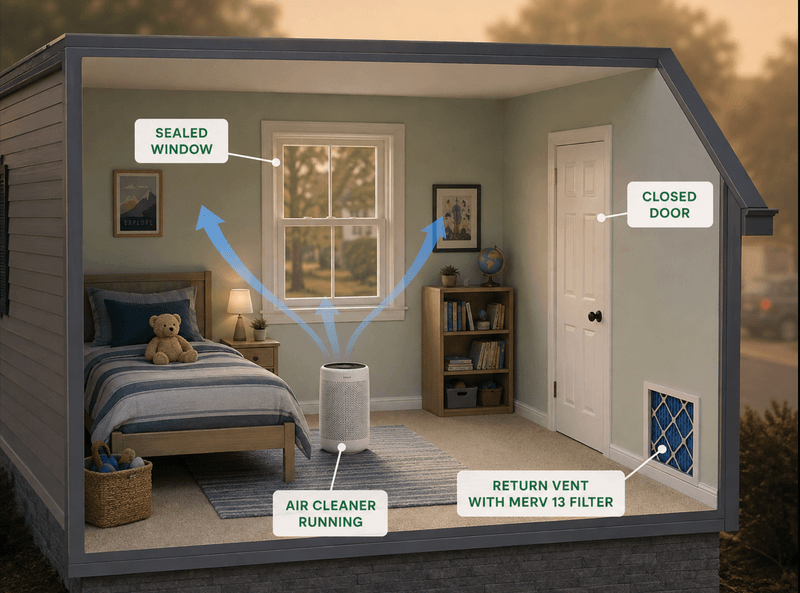
Run MERV 13 or higher in your central system. Smoke loads a filter fast: a 90-day filter can need replacing at 30 to 45 days in fire season. Unsure what your system takes? See the MERV rating chart.
Set the system to "Recirculate" and the fan to "On," not "Auto." On "Auto" the fan only filters while the system is heating or cooling, so you lose it the moment the house hits temperature.
Close the fresh-air intake. On a window AC unit, close the outdoor damper and check the seal against the frame.
Add a portable air cleaner where your child sleeps and plays, running with the door shut.
Build a clean-air room. The EPA recommends you set up a clean-air room where children sleep and play.
Skip ozone generators and ionizers. The EPA warns these emit ozone at levels that irritate airways.
There is one caveat the EPA includes and most articles drop, which is that a sealed house still has to stay livable. If it gets too warm with the windows closed and you cannot cool it, go and find cleaner air somewhere else, because overheating a small child to filter their air is not a trade worth making.
The part Filterbuy can speak to first-hand is the filter itself. A MERV 8 captures under 20% of particles in the size band wildfire smoke lives in, while the Filterbuy MERV 13 captures 98% down to 0.3 microns, a wider performance gap than sits between any two masks a parent can buy.
The same seal rule applies here too. About 70% of the filters Filterbuy ships are not one of the ten most common sizes, which tells you how many homes have a slot nothing on a hardware-store shelf will fill properly. A half-inch gap costs 20 to 30% of a filter's effectiveness (our filter fit guide). If your slot is an odd one, and in older houses and converted daycare buildings it usually is, order a custom size. We would rather say that than sell you a filter that rattles.
Before you decide whether today is a mask day at all, check your local AQI. For children, a sensitive group by every federal definition, AQI above 100 is where you start limiting outdoor time. More on what AQI levels are unsafe for sensitive groups.
First-hand: filtration media, seals, bypass, and sizing, all measured on Filterbuy production lines across four U.S. factories and 600+ sizes since 2013.
Cited, not ours: every clinical and pediatric claim here. We have never fit-tested a respirator on a child and will not imply otherwise. Age thresholds, the seal check, activity limits, and health effects come from the CDC, EPA, AAP, PEHSU, and state health authorities, linked at the point of use.
Where we have no stake: Filterbuy sells no masks, so telling you the respirator is the weaker half of the plan costs nothing and gains nothing, which is exactly why you can weigh it on the evidence.
Three numbers shaped the advice above, each from a U.S. agency, an NIH-indexed study, or a national medical charity, and each carrying its limitation where it has one.
The number: 33.5 million children under 18, or 46% of all U.S. kids, live in a county graded F for at least one measure of air pollution. Around 2.4 million of them have asthma.
Why it matters: This is not a Western-states problem you can move away from, and the American Lung Association ties part of the trend to wildfire smoke events.
Source: American Lung Association, State of the Air 2026: Populations at Risk (published April 23, 2026)
The number: In a block-randomized crossover trial across 17 Los Angeles elementary schools, HEPA classrooms averaged 39.9% lower PM2.5 across the school year than controls, with outdoor infiltration 13.8% to 82.4% lower by school.
Why it matters: Every classroom already had MERV 13 in the HVAC, so the filter and the room air cleaner were not alternatives to each other but partners. Do both in the room where your child sleeps.
The honest limitation: the study period had no wildfire smoke events and generally good outdoor air, so the authors state they cannot assess performance during extreme pollution episodes, and cannot say whether reductions this small carried health benefits. We cite it for the stacking effect, not as proof of a health outcome.
Source: Simona, Bartell & Vieira, Journal of Exposure Science & Environmental Epidemiology, 2025 (NIH PMC12234348)
The number: Across more than 9,300 modeled pediatric hospital visits in Alameda and Contra Costa Counties, each 10 µg/m³ rise in wildfire-specific PM2.5 was associated with a 4% increase in asthma encounter risk on the day of exposure, with further 3–4% increases on days 3 and 4, for a cumulative 13% over the five-day window.
Why it matters: The risk does not end when the sky clears, so keep filtration running and change the filter after a smoke event rather than only during one.
Source: Sugrue et al., GeoHealth, February 2026 (NIH PMC12892088)
Yes, with an adult present and for short periods, though the seal will almost certainly be imperfect. CDC guidance permits masks from age 2 up, but a mask a toddler keeps pulling down does very little, so keep the trip brief.
Do not mask them. No respirator is made in a size that fits an infant, and pediatric guidance sets the minimum age at 2. Filtration is the whole strategy. See our companion guide to protecting infants and toddlers from wildfire smoke.
Yes, as a second choice. A well-made KN95 clearly outperforms a cloth or surgical mask, but it is not NIOSH-tested, quality varies widely between manufacturers, and ear loops seal more loosely than head straps. Choose a head-strap version wherever one is available.
MERV 13. It is the level the EPA names for smoke events, and the highest most residential systems run without restricting airflow. See our guide to the best air filter for wildfire smoke, or shop MERV 13 filters directly.
Yes. For wildfire smoke, as distinct from infection control, a valved respirator filters incoming air normally and the valve only vents air outward. The EPA notes a valve may help if a respirator feels uncomfortably hot or hard to breathe through, which is often the difference between a child keeping it on and pulling it off.
Close the windows and switch the ventilation to recirculate so the system stops drawing smoke in from outside. The EPA/AAP/PEHSU factsheet names this specifically for family travel, and it matters more than it sounds, because the drive to school is often the longest stretch a masked child spends in smoky air.
Usually not, if the air is being filtered properly, since the whole point of a clean-air room is that nobody has to wear anything in it. If your child is symptomatic indoors and you have no filtration running, a mask will help in the short term while you get one going.
N95: A facepiece respirator capturing at least 95% of airborne particles. In the U.S., the term properly refers only to models approved by NIOSH, whose name is printed on the mask.
KN95: A respirator built to China's GB2626 standard. Comparable to an N95 when made to spec, but not NIOSH-approved.
NIOSH: The National Institute for Occupational Safety and Health, the U.S. body that tests and approves respirators. NIOSH has approved none in a children's size.
PM2.5: Fine particulate under 2.5 micrometers. The main hazard in wildfire smoke, small enough to reach deep lung tissue.
MERV 13: A filter efficiency rating on the ASHRAE MERV scale. The level the EPA recommends for smoke events, and the highest most residential HVAC systems run without restricting airflow.
Clean-air room: One room sealed against outdoor air and continuously filtered, used as a refuge during smoke.
AQI: The EPA's 0–500 pollution scale. Above 100, all children should reduce outdoor exposure. For children with asthma, limits start at 51.
PEHSU: Pediatric Environmental Health Specialty Units, the clinician network behind the seal check above.
Fire season rewards the household that got ready in spring, so here are five things to do now, cheapest first.
Close the house and stop making particles indoors. Free, and it is the foundation everything else sits on.
Put a MERV 13 in the system you already own, sized so it actually seals. Filterbuy makes MERV 13 in over 600 sizes plus custom, though be clear about the order of what matters: the rating first, the fit second, the brand a distant third. A properly sized MERV 13 from anyone beats no MERV 13 at all.
Add a portable air cleaner in the room where your child sleeps. Not an ozone generator or an ionizer.
Buy the masks now, in the smallest size your child will tolerate, and practice the seal check on a clear day. Compare how N95, KN95, and P100 respirators compare before you order.
Bookmark the live USA AQI map and check it the way you check the weather. Smoke can load a filter in 30 to 45 days, so set auto-delivery for the change nobody remembers to make in October.
If the budget stretches to only one thing, make it steps one and two, because a sealed house with a fresh, well-fitting filter will beat an expensive purifier in a house with the windows cracked.
Michelle Wan is Brand Manager and Air Quality Writer at Filterbuy, where she writes the company's air quality guides, including its companion pieces on protecting infants and toddlers from wildfire smoke and how N95, KN95, and P100 respirators compare. This guide was technically reviewed by David Clark, a Licensed HVAC Technician.
Filterbuy is an American air filter manufacturer based in Talladega, Alabama, building pleated HVAC filters in four U.S. factories since 2013 on a family filtration business dating to 1958. The company produces MERV 8, MERV 11, MERV 13, and activated-carbon filters in more than 600 standard sizes plus custom cuts, and has served over two million households. Because Filterbuy makes filtration media rather than personal protective equipment, the filtration claims on this page come from company production and fit data, while every clinical claim is cited to a public health authority.
Every link below was checked on August 21, 2026 and resolved to the intended page. See the Link Audit in the Production Notes.
U.S. EPA: Protect Children from Wildfires, Smoke, and Volcanic Ash (updated May 22, 2026)
U.S. EPA: Who Is at Increased Risk of Health Effects From Wildfire Smoke Exposure?
U.S. EPA: Create a Clean Room to Protect Indoor Air Quality During a Wildfire
American Academy of Pediatrics: Wildfires, Taking Care of Your Children & Yourself
American Lung Association: State of the Air 2026: Populations at Risk
Use these exact anchor texts every time these destinations are linked, across the whole cluster. Consistent anchors are how answer engines connect this page's chunks to its neighbours.
how N95, KN95, and P100 respirators compare: the ratings themselves, in depth
protecting infants and toddlers from wildfire smoke: the under-2 guide this page hands off to
best air filter for wildfire smoke: why MERV 13 is the floor
MERV rating chart: what each rating actually captures
what AQI levels are unsafe for sensitive groups: the thresholds that apply to children
filter fit guide: the three checks for filter bypass
check your local AQI: live USA AQI map
shop MERV 13 filters: 600+ sizes, made in the USA
This guide is educational and is not a substitute for medical advice. If you are worried about your child's breathing, call your pediatrician. For an emergency, call 911.
