
When Is It Safe to Open Windows After Wildfire Smoke? AQI Thresholds Explained
September 22, 2026
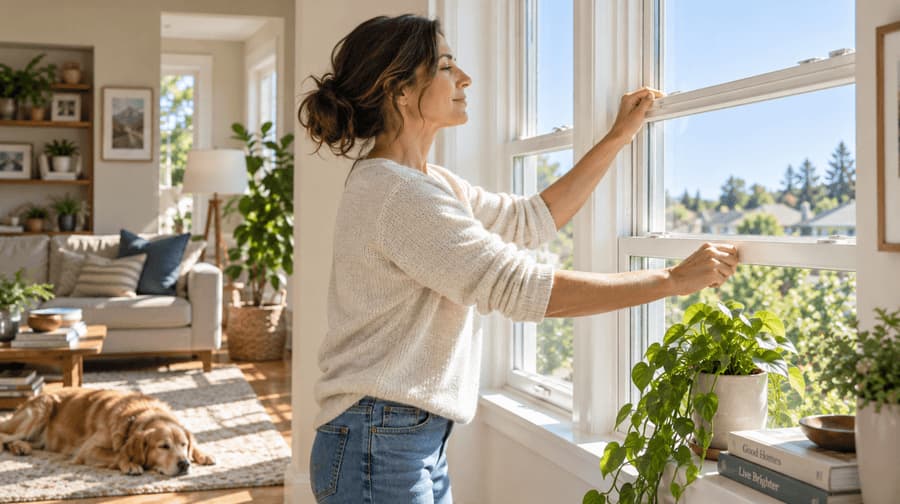
Open your windows once the outdoor AQI has held at 50 or below for three straight hours and isn’t climbing. Don’t judge by the sky. Check the raw hourly PM2.5 reading on the AirNow Fire and Smoke Map, because the AQI in most apps lags behind clearing air.
AQI 0–50, held 3 hours: Open up and cross-ventilate.
AQI 51–100: Ventilate 10–15 minutes, only while the number is falling.
AQI 101+: Stay closed and run your HVAC on recirculate.
Change your HVAC filter before you open a window. EPA guidance recommends MERV 13 or higher during smoke events. MERV 13 captures microscopic particles, the highest level of residential filtration.
Not sure which filter fits your system? Answer a few quick questions and we’ll match you.
TL;DR
Open your windows once the outdoor Air Quality Index has held at 50 or below for three consecutive hours and the trend is flat or falling. Do not judge by the sky. Check the raw hourly PM2.5 reading on the AirNow Fire and Smoke Map, because the dial most apps show is a 12-hour weighted average that reads high while smoke clears. Once outdoor air is cleaner than indoor, cross-ventilating flushes what your house has been holding.
Key Takeaways
The ventilation threshold is an outdoor AQI of 50 or below, held three straight hours, trend flat or falling. A single clean reading is not a clearance.
The NowCast AQI lags a clearing sky. The EPA builds the current-hour AQI from the previous 12 hours of data, so during rapid improvement it reads above the air you would actually breathe.
Indoor PM2.5 settles at roughly 55 to 60 percent of outdoor levels during a smoke event. That equilibrium does not fall when the outdoor plume moves on.
Indoor PM2.5 takes two to seven days to return to pre-fire background. Ventilation plus filtration shortens that considerably.
Do not ventilate if ash is visible outside or a structure fire burned nearby. Those are hazards the AQI does not measure.
When Is It Safe to Open Windows After Wildfire Smoke?
Open your windows once the outdoor AQI has been at or below 50 for three consecutive hours and is not climbing. AQI 50 equals 9.0 micrograms per cubic meter of PM2.5 under the EPA's 2024 breakpoints. Between 51 and 100, ventilate briefly, and only while the number is actively falling from a much higher one. Above 100, stay closed.
The three-hour hold is worth flagging, because no agency publishes it. It is our rule, drawn from how the EPA calculates the number you are reading, and the next section shows the working so you can judge it.
The pollutant driving all of this is PM2.5, fine particles small enough to pass deep into the lungs and straight through a standard filter. On the question of ventilating, the EPA’s guidance on reducing smoke exposure indoors is unambiguous. Airing out the home is the right move once conditions improve, including during the breaks that a long smoke event produces. So the judgment call was never whether to ventilate. It is when.
Filterbuy is an American air filter manufacturer, and we have spent a decade watching what smoke does to the filters that come back from fire country. That vantage point runs through this page. The outdoor number gets the attention, but the decision you are making is about the air already sitting inside your house.
Ventilation Decision Thresholds
Ranges reflect the EPA's revised PM2.5 AQI breakpoints, effective May 6, 2024. The "stay closed" rows assume you can keep the house at a safe temperature. If you have no air conditioning and the home is overheating, heat takes priority over the AQI.
See also: how to check outdoor air quality today and our full guide to the wildfire smoke air quality index.
Why the AQI on Your Phone Lags the Clearing Sky
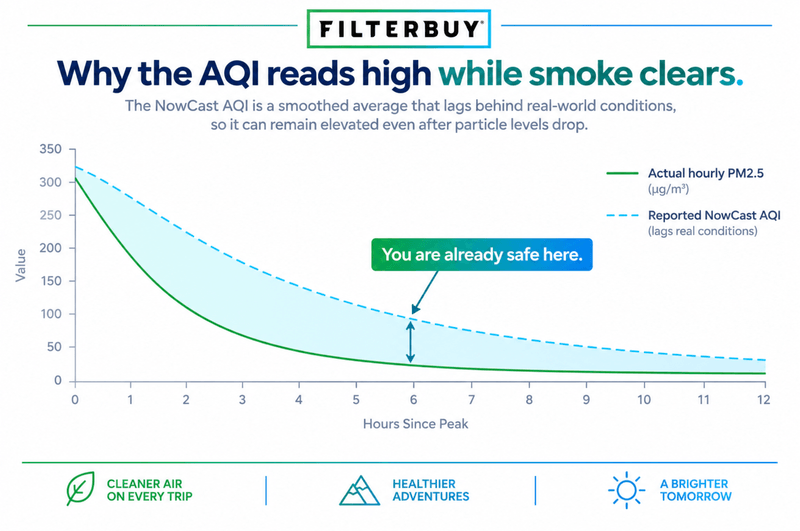
The AQI you see during a smoke event is a NowCast value, not a live measurement. Per the EPA's AQI technical assistance document, the NowCast algorithm builds each hourly figure from the previous 12 hours of PM2.5 data, weighting recent hours more heavily when conditions are volatile. During a fast clearance it behaves like a roughly three-hour average, better than a flat 24-hour figure but still trailing the actual air.
That lag runs in the direction that costs you. When smoke rolls in, the NowCast under-reports and the warning arrives late. When smoke clears, it over-reports, and you stay sealed longer than you need to while the air inside quietly becomes the worse of the two.
The EPA says as much itself. Its AQI guidance takes up the exact question homeowners ask during a smoke event. The sky looks smoky, the dial reads green, and both are telling the truth. The answer comes down to where the data comes from. The main AirNow site carries no sensor data and cannot always keep up with fast-changing conditions, while the AirNow Fire and Smoke Map pulls from thousands of sensors and can. Use the map, not the dial.
The fix takes ten seconds. On the Fire and Smoke Map, tap an individual monitor instead of reading the shaded contour. The popup shows raw hourly concentration alongside the NowCast AQI. The raw number is what the sensor measured in the last hour, and that is the figure to ventilate against. Contours are interpolated between monitors, not measured at your address, so read the monitor, not the color. Our guide to how to read a wildfire smoke map walks through each layer.
The Crossover Point: When Your Sealed House Becomes the Dirtier Space
Sealing the house works, but it buys time rather than cleaning anything. The EPA reports that during smoke events indoor PM2.5 settles at 55 to 60 percent of outdoor levels with the windows closed and no air cleaner running, ranging from 30 percent in tight construction up to 100 percent in leaky homes.
One detail decides how that ratio should be read. It applies to concentration, and concentration does not scale the way the AQI number does, so you cannot take 57 percent of an AQI reading. Done properly, outdoor air at AQI 200 puts a closed house near AQI 163. Still bad, but better than outside, which is why sealing up is right while smoke sits on you. The table below runs that conversion at four common readings.
What Your Indoor Air Is Likely Doing During a Sustained Smoke Event
Indoor figures apply the EPA's reported 55–60 percent indoor-to-outdoor PM2.5 ratio (midpoint 57.5 percent) to outdoor concentration, then convert using the EPA's 2024 AQI breakpoints. Steady-state estimate with windows closed and no air cleaner running. Measured ratios range from 30 to 100 percent by home.
Every row shows indoor air cleaner than outdoor, which raises a fair question. If inside is always better, when does the sealed house become the problem? Those figures describe a settled state, and the moment that matters is not settled at all.
That indoor number is an equilibrium built over days of infiltration, and it does not fall away when the outdoor plume moves on. Research on more than 1,400 California buildings found indoor PM2.5 nearly tripled during fire events, then took two to seven days to work back down. Outdoor air has no such inertia. A wind shift can drop it from AQI 200 to 45 in an afternoon while your indoor air is still grinding down from 163. For those few hours the two lines cross and inside becomes the dirtier place to breathe. We call that the crossover point, because homeowners kept describing it and nobody seemed to have a name for it.
We see the evidence from the manufacturing side. Filterbuy has built air filters in the United States since 2013 and shipped them to more than two million households, including the counties that absorb most of this country’s smoke days. Every fire season those filters come back visibly darker and heavier than the ones from clean-air months. That gray is a physical record of what the house held while the windows stayed shut, and it keeps building for as long as they stay shut. Opening up on the right afternoon collapses that timeline from days to hours.
The number everyone watches is the outdoor one. The number that decides how your family feels that evening is the one inside, and it moves slower. I have watched households stay sealed for two extra days after the sky went blue, running a loaded filter, breathing the tail end of a fire they could have flushed out in an afternoon. Checking the AQI is not the skill. Knowing which way it is moving, and how far behind your own air is lagging, is the skill.
Michelle Wan, Brand Manager and Air Quality Writer, Filterbuy
The Three-Number Check Before You Open a Window
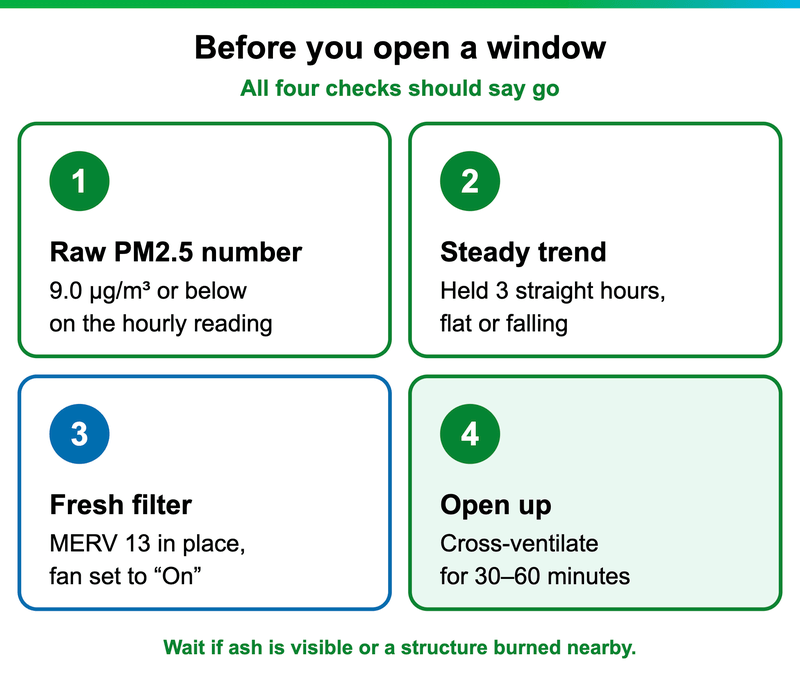
All of which reduces to a short routine. This is the check Filterbuy runs internally. It takes under a minute and replaces guessing at the sky with three things to confirm.
The raw outdoor number. Pull the hourly PM2.5 reading from the nearest monitor on the live wildfire and smoke map or AirNow. Target: 9.0 µg/m³ or below.
The trend. Check the last three hours rather than the current reading alone. Flat or falling is a go. A rising line means a wind shift is pushing a new plume toward you, and a clear sky at that moment means nothing.
Your indoor number. With a PM2.5 monitor, compare directly and ventilate when outdoor is meaningfully lower. Without one, use the table above.
Then ventilate properly. Once those three line up, open windows on opposite sides of the house so air moves through, rather than cracking one and hoping. Run the bathroom and kitchen exhaust fans to pull it along. Thirty to sixty minutes of real cross-flow does more than a full day of a single open window.
Then close up the moment the number starts climbing again. The EPA notes that with the windows open, indoor and outdoor particle levels end up much the same, which is the point while the air is clean and the risk once it turns.
When Not to Open the Windows, Even at AQI 50
A green reading is not a blanket clearance, because the AQI measures one thing and a post-fire neighborhood contains several. Keep the house closed if any of the following applies.
Visible ash is settled outdoors. Wind and foot traffic resuspend ash, and a monitor miles away will not register it. Wet it down first.
A structure fire burned nearby. Burned buildings release byproducts from plastics, insulation, and electronics that the AQI does not measure.
You are still cleaning smoke residue indoors. Finish HEPA vacuuming and wiping down, then ventilate.
Someone in the household has asthma, COPD, or a heart condition. Wait for a sustained green reading rather than ventilating in the moderate band.
Do not use a whole-house fan or evaporative cooler until the air is clean. Both pull unfiltered outdoor air straight through the house. While you wait, the EPA’s guidance on creating a clean room is the better move, and our guide to running an air purifier during wildfire season covers sizing.
If Your Home Has No Air Conditioning, Heat Wins
Everything above assumes you can stay comfortable with the windows shut. For a lot of households that assumption does not hold, and when it breaks the advice has to change with it. Fire season and heat season are the same season, and a sealed house with no cooling turns dangerous faster than smoke does.
The EPA is direct about this. If you have no air conditioner and it is too warm to stay inside with the windows closed, seek shelter elsewhere. Its AQI guidance repeats the warning, noting that staying indoors with windows closed may be dangerous in extreme heat, and points to air-conditioned spaces or local cooling centers. Heat kills faster than a bad AQI day. Treat the table above as guidance for a house you can actually live in.
For a home without cooling, the EPA recommends inverting the daily rhythm.
Close windows and shades during the day, before the outside air heats up.
Open the windows at night when it is cooler, using fans to push hot air out or pull cooler air in.
Once the indoor air is cool, close up again and run a portable or DIY air cleaner to filter what came in with the cool air.
That routine trades a little smoke for a lot of heat relief, which is the right trade. Check the raw hourly reading before the night window and pick the cleanest hours available, not the coolest. If heat stays up overnight, the EPA suggests leaving the area or getting a window unit. Libraries and malls work. So do the cleaner-air shelters many counties open during smoke events. And Filterbuy will say what a filter company has little incentive to say. No filter solves a heat problem, and on those nights the window matters more than the MERV rating.
Reset Your Filter Before You Ventilate
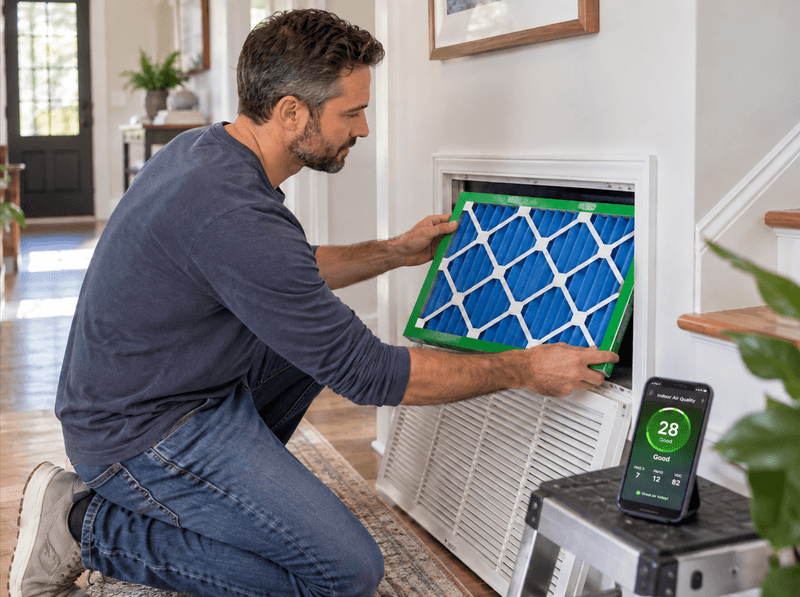
One piece of sequencing matters more than people expect. Change the HVAC filter before you open the windows, not after. A filter that worked through a smoke event is loaded with fine particulate whether or not it looks gray, and a loaded filter both restricts airflow and can re-release what it caught. In heavy smoke a 1-inch filter that normally lasts months is spent inside a week.
Fit the highest MERV rating your system safely accommodates. EPA guidance on wildfires and indoor air quality recommends MERV 13 or higher during smoke events. Set the thermostat fan from "Auto" to "On" so the filter works every hour.
Filterbuy’s baseline is every 90 days. Shorten that to 60 days in a home with pets, 45 days if someone has asthma or allergies, and 30 days during wildfire smoke or active renovation. What drives the interval is what is in your air, not the MERV rating on the frame.
David Clark, Licensed HVAC Technician, Filterbuy HVAC Solutions
One caveat. Ventilation clears the air, not the surfaces. Smoke residue on walls and fabrics needs physical cleaning, which our smoke recovery guide covers.
Keep filtering after the fire. Recovery is a filtration job, not just an open-window job. Shop MERV 13 filters in your size in 600+ standard sizes, or order a custom-size air filter if yours is odd. Made in the USA, shipped free and factory-direct. Set up auto-delivery so the next smoke season does not catch you short
Supporting Statistics
Three federal findings back the guidance above.
1. The AirNow Dial Can Miss Smoke Entirely
The Fire and Smoke Map draws on more than 1,700 regulatory PM2.5 monitors plus roughly 15,000 low-cost sensors. The dial draws on a smaller set chosen by state and local agencies, and AirNow states plainly that if no PM2.5 monitor is nearby, or another pollutant scores higher, the dial may not show how smoke is affecting your air at all.
What it supports: reading raw monitor data on the Fire and Smoke Map, not the dial or a weather widget.
Our read: most of the confused questions Filterbuy gets during smoke season trace back to two different numbers on two different screens.
Sources: U.S. EPA, Where to Find Air Quality Smoke Reports and AirNow, Using AirNow During Wildfires
2. Running the Fan Continuously Roughly Doubles What Your Filter Does
EPA reports that a high-efficiency HVAC filter may cut indoor PM2.5 by about 50 percent when the system fan runs continuously. Even a low-efficiency filter cuts particle concentrations about 24 percent under continuous operation. A filter only works on air that passes through it.
What it supports: changing the filter before ventilating and switching the fan from "Auto" to "On."
Source: U.S. EPA, Strategies to Reduce Exposure Indoors (citing Fisk and Chan, 2017)
3. Wildland Fires Are the Largest Single Source of U.S. Fine Particle Pollution
EPA’s 2020 National Emissions Inventory attributed 52 percent of all PM2.5 emitted in the United States to wildland fires.
What it supports: treating a ventilation rule as nationwide household knowledge, not a western specialty.
Source: U.S. EPA, Wildland Fire Research: Reducing Exposures
Frequently Asked Questions
How Long After a Wildfire Should I Wait to Open My Windows?
There is no fixed number of days. Wait until the outdoor AQI holds at 50 or below for three consecutive hours with a flat or falling trend. That can take hours after a wind shift, or over a week if a plume stalls.
Is AQI 50 or AQI 100 the Right Threshold?
AQI 50 is the safe default. AQI 100 is the outer limit some guidance permits, and only for brief ventilation in a home with no sensitive occupants while the number is actively falling from something much higher. Households with children, older adults, or anyone with asthma or heart disease should wait for 50 or below.
Can I Trust Clear Skies and No Smoke Smell?
No. PM2.5 is invisible at concentrations that still matter, and smell fades faster than the particles do. Sight and smell are the two checks most people rely on, and both clear before the air does.
What if There Is No Monitor Near Me?
Zoom out on the Fire and Smoke Map and use the nearest reading upwind of you, since smoke arrives on the wind. Treat that figure as a rough guide rather than your address, hold out for a clearly green reading instead of a borderline one, and give it an extra hour before you open up. A low-cost PM2.5 sensor pays for itself quickly in a rural county with thin monitor coverage.
Should I Sleep With the Windows Open?
Only if the overnight forecast holds AQI at or below 50. Smoke often settles into valleys overnight, so a clean 8 p.m. reading does not guarantee clean 3 a.m. air.
How Do I Know When My Indoor Air Has Actually Recovered?
An indoor PM2.5 monitor is the only direct answer. Without one, treat two to seven days of ventilation plus filtration as the recovery window. Our guide to recovering from wildfire smoke exposure covers the full cleanup sequence, including the surface cleaning that ventilation alone will not do.
Glossary
AQI (Air Quality Index) - The EPA's 0-500 scale for outdoor air pollution. It reports the single highest-scoring pollutant for an hour, not an average.
PM2.5 - Fine particulate matter 2.5 micrometers or smaller, the dominant pollutant in wildfire smoke.
NowCast - The EPA algorithm that turns the previous 12 hours of data into a current-hour AQI, weighting recent hours more heavily when conditions change fast.
Raw concentration - The unweighted PM2.5 measurement (µg/m³) from one monitor for one hour, shown when you tap it on the AirNow map.
MERV - Minimum Efficiency Reporting Value, the ASHRAE 1-16 scale for how well a filter captures particles.
Crossover point - A Filterbuy term for the moment when outdoor PM2.5 falls below indoor PM2.5, making ventilation a net gain.
Sensitive groups - Children, older adults, pregnant people, and anyone with asthma, COPD, or heart disease.
Sources
U.S. EPA, Where to Find Air Quality Smoke Reports: Fire and Smoke Map
Li et al., The persistence of smoke VOCs indoors, Science Advances (2023)
This page is informational and is not medical advice. If you have a heart or lung condition, talk to your physician about your smoke exposure plan.