
Urban vs. Forest Wildfire Smoke: Toxic Compounds, Health Risks, and Filtration
September 22, 2026
What's the Difference Between Urban and Forest Wildfire Smoke?
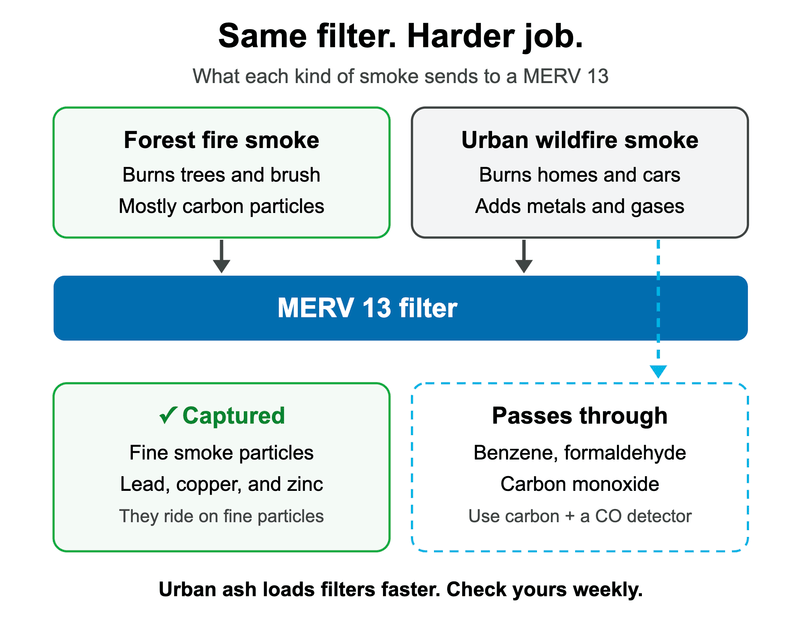
Forest fire smoke comes mostly from burning trees and brush. Urban wildfire smoke adds metals like lead, copper, and zinc, plus chemical gases, from burning homes, cars, and plastics.
Your filter rating doesn't change. A MERV 13 captures microscopic particles, including the fine particles those metals travel on.
What changes is the workload. Urban ash loads a filter faster, and gases pass through every fiber filter, so check yours weekly during a smoke event.
Made in the USA in 600+ sizes.
Not Sure Which Filter Fits Your System?
Answer a few quick questions and we'll match you to your filter.
TL;DR
Urban wildfire smoke and forest wildfire smoke are chemically different pollutants. A forest fire burns vegetation. When fire moves through a neighborhood it burns painted wood, PVC pipe, vehicles, and insulation as well, and the plume picks up lead, chlorine, copper, zinc, and far more polycyclic aromatic hydrocarbons than trees alone would produce. None of that changes the filter you should buy, since MERV 13 remains the EPA benchmark for smoke. What it changes is how hard that filter has to work. It loads faster, and a larger share of the hazard sits in the gas phase, where no fiber filter can reach it.
Key Takeaways
EPA emission factors for some toxic compounds, including polycyclic aromatic hydrocarbons, run 5 to 2,500 times greater in wildland-urban interface fires than in fires burning natural fuels.
During the January 2025 Los Angeles fires, the CDC reported airborne lead in PM2.5 rising roughly 110-fold 14 miles downwind of the Eaton fire.
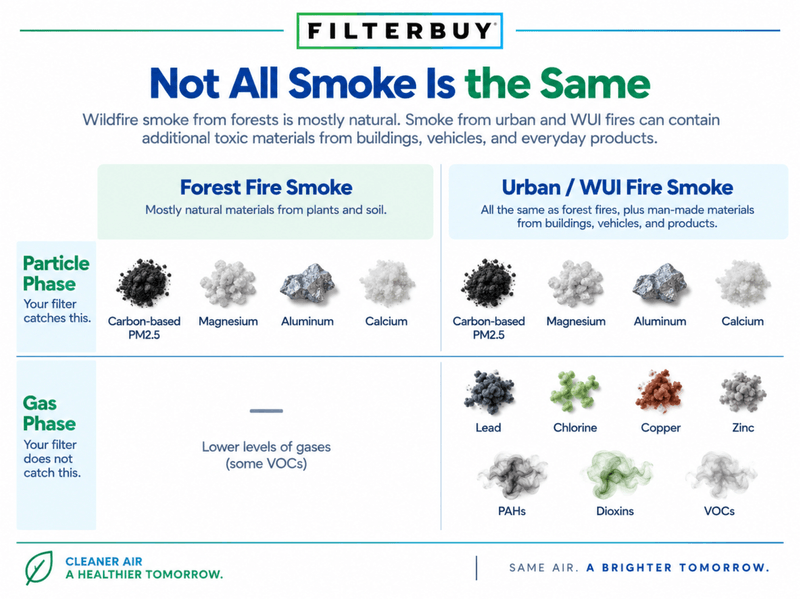
The toxic metals ride on fine particles, so a MERV 13 captures them like any PM2.5. Filterbuy’s fuel-to-filter map below shows which compounds a filter reaches and which it never will.
The gases, including benzene, formaldehyde, hydrogen chloride, and carbon monoxide, pass through every fiber filter regardless of MERV rating.
The AQI tells you how much particulate is in the air, never what it is made of. The structures-destroyed count in the incident report is the clearest tell.
Settled ash drives the long tail of exposure. Filtration clears air in hours to days; surfaces need physical cleaning.
What Is the Difference Between Urban and Forest Wildfire Smoke?
The difference comes down to fuel. A forest fire burns vegetation, and the smoke it produces is overwhelmingly carbonaceous, made up of organic and elemental carbon along with crustal elements like magnesium, aluminum, and calcium. A wildland-urban interface fire burns all of that plus the built environment around it, which adds trace metals, chlorinated compounds, and a much heavier load of toxic organics.
The EPA treats this as a distinct chemical signature. Its researchers found that smoke from WUI fires carries trace metals harmful to human health, including copper, lead, and zinc, and tied those concentrations specifically to burning structures. The scale of the gap is what stands out. Emission factors for some toxic compounds, including PAHs, ran 5 to 2,500 times greater for WUI fires than for natural fuels. Nor does distance protect you as much as you would expect. In 2018, lead measured over 40 times higher on smoke days at Point Reyes, some 200 kilometers from the Camp Fire.
What Toxic Compounds Does Urban Smoke Add, and Can a Filter Capture Them?
Most coverage of urban wildfire smoke stops at the toxicology, which leaves the question a homeowner actually needs answered. Filterbuy is a U.S. air filter manufacturer, so that next question is ours to take on: of everything in that plume, what can pleated media in a return duct physically reach? The answer divides urban smoke into two groups that behave very differently once they are inside your house. Particles, including every metal listed below, get captured. Gases do not. We call the table the fuel-to-filter map, and as far as we can tell it is the part of this topic nobody else publishes.
Partly means only the particle-bound fraction is captured; gases need a carbon stage and carbon monoxide needs a detector. Published emission factors put copper from vehicle combustion at over 60 times, and zinc over 400 times, the levels from burning biomass. Built by Filterbuy from EPA WUI research and published post-fire studies, mapped against what our own pleated media is rated to capture. It is a reading of the science, not a test of a specific filter.
The practical read runs counter to instinct. The compounds that sound most alarming, the heavy metals, are the ones your filter handles well, because they travel attached to fine particles. It is the volatile fraction that slips past.
What Did the 2025 Los Angeles Fires Reveal?
The Eaton and Palisades fires left the best-instrumented record of an urban firestorm plume we have, largely by luck. A research-grade monitoring station was already running downwind when they started.
At the Los Angeles ASCENT site in Pico Rivera, roughly 14 miles south of the Eaton Canyon fire, average PM2.5 lead concentration sat at 0.00068 µg/m³ during January 2–6, 2025. Between January 8 and 11 it climbed to an average of 0.077 µg/m³, an increase of about 110 times, peaking near 0.5. Those are measured values published by the CDC rather than modeled estimates. Caltech researchers operating the same site recorded chlorine at roughly 40 times its normal level on January 9.
What gave the fire away was the chemical signature itself. Caltech professor Richard Flagan, co-principal investigator at the site, found potassium, the usual tracer for burning vegetation, overshadowed by elements he had not expected to see. As he put it, "This was a wind-driven urban firestorm."
The housing stock explains where the lead came from. About 90 percent of the homes that burned in the Eaton fire predate 1975, squarely within the lead-paint era, and a 2026 analysis in Environmental Science & Technology Letters later found roughly 28 percent of structural-ash samples above the EPA screening level of 200 ppm.
For indoor air, though, what matters most is where all that material ended up. Caltech geochemist François Tissot, who evacuated his own Altadena home during the fire, calls what happened there "an urban firestorm" rather than a wildfire. His team traced lead more than seven miles from the burn zone and found it inside most of the homes they sampled, concentrated nearest the windows. Surfaces that had been cleaned held about ten times less than surfaces that had not.
How Do the Health Risks Compare?
Wildfire PM2.5 is already more damaging per microgram than the everyday PM2.5 that air quality standards were built around. A Southern California study in Nature Communications found it up to ten times more harmful to respiratory health than particulate from other sources.
Urban fires add to that baseline rather than replacing it. Lead has no safe exposure level in children, PAHs carry cancer risk, and the dioxins and furans released by burning chlorinated plastics are linked to reproductive and developmental harm. Because the mix depends entirely on what happened to burn, exposure during an urban fire is harder to predict than exposure during a forest fire.
The exposure also outlasts the smoke itself. A study of 19 Los Angeles homes conducted before residents moved back found indoor-to-outdoor particle ratios above 1, well clear of the 0.45 to 0.8 typical of a normal house, which points to particles still sitting indoors. Several of those homes carried lead on floors and windowsills above EPA clearance levels.
This article is educational and is not medical advice. If you have a heart or lung condition, or care for a child, an older adult, or someone pregnant, follow your physician and local health department during a smoke event.
How Do You Know Which Kind of Smoke You Are In?
That leaves the question the research never quite answers for a homeowner, and it happens to be the one that decides what you should do. The AQI on your phone reports how much particulate is in the air, but it tells you nothing about what that particulate is made of. A reading of 160 from a forest fire and a reading of 160 from a burning subdivision call for very different responses inside your house, and you cannot tell them apart from the number alone.
So we put together what we call the smoke-source check: five signals, ordered from most reliable to least, drawn from the questions Filterbuy readers send us during an active event. You are not looking for certainty here, only for enough evidence to change your plan.
The Filterbuy smoke-source check. Two or more signals pointing right is enough to treat it as an urban smoke event: shorten your filter interval, add a carbon stage, and clean surfaces rather than waiting them out. Smell is listed last on purpose. Researchers studying homes after the 2025 Los Angeles fires noted that residents commonly judge air by odor, and that doing so is subjective and unreliable.
The first two signals take about a minute to check. The AirNow Fire and Smoke Map, run jointly by the EPA and the U.S. Forest Service, plots fire locations and plume paths alongside monitor readings, so you can see at a glance whether the smoke over your house traces back to timber or to a town. The agency managing the incident also publishes a structures-destroyed count, and that number is the clearest tell of all. Vegetation fires report acres. Urban fires report addresses.
The ash deserves a word of caution on its own. If you find it indoors or on your car after a structure fire, resist the urge to dry-sweep it, and never take a leaf blower to it. Both send settled particles straight back into the air you are breathing, and it is that resuspension, rather than the original deposition, that causes most of the harm in the weeks after a fire.
What Does This Mean for Your Air Filter?
The rating stays the same. The job gets harder.
The EPA recommends MERV 13 or higher during smoky periods and notes that most systems handle it without equipment problems, provided the filter gets replaced frequently. That guidance reads identically for forest and urban smoke, and we cover the choice in depth in our guide to the best MERV rating for wildfire smoke. What an urban fire changes is everything surrounding the rating.
The first shift is loading. Structure fires produce heavier ash, and EPA guidance is to replace the filter once it looks dark brown or black rather than waiting for a date on the calendar. Think in weeks, sometimes days, instead of the usual 90-day schedule.
The second shift is the gas phase. Benzene, formaldehyde, hydrogen chloride, and carbon monoxide pass through pleated media at any MERV rating, because gas molecules are simply too small to capture mechanically. Activated carbon filtration adsorbs many odor gases and some VOCs, which helps, but carbon does nothing for carbon monoxide. A working CO detector is not optional.
Every fire season we hear the same question, and it is almost always the wrong one: is MERV 13 high enough? During an urban fire it usually is. What fails is the second half of the job. A MERV 13 packed solid with structure ash is worse than a MERV 11 you actually swap, because a blocked filter starves the blower you are trying to protect. And no filter of any rating touches the gases, or the ash already on your floor. Rating is the easy decision. Interval and cleanup are the ones that decide how your house feels in October.
Michelle Wan, Brand Manager and Air Quality Writer, Filterbuy
The third shift is that surfaces become the long-tail problem. Filtration only ever treats the air moving through your return. Lead-bearing dust on a sill and PAHs worked into carpet stay exactly where they are until someone cleans them, which is why recovering from a smoke event runs on two clocks rather than one.
Your Filter Checklist During an Urban Smoke Event
Install a MERV 13, or the highest rating your system is rated for, and put it in before fire season starts. The households that ride out a smoke week comfortably have usually made their decisions well before it.
Set the thermostat fan to "On," not "Auto." EPA guidance is to run it as often as you can, since a filter only ever treats the air that passes through it.
Close the fresh-air intake or set the system to recirculate.
Check the filter weekly and replace it when the media looks gray or matted.
Add a carbon stage if you can smell smoke. Odor is gas-phase; no particle rating solves it.
Clean surfaces with a damp wipe and a HEPA vacuum. In the 19-home Los Angeles study, non-HEPA vacuuming tracked with higher indoor PM10, because a standard vacuum throws ash back into the air instead of holding on to it. Skip ozone generators and ionizers.
Keep two or three spares on hand. Sizes sell out during a regional event.
If you do not control the HVAC. Most of the list above assumes a central system you can put a filter into, which leaves out renters, apartment dwellers, and anyone on window units or baseboard heat. The approach still works, it just moves. Run a portable air cleaner sized to the room where you spend the most time, and check that it does not produce ozone. If buying one is not realistic, the EPA has tested do-it-yourself box-fan cleaners and considers them a legitimate stopgap when commercial units are unavailable or unaffordable; its cleaner-room guidance covers both, along with how to seal a single room. Ask your landlord to change the building filter, but do not wait on the answer before setting up the room you sleep in.
When to stand down. Go back to your normal filter schedule once outdoor readings have held clear for several days and a fresh filter stops darkening at the old rate. Surfaces are the slower half, so finish the cleaning before you call it done.
Get ahead of it: check the live U.S. air quality index map, then find your size in Filterbuy’s MERV 13 range, made in the USA in 600+ sizes. If odor is the problem, the Odor Eliminator carbon filters add the carbon stage. Auto-delivery keeps a spare in the closet, the step people actually miss.
Supporting Statistics
Three figures from federal and national sources, none of them ours, explain why we treat this as a national topic rather than a Western one.
44 million homes, 32 percent of all U.S. housing, now sit in the wildland-urban interface. As of 2020 the WUI covered just 9.4 percent of the land area of the contiguous United States, yet it contained more than 44 million homes, a 47 percent increase since 1990. Roughly one in three American homes now sits in the zone where structure-fueled smoke starts, which makes this a good deal more than a California problem. Source: USDA Forest Service, Wildland-Urban Interface Growth in the U.S..
61.5 million Americans live in a county graded F for short-term spikes in particle pollution. The American Lung Association puts 152.3 million people, 44 percent of the country, in counties failing at least one air quality measure, and ties much of the recent worsening in particle pollution to wildfire smoke crossing state lines. A smoke spike is a national exposure rather than a local one. Source: American Lung Association, State of the Air 2026.
Americans spend about 90 percent of their time indoors, where some pollutants run 2 to 5 times higher than outdoors. That ratio is the reason the indoor side is the exposure that matters most, and during a smoke event the filter in your return decides the bulk of what your household actually breathes. Source: U.S. EPA, Report on the Environment: Indoor Air Quality.
Full citations with links appear in the body copy above. The Filterbuy custom HTML sanitizer does not allow anchor tags, so source links cannot live inside this table.
Frequently Asked Questions
Is Urban Wildfire Smoke More Dangerous Than Forest Fire Smoke?
Yes, based on composition. WUI fires emit trace metals like lead, copper, and zinc that vegetation fires largely do not, and EPA emission factors for PAHs run 5 to 2,500 times higher.
Will a MERV 13 Filter Capture the Lead in Urban Wildfire Smoke?
Yes, for the airborne fraction. Lead travels attached to fine particles, which a MERV 13 captures. It will not remove lead already settled onto floors, sills, and fabrics; that needs physical cleaning.
Do I Need a Different Filter for Urban Smoke Than for Forest Fire Smoke?
Not a different rating. MERV 13 is the recommendation for both, and Filterbuy makes it in over 600 sizes. What changes is replacement frequency, the value of a carbon stage, and the need to clean surfaces afterward.
Can an Air Filter Remove the Smell of Smoke?
Not a particle filter alone. Smoke odor is gas-phase, so it needs activated carbon. A MERV 13 and a carbon filter solve two different problems.
What if I Rent, or My Place Has No Central Hvac?
Filter the room instead of the house. Run a portable air cleaner sized to the room you spend the most time in, pick one that does not produce ozone, and keep windows and the fresh-air intake closed. The EPA also considers a do-it-yourself box-fan cleaner a reasonable stopgap when a commercial unit is not available or affordable.
How Can I Tell if the Smoke Reaching Me Came From Burning Buildings?
Check the structures-destroyed count in the incident report and look at what is upwind on the AirNow Fire and Smoke Map. Vegetation fires report acres; urban fires report addresses. Ash with painted flecks or melted plastic is a second confirmation. Smell is the weakest signal, so do not rely on it alone.
About the author and reviewer
Michelle Wan
is Brand Manager and Air Quality Writer at Filterbuy, where she turns pollutant science and EPA guidance into steps homeowners can act on. Working with Filterbuy’s U.S. manufacturing teams grounds her writing in how filters are built and used, not spec sheets. She holds a B.A. from the University of California, Santa Cruz. Learn more on her author page.
David Clark
is a Licensed HVAC Technician with Filterbuy HVAC Solutions. He reviews Filterbuy’s technical air quality content for accuracy, including system-compatibility guidance, and checked the filtration claims here.
Trust and Transparency
Every measurement above links to its source: the U.S. EPA, the CDC, Caltech, Nature Communications, and Environmental Science & Technology Letters. The Tissot lead figures are preliminary, released ahead of peer review, and Caltech labels them as such.
Filterbuy has made pleated air filters in the United States since 2013, in our own plants in Alabama, Florida, Pennsylvania, and Utah. Knowing how the media is built is also how we know its limits, and we would rather say so. MERV 13 is our recommendation for smoke because it is the EPA’s. It still leaves carbon monoxide to a detector, gases to a carbon stage, and settled ash to a rag. A page that sells you a filter as the whole answer to an urban fire is selling you short.
Glossary
Each definition stands alone if retrieved without the article.