Shop by
September 13, 2026
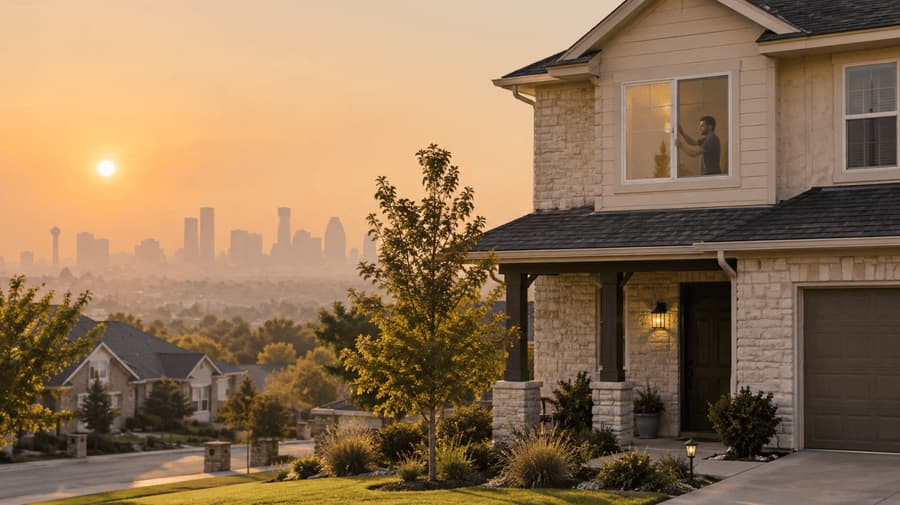
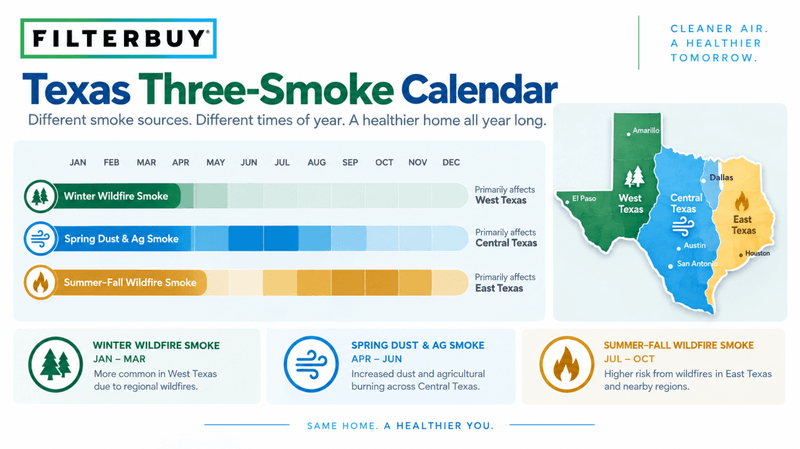
Texas gets wildfire smoke in three separate windows, and only the first one is a Texas fire. Whichever window you are in, the indoor fix is the same: a MERV 13 filter, the thermostat fan moved from Auto to On, and a spare in the closet before the haze arrives. Find your window below, then get the filter in place before you need it.
Mid-Feb – Mid-April
In-state grass fires in freeze-cured fuels Panhandle, High Plains, Hill Country, Cross Timbers
Install a MERV 13 by late January and keep two spares.
May – Early June
Agricultural burning in Mexico and Central America Houston, San Antonio, Austin, Gulf Coast, the Valley
Switch the fan to On and close fresh-air intakes.
July – September
Western U.S. and Canadian smoke, layered on peak ozone Dallas–Fort Worth, Houston, El Paso, most of the state
Run the highest MERV your system allows, continuously.
Mini splits use washable mesh screens built to catch lint and hair, not the fine PM2.5 in wildfire smoke. Answer a few quick questions and we will point you to the right filter for your unit.
Texas has a wildfire smoke problem, and it looks nothing like California's. The Smokehouse Creek Fire burned 1,058,482 acres of the Panhandle in early 2024, the largest wildfire in state history, while Houston and Dallas absorb smoke drifting in from Mexico, the Rockies, and Canada. Wherever you live in Texas, the indoor fix is the same: a MERV 13 filter, the fan switched from Auto to On, and spares in the closet before the smoke arrives. This guide is Filterbuy's read on which Texas months actually carry the risk, and why the national advice is mistimed here.
The Smokehouse Creek Fire burned 1,058,482 acres in February and March 2024, making it the largest wildfire in Texas history, according to the Texas A&M Forest Service.
Texas peak wildfire season is mid-February through mid-April, not summer. Freeze-cured grass plus the wind ahead of a dry cold front is the dangerous combination.
Southern Plains Wildfire Outbreak days are 3% of Texas wildfires but 49% of acres burned since 2005. A handful of days each year does nearly half the damage.
Houston's worst smoke days are usually not Texan. Agricultural burning in Mexico and Central America peaks in May and early June, and southerly winds carry that smoke into Southeast Texas.
The EPA recommends a MERV 13 or higher HVAC filter during smoky periods, and notes most residential furnaces can handle one if it is replaced frequently.
Wildfire smoke loads a filter in days, not months. Check yours every two weeks during a smoke event and replace it when it looks dark.
Yes, and the record fire happened in February. The Smokehouse Creek Fire ignited February 26, 2024, in Hutchinson County near Stinnett and reached 1,058,482 acres before the Texas A&M Forest Service declared it fully contained on March 16. It killed two people, destroyed more than 500 structures, and crossed into Oklahoma.
Source: Texas A&M Forest Service.
Those are the fires Texans remember, and they are not why most Texans see haze. A homeowner in Katy or Plano is far more likely to be breathing smoke that started somewhere else entirely. That is what makes this state hard to answer in one sentence: Texas has a fire problem and a smoke problem, running on different schedules in different halves of the state. Filterbuy is an air-filter manufacturer in Talladega, Alabama, and we have built them in the United States since 2012. What stands out to us about Texas is not which filter people need but when they need it. Guidance written for California is rarely wrong here. It is mistimed.
Most smoke guides assume a single fire season. Texas has three, each with its own source, its own months, and its own corner of the state. We call it the Texas Three-Smoke Calendar, and as far as we can find, nobody had laid the state out this way before. Knowing which window you are in is what tells you when to upgrade your filter and how long to leave it in. The Texas live wildfire smoke map shows what is overhead today.
The middle window is the one Texans most often misread. In May 2024, South Padre Island recorded the worst air quality in the country on a single Friday, driven largely by wildfires and agricultural burns across Mexico and Central America. A Texas Commission on Environmental Quality (TCEQ) spokesperson has noted that agricultural fire smoke behaves much like wildfire smoke, carrying the same very small particles that irritate eyes and throats. Your lungs do not care whether the fire was a rangeland accident in Hutchinson County or a planned burn in Chiapas.
Set the Texas fire calendar beside the way people actually change filters, and a gap opens up. Peak fire weather lands in February and March. The standard filter routine is seasonal: one change when the heat goes on, another when the AC goes on. So the state's highest-risk smoke window arrives while most homes are still running the filter they installed before Thanksgiving, at the oldest and most loaded point in its life.
A loaded filter is the wrong tool twice over: less capacity left for fine particles, and enough added resistance to discourage running the fan continuously, which is the setting that matters most. The fix is free and takes five minutes. Move one filter change from spring to late January, ahead of the dormant-season peak. No national guide will tell a Texan to do that, because no national guide is written for a fire season that peaks in winter.
The filter is the one part of the system a homeowner controls completely, and it is also the part they think about least. That costs more in Texas than it does elsewhere, because our worst air tends to arrive in the weeks when the filter in the return is at its oldest. Nobody plans it that way. It is just what happens when the fire season and the maintenance calendar sit six months out of step.
Michelle Wan, Brand Manager and Air Quality Writer, Filterbuy
Smoke does not arrive in a vacuum in Texas's two largest metros. Houston and Dallas-Fort Worth are both federal ozone nonattainment areas, meaning ground-level ozone already exceeds national health standards regularly. Summer smoke stacks fine particle pollution on top of an ozone problem that was there anyway. In the American Lung Association's 2026 State of the Air report, Houston ranked 6th worst in the nation for ozone and Dallas-Fort Worth 9th, both worse than the year before.
That changes how you should read the number. A "Moderate" AQI in Houston in August may be ozone, distant-fire particles, Saharan dust, and Gulf humidity all at once, a mix a single figure flattens into one word. The two halves of it also call for different responses: your HVAC filter captures the particles but does not remove ozone. We would rather say that plainly than sell you something that cannot do the job. Filtration solves part of a Texas summer air problem, not all of it.
So what do you do on a high-ozone day? Ozone forms outdoors in sunlight and peaks in the afternoon and early evening, so the lever is timing rather than filtration: move runs, yard work, and kids' practices to the morning, and keep windows shut through the afternoon peak so you are not pulling it inside. One thing to avoid outright is any air purifier that generates ozone to "clean" the air. California's Air Resources Board maintains a list of certified air cleaning devices that stay under its ozone limit, and it is worth checking a model against that list before buying, wherever you live.
For what is actually overhead in each metro today, check the Houston live wildfire smoke map or the Dallas live wildfire smoke map.
Panhandle and West Texas homes sit inside the fire environment, not downwind of it. Texas A&M Forest Service crews responded to 434 wildfires burning 11,425 acres between October 2025 and mid-January 2026, roughly 136% above normal, and its 2026 Dormant Fire Season Outlook flagged heavy grass loading west of Interstate 35 under warmer, drier La Nina conditions. The agency also reports that since 2005, fires igniting under Southern Plains Wildfire Outbreak conditions account for just 3% of Texas wildfires but 49% of all acres burned.
If you live west of I-35:
Treat February like fire season, because it is. Most of the largest fires in Texas history burned in freeze-cured grasses between mid-February and mid-April.
Buy filters ahead of the window. Demand concentrates the moment smoke arrives, which is the worst possible time to be sourcing a filter. We stock more than 600 standard sizes and cut custom sizes to the nearest eighth of an inch, but no supply chain beats already having one in the closet.
Expect ash, and seal the system. Nearby fires drop coarse ash and soot that clog a high-MERV filter in days. Close the fresh-air intake if you have one, and if you run an evaporative cooler, common across West Texas, the EPA advises covering its outside air intakes with 4-inch MERV 13 filters, or using it sparingly during smoke.
Wildfire smoke's health risk comes mostly from PM2.5: fine particles 2.5 microns and smaller that travel deep into the lungs. The EPA recommends upgrading to a MERV 13 or higher HVAC filter during smoky periods, and notes most furnaces can accommodate one without equipment problems provided it is replaced frequently.
MERV ratings follow ASHRAE Standard 52.2. Confirm system compatibility before upgrading.
Three things make that upgrade work:
Run the fan on "On," not "Auto." A filter only cleans air that moves through it. On Auto, your system filters only while heating or cooling.
Replace on appearance, not on the calendar. The EPA's guidance is to replace when the filter looks dirty, dark brown or black, which during a smoke event may be far sooner than the manufacturer's interval.
Add a clean room for anyone vulnerable. Pick the bedroom, add a portable air cleaner sized for the space, keep the door closed. EPA research found a DIY cleaner built from a certified box fan and a 4-inch MERV 13 filter raised clean air delivery by 123% over the basic design, a legitimate backup when purifiers sell out.
Not every system is a candidate, and the EPA says so directly: you may need a technician to confirm a MERV 13 is compatible with yours. Older units with weaker blower motors are the usual holdout. If that describes your house, or if you rent and do not control the system at all, skip ahead to the fallbacks further down. There is a version of this that works for you.
Our guides on the best MERV filter for wildfire smoke and MERV 13 vs. HEPA for wildfire smoke go deeper on system compatibility.
Almost every wildfire smoke guide assumes you own the house and the furnace inside it. In Houston and Dallas, plenty of readers do not, and the advice above quietly leaves them out. Three situations, and what to do in each.
Your System Will Not Take a MERV 13
You do not necessarily need a technician to find out. Install the filter, live with it for a few days, and watch for three things: airflow dropping at the vents, rooms starting to feel stuffy, or a blower that sounds like it is working harder than it used to. Any of those, step back to MERV 11. Normal comfort and normal airflow are the signal.
Before you give up on the rating, though, try going thicker rather than lower. A 2-inch or 4-inch pleated filter holds far more media than a 1-inch, so the same airflow spreads across more surface and the blower has less resistance to fight. It also lasts longer once smoke starts loading it, which matters when you are changing filters in days rather than months. Measure the slot before you order. Filterbuy stocks over 600 standard sizes and cuts custom air filters to the nearest eighth of an inch, so an odd cabinet is not a reason to stay on a 1-inch.
You rent, or your building has shared HVAC
Then the portable air cleaner stops being half the strategy and becomes all of it. You probably cannot change a filter in a shared system or get near a fresh-air intake, so put the effort into one room instead: close it off, seal the obvious gaps, and run a cleaner sized to that space. Everything in the clean-room approach works in a rental, and only the central-system step needs a landlord. It is still worth asking whether you can supply your own filter for an in-unit return, since the answer is often yes and a single filter is a cheap thing to test.
You cool with a window or portable unit
Set the unit to recirculate, close its fresh-air vent, and seal the gaps around the sash where it sits, since those are a direct path for smoke. Use single-hose portable air conditioners sparingly during heavy smoke: they exhaust indoor air outside, and the replacement air gets pulled in through every leak in the building. Run a portable cleaner in the same room.
Check your local AQI before opening windows on the AirNow Fire and Smoke Map or the Texas live wildfire smoke map.
Close windows and exterior doors, and shut the fresh-air intake or damper if your system has one.
Set the fan to On so air keeps cycling through the filter between cooling calls.
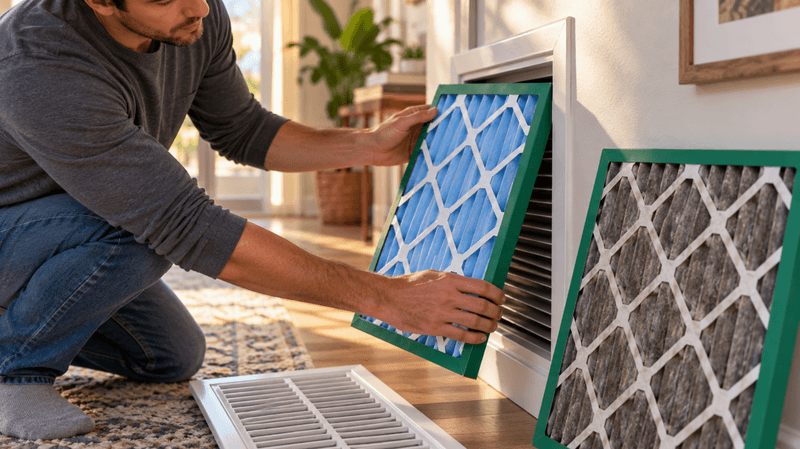
Install a MERV 13 filter sized for your system, seated tight so air cannot bypass the frame.
Skip the indoor smoke you control: no candles, no frying, no vacuuming without a sealed HEPA vacuum.
Inspect the filter every two weeks during an event; replace it when it darkens.
Keep two spares on hand through your region's smoke window. Filterbuy auto-delivery handles the remembering if you would rather not track it.
Three findings from federal and national health sources that underpin the guidance above. Each is linked so you can check it.
1. Houston Averages 43.3 Unhealthy Ozone Days a Year, and Dallas-Fort Worth Got Worse
The Houston-Pasadena metro ranked 6th worst in the nation for ozone pollution, based on Harris County averaging 43.3 unhealthy days per year, an F grade. That is up from 34.8 days and 7th worst a year earlier.
Dallas-Fort Worth ranked 9th worst for ozone, on Denton County's 27.8 unhealthy days per year, also an F, worse than its 10th-place ranking the year before.
Houston also ranked 8th worst in the nation for year-round particle pollution, the same measure wildfire smoke loads.
5,474,038 Texas children live with unhealthy levels of air pollution.
What this means for a Texas home: smoke does not land on clean air here. It stacks fine particles on top of an ozone problem already among the worst in the country, and one that is deepening rather than easing.
Source: American Lung Association, State of the Air 2026, Texas findings (data years 2022-2024).
2. The 2023 Smoke Crisis That Taught America About Wildfire Smoke Skipped Texas
Across the United States, asthma-associated emergency department visits ran 17% higher than expected on the 19 wildfire smoke days between April 30 and August 4, 2023.
Canadian smoke reached every HHS region except Region 6 during that window. Region 6 is Texas, Louisiana, New Mexico, Oklahoma, and Arkansas.
The trap in that finding: the event that made wildfire smoke a national household concern is the one that largely missed Texas. Texas smoke risk is real, but it runs on its own calendar, so a Texan who judges the threat by the 2023 headlines will prepare for the wrong months.
Source: CDC, Asthma-Associated Emergency Department Visits During the Canadian Wildfire Smoke Episodes, United States, April-August 2023, MMWR Vol. 72, No. 34.
3. More Than 14,500 Texas Communities Are at Risk of Wildfire
Texas A&M Forest Service counts over 14,500 communities at risk of wildfire statewide.
The agency attributes the growth to Texas expanding into the wildland urban interface, the zone where homes and neighborhoods meet undeveloped vegetation.
More than 90% of Texas wildfires are caused by people and their activities, with careless debris burning the single largest cause.
The part Texans most often get wrong: wildfire exposure is not a Panhandle story. It follows suburban growth. A homeowner outside Austin or Fort Worth has more in common with one near Stinnett than the map suggests.
Source: Texas A&M Forest Service, Texas Wildfire Risk Assessment Portal, The Wildland Urban Interface.
The particle risk is the same; the exposure pattern differs. Texas fires are typically fast-moving grass fires that burn huge acreage in days, so heavy local smoke is intense and short. Metro Texas more often gets low-concentration smoke over long stretches from distant fires, easier to ignore and just as worth filtering.
The dormant season runs roughly mid-February through mid-April and produces most of the state's largest fires, with a secondary summer peak during drought. Out-of-state and international smoke adds two more windows: May to June and July to September.
Your central system is the whole-home baseline, since it moves far more air than any portable unit. Add a portable cleaner for the one room where someone with asthma, COPD, or heart disease sleeps.
AQI (Air Quality Index): The EPA's 0-500 scale for daily air quality, color-coded green (Good) to maroon (Hazardous).
PM2.5: Fine particulate matter 2.5 microns or smaller. The primary health hazard in wildfire smoke.
MERV (Minimum Efficiency Reporting Value): The ASHRAE 52.2 scale, 1-16, rating how well a filter captures particles. Higher numbers capture smaller particles.
MERV 13: The filtration level the EPA recommends during smoky periods; effective against fine smoke particles.
HEPA: A filter capturing at least 99.97% of particles at 0.3 microns. Standard in portable air cleaners; most residential HVAC systems cannot accommodate one.
Dormant fire season: The Texas winter-to-spring window when freeze-cured grasses become highly flammable fuel.
Ozone nonattainment area: A region the EPA designates as exceeding federal ground-level ozone standards. Houston and Dallas-Fort Worth are both designated.
Texas A&M Forest Service: The Texas state agency responsible for wildfire response and fire potential forecasting.
TCEQ (Texas Commission on Environmental Quality): The Texas state agency that issues the daily Texas air quality forecast.
Smokehouse Creek Fire: The February-March 2024 Hutchinson County wildfire that burned 1,058,482 acres, the largest in Texas history.
Filterbuy: An American air-filter manufacturer headquartered in Talladega, Alabama, producing HVAC filters in the United States since 2012 in more than 600 standard sizes plus custom cuts. Publisher of this guide.
Texas A&M Forest Service, Dry conditions and increased vegetation set stage for higher wildfire risk in Texas (January 16, 2026)
Texas A&M Forest Service, 2026 Dormant Fire Season Outlook
U.S. EPA, Create a Clean Room During a Wildfire, Preparing for Smoke and Heat, and Research on DIY Air Cleaners
TCEQ, Air Quality Monitoring Operations and Today's Texas Air Quality Forecast
EPA and U.S. Forest Service, AirNow Fire and Smoke Map
American Lung Association, State of the Air 2026, Texas findings
CDC, Asthma-Associated ED Visits During the Canadian Wildfire Smoke Episodes, MMWR 72(34)
Texas A&M Forest Service, Texas Wildfire Risk Assessment Portal
Houston Chronicle, reporting on Texas haze from Mexican and Central American agricultural burning
Brand Manager and Air Quality Writer at Filterbuy, where she translates MERV ratings, filtration, and HVAC efficiency into plain-English advice and fronts much of the brand's educational video content (B.A., University of California, Santa Cruz). She works directly with Filterbuy's manufacturing teams, writing from how filters are built and used rather than from spec sheets. Learn more on her author page.
This article was technically reviewed by David Clark, a Licensed HVAC Technician, who verified its claims on MERV ratings, airflow, and filter compatibility. .
Published by Filterbuy, an American air-filtration company that has manufactured HVAC filters in the United States since 2012 and shipped them to millions of households. Filterbuy stocks more than 600 standard sizes and cuts custom air filters to the nearest eighth of an inch.
This page is general information about air quality and filtration. It is not medical advice and it is not emergency guidance. During an active wildfire, follow direction from your local fire authority and emergency management agency.
