
Swamp Coolers and Wildfire Smoke: Why Smoke Gets Indoors and How MERV 13 Fixes It
October 21, 2026
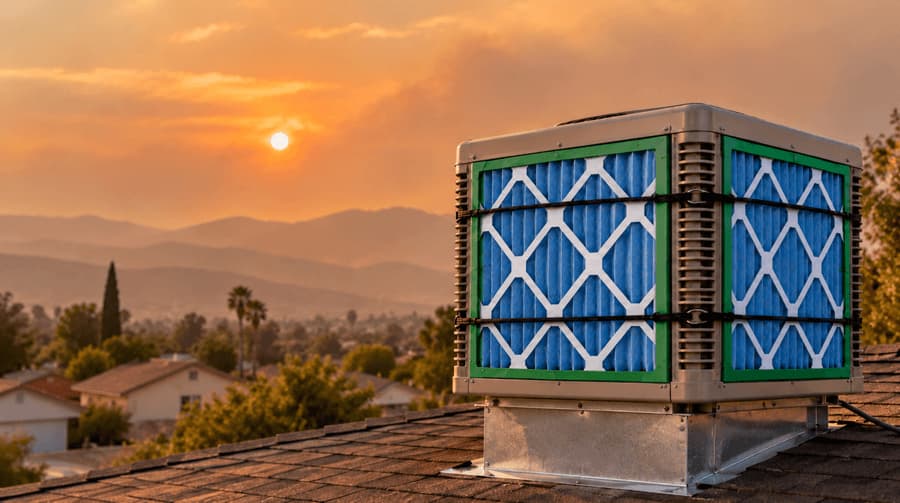
What Filter Should You Use on a Swamp Cooler During Wildfire Smoke?
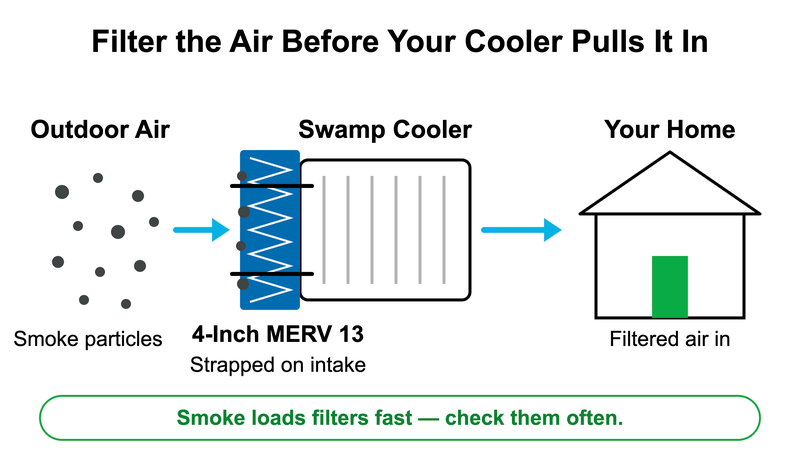
Strap a 4-inch MERV 13 filter over your swamp cooler’s outdoor intake, or run the cooler sparingly while smoke is in the air. A swamp cooler pulls outdoor air straight into your home, so the filter needs to sit in front of the intake.
MERV 13 captures microscopic particles. It’s the highest level of residential filtration and the rating the EPA points to for wildfire smoke. Not sure what fits the rest of your home? Take the quick match quiz below.
Find Your Filter Match in a Few Quick Questions
Answer 3 quick questions and we’ll match you to your perfect filter.
TL;DR
A swamp cooler (evaporative cooler) cools a home by pulling in a constant stream of outdoor air. On a smoke day, it pulls wildfire smoke inside too, and the wet pad catches little of it. The fix Filterbuy recommends, and the one the EPA names, is to strap 4-inch MERV 13 filters over the cooler's outside intakes until the smoke clears, or run the cooler sparingly.
Key Takeaways
Swamp coolers run on 100% outdoor air, so smoke comes in with the cool air.
The wet pad cools; it doesn't filter. In lab tests, wet pads cut fine particles (PM2.5) by only about 10–40%.
Filter depth decides whether the fix works. In testing, 1-inch MERV 13 filters choked cooler airflow while 4-inch filters kept it cool, so Filterbuy recommends 4-inch.
Filter the intake, not the vent. Air leaving a cooler is too wet for a filter.
Why we wrote this guide. Filterbuy has made air filters in the USA since 2013, and most smoke advice, ours included, assumes a home has a furnace filter slot. A swamp cooler doesn't, so its owners tend to hear just one thing: turn it off. On a triple-digit smoke day, that forces a choice between heat and smoke. This guide is our better answer.
Does a Swamp Cooler Bring in Smoke?
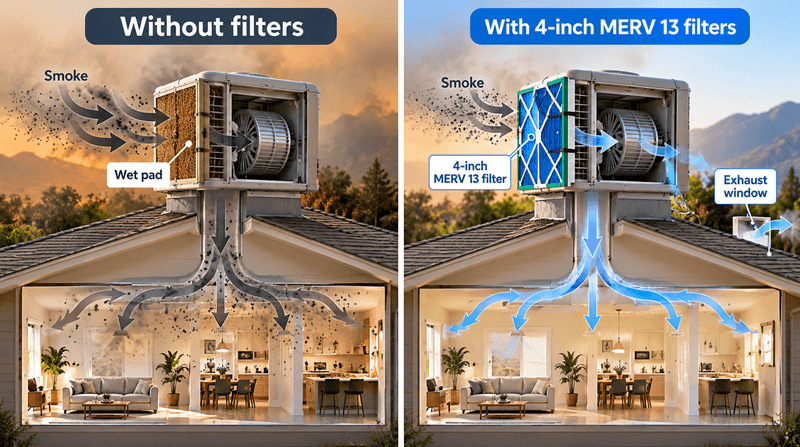
Yes. Outdoor air is the only air a swamp cooler uses. Its fan draws that air through moist pads and pushes it through the house, where it leaves through open windows. Central AC recirculates indoor air instead.
That design is common in hot, dry places: a California Energy Commission survey cited by researchers on the EPA-funded FRESSCA study found evaporative coolers in 12% of the state's single-family homes and 27% of its mobile homes. There, wildfire season overlaps with heat waves, so the hottest days are often the smokiest.
Filterbuy's analysis of San Joaquin Valley smoke found it often peaks between about 2:00 and 9:00 a.m., as air drains down from the Sierra canyons. That's when opening up for cool night air does the most harm, as Filterbuy's Michelle Wan has seen:
I check smoke maps across Filterbuy’s coverage areas most mornings during fire season. Stockton is the one where the overnight reading and the afternoon reading tell completely different stories, and almost nobody is looking at the first one.
Michelle Wan, Brand Manager and Air Quality Writer, Filterbuy
Because a swamp cooler can't switch to indoor air, you have two real choices on a smoky day: filter the air on its way in, or run the cooler less. Check the live AQI map and Filterbuy's live wildfire smoke map before you turn it on, and again before bed.
Does the Swamp Cooler Filter Pad Stop Smoke?
Not enough to protect you. The pad was designed to cool air, not filter it. Lab testing cited by FRESSCA researchers found wet pads reduce PM2.5 by only 10–40%, and a field study in 10 Texas homes measured a reduction near 35%.
When outdoor PM2.5 climbs past 250 µg/m³, a 35% reduction still leaves more than 150 µg/m³ indoors, a level researchers call unsafe. Removing fine particulate matter takes a filter made for the job, as Filterbuy's guide to what PM2.5 is and how filters stop it explains.
How Do You Put a MERV 13 Filter on a Swamp Cooler?
The fix is to strap 4-inch MERV 13 filters over every outside intake, so incoming air passes through them first. The EPA recommends this approach, and the EPA-funded FRESSCA study put it to the test in real homes.
In a 2026 field study of 48 California homes, published in ACS ES&T Air, running the cooler raised outdoor smoke getting indoors by roughly 36–42% in homes with only a portable air cleaner. With cooler filters added, the increase was only about 10–11%.
Why not filter the indoor vent instead? The FRESSCA team ruled it out: the air leaving a cooler is too wet, and cooler fans are built to handle very little resistance.
One honest caveat from a filter company: if you can't reach a rooftop cooler safely, don't climb up for a filter. Run the cooler sparingly and lean on a portable air cleaner until a technician can install the filters. If you can reach it safely, the retrofit is a do-it-yourself job:
Turn off the power. Shut off the cooler and its water pump at the switch or breaker.
Measure each intake face. Cover every intake, up to three sides, edge to edge (see the formula below). Filterbuy cuts custom air filters to the eighth of an inch. Custom sizes can't be returned, so measure twice.
Choose 4-inch MERV 13 filters. FRESSCA's laboratory testing showed that 1-inch MERV 13 filters choke cooler airflow. Filterbuy makes 4-inch MERV 13 filters in common sizes like 20x20x4 and 20x25x4.
Point the airflow arrows toward the cooler.
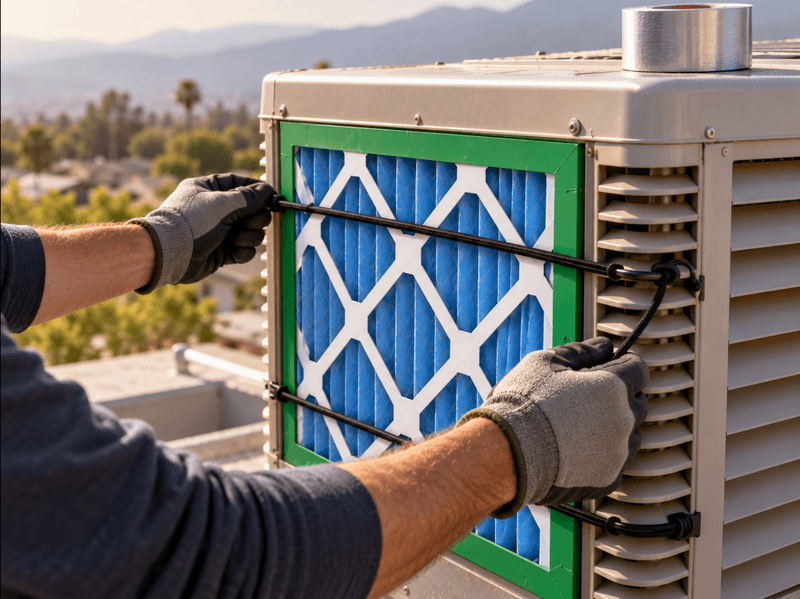
Strap the filters in place with bungee cords, snug against each intake.
Tape the gaps with outdoor-rated tape. Smoke finds any opening.
Test it. Run the cooler 15–20 minutes and confirm the pads stay wet and the air feels cool. If the motor strains, turn it off and call a technician.
Take the filters off once the smoke clears. In the study, filters left on for weeks picked up water damage and dust. It's also a good moment to change the pads, which the Department of Energy recommends replacing at least twice a season.
What Are Your Options on a Smoke Day?
Of five realistic choices, 4-inch MERV 13 intake filters plus a HEPA air cleaner protect best while keeping the house cool.
Sources: U.S. EPA wildfire clean room guidance; FRESSCA study (Solomon et al., 2025; Singh et al., 2025).
How Many Filters Will Your Cooler Need, and What Will It Cost?
Divide each intake face's height and width by the filter's actual size, round both numbers up, then multiply them. A Filterbuy 20x20x4 actually measures 19.5 × 19.5 inches, and a 20x25x4 measures 19.5 × 24.5.
For example, a 28 × 34-inch side panel needs 2 × 2, or 4 filters of 20x20x4. A three-sided cooler with panels that size needs 12. Kit costs:
Filterbuy 20x20x4 MERV 13 one-time prices with free shipping, as of October 19, 2026. Prices change; auto-delivery saves 5%.
When Should You Put the Filters On?
With a kit on hand, the AQI tells you when to use it. This is how Filterbuy would run a swamp cooler at each EPA Air Quality Index level:
0–100 (Good to Moderate): run the cooler as usual and keep the filters on the shelf.
101–150 (Unhealthy for Sensitive Groups): put the filters on, and run a HEPA air cleaner where sensitive family members sleep.
151+ (Unhealthy or worse): run the filtered cooler only as much as heat safety requires, and spend time in a clean room. If the house won't stay cool, head somewhere that will.
What Can't MERV 13 Cooler Filters Do?
Filterbuy makes MERV 13 filters, so we'd rather be straight with you about their limits.
They catch particles, not gases. Filterbuy's Odor Eliminator carbon filters target odors, but they come in 1-inch sizes and aren't MERV 13, so they can't replace 4-inch MERV 13 filters on a cooler.
They load up fast in heavy smoke. Check them daily; once the face turns gray or the cooling weakens, swap in fresh ones.
Some smoke still gets in around doors and through the open windows a cooler depends on. Open windows only on the downwind side, and only as wide as necessary. The DOE suggests 1–2 square feet of opening per 1,000 cfm of cooler capacity.
Layering closes much of that gap. FRESSCA researchers found the strongest setup paired intake filters with a HEPA air cleaner where the family sleeps; see the EPA's clean room guidance and why MERV 13 and a HEPA purifier work best together. If the house also has a furnace or central AC, read whether air conditioners filter wildfire smoke and the best MERV filter for wildfire smoke.
Stock up before fire season. Most local stores don't carry 4-inch media filters, and portable air cleaners sell out within days of a smoke event. Keep a set of Filterbuy MERV 13 air filters in 4-inch depth on the shelf. Filterbuy makes them in U.S. plants in Alabama, Florida, Pennsylvania and Utah and ships them free.
Supporting Statistics
20–40 air changes per hour. Coolers are sized to replace a home's air with outdoor air 20 to 40 times an hour. Source: U.S. Department of Energy, Energy Saver.
55–60% of outdoor smoke levels, even when sealed. In a closed-up home with no air cleaner, indoor PM2.5 still reaches roughly 55–60% of outdoor smoke levels; with windows open, it matches outdoors. Source: U.S. EPA, Strategies to Reduce Exposure Indoors.
17% more asthma ER visits on smoke days. Across 19 wildfire smoke days in 2023, asthma-related emergency visits ran 17% above expected, according to data from 4,317 U.S. emergency departments. Source: CDC, Morbidity and Mortality Weekly Report.
Frequently Asked Questions
Should I Turn Off My Swamp Cooler During Wildfire Smoke?
Not necessarily. The EPA advises running an evaporative cooler sparingly during smoke unless its intakes are fully covered with 4-inch MERV 13 filters. In dangerous heat without filters, running it alongside a HEPA purifier may be safer than no cooling.
Glossary
About the Author and Reviewer
Michelle Wan is Brand Manager and Air Quality Writer at Filterbuy, covering wildfire smoke and indoor air quality. She holds a B.A. in Sociology from UC Santa Cruz.
David Clark is CEO of Filterbuy HVAC Solutions and a Licensed HVAC Technician. He reviewed this guide's HVAC claims.
Sources
U.S. EPA: Create a Clean Room to Protect Indoor Air Quality During a Wildfire (evaporative cooler intake guidance; updated August 18, 2026)
U.S. EPA: Indoor Particulate Matter
U.S. EPA Grantee Research: FRESSCA Final Report
Solomon et al., Frontiers in Public Health (2025): Evaporative coolers and wildfire smoke exposure: a climate justice issue in hot, dry regions
Wang et al., ACS ES&T Air (2026), via UC eScholarship: Field Evaluation of DIY Air Filtration Solutions for Evaporative Coolers
Singh et al., Building and Environment (2025), via Lawrence Berkeley National Laboratory: Development and laboratory evaluation of a DIY filtration solution for residential evaporative coolers