
Mini-Splits and Wildfire Smoke: Why Ductless Systems Can't Capture PM2.5 and What Filtration to Add Instead
October 24, 2026
Do Mini-Splits Filter Wildfire Smoke?
No. A ductless mini-split’s washable mesh screen protects its coil, has no MERV rating, and lets fine smoke particles (PM2.5) pass right through. Keep it running so you can stay cool with the windows shut. It doesn’t pull smoke in from outside. Then add filtration that fits your setup:
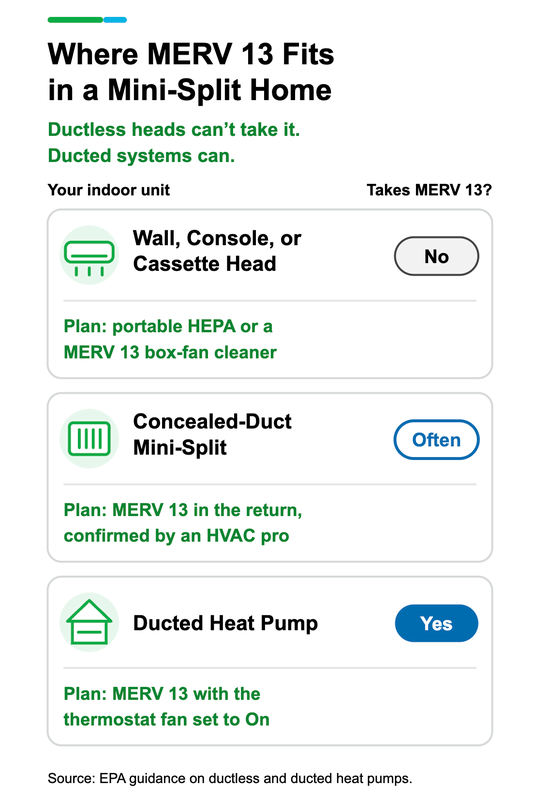
Wall, console, or cassette head: Can’t take MERV 13. Add a portable HEPA cleaner or a MERV 13 box-fan cleaner, bedroom first.
Concealed-duct mini-split: Often fits a pleated MERV 13 in the return. Confirm with an HVAC pro.
Ducted heat pump or central system: Takes MERV 13. Set the thermostat fan to On.
Not sure which setup you have? Take the quick match quiz below.
600+ sizes, made in the U.S., with free shipping.
Get Matched to the Right Filter for Your Setup
Answer a few quick questions about your home, and we’ll match you to the right filter.
TL;DR
A ductless mini-split does not filter wildfire smoke. The washable mesh screen inside it protects the indoor coil, carries no MERV rating, and lets PM2.5, the fine smoke particles 2.5 microns and smaller, pass straight through. Filterbuy recommends keeping it running for comfort and adding a portable HEPA air cleaner in each occupied room, starting with the bedroom.
Key Takeaways
The U.S. Environmental Protection Agency (EPA) says ductless mini-split heat pumps generally don't filter fine particles and recommends a portable air cleaner.
A standard wall-mounted head can't take a MERV 13 filter, because its low-pressure fan can't push air through dense media.
Concealed-duct mini-splits and ducted heat pumps are the exception, since their return slot can hold a pleated MERV 13.
Mini-splits don't pull smoke in from outside, so keep them running on hot, smoky days and add filtration.
Do Mini-Splits Filter Wildfire Smoke?
No. A ductless mini-split heats and cools well, but it doesn't remove the fine particles (PM2.5) in wildfire smoke. The EPA's guidance on ductless mini-split heat pumps says these units generally don't filter fine particles and recommends a portable air cleaner if yours lacks a documented MERV 13 filter.
Filterbuy has built replacement filters for every major mini-split brand for more than a decade, and every week ductless owners ask us which stronger filter will fit. "What I tell them is that the screen was designed to keep the coil clean, and the fan behind it was sized for that job and nothing harder," says Michelle Wan, Filterbuy's Brand Manager and Air Quality Writer.
Why a Ductless Head Can't Capture PM2.5
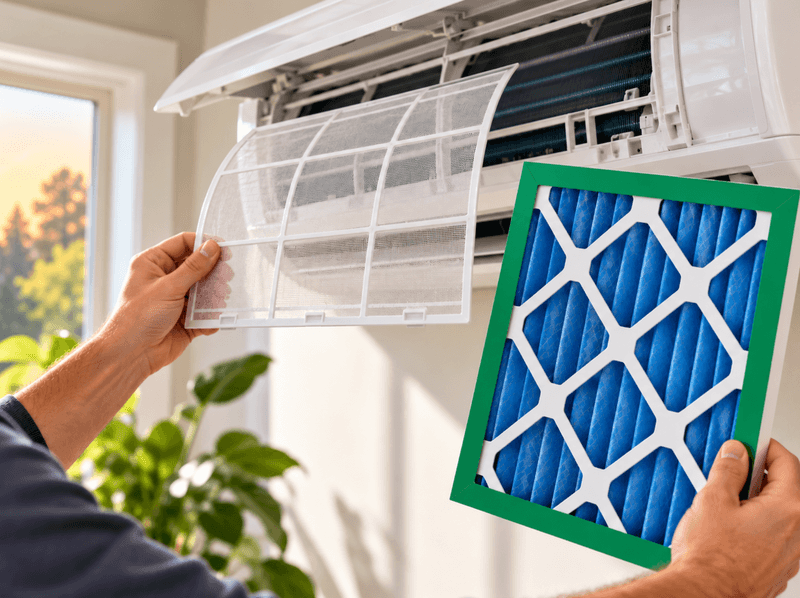
Every wall-mounted mini-split has a washable mesh screen that keeps lint and dust off the coil, which helps everyday mini-split air quality. According to the EPA's Guide to Air Cleaners in the Home, though, ductless units typically filter only to keep the unit itself clean, not to remove fine particles.
Hold that screen next to a pleated Filterbuy MERV 13 filter and the difference shows. The mesh is open, while the MERV 13 has dense, charged pleats that a low-pressure ductless fan can't pull air through.
Mini-split maker MRCOOL says its built-in filters target dust and debris, not PM2.5.
Can You Put a MERV Filter in a Mini-Split?
Not in a standard wall-mounted, floor console, or ceiling cassette head. Placing a pleated MERV 13 over the intake starves the coil of airflow, cutting capacity and risking a frozen coil. It may also void your warranty.
"On a wall-mounted head I am looking at a cross-flow blower with no filter rack and no gasket. There is nowhere to seal a HEPA cartridge," says David Clark, a Licensed HVAC Technician and Filterbuy's technical reviewer. "Even if you cut one to fit, most of the air travels around it instead of through it."
To identify your unit, look at where it sits: high on the wall is wall-mounted, a square ceiling panel is a cassette, and a low box is a console. Only a grille usually means concealed-duct, with the filter behind it.
Source: EPA guidance on ductless and ducted heat pumps.
Add-on filters without a documented MERV 13 rating aren't smoke filters either, including the washable multi-layer filters in Filterbuy's own mini split systems.
If you have a concealed-duct unit, measure the return opening before ordering. In our analysis of 500,000+ Filterbuy orders, nominal-versus-actual size confusion caused 30% of filter returns. We cut custom-size air filters for that reason.
Which Smoke Plan Fits Your Ductless Home?
Good ductless filtration for PM2.5 depends on your layout. The EPA's ductless guidance notes that a mini-split filters mainly its own room, and only while running. Filterbuy's matrix matches each layout to its fix.
Filterbuy planning matrix based on EPA ductless guidance.
What to Do When the AQI Reaches 100
Check the AirNow Fire and Smoke Map and your local air agency first, and follow their advice. An AQI of 100 is Filterbuy's action line. On the official AQI scale, 100 is still the top of the Moderate range, and Unhealthy for Sensitive Groups begins at 101. In a home without central HVAC, a portable HEPA air cleaner is your primary defense. At 100 or above, take these steps in order:
Put MERV 13 in any ducted system. If part of your home has ductwork or a concealed-duct mini-split, switch that system to MERV 13 for wildfire smoke. The EPA's Guide to Air Cleaners in the Home notes that most furnaces and HVAC systems can use MERV 13 without equipment problems, provided the filter is replaced often.
Set the thermostat fan to On. On a ducted system, Auto filters only while heating or cooling, and On filters continuously. Keep mini-split heads running in cool or dry mode so you can stay cool with the windows shut. If you can't, EPA advises finding cooler shelter elsewhere.
Run a portable HEPA air cleaner in each occupied room, bedrooms first. EPA sizing calls for a smoke CADR of at least two-thirds of the room's square footage, so a 300-square-foot bedroom needs a smoke CADR of about 200. Place it near the room's center, run it on high, and skip any model that produces ozone, which EPA advises against. See our wildfire smoke clean room guide.
Close the house up. Shut windows, doors, and any vent that brings in outdoor air. Skip candles, frying, smoking, and vacuuming unless your vacuum has a HEPA filter.
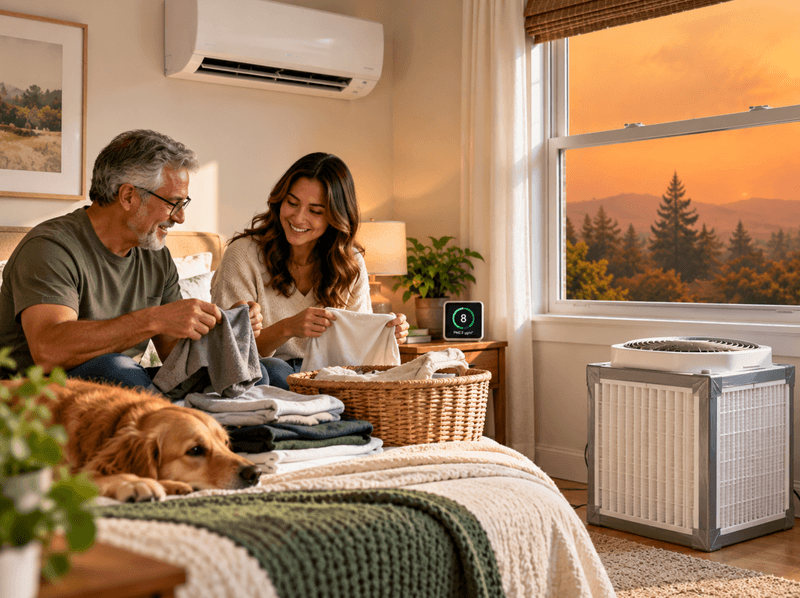
No portable cleaner yet? A MERV 13 box-fan cleaner is a reasonable stopgap. A nominal 20x20x1 Filterbuy filter measures 19.5 x 19.5 x 0.75 inches, so tape every seam. EPA's DIY guidance calls for a certified fan made in 2012 or later, never left running unattended. Our Corsi-Rosenthal box guide covers the build.
While smoke lasts: Replace filters when they look dark brown or black, which can be well before the normal interval, and keep spares on hand. Rinse the mesh screen more often too. A PM2.5 monitor shows whether your setup is working, and Filterbuy's live wildfire smoke map tracks conditions. At very high readings, official guidance comes first.
Sizing Your Air Cleaner by Room
Based on EPA's two-thirds sizing rule. Ratings assume 8-foot ceilings.
Why the bedroom comes first: In a 2024 CDC/NIOSH study of 29 homes, a portable HEPA cleaner cut PM2.5 by 78.8% in the room where it ran and by 57.9% in a second room. So put your first unit where you sleep.
Filterbuy's sizing check: In 2022 EPA chamber testing, one MERV 13 filter on a box fan delivered about 111 CFM. By the two-thirds rule, that covers a room of roughly 170 square feet. For a larger bedroom, we recommend the four-filter cube.
Heat Pumps vs. Mini-Splits in Wildfire Smoke
"Heat pump" describes how a system makes heat, not how it filters air. A ducted heat pump takes a standard filter, so it can run MERV 13, which the EPA's guidance on ducted heat pumps recommends. A ductless heat pump has no slot for one.
Supporting Statistics
1. 61.5 Million Americans Live With Failing Grades for Particle Pollution Spikes
Their counties earned an F for short-term particle pollution in 2022–2024 data that includes the 2023 Canadian smoke, so smoke spikes now reach well beyond the West.
Source: American Lung Association, State of the Air 2026: Key Findings
2. Half of Northeast Households Cool With Individual Units Like Mini-Splits
Half of Northeast households cool mainly with individual units, including mini-splits.
Many smoke-affected homes rely on units with no smoke filter.
Source: U.S. Energy Information Administration, 2020 Residential Energy Consumption Survey
3. Closed Windows Still Leave 55% to 60% of Outdoor Smoke Inside
With doors and windows shut and no air cleaner running, indoor PM2.5 typically reaches 55% to 60% of outdoor levels.
Sealing up helps, and filtration reduces what still gets in.
Source: U.S. EPA, Strategies to Reduce Exposure Indoors
Frequently Asked Questions
Does a Mini-Split Bring Smoke Into the House?
No. A ductless mini-split recirculates indoor air and doesn't pull in outdoor air, but it won't filter smoke that seeps in around doors and windows.
Can I Put a HEPA Filter in a Mini-Split?
No. HEPA media is too restrictive for a standard mini-split fan, so HEPA belongs in a portable air cleaner. Our MERV 13 vs. HEPA comparison explains where each one fits.
Glossary
Mini-split (ductless mini-split heat pump): A heating and cooling system with an outdoor unit piped to one or more indoor heads and no ductwork.
Concealed-duct mini-split: A hidden mini-split air handler with short ducts and a return filter.
PM2.5: Fine particulate matter 2.5 microns or smaller, the main health concern in wildfire smoke.
MERV: Minimum Efficiency Reporting Value, the ASHRAE 52.2 scale (1-16) for HVAC filter efficiency.
HEPA: High-efficiency particulate air filter, capturing at least 99.97% of 0.3-micron particles.
AQI (Air Quality Index): The official U.S. color-coded scale for daily air quality, from Good (0–50) to Hazardous (301 and higher).
CADR: Clean Air Delivery Rate, the filtered airflow, in cubic feet per minute (CFM), that a portable air cleaner delivers.
Corsi-Rosenthal box: A DIY air cleaner made from a box fan and four or five MERV 13 filters taped into a cube.
Close Your Home's Ductless Wildfire Smoke Gap
A mini-split keeps you comfortable, and MERV 13 captures smoke particles from the air that passes through it. Filterbuy makes MERV 13 filters in 600+ sizes in the U.S., with free shipping and auto-delivery so spares arrive before fire season.