Shop by
September 15, 2026
Under AQI 100, train as usual. From 101 to 150, cut the session to 20–30 minutes. At 151, take it indoors. Past 201, nobody should be training outside.
If you have asthma, COPD, or heart disease, are pregnant or over 65, or you're coaching kids, move indoors one band earlier, at AQI 101.
Moving inside only works if the air inside is clean. During smoke events, a closed-up home with no air cleaner still holds about 55–60% of the outdoor PM2.5, and you're breathing it at up to ten times your resting rate. A MERV 13 filter with your thermostat fan set to On cuts that roughly in half, according to the EPA.
Filterbuy makes MERV 8, 11, and 13 air filters in the USA in more than 600 sizes, shipped free to your door.
Find Your Filter SizeMade in the USA. 600+ sizes. Free shipping and auto-delivery.
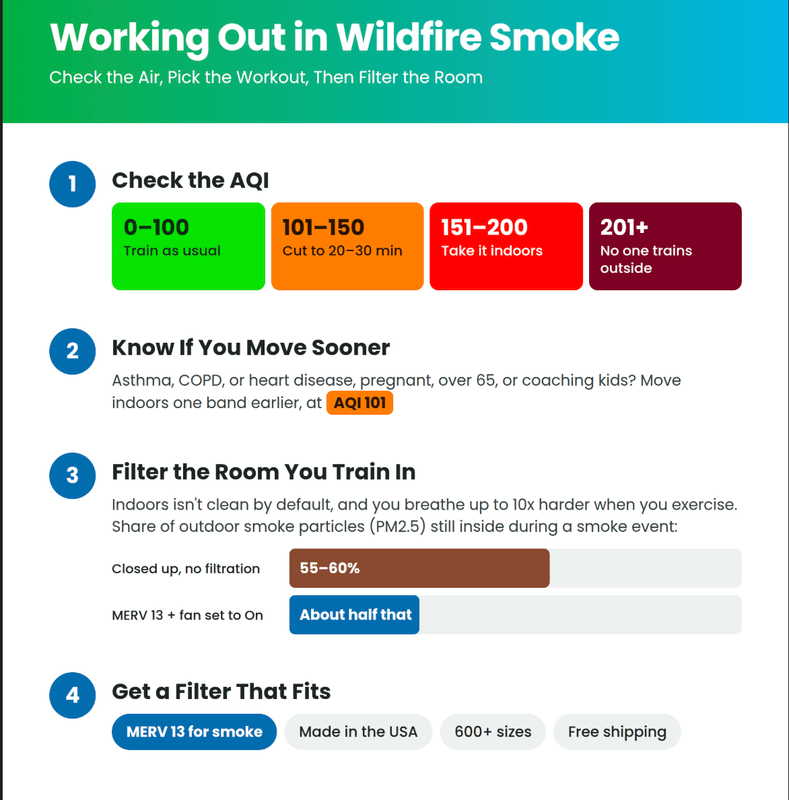
Below AQI 100, healthy adults can train outside as usual. Between 101 and 150, shorten the session. At 151 and above, take it indoors, and once the number clears 201 nobody should be training outdoors at all. If you have asthma, COPD, or heart disease, or you’re pregnant, over 65, or coaching kids, shift every one of those thresholds down a band.
AQI 151 is the practical cutoff for outdoor workouts for healthy adults. AQI 201 is the hard stop for everyone, regardless of fitness.
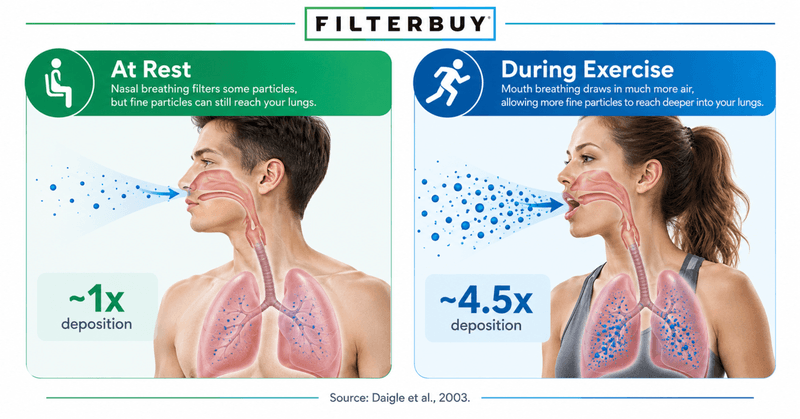
Exercise multiplies your exposure. Lung deposition of pollutants increases roughly 4.5-fold during exercise versus rest, driven by higher minute ventilation and mouth breathing (Daigle et al., 2003).
Dose is intensity x duration x concentration. A 20-minute easy walk at AQI 130 can deliver less particulate to your lungs than a 60-minute hard run at AQI 90.
Moving indoors only helps if the indoor air is filtered. Wildfire PM2.5 infiltrates buildings through gaps and fresh-air intakes. The EPA recommends a MERV 13 or higher HVAC filter plus a portable air cleaner during smoke events.
Do not train hard in an N95. Respirators add breathing resistance and heat load. If the air is bad enough to need one, the workout belongs inside.
Most advice about training in wildfire smoke hands you a number and stops there. Under 150 you’re fine, over 150 you’re not. We kept running into the same two problems with that. It treats the AQI reading as the whole decision, when the EPA’s own guidance describes the reading as one of three terms. And it assumes "move it indoors" settles the matter, without ever asking what the air indoors is like.
So this page does three things. It uses the thresholds the sports medicine literature actually supports. It says plainly where the experts disagree rather than papering over the gap. And it puts a number on what an unfiltered indoor space is really giving you during a smoke event, which is the part nobody else covers. That last piece is where Filterbuy can add something a running publication can’t. We’ve built air filters in the United States since 2013 and ship them factory-direct to households across the country, including the wildfire-prone counties behind most of the red and purple days on the map. Every fire season, those filters come back to us. What they look like after a smoke week shapes the second half of this guide.
Every fire season I watch people make the same swap. The AQI goes red, they cancel the run, they move the workout into the garage, and they think the decision is done. It is not. The garage is the leakiest room in the house and there is nothing filtering it. Once I started treating the indoor number as a real number instead of a safe default, the whole thing got simpler. Check the air, decide the workout, then decide the room. Three steps, not one.
Michelle Wan, Brand Manager and Air Quality Writer, Filterbuy
Healthy adults can train outdoors normally at AQI 0-100, should shorten the session at 101-150, and should move workouts indoors at 151-200. At AQI 201 and above, all outdoor exercise should stop. These thresholds match the activity guidance the EPA publishes on AirNow and the written policies U.S. athletic conferences use to run practices, such as the Mid-American Conference AQI threshold policy.
Here is the whole decision in one chart.
Table 1. AQI Activity-Modification Chart
PM2.5 concentrations reflect the EPA's revised AQI breakpoints, effective May 6, 2024. Sensitive groups include people with heart or lung disease, older adults, children and teens, and pregnant people.
Those PM2.5 concentrations reflect the EPA's revised AQI breakpoints, effective May 6, 2024. Plenty of training advice online still uses the old numbers, so any page telling you 12.0 µg/m³ tops the "Good" band is out of date.
For a real-world reference point: the Mid-American Conference’s air-quality policy tells member schools to consider moving practice indoors at AQI 151-200, and requires it at 201 or above.
Sitting on your porch at AQI 140 and running intervals at AQI 140 are nowhere near the same exposure. Exercise pushes minute ventilation to more than ten times its resting level, and as the effort climbs you stop breathing through your nose and start breathing through your mouth. That switch matters: it skips the nasal filtration that would have caught a share of the incoming particles, and it drives air deeper into the lungs at higher velocity.
The combined effect is large. Reviews of air pollution and athletic performance put lung deposition of pollutants during exercise at roughly 4.5 times resting levels (Daigle et al., 2003).
This is why "it is just a little haze" fails as reasoning for athletes. Dr. Michael Fredericson, a Stanford sports medicine physician, draws the line at the red tier: "The potential negative outweighs the positive at that point."
Most AQI charts treat air quality as the only variable that matters. The EPA doesn’t. Its clinician guidance frames the inhaled dose of smoke as the product of three terms: ambient concentration x minute ventilation x exposure duration. The agency notes that reducing any one of them lowers the dose (EPA, Using the AQI to Plan Daily Activities). Two of the three are yours to control.
Concentration: the AQI reading. Change it by moving indoors, training at a cleaner hour, or driving to cleaner air.
Minute ventilation: how hard you are breathing. The EPA offers a blunt example, which is to go for a walk instead of a jog.
Duration: how long you are out there. Spend less time in outdoor exertion.
Practical consequence: a 20-minute easy walk at AQI 130 can be a smaller inhaled dose than a 60-minute hard run at AQI 90. The AQI number alone does not tell you the dose.
We are flagging this because most pages will not. This one is genuinely contested, and any page handing you a confident rule here is overstating what the evidence supports. Dr. Michael Fredericson, the Stanford sports medicine physician quoted above, argues the opposite of what seems intuitive: he recommends capping orange-zone workouts at 20 to 30 minutes and says you are better off going high-intensity for a short period than low-intensity for a long one. He bases that on research in which cyclists exposed to diesel exhaust for 30 minutes at higher intensity showed fewer inflammatory markers than cyclists riding longer at lower intensity (Public Health Institute / San Francisco Chronicle). A 2024 review of exercise and air pollution by Dr. Michael Koehle at the University of British Columbia reaches a compatible conclusion, reporting that shorter, higher-intensity bouts appear well tolerated while very prolonged exercise beyond 90 minutes is the less-studied risk.
Where that leaves you: duration is the lever with the clearest support, so cap the session first. Treat the intensity question as unsettled rather than following anyone’s rule of thumb. None of this buys room above 150. A shortened workout at AQI 180 still means breathing red-tier air at an elevated rate.
Before you act on the number, find out which pollutant produced it. AQI reports whichever pollutant is worst at the moment, and during fire season the two likeliest candidates behave almost oppositely. An AQI of 130 from wildfire smoke and an AQI of 130 from ozone call for different responses, so following smoke advice on an ozone day costs you outdoor training you didn’t need to give up.
Ozone is not emitted directly. The EPA describes it as forming when pollutants from vehicles, power plants, and industry react in sunlight, so it reaches unhealthy levels on hot sunny days (EPA, Ground-level Ozone Basics). Because it needs sunlight, it climbs through the afternoon and falls once the sun goes down. AirNow’s activity guide puts it plainly: ozone is worse in the afternoon and early evening, so plan around it (AirNow, Air Quality Guide for Ozone). Wildfire smoke has no such rhythm. A plume can park over a city for days.
That difference has a consequence most training guides miss. On a smoke day you change where you train. On an ozone day you change when.
Table 2. Same AQI, Different Pollutant, Different Move
Check which pollutant is driving your reading before deciding what to change. AirNow and most AQI maps name the responsible pollutant alongside the number.
Here’s the awkward part, and you’d find it out soon enough anyway: a Filterbuy pleated filter does nothing for ozone. Ozone is a gas, and pleated media captures particles. Activated carbon adsorbs some of it, which is what our Odor Eliminator media is built for, but on a high-ozone day the filter simply isn’t your tool. Shifting your run to 7 a.m. is. On a smoke day the reverse holds, which is the whole reason this section exists.
Fire season is also the hot half of the year, which puts two pieces of standard advice on a collision course. Smoke guidance says close the windows; heat guidance says get air moving and cool the place down. The EPA publishes specific guidance on smoke and heat co-exposure precisely because this conflict is common. For anyone training at home the practical resolution is a running air conditioner or a window unit set to recirculate rather than open windows, and a workout scheduled for the coolest part of the day rather than the coolest-feeling one. If you can’t keep the space both cool and filtered, that’s a real reason to use a gym rather than tough it out; heat illness during a hard session is a faster problem than smoke exposure.
For anyone who feels smoke effects sooner, every threshold in the chart above shifts down a category. AQI 101 becomes the move-indoors line instead of 151.
Table 3. Move-Indoors Thresholds by Group
A symptom overrides the number. Chest tightness, wheezing, a cough that will not settle, headache, or unusual fatigue means stop, whatever the reading says.
Telling a coach to have a policy is easy. Here is what one actually contains, drawn from how collegiate conferences write theirs. The Mid-American Conference model is worth copying because it settles the awkward questions before anyone is standing on a field arguing about them.
Name one person responsible for the reading, and make sure it is not a coach. Conferences specify this deliberately, because the person who wants the practice to happen should not be the person judging whether it can.
Set a check time. The MAC takes a reading at least five hours before a contest, then every 30 minutes once the AQI passes 150.
Write the thresholds down in advance, using the numbers in Table 2, so nobody is interpreting a color on a phone screen in the moment.
Know your sensitive athletes before the season starts, not during a smoke event. Anyone with asthma, a cardiac history, or a recent respiratory illness moves indoors a full band earlier than the team does.
Decide who communicates the call, and to whom. Most of the friction in these decisions is parents and athletes hearing different things from different people.
One point worth making to parents directly: showing them the AirNow reading is far easier than defending a judgment call. A number everyone can look up ends the conversation that a coach’s opinion tends to start.
Here’s the part most training guides skip. "Move it indoors" quietly assumes indoor air is clean air, and during a smoke event it usually isn’t. Fine particles work their way in through door gaps, window frames, recessed lighting, and any HVAC system drawing outdoor air. Then you go breathe that air at ten times your resting rate.
The EPA puts numbers on this. During wildfire smoke events, with doors and windows closed and no air cleaner running, indoor PM2.5 typically runs about 55% to 60% of outdoor levels, though it ranges from 30% to 100% depending on the home. Upgrading to a high-efficiency HVAC filter and running the fan continuously cuts indoor PM2.5 by roughly 50%. Even a standard filter with the fan running continuously cuts it about 24% (EPA, Strategies to Reduce Exposure Indoors). Put those figures against the AQI scale and the picture gets concrete.
Table 4. What "Indoors" Actually Means Without Filtration
USG = Unhealthy for Sensitive Groups. Estimates, not measurements. Calculated by Filterbuy from two EPA figures: indoor PM2.5 runs about 55–60% of outdoor levels during smoke events with windows closed and no air cleaner running, and a high-efficiency HVAC filter with the fan running continuously cuts indoor PM2.5 by roughly half. Indoor values are converted back to AQI using the EPA's 2024 PM2.5 breakpoints, from the midpoint of each outdoor band. Real homes vary widely; EPA reports infiltration anywhere from 30% to 100%.
Read the middle column first. At an outdoor AQI of 175, an unfiltered indoor space still sits around AQI 141, which is Unhealthy for Sensitive Groups, and you’re about to breathe it at ten times your resting rate. That’s the whole argument for filtering the room you train in. One caution worth stating plainly: the EPA advises against exercising inside a designated clean room, because exertion stirs up settled particles and raises your intake in the one space you’ve worked hardest to keep clean. Build filtration into your training space, and don’t turn your clean room into a gym.
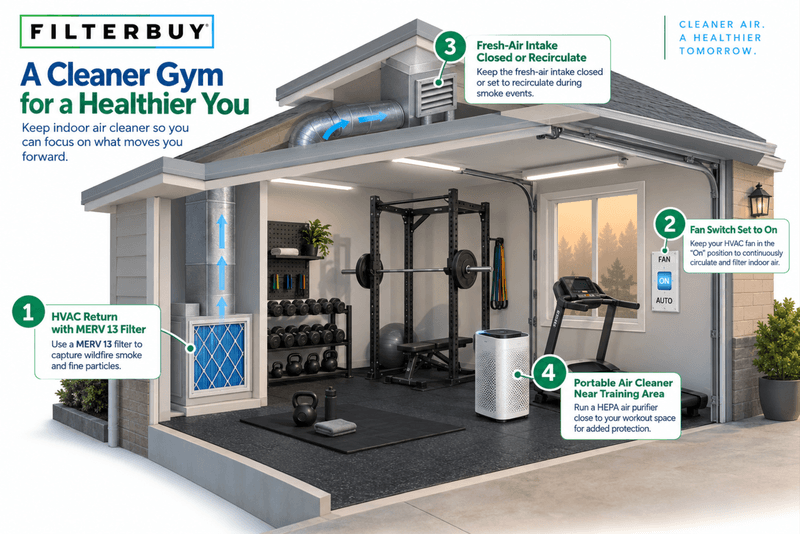
If you train at home, borrow the mechanics from the EPA’s clean room guidance and apply them to the room with the equipment in it.
A commercial gym is usually a better bet than an unfiltered house, because larger buildings tend to run better filtration and tighter envelopes. But it is not automatic, and a room full of people breathing hard is exactly where you want to know rather than assume. Three questions get you an answer at the front desk: what MERV rating is in the rooftop units, does the fan run continuously or only on a call for cooling, and is the outdoor-air intake closed during smoke events.
Plenty of staff will not know, and that itself is information. If nobody can answer, look at the practical signals instead. A gym that has posted anything about air quality during past smoke events has thought about it. One that props the doors open on a hot day has not.
This table is Filterbuy’s work, and we’d rather show the arithmetic than ask you to take it on faith. We took the EPA’s stated infiltration range for smoke events, used the midpoint of 57.5%, and applied it to the midpoint PM2.5 concentration of each outdoor AQI band. For the filtered column we applied the EPA’s roughly 50% additional reduction for a high-efficiency filter running with the fan on continuously. Then we converted the resulting indoor concentrations back into AQI using the EPA’s 2024 PM2.5 breakpoints.
What the table can’t tell you is your house. A tight 2015 build with good ducts will beat these figures; a 1940s bungalow with a leaky return won’t. The EPA reports real-world infiltration anywhere from 30% to 100%, which is a wide enough range that the honest use of this table is as an order-of-magnitude argument, not a prediction. The argument holds at either end: unfiltered indoor air on a red-tier day isn’t clean air.
Table 5. Clean-Air Setup for a Home Gym
Set the fan to "On" during and after a workout, when your breathing rate, and your intake, are highest.
Our guide to the best MERV filter for wildfire smoke covers checking system compatibility before you upgrade. Filterbuy makes pleated MERV 8, MERV 11, and MERV 13 filters in more than 600 standard sizes plus custom dimensions, and tests every batch to ANSI/ASHRAE Standard 52.2, so the rating on the box is the rating you get. Our MERV 8 vs MERV 11 vs MERV 13 comparison explains what each rating actually captures. If smoke pushes your area past AQI 300, see our guide to hazardous air quality.
No, and the reasons are worth knowing. A NIOSH-approved N95 earns its keep for unavoidable outdoor time in smoke: walking the dog, getting to your car, an evacuation drive. For a workout it’s the wrong tool. Respirators add inhalation resistance and heat load, sweat degrades the seal, and facial hair breaks it outright. Federal wildland fire guidance advises against wearing one during high-exertion work for exactly these reasons.
The question comes up constantly, and the honest answer disappoints people who were hoping for a workaround. The cleaner logic: if the air’s bad enough that you’re reaching for a respirator, it’s bad enough that the workout belongs indoors. Cloth masks, bandanas, and neck gaiters do essentially nothing against PM2.5 and shouldn’t factor into the decision at all.
Watch the number, not the sky. Visibility lags and misleads, because smoke can thin out to the eye while PM2.5 stays high. Check the live AQI map the morning of, and again before you head out. During an active fire, the AirNow Fire and Smoke Map is the better tool, because it blends regulatory monitors with temporary smoke-event monitors and low-cost sensors.
One housekeeping step belongs here, because it’s the one people skip: change the filter once the smoke clears, not on whatever calendar date you had in mind. A filter that spent a week catching wildfire particulate is loaded well before its normal service life. Keeping a spare on the shelf, or running Filterbuy Auto Delivery so a clean one arrives without you thinking about it, is the difference between a filtered training space in September and a restricted one.
When the reading drops under 100, ease back in rather than jumping straight into the session you missed. If you were symptomatic during the event, with a persistent cough, tightness, or wheeze, give it a few clear days and talk to your doctor before returning to hard training. Smoke exposure can leave asthmatic airways reactive well after the air clears.
Filterbuy tracks air quality across every U.S. market we ship to, and three findings from public-health sources explain why these thresholds are worth taking seriously. Each one measures something different: that harm shows up at the exact AQI numbers used above, how many Americans now meet those numbers, and why children need the strictest version of the rule.
During 19 days of Canadian wildfire smoke between April and August 2023, asthma-related emergency department visits across the United States ran 17% higher than expected. The CDC defined a wildfire smoke day as one where PM2.5 reached 35.5 micrograms per cubic meter, the concentration that produces an AQI of 101. The largest increases appeared among people aged 5 to 17 and 18 to 64 (CDC, MMWR, August 2023). That number carries weight beyond convention. It marks where a national surveillance system detected excess emergency visits, and it is the same line Table 2 draws for sensitive groups.
The American Lung Association found that 145 million people lived through at least one day of red, purple, or maroon particle pollution, up from 133.4 million in the previous edition. Red begins at AQI 151, the threshold at which this page tells healthy adults to move workouts indoors (American Lung Association, State of the Air 2026). The same report counted 960 red days and 182 purple days nationally, and notes that wildfire smoke remains a key factor behind those grades.
Nearly half of American children, 33.5 million or 46%, live in a county that received a failing grade for at least one measure of air pollution. The Lung Association attributes children’s heightened vulnerability to three things at once: their lungs are still developing, they breathe more air relative to their body size than adults, and they spend more time outdoors (American Lung Association, State of the Air 2026 key findings). For a coach, that’s the argument for a written AQI policy instead of a sideline judgment call.
Table 6. Supporting Statistics at a Glance
Figures current as of September 2026. Lung Association figures cover monitoring years 2022–2024; CDC figures cover April–August 2023.
My AQI Is 130. Do I Have to Skip the Workout?
Check the pollutant first. If ozone is driving it, move the session to early morning or after sundown and you can usually train outside. If wildfire smoke is driving it, the number will not improve much by evening, so shorten the session or take it indoors. Same number, different answer.
Is It Safe to Run When the AQI Is 100?
For a healthy adult, yes. AQI 100 is the top of the Moderate band and outdoor running is generally reasonable there. If you have asthma or another respiratory condition, treat 100 as your signal to move indoors or drop to an easy effort.
Can I Still Lift Weights Outside in Wildfire Smoke?
Resistance training raises ventilation far less than running or cycling, so it is a sensible substitution in the 101-150 orange band. Above 151, take it inside like everything else. Lower ventilation is a smaller dose, not a safe one.
Does the Gym Have Clean Air During a Smoke Event?
Not automatically, though a large commercial building is usually better filtered than an unfiltered house. Ask the front desk about the MERV rating, whether the fan runs continuously, and whether the outdoor-air intake is closed during smoke events. If nobody knows, that is an answer too.
Is It Better to Work Out Hard and Fast or Long and Easy in Smoke?
The evidence is genuinely mixed. Duration is the lever with the clearest support, so cap the session first. On intensity, Stanford sports medicine physician Dr. Michael Fredericson argues shorter and harder beats longer and easier, citing research on cyclists in diesel exhaust. Treat it as unsettled rather than a rule.
My AQI Is Fine but the Air Smells Like Smoke. What Do I Do?
Trust the monitor over your nose for the training decision, but treat the smell as a cue to close up the house and run the HVAC fan. Odor comes from gas-phase compounds a particle filter will not remove, so the reading and the smell can legitimately disagree.
How Long After a Smoke Event Should I Wait to Train Outside?
Once the AQI is back under 100, you can resume, easing in rather than picking up where you left off. If you had respiratory symptoms during the event, give it a few clear days first.
Fire season should not cost you your training. Check your local reading on the live AQI map. If you are moving workouts indoors this smoke season, make sure the air in there is worth breathing. Filterbuy builds pleated MERV 8, 11, and 13 filters in the USA in over 600 sizes, with free shipping and auto-delivery.
AQI (Air Quality Index): The EPA’s 0-500 color-coded scale for outdoor air quality, set by whichever pollutant is currently highest. In wildfire events, that is almost always PM2.5.
PM2.5: Fine particulate matter 2.5 micrometers in diameter or smaller. Small enough to reach the deep lung and enter the bloodstream, and the primary health hazard in wildfire smoke.
Minute ventilation: Total air volume moved in and out of the lungs per minute. It rises more than tenfold from rest to hard exercise, which is why exercise raises pollutant exposure so sharply.
Filterbuy: A second-generation, family-owned American air filter manufacturer that has produced pleated HVAC filters in the United States since 2013, in MERV 8, MERV 11, MERV 13, and activated-carbon Odor Eliminator media, in over 600 standard sizes plus custom dimensions. Filterbuy HVAC Solutions is its licensed service arm.
Ground-level ozone: A gas formed when pollutants from vehicles, power plants, and industry react in sunlight. Unlike smoke particles it is not emitted directly, it peaks on hot sunny afternoons, and HVAC filters do not capture it.
MERV (Minimum Efficiency Reporting Value): The 1-16 scale rating how well an HVAC filter captures particles between 0.3 and 10 microns. Higher numbers capture smaller particles.
MERV 13: The filtration level the EPA recommends for central HVAC systems during wildfire smoke events, provided the system can handle the added airflow resistance.
N95 respirator: A NIOSH-approved filtering facepiece removing at least 95% of airborne particles when properly fitted on a clean-shaven face.
Clean room: An EPA term for a single room kept closed off from outdoor air and actively filtered, used as a refuge during smoke events. The EPA advises against exercising inside one, which is why a filtered training space is a separate idea.
Sensitive groups: In EPA usage: people with heart or lung disease, older adults, children and teens, and pregnant people, who feel health effects at lower pollution concentrations than the general public.
is Brand Manager and Air Quality Writer at Filterbuy, where she translates pollutant science and EPA guidance into steps homeowners can act on. She works directly with Filterbuy’s U.S. manufacturing teams, so her guidance reflects how filters are built and used rather than spec sheets alone, and she appears in Filterbuy’s educational videos and social content. She holds a B.A. in Sociology from the University of California, Santa Cruz. Learn more on her author page.
is a Licensed HVAC Technician with Filterbuy HVAC Solutions and reviewed the filtration, HVAC, and home-gym guidance on this page, including MERV compatibility and airflow claims.
About Filterbuy. Filterbuy is a second-generation, family-owned American manufacturer that has produced pleated HVAC air filters in the United States since 2013, in more than 600 standard sizes plus custom dimensions.
EPA, Using the Air Quality Index (AQI) to Plan Daily Activities. Inhaled-dose equation; the three levers.
EPA, Strategies to Reduce Exposure Indoors. Indoor PM2.5 at 55-60% of outdoor; ~50% reduction from a high-efficiency filter with the fan on; 24% with a standard filter.
EPA, Create a Clean Room to Protect Indoor Air Quality During a Wildfire. MERV 13 guidance, fan set to On, and the advisory against exercising in a clean room.
EPA, Final Updates to the Air Quality Index (AQI) for Particulate Matter (PDF). 2024 revised PM2.5 breakpoints used in Tables 1 and 4.
CDC, Wildfire Smoke Fact Sheet (PDF). N95 guidance; surgical masks, bandanas, and neck gaiters do not protect against wildfire smoke.
CDC, How Wildfire Smoke Affects Your Body. Who is at higher risk from smoke exposure.
CDC, Asthma-Associated Emergency Department Visits During the Canadian Wildfire Smoke Episodes, MMWR (2023). Asthma ER visits 17% above expected across 19 smoke days; AQI 101 threshold; largest increases among ages 5-17 and 18-64.
American Lung Association, State of the Air 2026, Short-Term Particle Pollution. 145 million people experienced at least one red, purple, or maroon particle-pollution day; 960 red and 182 purple days nationally.
American Lung Association, State of the Air 2026, Key Findings. 33.5 million children (46%) live in a county with a failing air-quality grade.
AirNow Fire and Smoke Map. Real-time smoke conditions during active fires.
EPA, Ground-level Ozone Basics. Ozone forms in sunlight from vehicle and industrial emissions; peaks on hot sunny days; people with asthma are at greatest risk.
AirNow, Air Quality Guide for Ozone (PDF). Ozone is worse in the afternoon and early evening; how to keep exercising while reducing exposure.
EPA, Protect Yourself from Smoke and Extreme Heat (PDF). Guidance for the common case where a smoke event and a heat event overlap.
Public Health Institute / San Francisco Chronicle, Experts Offer Advice on Working Out During Wildfire Smoke Events. Dr. Michael Fredericson and Dr. John Balmes on AQI thresholds, the 20-30 minute cap, and intensity vs. duration.
Mid-American Conference, AQI Threshold Policy. Collegiate practice thresholds at AQI 151-200 and 201+.
Koehle, M., Effects of environmental air pollution on exercise, Physiological Reports (2024). Ventilation, oral breathing, deposition, and mask use during exercise.
Acute effects of short-term exposure to air pollution while being physically active (PMC). Increased ventilation raises inhaled dose; nasal-filtration bypass. Reports Daigle et al. (2003) 4.5-fold deposition figure.
Experimental and Modeled Assessment of Interventions to Reduce PM2.5 in a Residence during a Wildfire Event (PMC). Measured indoor/outdoor ratios of 0.55 with MERV 13 alone and 0.22 with an added portable air cleaner.
