
Can Dogs Wear Masks for Wildfire Smoke? Risks and Safer Alternatives
September 1, 2026
By Michelle Wan | Reviewed by David Clark, Licensed HVAC Technician | Published September 01, 2026
Veterinarians advise against putting masks on dogs, and a mask cannot work on a dog anyway. A respirator only seals against bare skin, and your dog's muzzle is covered in fur. Covering that muzzle also blocks panting, which is how dogs shed heat.
What works instead is the air itself. Keep your dog indoors, close the windows, and run your HVAC with a MERV 13 filter, which captures the microscopic particles carried in wildfire smoke. Almost all of your dog's daily air comes from inside your home, so that is where filtration does the work.
Answer a few quick questions and we'll match you to the right filter for your system.
Shop Air Filters Made in the USA
TL;DR
Veterinarians and public health agencies advise against putting masks on dogs during wildfire smoke. A respirator only works if it seals against bare skin, and a dog's muzzle is covered in fur. Covering that muzzle also blocks panting, which is how dogs shed heat. The protection that works is environmental: keep your dog indoors, close the windows, run your HVAC with a MERV 13 filter, and keep bathroom breaks short.
Key Takeaways
Do not put an N95 on your dog. Los Angeles County Public Health warns that elastic straps can choke or strangle pets, and mask material can block their ability to breathe through the nose or pant.
A sealed respirator cannot work on a furry face. NIOSH policy requires skin contacting a respirator's sealing surface to be hair-free. No dog's muzzle meets that standard.
Covering the muzzle shuts down cooling. A resting dog breathes roughly 10 to 35 times a minute, while a panting dog reaches 300 to 400 breaths a minute to move heat out through evaporation.
The EPA's 2026 pet guidance never mentions masks. Every recommendation is environmental: filter the indoor air, keep pets inside, shorten outdoor time, and keep water available.
Filtration is the lever that pays off. Per the EPA, filters rated MERV 13 through 16 can cut indoor particles by as much as 95 percent.
Can Dogs Wear Masks During Wildfire Smoke?
No. Veterinarians do not recommend masks for dogs during wildfire smoke, and no respirator sold for dogs is certified to filter smoke the way a NIOSH-approved N95 does for people. The mask cannot seal against fur, and it blocks panting, which is the dog's primary cooling system. What veterinary and public health agencies recommend instead is simpler: cut the exposure rather than trying to filter the air at your dog's nose.
Before we talk you out of it, the instinct deserves credit. Wildfire smoke carries PM2.5, particles fine enough to travel deep into the lungs and cross into the bloodstream, and your dog breathes the same air you do from about a foot off the ground. Reaching for a mask is what caring looks like. Filterbuy has made air filters in the United States for over a decade, so we have an obvious stake in steering you toward filtration, which is why we would rather be plain about where the evidence goes.
That impulse is widespread. During the June 2023 Canadian smoke event, a photo of a dog wearing a homemade mask built from a shower cap and an N95 circulated widely online. Nobody in that picture was being careless. They saw an orange sky and improvised. The trouble is that the improvisation cannot work, and the reason has nothing to do with how much they cared.
Dr. Aly Cohen, an extension veterinarian at Cornell University's College of Veterinary Medicine, told AVMA News that people can wear masks outdoors but pets cannot, so “decreasing exposure is the best step for protecting our pets.”
Why an N95 Can't Work on a Dog: Four Failure Points
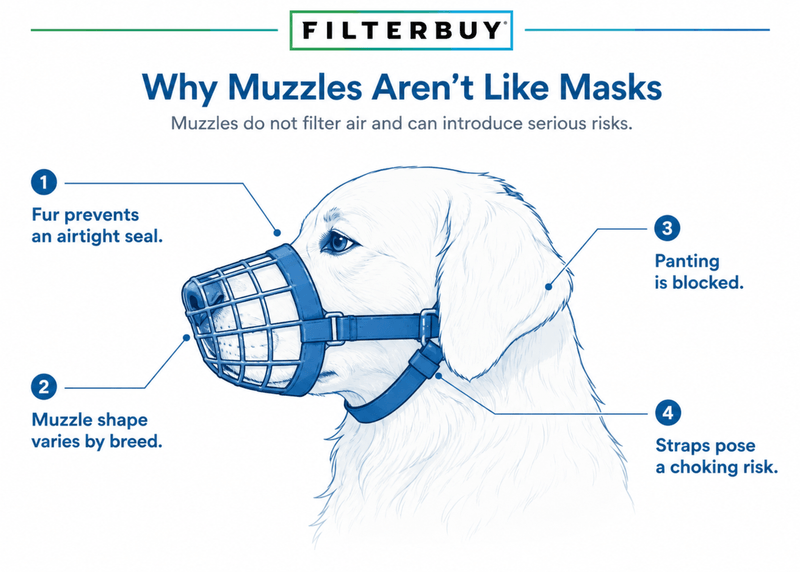
An N95 cannot work on a dog because it fails at four separate points: it cannot seal against fur, it cannot fit the range of muzzle shapes across breeds, it obstructs panting, and it relies on a wearer who can report distress. A human N95 works because all four conditions hold at once. On a dog, every one of them breaks.
The seal problem ends the conversation. NIOSH has held since 2006 that skin contacting a respirator's seal must be hair-free, which is why a few days of stubble makes a worker fail a fit test. A dog's muzzle is not stubble. Air takes the path of least resistance, so smoke flows around an unsealed mask rather than through it.
The panting problem creates new danger. Dogs have very few sweat glands, so they shed heat by moving air rapidly across the wet surfaces of the tongue, mouth, and upper airway. Restrict the muzzle and you have done more than fail to filter the smoke. You have narrowed the one system your dog has for cooling down, in the season when smoke arrives alongside heat.
The risk is not theoretical. Los Angeles County Public Health instructs owners not to place an N95 on a pet, citing strangulation risk from elastic straps and the mask blocking nose breathing and panting.
The One Mask That Does Belong on a Dog
Pet oxygen masks are the source of most of the confusion. Firefighters carry cone-shaped masks sized for cats and dogs to deliver oxygen to an animal already overcome by smoke, which is emergency treatment rather than a filter a dog wears on a walk.
What Veterinarians Recommend Instead
The EPA's 2026 fact sheet on protecting pets never mentions masks once. Every recommendation it makes is environmental, and so is the AVMA's guidance. In practice, that consensus comes down to seven things.
Check the AQI first. Use the AirNow Fire and Smoke Map or a live AQI map to decide how long your dog goes out.
Keep pets indoors, doors and windows closed. Let dogs and cats out only for brief bathroom breaks while an alert is active. Bring outdoor pets into a less smoky space like a utility room.
Cancel the run, not just the long walk. The AVMA advises against activities that substantially increase airflow into and out of the lungs. Exercise pulls in far more smoke than a slow potty break.
Filter the air your dog actually lives in. Run your HVAC fan continuously rather than on “Auto,” and fit the highest-efficiency filter your system supports. EPA reports MERV 13 to 16 filters cut indoor particles by as much as 95 percent, and running the fan alone cuts them by as much as 24 percent.
Set up a cleaner air room. Keep it closed and add a portable air cleaner that does not produce ozone. Make it where your dog sleeps.
Stop adding particles indoors. Skip frying, candles, the fireplace, and vacuuming. Your dog's nose is at floor level, where dust concentrates.
Keep water available at all times. A dog that cannot pant efficiently in warm, smoky air needs every other cooling advantage.
Will a MERV 13 Filter Work With Your System?
Most residential systems handle MERV 13, though not all do, and EPA guidance advises asking an HVAC technician or your manufacturer for the highest-efficiency filter your equipment supports. Two things matter more than the number on the box. The filter has to sit snugly in its slot, since air that slips around a filter is not filtered at all. And if your system is borderline, a thicker filter is the easier upgrade: a 2-inch or 4-inch MERV 13 spreads the same airflow across more media, so it creates less resistance than a 1-inch of the same rating. Filterbuy's MERV pressure drop chart shows how far thickness moves that number.
Filters also load far faster during a smoke event than owners expect, and this is the part we would underline. A filter that spent a week straining smoke is no longer on a 90-day clock, and a loaded one stops doing its job without ever announcing it.
Buy the Filter Before the Sky Turns Orange
One thing we notice as a filter manufacturer rarely makes it into pet-safety advice. The EPA tells people to choose filtration before a smoke event because filters get hard to find once smoke arrives, and that matches what we see: demand spikes at the exact moment everyone needs it.
Which makes this an article to act on before you need it. Know your filter size, keep a spare MERV 13 in the closet, and put replacement on a schedule you do not have to remember.
If the Smoke Is Already Here and You Do Not Have the Right Filter
Do not order a filter and wait for it to arrive. Build a DIY air cleaner tonight instead: a 20-inch box fan with a 20x20 MERV 13 filter taped or clamped to the back, airflow arrows pointing toward the fan. Use a fan made in 2012 or later carrying a UL or ETL mark, since older models lack the thermal safety features that matter once you restrict airflow.
Two upgrades are worth knowing. In EPA research published in Indoor Air, a cardboard shroud around the fan face raised clean air delivery about 40 percent at no cost, and a 4-inch filter instead of a 1-inch roughly doubled it. The study also found smoke-loaded filters sharply reduced delivery, so change it more often than feels reasonable.
Filterbuy sells filters, so take this in the spirit it is offered: a box fan and one filter in the room where your dog sleeps will do more tonight than anything you can strap to their face. The EPA treats it as a legitimate stopgap when air cleaners are unavailable or unaffordable.
Would a Mask Even Help? Run the Time Math
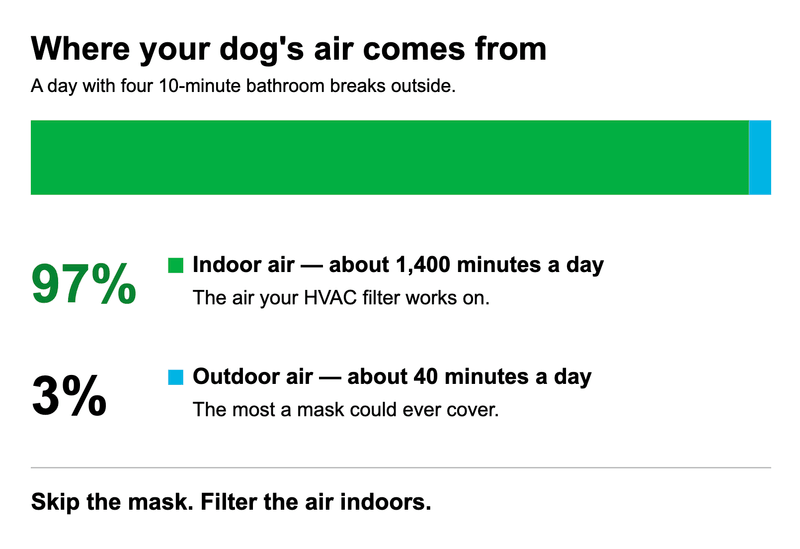
This is where most mask advice goes wrong. Even a perfect mask would only protect your dog during the minutes it is actually on, and indoor air is where the exposure hours pile up. Run the arithmetic on four bathroom breaks at ten minutes each: roughly 40 minutes outdoors against about 1,400 minutes indoors, which means 97 percent of your dog's daily air comes from inside your home.
That is the ratio worth acting on. A device aimed at the other 3 percent, which cannot seal and is not safe to leave unattended, is solving the smaller half of the problem.
Two Problems the Mask Conversation Leaves Unsolved
Talking someone out of a dog mask answers the question they asked. It leaves two more sitting there, and both have practical answers.
The Walk Your Dog Is Not Getting
A dog who misses three days of exercise becomes a different animal in the house, and that pressure is what pushes owners back outside on bad-air days. The way through it is to substitute mental work rather than replace the mileage. Scatter part of a meal across a rug and let your dog hunt for it, run a few short training sessions through the day, or serve dinner from a puzzle instead of a bowl. Sniffing and problem-solving tire most dogs faster than a walk around the block, and none of it costs a lungful of smoke.
Ash on Paws and Coat, the Exposure Route Most Articles Skip
Smoke is not the only way wildfire particulate gets into a dog. Ash settles on fur and paws, and a dog grooming afterward swallows whatever they were standing in. Los Angeles County Public Health recommends wiping paws and coat with a damp cloth after every outing during and after a fire, checking paws for limping or licking, and bathing more often.
The same guidance covers details that are easy to miss: no drinking from puddles or bowls left outside, feed indoors from washable bowls, and clean floors, bedding, and toys before letting a dog roam freely after a fire. Ash from burned structures is not just wood smoke, which is why ingestion deserves as much attention as inhalation.
How Bad Is Wildfire Smoke for Dogs? What the Research Shows
Three findings from U.S. research explain why smoke exposure recurs, and why the fix is environmental.
Wildland fires produce more than 30 percent of the nation's primary PM2.5 emissions. The EPA attributes over 30 percent of U.S. primary fine particulate emissions to wildfires and prescribed fires. Smoke is a leading contributor to particle pollution, not a marginal one, which is why a smoke event moves your local AQI so sharply.
145 million Americans experienced at least one day of Unhealthy or worse particle pollution. The American Lung Association's State of the Air 2026 counted 960 Unhealthy (red), 182 Very Unhealthy (purple), and 26 Hazardous (maroon) days nationwide, naming wildfire smoke a key factor. For scale, reports from 2004 through 2019 recorded zero to eight maroon days each.
Each 1 microgram per cubic meter rise in weekly PM2.5 is associated with a 0.7 percent increase in veterinary visits for dogs and cats. A 2025 study in PNAS, the journal of the U.S. National Academy of Sciences, analyzed over seven million veterinary visits. It is the first large-scale evidence that PM2.5 reaches companion-animal healthcare, not just human.
Warning Signs to Watch For
Call your veterinarian if your dog shows any of these signs during or after a smoke event, per EPA and AVMA:
Excessive coughing or gagging
Trouble breathing, including open-mouth, noisier, or rapid breathing
Red or watery eyes, nasal discharge, or reluctance to eat hard food
Excessive panting
Fatigue, weakness, disorientation, uneven gait, or stumbling
Reduced appetite or thirst
Healthy dogs are not exempt. During the 2023 smoke events, Penn Vet's Ryan Veterinary Hospital reported an uptick in breathing difficulties in cats and dogs, including animals with no preexisting conditions.
Two groups need extra caution. Short-nosed breeds such as Pugs and Bulldogs already have compromised airways. Pet birds are the most vulnerable companion animals of all and should stay inside whenever smoke is present.
Frequently Asked Questions
Can Dogs Wear N95 Masks?
No. N95 respirators are designed and certified for human faces, and public health guidance warns against placing one on a pet. The straps pose a strangulation risk and the mask blocks nose breathing and panting.
Do the Dog Masks Sold Online Actually Work?
Dog masks marketed for smoke are not NIOSH-certified, because that certification covers respirators for human occupational use. Without a verified seal against skin, filtration claims cannot be validated the way they are for an N95.
What MERV Rating Should I Use During Wildfire Smoke?
MERV 13, provided your system supports it. A MERV 13 filter built for smoke captures fine particles while maintaining airflow.
Can I Walk My Dog When the AQI Is Over 150?
Keep outings to short bathroom breaks and skip exercise. Los Angeles County Public Health advises keeping pets inside once the AQI passes 100, and exertion multiplies how much smoke reaches the lungs.
How Long After a Fire Is It Safe for My Dog Again?
Keep filtering after the visible smoke clears. Settled ash resuspends easily and dogs disturb it at nose level, so wipe paws and coats and clean floors and bedding before letting them roam. Replace loaded filters early, since a filter that worked hard during the event clogs well ahead of schedule.
Protect the Air Your Dog Breathes All Day
Skip the mask. Upgrade the filter. Filterbuy builds MERV 13 Smoke Defense filters in the USA in more than 600 sizes, ships factory-direct, and auto-delivery means a loaded filter never catches you mid-season. Your dog does not need equipment. Your house does.
About This Article
Written by Michelle Wan and reviewed for technical accuracy by David Clark, a licensed HVAC technician. Published by Filterbuy, an American air filter manufacturer producing residential and commercial filters in the United States in more than 600 sizes. We publish air quality guidance because the equipment that heats and cools a home is the equipment that cleans its air, and most people never think about it until the sky turns orange.
Glossary
AQI (Air Quality Index): The EPA's 0 to 500 scale for daily air quality, color-coded green to maroon.
PM2.5: Fine particulate matter 2.5 micrometers or smaller, the main hazard in wildfire smoke, small enough to reach deep lung tissue and enter the bloodstream.
MERV: Minimum Efficiency Reporting Value, the 1 to 16 scale rating how well an HVAC filter captures particles. MERV 13 is the level recommended for smoke.
N95 respirator: A NIOSH-certified filtering facepiece removing at least 95 percent of airborne particles when sealed against bare skin. Certified for human occupational use only.
NIOSH: The National Institute for Occupational Safety and Health, the U.S. agency certifying respirators.
Brachycephalic: Short-nosed, flat-faced breeds including Pugs and Bulldogs, whose shortened airways make breathing harder.
Cleaner air room: A single room kept closed and filtered with a portable air cleaner to create a low-smoke space.
Pressure drop: The airflow resistance a filter creates. Thicker filters lower it at the same MERV rating.
Sources
EPA, Protect Your Pets From Wildfire Smoke (EPA-452/F-26-007, June 2026) · AVMA, Wildfire Smoke and Animals · AVMA News, Wildfire smoke endangers animal health (June 2023) · LA County Public Health, Wildfire Pet Safety Fact Sheet · NIOSH Policy for Respirator Sealing Surfaces and Facial Hair (2006) · EPA, Indoor Air Filtration · EPA, Create a Clean Room During a Wildfire