
What Is UV-C Light, and Why Does 254nm Keep Coming Up?
September 30, 2026
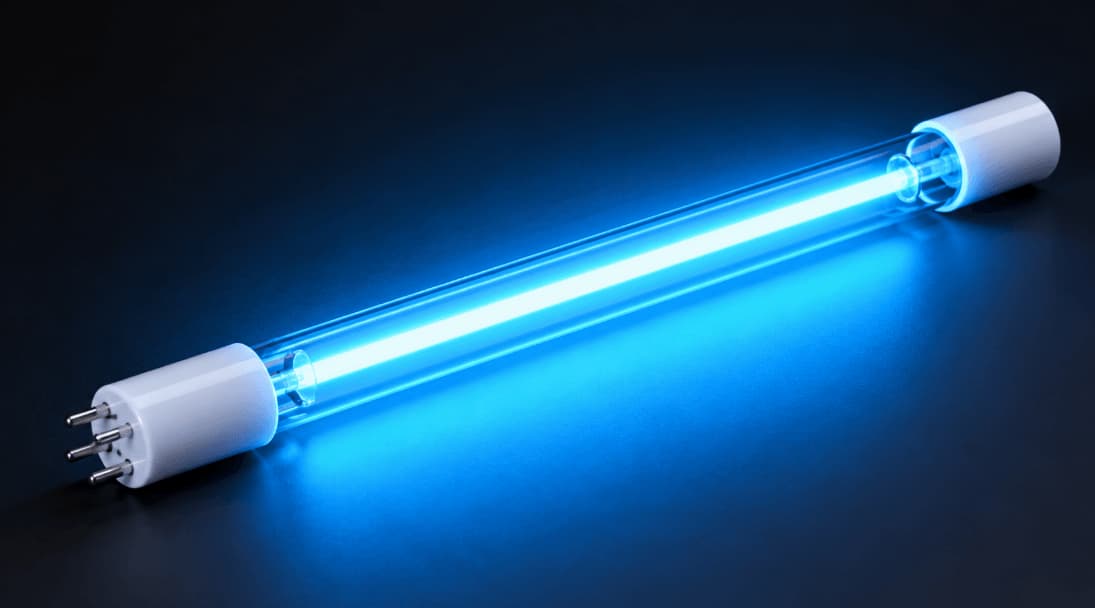
TL;DR: UV-C is the shortest-wavelength band of ultraviolet light, running from 100 to 280 nanometers (nm), and Earth's ozone layer blocks all of it. The 254nm figure on HVAC UV lamps comes from low-pressure mercury lamps, which release most of their UV energy at 253.7nm, close to where microbial DNA absorbs UV best. Ozone comes from shorter wavelengths, mainly mercury's 185nm line, and "ozone-free" lamps block that line with doped quartz glass.
Where we're coming from: Filterbuy makes pleated air filters 100% in the USA, and our Filterbuy HVAC Solutions team installs UV lights in homes across South Florida and Greater Orlando. Since we sell both, we have no reason to oversell either one. In our view, filters and UV lights do different jobs.
Key Takeaways
UV-C covers 100–280nm.
"254nm" is mercury's 253.7nm emission line, rounded.
UV-C disinfects by damaging DNA and RNA, and its germicidal effect peaks around 260–265nm, just above mercury's line.
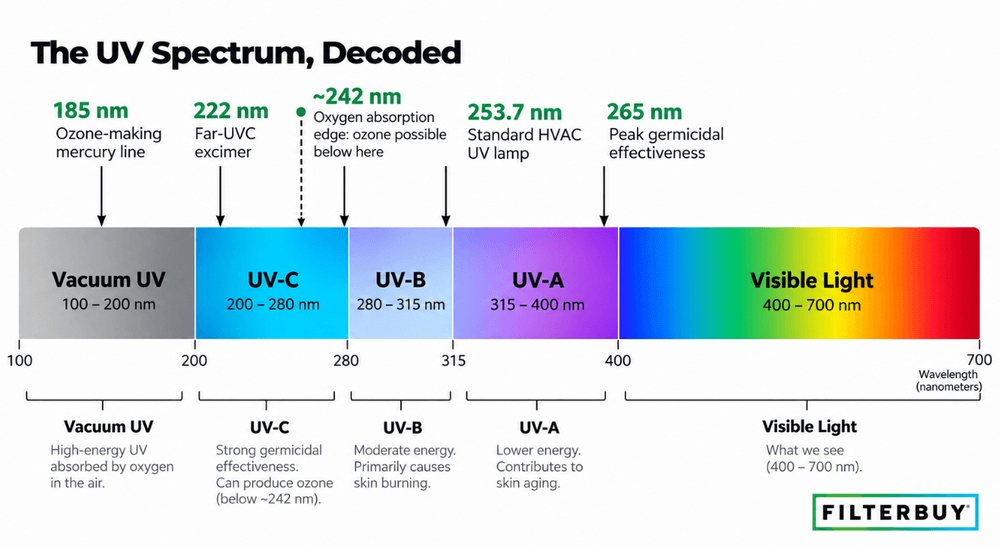
Mercury's 185nm line is the main source of ozone in UV lamps, but any UV below about 242nm can make ozone, including 222nm far-UVC.
In a home HVAC system, UV-C is best at keeping the coil and drain pan clean.
What Is UV-C Light?
UV-C light is ultraviolet radiation with wavelengths between 100 and 280 nanometers, making it the shortest and most energetic of the three UV bands. The sun produces it, but Earth's ozone layer absorbs all of it, so any UV-C in your home comes from a lamp or LED. It's often called germicidal UV because it damages the genetic material of bacteria, viruses, and mold.
Air absorbs wavelengths below about 200nm, known as vacuum UV, so the International Ultraviolet Association (IUVA) places the practical germicidal range at about 200–300nm, with a peak near 260nm.
UV-A vs. UV-B vs. UV-C: The UV Light Spectrum Explained
The table below compares the three UV bands and where you encounter each one.
UV Bands Compared
Band boundaries follow ISO 21348. The practical germicidal range of UV-C starts near 200nm because air absorbs shorter wavelengths.
Why 254nm? What 253.7nm Means on a UV Lamp
The 254nm figure comes from mercury itself. Mercury vapor's strongest ultraviolet emission line sits at 253.7nm, and "254nm" is that figure rounded. The tube-style bulbs in most residential HVAC UV systems are low-pressure mercury lamps, and the U.S. Food and Drug Administration (FDA) rule for UV food processing, 21 CFR 179.39, defines them as emitting 90 percent of their output at 253.7nm.
That wavelength also happens to suit disinfection. Microbial DNA absorbs UV most strongly around 260–265nm, so mercury's natural line lands close to the ideal germicidal wavelength. In Filterbuy's view, that closeness is a lucky overlap of physics and biology.
Common UV-C Light Sources
Sources: 21 CFR 179.39; Claus, Photochemistry and Photobiology (2021); Peng et al., ES&T Letters (2023); PLOS One (2025).
Which UV Wavelengths Make Ozone?
Ozone (O3) forms when UV light splits oxygen molecules (O2) and the freed atoms bond with other O2 molecules. In most UV lamps, the culprit is mercury's 185nm emission line. Oxygen absorbs UV at any wavelength below about 242nm, though, so light between 200 and 242nm, including 222nm far-UVC, can make smaller amounts of ozone too. The 254nm line itself does not.
Whether a mercury lamp's 185nm line escapes depends on its glass. A 2021 review in Photochemistry and Photobiology explains that clear fused quartz lets 185nm through and generates ozone, while titanium-doped quartz blocks wavelengths below roughly 230nm. The two look identical, so only the label or spec sheet can tell them apart.
It's also a mistake to assume only wavelengths under 200nm make ozone. Indoor studies of 222nm lamps have measured ozone increases, especially in poorly ventilated rooms. Ozone irritates the lungs, and the U.S. Environmental Protection Agency (EPA) advises avoiding air cleaners that produce it on purpose.
"The ozone question surprised me most. The 222nm lamps marketed as the gentler option still make some ozone, while a 254nm lamp in doped quartz is built to make essentially none." — Michelle Wan, Filterbuy
How To Read A UV Lamp Label
What Does UV-C Light Do Inside an HVAC System?
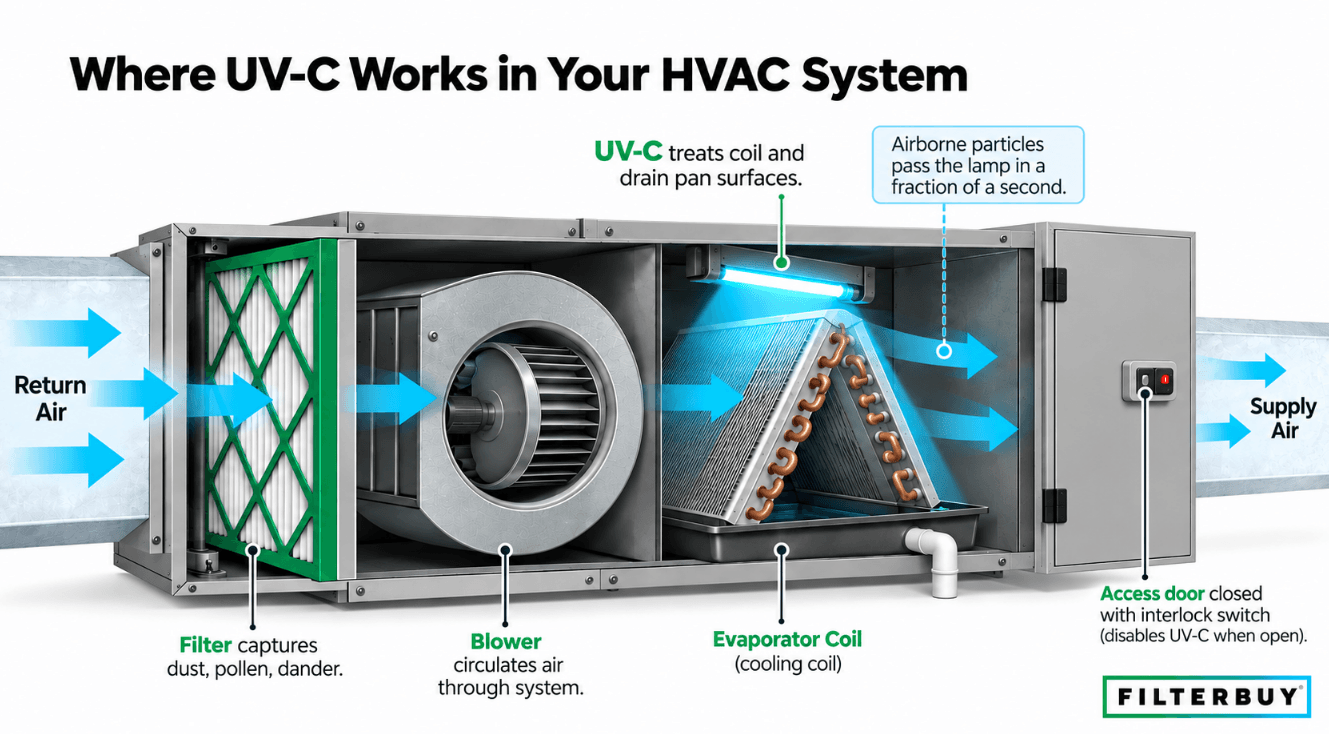
Inside a home HVAC system, UV-C lamps are best at keeping damp, stationary surfaces like the evaporator coil and condensate drain pan free of mold and bacterial film. Moving air is a different story, because it passes the lamp in seconds or less.
The difference comes down to dose, which is UV intensity multiplied by exposure time. The EPA's technical guide to residential air cleaners finds that typical home UV germicidal irradiation (UVGI) units don't deliver enough UV to kill most airborne microorganisms.
By the numbers: One study cited in the EPA guide found a 99% reduction in microbial growth on exposed HVAC surfaces, but only a 25–30% reduction in airborne bacteria.
"I aim a coil lamp at the evaporator coil and drain pan, because that's where moisture collects and growth starts. Before installing one, I check the spec sheet for doped quartz or UL 2998 validation. I also keep the lamp's direct light off plastic parts and wiring that aren't UV-rated, since UV-C breaks them down." — David Clark, Licensed HVAC Technician
Filterbuy's Take: Two Jobs, Two Tools
Filterbuy suggests this order:
Start with the filter. A pleated air filter captures airborne dust and pollen, and it also keeps that dust off the UV bulb and coil. The EPA notes that in-duct UV lamps usually sit downstream of the filter and need their bulbs kept free of dust. Filterbuy makes MERV-rated air filters in MERV 8, 11, and 13.
Add UV for the coil. Filterbuy HVAC Solutions technicians install UV lights near the evaporator coil, where moisture and microbial growth are most common. A lamp running 24/7 gives the coil 86,400 seconds of exposure a day, while a spore riding the airflow gets a few seconds at most.
Plan for bulb changes. Most HVAC UV bulbs last one to two years, and Filterbuy recommends two-year bulbs. With a 1-inch filter changed every three months, a two-year bulb lasts eight filter changes.
Skip UV for allergy relief. Because dead mold particles can still trigger allergies, the EPA says UV may not reduce allergy or asthma symptoms.
UV Light Marketing Claims, Decoded
Filterbuy checked the most common UV marketing promises against the evidence. If a product claims to be ozone-free, UL 2998 zero-ozone validation is the proof to look for.
Uv Light Marketing Claims, Decoded
Sources: U.S. FDA UV wand safety communication; U.S. EPA, Residential Air Cleaners (2018); Peng et al., ES&T Letters (2023).
Is UV-C Light Safe?
For people, UV-C becomes a hazard when it reaches skin or eyes. The FDA warns that unsafe UV-C devices can cause burn-like skin reactions and photokeratitis, a painful eye injury, after just seconds of exposure. HVAC UV lamps avoid that risk by shining only inside a closed air handler or duct, and a few precautions keep it that way:
Never look at an operating UV-C lamp. Switch it off before opening the air handler.
Have a licensed installer place the lamp, since UV-C slowly degrades plastics, wiring insulation, and duct liners that aren't UV-rated.
Recycle spent tube-style bulbs the way you would fluorescent tubes, because they contain mercury.
Supporting Statistics
About 90% of our time is spent indoors, mostly at home, according to the EPA's consumer guide to air cleaners.
Up to 3,000 times the recommended UV-C exposure limit came from some consumer UV wands at about two inches in FDA testing of UV wands.
About 6.5 ppb of added ozone was measured in an office while 222nm far-UVC lamps were running, in a peer-reviewed study archived by the National Oceanic and Atmospheric Administration (NOAA).
Frequently Asked Questions
Is 254nm UV light the same as UV-C?
Not quite. The UV-C wavelength band covers 100–280nm, and 254nm is one wavelength inside it: the line mercury germicidal lamps emit, rounded from 253.7nm.
What's the difference between UV-C and far-UVC?
Far-UVC is the short end of UV-C, roughly 200–235nm, and it usually comes from 222nm krypton-chloride lamps. Research published in PLOS One reports that it's gentler on skin and eyes because it penetrates so shallowly, though it can still make ozone.
Do I still need an air filter if I have a UV light?
Yes. UV-C lamps don't capture particles, so your air filter still has to trap the dust, pollen, pet dander, and airborne mold spores that drift past the lamp.
Can a UV light kill viruses in my home's air?
Only to a limited degree. The EPA's technical guide says a well-designed in-duct UV system can provide low to moderate reductions in airborne viruses, but destroying them reliably takes much higher UV doses than a typical home unit delivers. The EPA advises using UV alongside filtration.
Can a UV light make my HVAC system more efficient?
It can help indirectly. The EPA's technical guide notes that limiting microbial growth on cooling coils improves their heat transfer, which improves energy efficiency. That's one more reason Filterbuy HVAC Solutions technicians mount UV lights near the evaporator coil.
Glossary
UV-C: Ultraviolet light from 100 to 280nm, or germicidal UV.
UV-A: UV from 315 to 400nm; most ground-level UV.
UV-B: UV from 280 to 315nm; causes sunburn.
Nanometer (nm): One-billionth of a meter, the unit for light wavelengths.
253.7nm: Mercury vapor's strongest UV emission line, commonly rounded to 254nm.
Low-pressure mercury lamp: A tube-style germicidal lamp that emits most of its UV at 253.7nm.
Doped quartz: Lamp glass treated to block UV below about 230nm, including the 185nm ozone line.
Vacuum UV (VUV): UV from about 100 to 200nm; air absorbs it, making ozone.
Far-UVC: UV-C from about 200 to 235nm, usually from 222nm krypton-chloride lamps.
UVGI (ultraviolet germicidal irradiation): Using UV to inactivate microbes.
Ozone (O3): A reactive, lung-irritating gas formed when UV below about 242nm splits oxygen.
ppb (parts per billion): A unit for trace gases such as ozone in air.
Photokeratitis: A painful, temporary UV injury to the cornea.
Evaporator coil: The air handler's cooling coil, which stays damp during cooling.
UL 2998: UL Solutions' validation that an air cleaner's ozone emissions stay below 5 ppb.
Better Air for All Starts With the Basics
Start with the right air filter, changed on schedule, and add UV-C if your coil or drain pan needs it.
CTAs: Find your filter size · Explore UV light installation from Filterbuy HVAC Solutions (South Florida and Greater Orlando)
Sources
U.S. FDA: Do Not Use UV Wands That Give Off Unsafe Levels of Radiation (Safety Communication)
eCFR: 21 CFR 179.39, Ultraviolet Radiation for the Processing and Treatment of Food
U.S. EPA: Residential Air Cleaners, A Technical Summary, 3rd Edition (2018)
Claus, "Ozone Generation by Ultraviolet Lamps," Photochemistry and Photobiology, 2021
"Effects of germicidal far-UVC on ozone and particulate matter in a conference room," PLOS One, 2025