
What Is Photocatalytic Oxidation, and How Does It Pair With a UV Lamp?
September 30, 2026
TL;DR
Photocatalytic oxidation (PCO) uses ultraviolet (UV) light and a catalyst, usually titanium dioxide, to break down VOCs and odors as air passes through. A bare UV lamp mainly treats microbes on surfaces like your AC coil. Because PCO can leave behind byproducts such as formaldehyde and does nothing for dust or pollen, it belongs alongside a good air filter.
Key Takeaways
PCO targets gases, not particles. Dust, pollen, dander, and smoke pass straight through.
The catalyst is the difference. A PCO module adds a titanium dioxide–coated surface to the UV lamp.
Incomplete reactions are the main safety concern. Lawrence Berkeley National Laboratory measured net formaldehyde and acetaldehyde production from a PCO air cleaner.
Filterbuy's view: a filter comes first. Pleated filters carry a tested MERV rating, while a standard byproduct test for portable air cleaners, ASTM D8625, only arrived in 2025.
What Is Photocatalytic Oxidation (PCO)?
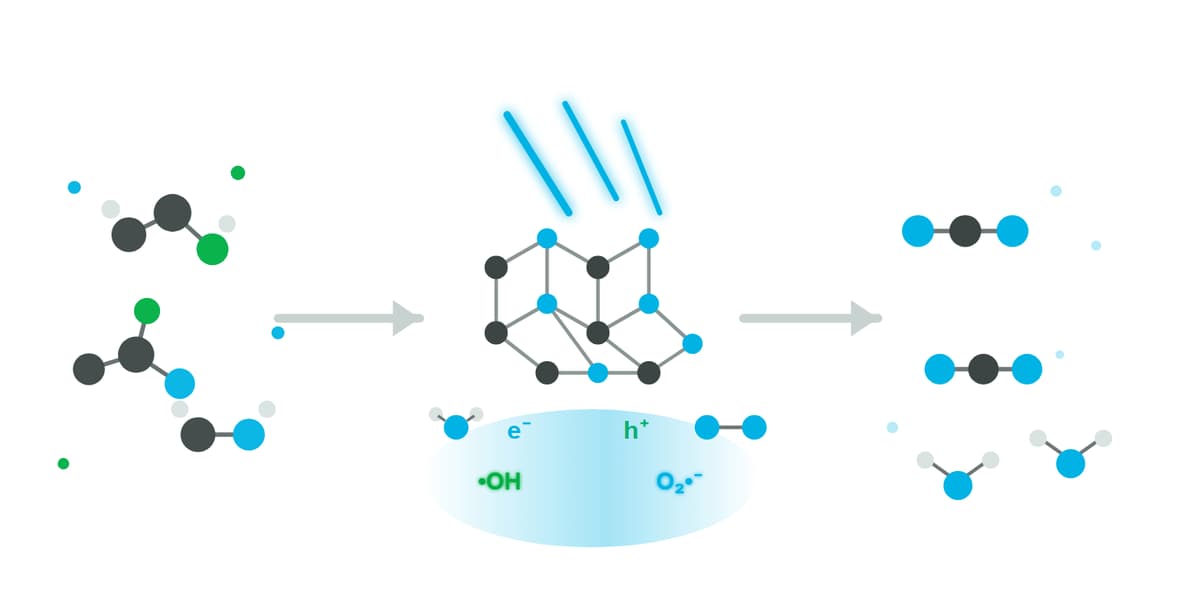
Photocatalytic oxidation (PCO) is a gas-phase air-cleaning technology. PCO uses ultraviolet light to activate a catalyst, most often titanium dioxide (TiO2), and the energized catalyst sets off reactions that attack volatile organic compounds (VOCs) and odor molecules in the air flowing past. When a reaction runs to completion, those pollutants end up as carbon dioxide and water vapor.
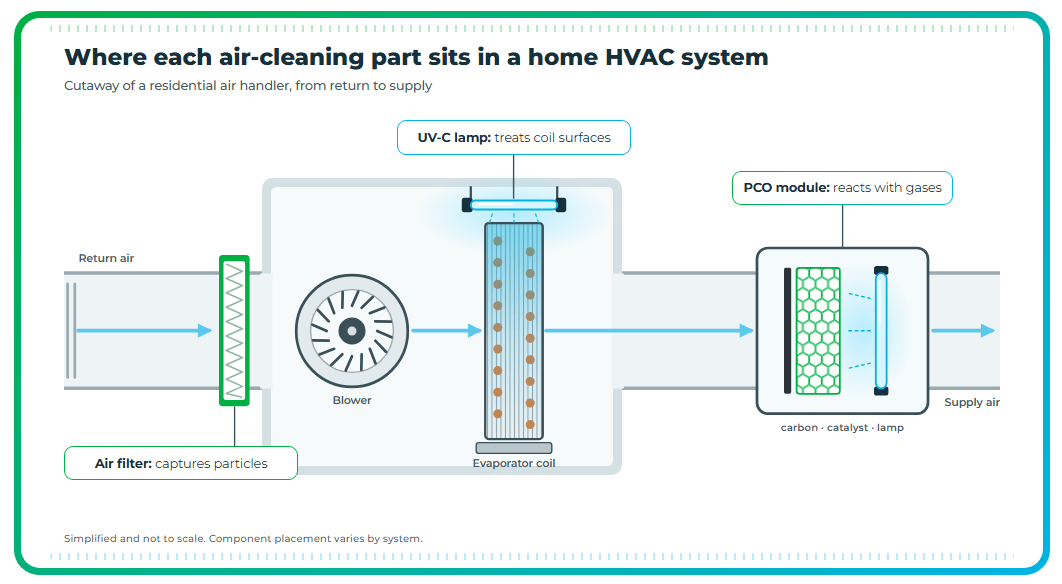
You'll find PCO in portable purifiers and in in-duct modules near your air handler, both built around a UV-lit, titanium dioxide–coated surface, according to the U.S. EPA's technical summary on residential air cleaners.
Filterbuy has a stake in both halves of this decision. We're a U.S. air filter manufacturer that makes filters to order in company-owned plants, and our Florida service team, Filterbuy HVAC Solutions, installs UV lights in customers' homes. The advice in this guide follows the research we cite.
How Does A PCO Air Purifier Work?
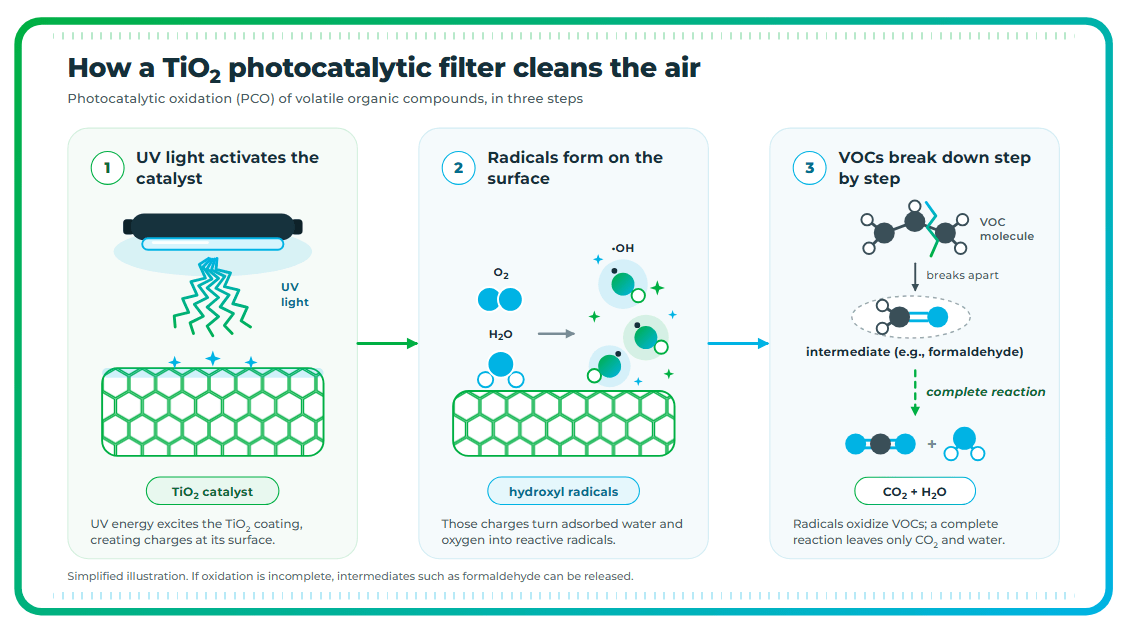
A photocatalytic oxidation air purifier cleans air through a chain of surface reactions. Everything happens on the catalyst, so a pollutant has to touch the coating to react. The process runs in three steps:
Light activates the catalyst. UV photons create separated electrical charges on the titanium dioxide.
Reactive species form. Those charges react with water vapor and oxygen to produce hydroxyl radicals and superoxide ions.
Pollutants break down in stages. Each step leaves an intermediate compound, and only a finished reaction ends at carbon dioxide and water.
In a Lawrence Berkeley National Laboratory (LBNL) test using realistic office VOC mixtures, a PCO air cleaner's conversion efficiency usually topped 20%, peaked near 80%, and generally dropped as airflow increased (Hodgson et al., 2007).
PCO Vs. UV Light: What's The Difference?
A bare UV lamp and a PCO module can use the same kind of bulb, yet they do very different jobs. A germicidal UV-C lamp, typically 254 nanometers, mainly inactivates mold and bacteria on the surfaces it shines on, such as your AC's evaporator coil. A PCO module points its lamp at a titanium dioxide catalyst instead, to break down gases and odors. So when an HVAC quote lists "UV" as an add-on, ask which one you're getting.
The table below compares both with the two filter types most homes already use:
Sources: ASHRAE Position Document on Filtration and Air Cleaning; U.S. EPA Residential Air Cleaners technical summary; Lawrence Berkeley National Laboratory.
Ozone depends on the lamp. The ASHRAE Position Document on Filtration and Air Cleaning notes that UV near 185 nanometers produces ozone. Standard mercury lamps emit that wavelength unless their glass blocks it, which is why the EPA warns that uncoated lamps can generate ozone. Some PCO designs use it on purpose to speed up oxidation.
What Does An Activated Carbon Layer Do In A Pco Module?
Many PCO modules add a layer of activated carbon, a porous material that holds gas molecules on its surface. In a PCO design, that carbon does two jobs. The carbon keeps VOCs near the catalyst longer, giving them more time to react, and it can trap some intermediate compounds before they reach your living space.
We build activated carbon into Filterbuy's Odor Eliminator filters, so we know its limits well. A thin carbon layer handles everyday odors, but it fills up over time and, as the EPA also notes, holds formaldehyde poorly. The carbon inside a PCO module faces the same limits, which is why LBNL tested a stronger chemical scrubber downstream.
A spec sheet that says "includes carbon" doesn't guarantee low byproducts. For more on carbon filtration, see Filterbuy's guide to activated carbon air filters.
Is PCO Air Purification Safe?
Independent research shows that some PCO devices produce harmful byproducts when their reactions stop partway. Formaldehyde and acetaldehyde, both respiratory irritants, are reported most often. Safety depends on lamp design, catalyst, airflow, downstream media, and upkeep.
LBNL's 2007 tests with realistic indoor VOC mixtures found exactly that, and a study funded by the California Air Resources Board concluded that PCO units without downstream treatment may be a significant formaldehyde source (CARB report).
A 2024 National Institute of Standards and Technology (NIST) study of portable air cleaners across seven technologies found PCO devices emitted aldehyde byproducts at about 202 micrograms per hour, second only to germicidal UV devices at 243 (NIST).
NIST's work later became ASTM D8625, a 2025 test method for measuring byproducts from portable air cleaners. As NIST researcher Dustin Poppendieck explained, "Most air cleaners are designed to remove relatively large particles rather than small molecules."
Catalysts also wear out: siloxanes from personal care products can coat titanium dioxide with silica, blocking its active sites.
Lamps wear out, too. "Most lights last one to two years," writes David Clark, a licensed HVAC technician and President of Filterbuy HVAC Solutions.
Supporting Statistics: What The Research Shows
Indoor VOC levels average 2 to 5 times higher than outdoors, and can reach up to 1,000 times outdoor levels during paint stripping (U.S. EPA).
PCO portable air cleaners deliver under about 20 cfm of clean air for fine particles, versus 150 to 300 cfm for many HEPA units (U.S. EPA).
A downstream chemical scrubber brought a PCO system's net formaldehyde removal to 90%, though acetaldehyde removal reached only 40% (Lawrence Berkeley National Laboratory).
Does Your Problem Actually Call For PCO?
PCO fits only a few household problems, mainly odors and gases. Find yours below with the first fix EPA guidance points to.
Sources: U.S. EPA Residential Air Cleaners technical summary; U.S. EPA guidance on VOCs in indoor air.
How To Evaluate A PCO Air Purifier Or In-Duct Module
If a PCO product is still on your list, start with these six questions:
Is there third-party byproduct data? For portable units, ask for ASTM D8625 results on formaldehyde and ozone.
Is the lamp ozone-free? Find out whether the lamp's glass blocks the 185 nm wavelength that creates ozone.
Is it ozone-certified? Look for California Air Resources Board (CARB) certification, which covers in-duct modules too, or UL 2998 validation.
What's downstream of the catalyst? Carbon or permanganate media can catch some of the byproducts.
What will upkeep cost? Price out five years of lamp, catalyst cell, and carbon replacements.
What protects the catalyst? Dust keeps light from reaching the coating, and an overdue filter lets air slip around its edges.
Marketing Phrases That Should Prompt Questions
"Activated oxygen" or "super oxygenated": According to CARB, these terms are sometimes used to make ozone sound healthy.
"Turns pollutants into harmless CO2 and water": That only happens when breakdown is complete, so ask for measured formaldehyde results.
A single VOC "reduction" percentage: Removal varies widely by chemical, the EPA notes, so ask which ones were tested.
Where Your Air Filter Fits In
Your HVAC air filter handles the job PCO can't: capturing particles. If odors are the concern, Filterbuy's Odor Eliminator filters pair activated carbon with pleated media, with no lamp, catalyst, or reaction byproducts. With auto-delivery, a fresh filter arrives before you need it.
Filterbuy's take: After more than a decade of making filters, we'd spend in this order for most homes: cut VOC sources and ventilate, keep a quality filter on schedule (with a portable purifier for any problem room), add carbon for odors, and consider PCO last, with independent byproduct data (ASTM D8625 for portable units) and your HVAC pro's input. Then find your filter size or compare options in our MERV rating chart.
Frequently Asked Questions
Does a PCO air purifier remove dust, pollen, or smoke particles?
No. PCO works on gases, so dust, pollen, pet dander, and smoke particles still need a pleated MERV-rated filter.
Is a titanium dioxide air purifier the same as a PCO air purifier?
In most cases, yes. Titanium dioxide is the most common catalyst in PCO devices, so a "titanium dioxide air purifier" usually refers to a PCO unit.
Does PCO kill viruses, bacteria, or mold?
Many PCO makers claim it does, but the evidence for homes is thin. The EPA found no studies showing that PCO in homes improves occupants' health, and it calls the effectiveness of home PCO units largely undocumented.
Can a PCO module replace my HVAC air filter?
No. A PCO module can't capture particles, and dust can foul its catalyst. Keep a quality filter in place and change it on schedule. Filterbuy recommends every 90 days for most pleated filters, and sooner if you have pets.
Are PCO air purifiers legal in California?
Yes, if they're certified. The California Air Resources Board (CARB) requires air cleaners sold in the state, including portable PCO units and electronic in-duct modules, to be certified below 0.050 parts per million of ozone and labeled "CARB certified." CARB notes that certification covers ozone only, not cleaning performance.
Can I add a PCO module to my existing HVAC system?
Yes, in-duct modules mount in existing ductwork, but plan on a professional install. The EPA notes that duct-mounted air cleaners may need system changes, such as added electrical power, and need easy access for lamp and catalyst maintenance.
Glossary
Sources
U.S. EPA, Residential Air Cleaners: A Technical Summary, 3rd ed.: PCO design, byproducts, no standard test methods, finite catalyst life.
U.S. EPA, Volatile Organic Compounds' Impact on Indoor Air Quality (updated June 23, 2026): 2 to 5 times indoor/outdoor ratio; 1,000 times during paint stripping.
Hodgson et al., LBNL, Evaluation of Ultraviolet Photocatalytic Oxidation (LBNL-59631): conversion efficiency range; formaldehyde and acetaldehyde production.
Hodgson et al., LBNL, Evaluation of a Combined UVPCO / Chemisorbent Air Cleaner (LBNL-62202): permanganate scrubber; carbon's weak formaldehyde retention.
California Air Resources Board, Evaluation of Pollutant Emissions from Portable Air Cleaners (10-320): PCO as a possible formaldehyde source without downstream treatment.
Link, Robertson and Poppendieck, NIST, Quantifying Byproduct Formation from Portable Air Cleaners Using a Proposed Standard Test Method, Environmental Science & Technology 58(18), 2024: 202 vs. 243 µg/h aldehyde emission rates.
NIST, Some Air Cleaners Release Harmful By-Products. Now We Have a Way to Measure Them. (September 2, 2025): Poppendieck quote; ASTM D8625 publication.
ANSI, Unwanted Byproducts from Air Cleaners: New Standard Provides Clear Solutions (September 10, 2025): ASTM D8625 scope.
ASHRAE, Position Document on Filtration and Air Cleaning: 185 nm lamps and ozone; 254 nm over TiO2.
U.S. EPA technical summary (above), UVGI section: uncoated UV-C lamps can generate ozone.
ASHRAE, Position Document on Infectious Aerosols: UL 2998 ozone limit of 5 ppb.
CARB, Air Cleaner Information for Consumers: 0.050 ppm certification for portable and electronic in-duct air cleaners; "CARB certified" label; "activated oxygen" warning.
CARB, List of CARB-Certified Air Cleaning Devices: PCOs listed as electronic air cleaners; certification covers ozone, not effectiveness.
Recent Developments in Photocatalytic Nanotechnology… Catalyst Deactivation, Catalysts (2023): adsorbent pairing; siloxane deactivation.