
What CARB Certification Means, and Which Air Cleaners Need It
October 7, 2026
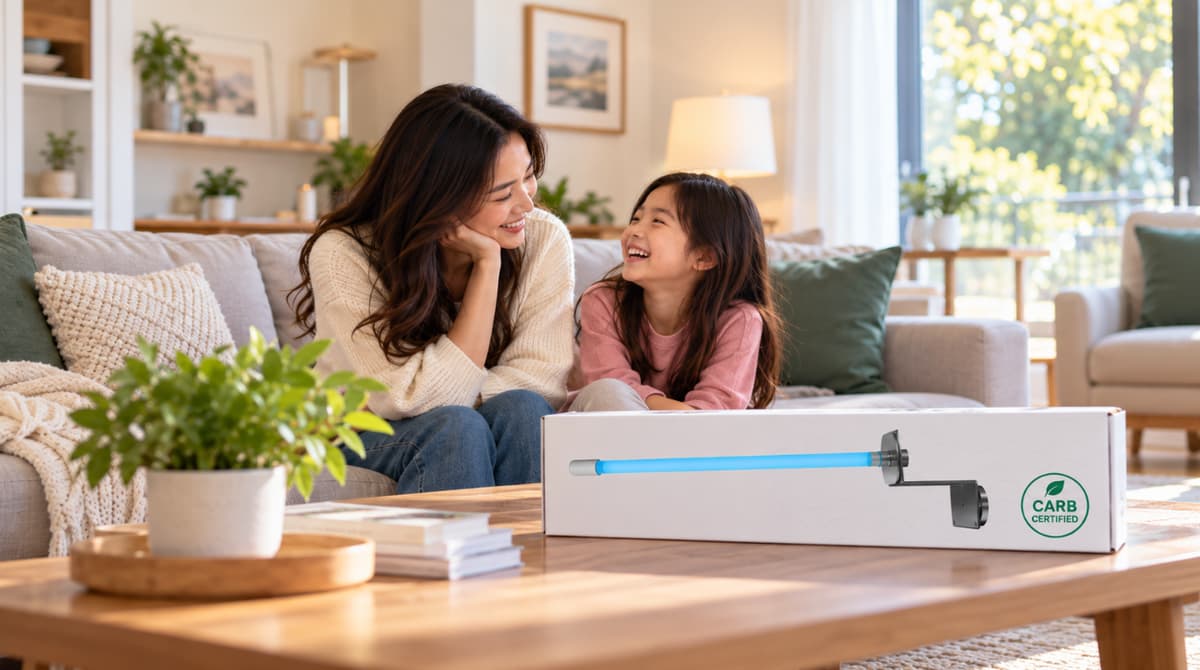
CARB certification is California's sign-off that an air cleaner is electrically safe and stays under the state's ozone limit. Most devices that use electricity to clean indoor air need it before they can be sold in California, and in-duct UV lights are on that list.
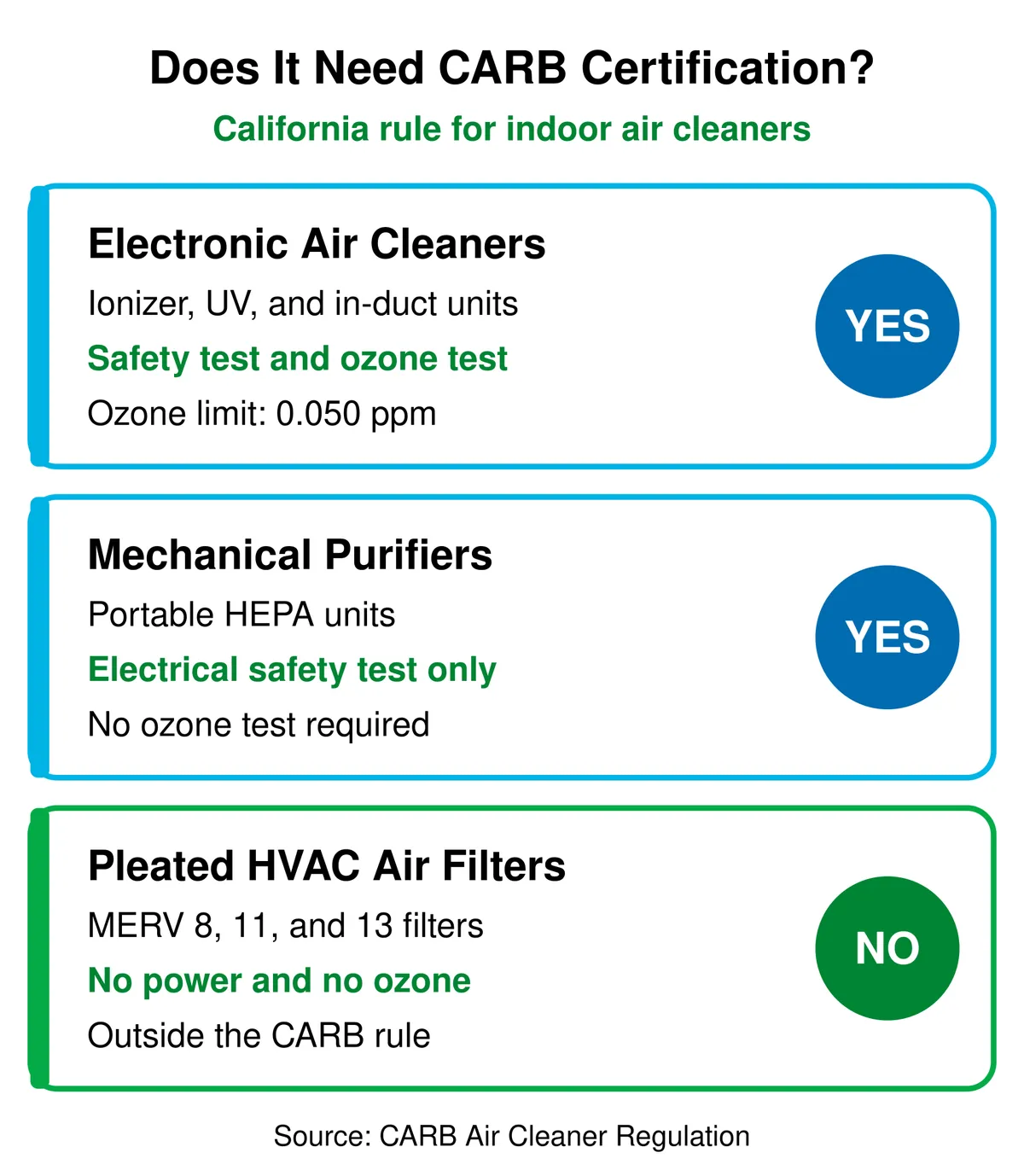
Electronic air cleaners (ionizers, UV lights, in-duct units): safety test plus the 0.050 ppm ozone test
Mechanical purifiers (portable HEPA units): electrical safety test only
Pleated HVAC air filters: no certification needed, since they use no power and make no ozone
Shopping for an HVAC filter instead? Take the quick match quiz below.
Filterbuy pleated filters in MERV 8, 11, and 13 run without power and add no ozone to your home.
Answer a few quick questions and we'll match you to the right filter for your system.
Check your HVAC system's manual for the highest MERV rating it supports.
TL;DR
CARB certification is California's confirmation that an indoor air cleaner is electrically safe and releases no more than 0.050 parts per million (50 ppb) of ozone. Nearly every powered air cleaner sold into the state needs it, including HVAC UV lights since October 1, 2022. To check a product, find the "CARB certified" label, then look up its model number on CARB's list.
Key Takeaways
UV and in-duct units: HVAC UV lights and other electronic in-duct units need certification as of October 1, 2022.
The proof: Search CARB's list by model number, since one certified unit often carries several brand names.
Mechanical vs. electronic: Units CARB lists as "Mechanical" make no ozone, while "Electronic" units passed the 0.050 ppm test but can still emit a small amount.
Safety, not performance: CARB certification doesn't measure cleaning power, so compare a purifier's CADR to your room size as well.
Your HVAC filter: A pleated furnace filter, like the ones Filterbuy makes, uses no power and makes no ozone, so the rule doesn't apply to it.
What Is CARB Certification?
CARB certification is a state approval showing that an indoor air cleaner passed electrical safety testing. If the device uses electronic technology, it also had to pass an ozone emissions test with a result of 0.050 ppm or lower. The California Air Resources Board (CARB) issues it and publishes every approved model online.
The rule exists because some "air purifiers" make indoor air worse. Ionizers and certain UV devices can create ozone, a lung irritant, which is why CARB strongly advises against ozone generators at home. Assembly Bill 2276, passed in 2006, led to CARB's air cleaner regulation, and today more than 9,000 models from over 800 manufacturers carry certification.
What Does the 0.050 ppm Ozone Limit Mean?
The 0.050 ppm limit is the most ozone an electronic air cleaner may emit during CARB's required lab test, or 50 parts per billion. A device that tests above it can't be certified. It's a pass/fail lab result, though, not a promise about your living room, where ventilation and outdoor ozone also matter.
Which Air Cleaners Need CARB Certification?
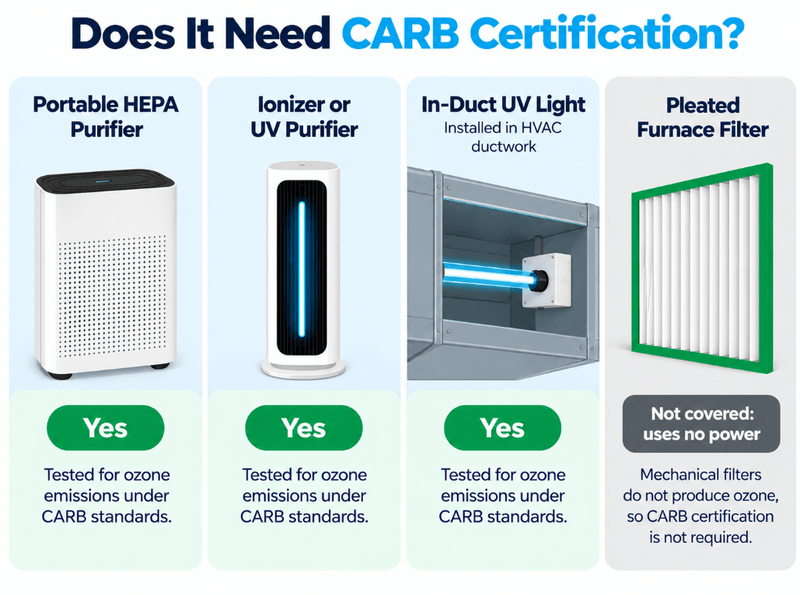
Nearly every powered air cleaner sold in, or shipped to, California needs CARB certification. CARB defines an indoor air cleaning device as any energy-consuming product that reduces indoor air pollutants. The test each one must pass depends on its technology, per CARB's compliance FAQ:
Source: CARB Air Cleaner Regulation FAQ, accessed October 7, 2026.
CARB's certified device list notes that certification doesn't measure cleaning ability, so before you buy a CARB certified air purifier, compare its CADR to your room size, which Filterbuy's guide to what a true HEPA air filter is walks through.
Do UV Lights Need CARB Certification?
Yes. A UV light hardwired into your heating and cooling system counts as an electronic in-duct air cleaner, and California has required those to be CARB certified since October 1, 2022.
Electronic in-duct units were exempt until CARB amended the regulation effective October 1, 2020 and gave manufacturers 24 months to comply. They now face an ozone test because UV light below about 240 nanometers can split oxygen molecules into ozone.
We see this up close. Filterbuy HVAC Solutions, our professional service division, installs UV lights sealed inside customers' air handlers. That placement protects people from the light, but ozone depends on the lamp's design, which is what CARB testing checks.
Pro Tip: When you shop for a carb certified UV light, look up the exact model number on CARB's list instead of trusting "ozone-free" on the box. That phrase is a marketing claim, not a certification.
Adding a UV Light or Electronic Air Cleaner? Ask These 4 Questions
Filterbuy recommends asking any installer these questions first.
What are the model and CARB Executive Order (EO) numbers? Every entry on CARB's certified list carries an EO number, a code like G-26-061.
What wavelength is the lamp? Ask for the spec sheet, since lamps below 240 nm can make ozone. CARB's 2019 notice waived ozone testing only for portable units with 240 nm-plus lamps.
Which replacement bulb keeps it compliant? Certification covers the unit as tested, and for portable UV units CARB's FAQ says the lab verifies the bulb's brand and model. Use the specified part.
Where will it be mounted? Inside the air handler cabinet, where Filterbuy HVAC Solutions mounts them, the UV light stays away from people.
Is My Air Purifier Legal in California? How to Check in 5 Steps
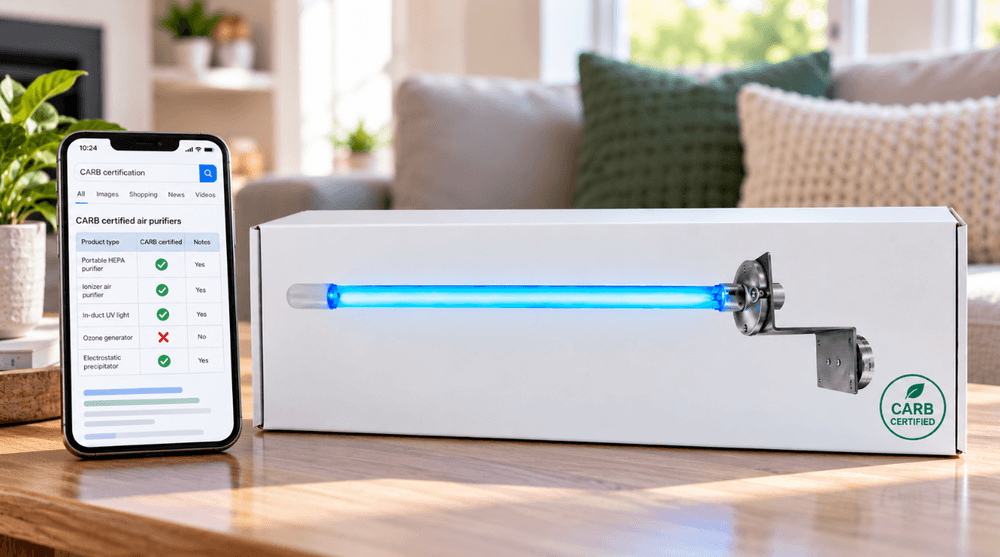
An air purifier is legal to sell in California when its exact model appears on CARB's list of certified air cleaning devices and its packaging carries the CARB certification label.
Find the model number. It's on the rating plate or in the manual.
Check the box for the label. It should read "Meets California ozone emissions limit: CARB certified."
Search CARB's official list. Open the List of CARB-Certified Air Cleaning Devices and search by model number.
Look for a lab mark. Certified units also carry a testing-lab mark, such as UL or Intertek.
Read the fine print online. Uncertified listings must state they can't ship to California.
What we noticed on CARB's list: Working through the list in October 2026, two patterns stood out. The same model number often appears under several brands, so a brand search can miss a certified unit. And the Type column is a quick tell: a purifier marketed for its HEPA filter but listed as "Electronic" has an ionizer, UV lamp, or other electronic stage inside.
Does My HVAC Air Filter Need CARB Certification?
No. A pleated HVAC air filter uses no electricity and makes no ozone, so it falls outside a rule written for energy-consuming devices.
We build every Filterbuy filter that way on purpose. Our U.S.-made MERV 8, 11, and 13 filters trap dust, pollen, dander, and, at MERV 13, fine smoke, with nothing powered in the airstream.
If you're weighing an electronic add-on against a better filter, start with the filter. CARB itself advises homes with central forced-air systems to consider at least MERV 13, and a MERV 13 air filter adds nothing to your air. Just check which MERV rating your system can handle first.
Disclosure: Filterbuy does not sell portable air purifiers, so we have no stake in which certified purifier you buy. Filterbuy HVAC Solutions installs in-duct UV lights in the areas it serves.
More from Filterbuy: air purifier vs. HVAC filter for outdoor pollution, HEPA vs. HVAC furnace filters, and California's live air quality map.
Is California Changing the Air Cleaner Rule Again?
CARB may amend the rule again after a public workshop on April 16, 2026. Current rules apply for now, and Filterbuy will update this page if they change.
Why We Wrote This Guide
Filterbuy has made pleated HVAC filters in the U.S. for over a decade and shipped them to more than two million households. Our filters use no power and create no ozone, so they sit just outside CARB's rule, and we know exactly where that line falls.
We built this guide from CARB's compliance FAQ and certified list, read as a shopper would, and a licensed HVAC technician reviewed it.
"A CARB label tells you a device won't add ozone to your home. It doesn't tell you the device will clean your air. Check both before you plug anything new into your home or your HVAC system," says Michelle Wan, Brand Manager and Air Quality Writer at Filterbuy.
Supporting Statistics
90% of our time is spent indoors. Americans spend about 90 percent of their time inside, where some pollutants run 2 to 5 times higher than outdoors. EPA also lists ozone from some air cleaners as an indoor pollutant. Source: U.S. EPA, Report on the Environment: Indoor Air Quality
159.2 unhealthy ozone days a year. Los Angeles-Long Beach is the most ozone-polluted U.S. metro, and 82% of Californians live in counties with unhealthy air. Source: American Lung Association, State of the Air 2026
103,200 in-duct units in one year. Californians bought 103,200 electronic in-duct air cleaners in 2017, per a CARB market report. Source: CARB, 2019 Notice of Public Hearing
Frequently Asked Questions
Do HEPA air purifiers need CARB certification?
Yes. HEPA purifiers need certification for electrical safety under UL 507, but they skip the ozone test because mechanical filtration creates no ozone.
Is it illegal to own an air purifier that isn't CARB certified?
No. CARB's regulation covers selling and shipping air cleaners into California, not owning one. Still, stop using any uncertified ionizer, UV, or "activated oxygen" device, especially around kids or anyone with asthma. Filterbuy's comparison of air filters vs. air purifiers covers safer options.
Are ozone generators legal in California?
Only for specific industrial jobs, such as smoke and mold remediation by trained crews, and only in unoccupied spaces. CARB's FAQ requires an ozone warning label, and home use isn't allowed.
Does CARB certified mean ozone-free?
Not always. Certified units listed as "Mechanical" on CARB's list produce no ozone. "Electronic" units tested at or under 0.050 ppm, which is low but not zero. For no added ozone, choose a mechanical unit.
Does CARB certification matter outside California?
Yes, as a benchmark. No federal rule limits ozone from home air cleaners, and CARB's 2019 notice says shoppers across the U.S. use its certified list. It's a free way to screen any purifier.
Glossary
AB 2276: The 2006 California law directing CARB to limit ozone from indoor air cleaners.
CADR: Clean air delivery rate, how fast a purifier cleans a room's air.
CARB: The California Air Resources Board, which certifies air cleaners.
EO number: The CARB Executive Order code listed with each certification approval.
Electronic air cleaner: An air cleaner using ionizers, electrostatic plates, PCO, or UV components, which can generate ozone.
In-duct air cleaner: An electrically connected air cleaner built into a central HVAC system.
HEPA: A filter standard capturing at least 99.97% of 0.3-micron particles.
Mechanical filtration: Trapping particles in a physical filter, such as HEPA or pleated media, with no ozone.
MERV: Minimum Efficiency Reporting Value, the 1 to 16 scale for HVAC filter efficiency.
Ozone: A lung-irritating gas some electronic air cleaners release as a byproduct.
ppm / ppb: Parts per million and per billion; 0.050 ppm equals 50 ppb.
UL 507 / UL 867: Air cleaner safety standards; UL 867 adds the Section 40 ozone test.
Sources
American Lung Association, State of the Air 2026: California findings