
What "Kills 99.9%" Actually Means on a UV Air Purifier Listing
October 8, 2026
"Kills 99.9%" means one lab test ended with about 1,000 times fewer live microbes than a run with the device turned off. That figure comes from a single microbe in a sealed chamber, and no federal agency checks it before the product is sold.
UV light inactivates microbes but doesn't capture particles, so it works best alongside a pleated air filter rated for your system. The quick match quiz below points you to the right one.
Find Your Filter Match
Answer a few quick questions and we'll match you to the right MERV rating for your home.
TL;DR
A "kills 99.9%" claim on a UV air purifier usually describes a lab result: one test microbe in a sealed chamber, measured against a run with the device off. It can be accurate for that test, but it won't tell you what happens in your home or ductwork. The EPA doesn't verify these claims before sale.
Key Takeaways
A 99.9% claim is a 3-log reduction: about 1,000 times fewer live microbes than the control, under one set of test conditions.
In-duct UV lamps work best on surfaces they light all day, like cooling coils. Moving air gets a fraction of a second of exposure.
UV inactivates microbes but doesn't capture anything, so it belongs alongside a good pleated filter, such as a Filterbuy MERV 13.
The boldest number on a UV air purifier listing often has the most fine print behind it. Filterbuy has made air filters since 2013 and lives by test numbers. Every MERV rating on a Filterbuy box comes from ANSI/ASHRAE Standard 52.2, a shared method any lab can repeat. Most "99.9%" UV claims have nothing like that behind them, so we read them the way we'd want our own ratings read: test first, badge second.
"When I put a UV listing next to one of our filter spec sheets, the difference is the fine print. A MERV rating tells you exactly which test it passed. A '99.9%' badge usually doesn't."
Michelle Wan, Brand Manager and Air Quality Writer, Filterbuy
Where Does the "99.9%" Number Come From?
A 99.9% result means the device-on run of a lab test ended with roughly 1,000 times fewer live microbes than a device-off run. A technician releases a test microbe into a sealed chamber, runs the device for a set time, then repeats with the device off.
Those small decimals hide big gaps. For every 1 million live microbes in the control run:
99% leaves 10,000.
99.9% leaves 1,000.
99.99% leaves 100.
Each step is a tenfold difference, and none tells you how fast your home refills with microbes.
The 2021 EPA aerosol test shows how controlled these setups are. Researchers used a 3,000-cubic-foot chamber that was filtered clean before every run and held at 30–35% humidity for 90 minutes. Their test virus was MS2, a harmless virus that infects only bacteria and is a common stand-in for human viruses. Brands publish similar setups in footnotes. Dyson, for example, cites a 30-cubic-meter chamber and 60 minutes at maximum fan speed.
Use this decoder when you read a test report:
One more catch: a chamber reduction can mix UV kill with filter capture and settling. If a purifier pairs a HEPA filter with a UV lamp, the filter may be doing most of the work.
How Filterbuy holds a UV claim to a filter maker's standard. A MERV rating is a floor. ASHRAE 52.2 tests a filter across 12 particle-size ranges as it loads with dust, and the rating reflects the lowest efficiency it holds. A "99.9%" UV figure is usually the opposite: one microbe, one run, the best moment. Ask any UV seller for its worst-case number too.
Why Doesn't a Chamber Result Transfer to Your Home or Ductwork?
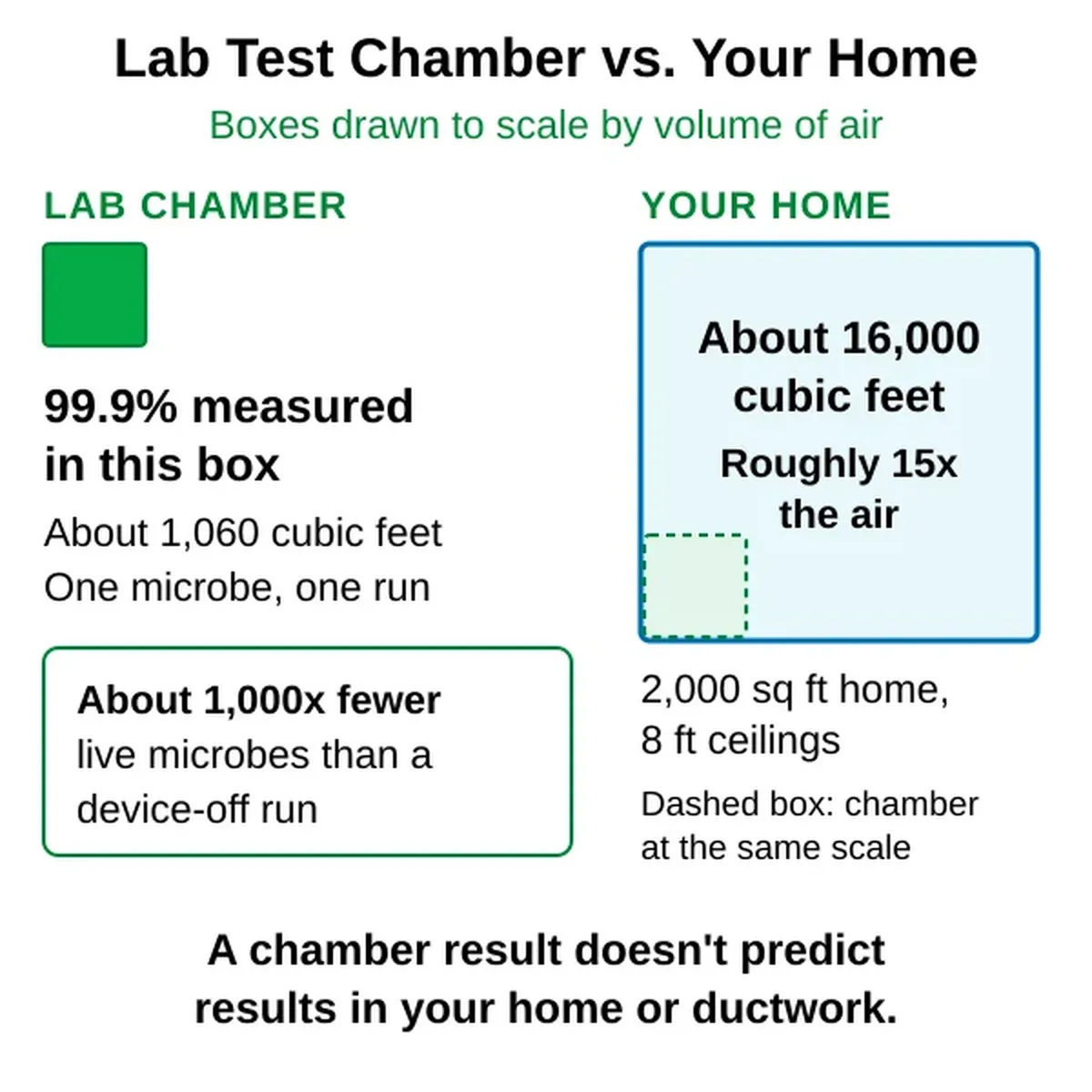
A chamber result is a best case, with a small sealed space and the device at full power the whole time. Homes are bigger and leakier, and people and pets keep adding new microbes.
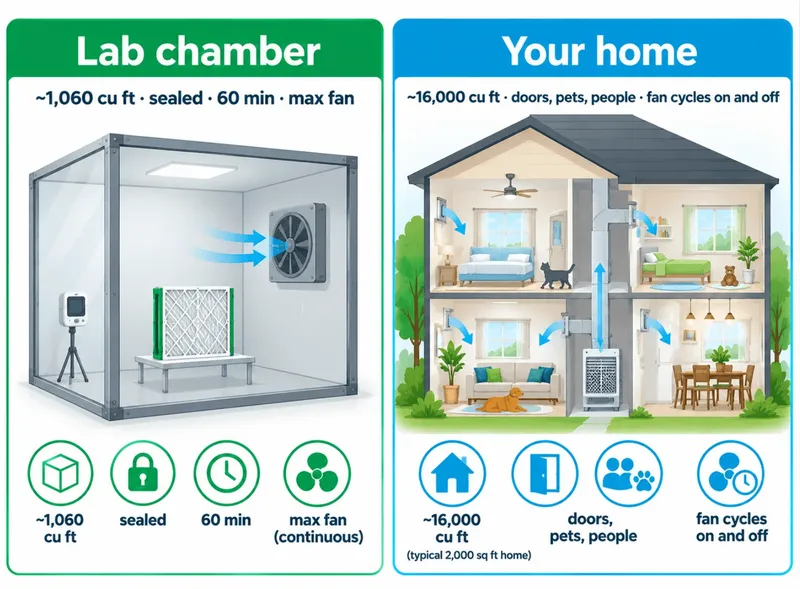
Size. A 2,000-square-foot home with 8-foot ceilings holds about 16,000 cubic feet of air, roughly 15 times a 30 m³ test chamber.
Run time. EPA research on residential air cleaners finds home air cleaning typically runs less than 25% of the year's hours, and an in-duct device only works while the HVAC fan is on.
Exposure time in a duct. Here's Filterbuy's illustrative math. A typical 3-ton system moves about 1,200 cubic feet of air per minute. Through a 16-by-25-inch duct, that air travels about 7.2 feet per second. If a UV lamp lights a 2-foot stretch, a single microbe sits in the light for roughly 0.3 seconds per pass.
The EPA says reliably inactivating spores takes strong light and exposure "on the order of minutes and hours." Its verdict: typical home ultraviolet germicidal irradiation (UVGI) units don't deliver enough dose to kill most airborne microbes.
Where in-duct UV earns its keep. Surfaces that sit in constant light get a far larger dose. One study cited by the EPA found a 99% reduction in microbial growth on exposed HVAC surfaces, but only a 25–30% reduction in airborne bacteria. That's why many residential UV lamps are aimed at the cooling coil, where the light works on the same surface around the clock. Coil UV makes sense as a maintenance tool, but it won't protect a whole home. That's why our Filterbuy HVAC Solutions technicians mount UV lights near the coil and still pair them with a pleated filter.
What Does the EPA Require of UV Devices Sold With Kill Claims?
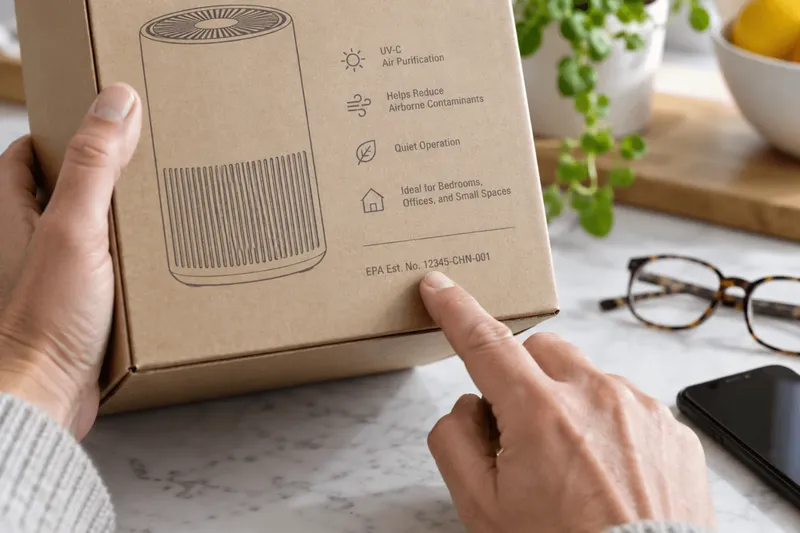
When a UV device claims to kill or inactivate germs, the EPA treats it as a pesticidal device under FIFRA, the federal pesticide law. It needs no EPA registration or review before sale, but it must be made in an EPA-registered establishment, display that facility's EPA establishment number, and avoid false or misleading claims.
The agency is clear about its limits. Its compliance advisory on UV lights says the EPA doesn't routinely review UV devices and can't confirm whether, or when, they work against viruses and bacteria.
Establishment number vs. registration number. The establishment number only identifies the factory. It doesn't mean the EPA tested or endorsed the device. A UV device also shouldn't carry an "EPA Registration Number," since those belong only to registered pesticide products like disinfectant sprays. In a 2021 letter to the lighting industry, the EPA added that it doesn't support generic UV efficacy claims, and that a claim against a specific germ needs testing against that germ.
Other regulators check different things, and none confirms a "99.9%" kill rate before sale:
The FTC has acted on this exact claim. In 2011, Oreck agreed to pay $750,000 after the FTC challenged ads saying its UV vacuum killed up to 99.9% of bacteria and that Oreck products could reduce flu risk.
How Do You Check a UV Air Purifier Claim Before You Buy?
Most of a UV claim takes a few minutes to check:
Find the conditions. Look for the organism, chamber size, run time, and fan speed. If they're missing, ask the seller for the full report.
Read the report header. Note the lab, the test date, and whether it names a standard or says "non-standardized."
Look for the control. A credible report includes a device-off run that shows natural decay.
Check the label. Look for an EPA establishment number on the device, box, or manual, and no "EPA Registration Number."
Rule out ozone. Uncoated UV-C lamps can produce ozone, a lung irritant. Check CARB's list of certified air cleaners, and skip anything sold as an ozone generator.
Find the particle rating. For a portable unit, look for an AHAM Verified CADR. For your HVAC system, check the filter's MERV rating.
Ask about lamp age. The EPA lists bulb age among the factors that decide whether a UV device works, so ask how often the lamp needs replacing.
Filterbuy Pro Tip: Filterbuy publishes the standard behind every filter it makes, and you should expect the same from a UV seller. If one can't name the microbe and the test conditions, treat "99.9%" as a marketing number.
Copy and paste this to any seller:
"Before I buy, can you send the lab report behind your 99.9% claim? I'm looking for the test organism, chamber size, run time, fan speed, humidity, device-off control results, lab name, and the product's EPA establishment number."
Where Does UV Fit in a Clean-Air Plan?
The EPA advises using UV alongside a particle filter, because mold and bacteria that UV inactivates can still carry allergens. And adding UV to MERV 13 or HEPA filtration brings only a small infection-control benefit over the filters alone.
If fine particles are your concern, the EPA recommends a furnace filter rated at least MERV 13, or as high as your system can handle. That's the job Filterbuy builds its filters for, with MERV 8, 11, and 13 made in the USA in more than 600 sizes. Shop MERV 13 air filters or find your air filter size.
Supporting Statistics
27,339 refund checks. The FTC mailed them to buyers of Oreck's UV vacuum and air cleaner after challenging its ads.
Total paid: $698,000.
Why it matters: a lab-style percentage in an ad doesn't prove a health benefit.
103,200 in-duct electronic air cleaners. Californians bought this many in 2017, per a CARB-commissioned market report.
Projected for 2023: 146,620.
Why it matters: the growth led California to require ozone testing for in-duct devices.
Source: CARB rulemaking notice (2019)
A tenfold cut in allowable ozone. UC Davis research commissioned by the state recommends 5 ppb instead of 50 ppb, with American Lung Association support.
Why it matters: look for UL 2998 zero-ozone validation on any UV unit.
Frequently Asked Questions
Are "Kills 99.9%" UV Air Purifier Claims Verified?
Not before sale. No federal agency checks the number. It can still be accurate for one microbe under one set of lab conditions, but it doesn't describe a whole home or duct.
Can a UV Light in My HVAC System Kill Mold?
A UV lamp aimed at a cooling coil or drain pan can limit mold growth on those damp surfaces. It's far less effective on spores moving through the airstream, because they resist UV. Controlling moisture and using an air filter rated for mold spores matter more.
How Are Air Purifier Claims Tested?
Particle claims for portable purifiers are tested under ANSI/AHAM AC-1, which produces a CADR. Germ-kill claims are usually tested in sealed chambers with a stand-in microbe, often using methods the lab itself calls non-standardized. Filterbuy's HVAC filters, by contrast, are rated under the standardized ANSI/ASHRAE 52.2 test.
Does the EPA Approve or Certify UV Air Purifiers?
No. The EPA neither certifies nor recommends brands of home air cleaners. For UV devices with kill claims, it only requires an establishment number and claims that aren't false or misleading.
Do UV Air Purifiers Produce Ozone?
Some can, if the lamps lack proper coatings. Look for CARB certification or UL 2998 zero-ozone validation. Outdoor ozone also shows up on Filterbuy's live air quality (AQI) map.
Glossary
MERV (Minimum Efficiency Reporting Value): A 1–16 ASHRAE rating of how well an HVAC filter captures particles. Filterbuy makes MERV 8, 11, and 13.