
UV Lights in the Air Handler: Why Placement Near the Coil Matters
October 7, 2026

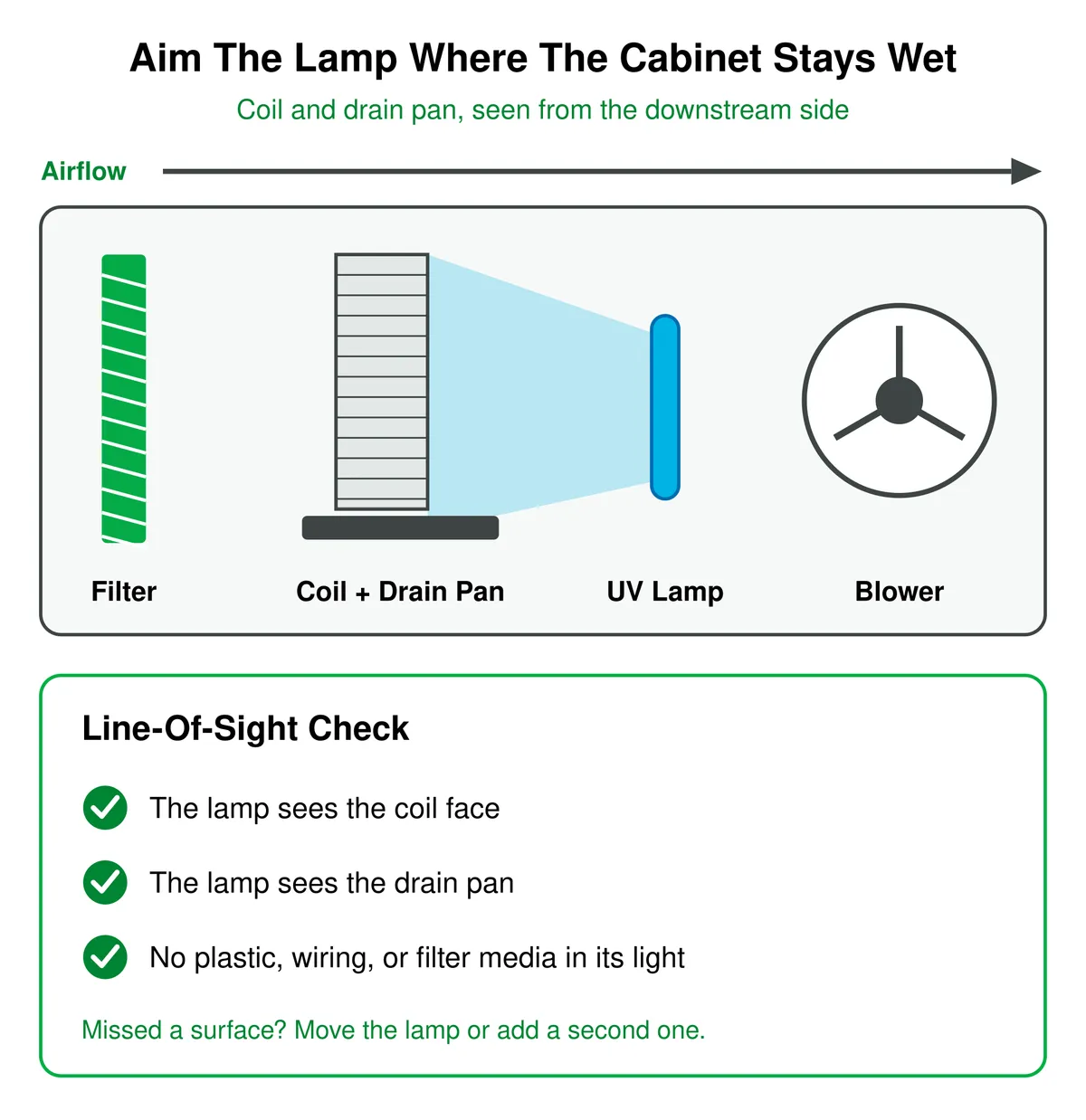
Aim it at the evaporator coil and drain pan, usually from the downstream side within about 3 feet of the coil. Those are the wettest, stillest surfaces in the cabinet, so that is where mold and bacterial film take hold. A lamp shining on the same spot around the clock builds a steady dose that fast-moving air never gets.
Where the lamp usually goes:
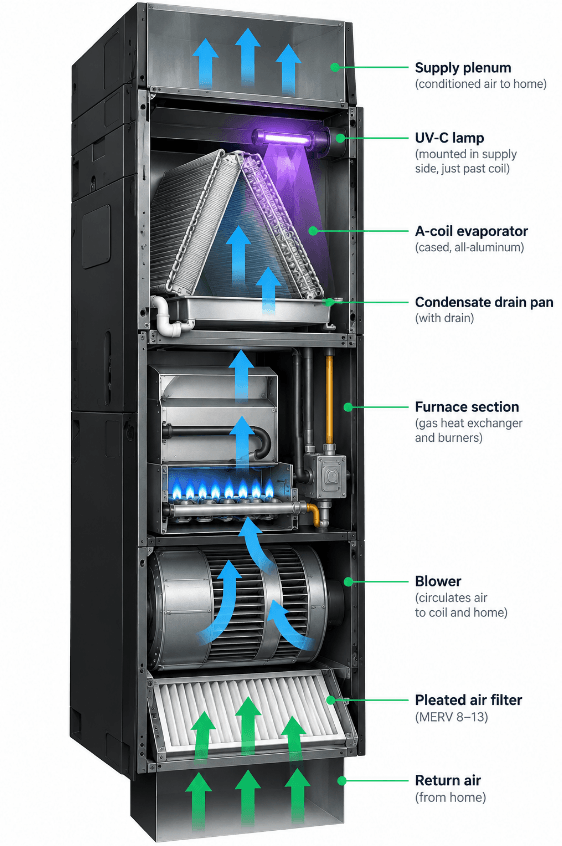
Upflow furnace with an A-coil: in the supply plenum above the coil, aimed at both slabs and the pan.
Heat pump or AC air handler: between the coil and the blower.
Horizontal attic or crawlspace unit: on the downstream side, angled across the full length of the pan.
Filter first, coil UV second. A UV lamp cleans surfaces, but it does not capture dust or pollen. A loose filter lets dusty air slip past onto the coil, where no lamp can make up for it. The quiz below matches you to a filter for your system.
Answer a few quick questions and we'll match you to the right MERV rating for your system.
Already know your filter size? Shipping is fast and free on every order.
Shop Air Filters By SizeTL;DR
Most air handler UV lights point at the evaporator coil and drain pan, because those damp, still surfaces are where mold and bacterial film take hold. A lamp that shines on the same spot around the clock builds a dose that fast-moving air never gets, and the payoff is a cleaner coil and pan. The lamp won't capture dust or replace your filter, and it can't unclog a drain.
Key Takeaways
The Air-Conditioning, Heating, and Refrigeration Institute (AHRI) names the coil and drain pan as the preferred location for residential UV lights.
Your blower decides where the lamp goes. Most furnaces push air through the coil, and most heat pump air handlers pull it through.
Filterbuy's rule of thumb is to fix the filter and drainage first, then add a coil lamp if growth keeps coming back.
Choose an ozone-free 254nm lamp, and keep plastics and synthetic filter media out of its line of sight.
Coil lamps should run 24/7, since mold grows fastest when the system is off and the air sits still.
Why Is a UV Light Placed Near the Evaporator Coil?
The evaporator coil and the drain pan beneath it are the wettest, most stable surfaces in an air handler. AHRI describes the typical coil as dark and damp, conditions mold and bacteria favor, and notes that the warm, still air of an off-cycle speeds their growth (AHRI).
Dose matters too, and dose is UV intensity multiplied by exposure time. Because a coil never moves, a lamp that runs all day gives the same fins hours of exposure. Air at a typical 500 feet per minute crosses a two-foot lit zone in about a quarter second (ASHRAE Journal).
In Florida, where Filterbuy HVAC Solutions works, 96% of households use air conditioning and 90% rely on central AC (U.S. Energy Information Administration). Long cooling seasons keep coils wet most of the year, so our technicians look at the coil first. Our coil-mounted vs. in-duct UV lights guide compares both styles.
What Is Coil Placement Meant to Address?
A UV light near the coil is meant to keep two surfaces clean: the coil fins and the drain pan below them. That means less of the mold and bacterial film behind musty odors and lost cooling performance. The table shows where that job ends.
Sources: AHRI; LBNL; EPA. For airborne spores, see Filterbuy's guide to the best air filter for mold allergies.
Where Does a UV Light Go Inside an Air Handler?
Most coil lamps sit within about 3 feet of the evaporator coil, either upstream on the return side or downstream on the supply side. ASHRAE notes that UV-C reaches coil fins from either direction, but a downstream lamp usually has the better view of the drain pan.
Filterbuy's UV Light Placement Map
Sources: ASHRAE Journal; AHRI. Always follow the lamp maker's instructions.
Find Your Setup: Where the Lamp Usually Goes
The right spot depends less on the lamp than on how your blower moves air across the coil. Most furnace systems push air through it (blow-through), while most heat pump and AC air handlers pull it through (draw-through), according to the American Society of Home Inspectors (ASHI).
Sources: American Society of Home Inspectors; ASHRAE Journal; Filterbuy HVAC Solutions.
I aim a coil lamp at the evaporator coil and drain pan, because that's where moisture collects and growth starts. … I also keep the lamp's direct light off plastic parts and wiring that aren't UV-rated, since UV-C breaks them down.
— David Clark, Licensed HVAC Technician and President, Filterbuy HVAC Solutions
In the homes Filterbuy HVAC Solutions services, we're also seeing more two-lamp setups, usually one at the coil and a second at the blower or supply plenum.
Can a UV Light Prevent Drain Pan Mold?
A UV light can keep mold and slime off the parts of the drain pan it can see, but it can't solve every pan problem. The drain outlet and the pipe beyond it sit in shadow. Ask whether a plastic pan needs shielding. A pan that stays full points to a clogged drain, which needs cleaning, not a lamp.
The U.S. Environmental Protection Agency (EPA) makes the same point: moisture control and pans that drain properly should remain the primary defense, with UV as a supplement (EPA). It's the reason Filterbuy HVAC Solutions' maintenance plan includes drain line flushes. Between visits, Filterbuy's musty AC smell guide walks you through a vinegar flush.
How to Avoid Common UV Light Placement Mistakes
Before a lamp goes in, run through Filterbuy's Line-of-Sight Check. Can the lamp see both coil faces? Can it see the drain pan? Is anything plastic in its view? If the lamp can't see a surface, move it or add a second one. If plastic is in view, shield it.
ASHRAE recommends shielding synthetic filter media within 6 feet of a lamp, which includes Filterbuy's MERV 13 filters. Finally, choose an ozone-free 254nm lamp in doped quartz; Filterbuy's UV-C light explainer shows how to read the label.
Living With a Coil UV Light
Track the date, not the glow. A lamp's germicidal output fades before the bulb goes dark, so write the install date on the cabinet. AHRI notes that many makers call for yearly replacement.
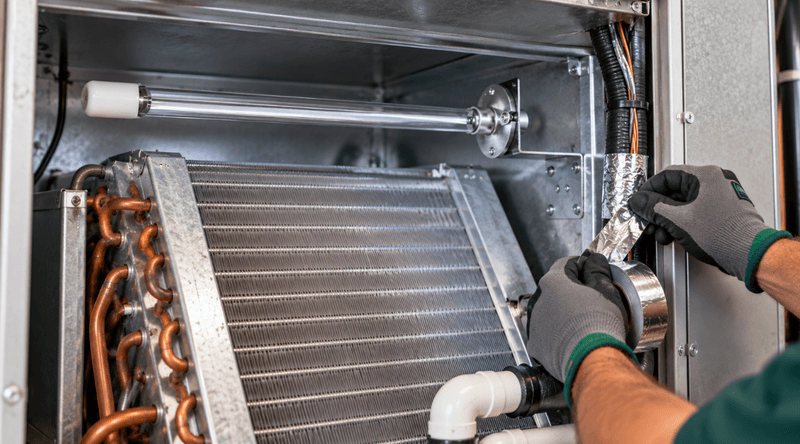
Service it cold and unplugged. Cut power and give the bulb time to cool, then wear gloves, since skin oils can etch the glass (AHRI).
Never look at a lit lamp; UV-C injures eyes and skin.
Recycle old tubes the way you would fluorescent bulbs, since they contain mercury.
Filterbuy's Take: Filter First, Coil UV Second
A UV lamp cleans surfaces, while a pleated filter keeps dust and pollen from reaching them. On Filterbuy's production floor, we cut every filter half an inch under its nominal size so it slides in and still seals. A filter that rattles in its slot lets dusty air slip past onto the coil, and no lamp can make up for that.
The best filter is the highest rating your system can move air through, changed on schedule. A MERV 11 you actually replace beats a MERV 13 you leave in for six months.
— David Clark, Licensed HVAC Technician and President, Filterbuy HVAC Solutions
Here's the order Filterbuy suggests:
Start with a filter that fits snugly. Use Filterbuy's air filter sizes chart and MERV rating guide.
Change it on schedule. Our guide to how often to change your HVAC filter sets the pace, or air filter auto-delivery can handle the reminder.
Add a coil UV light if growth keeps coming back.
Plan for bulb changes. Filterbuy HVAC Solutions prefers two-year bulbs, which last through eight 1-inch filter changes on a three-month schedule. The lamp costs about 5 to 10 cents a day to run.
Why a filter maker wrote this: Filterbuy works on both sides of the evaporator coil. Our plants in Alabama, Pennsylvania, Texas, and Utah make the pleated filter that sits upstream of it, and our Filterbuy HVAC Solutions technicians install UV lamps beside it in homes across South Florida and Greater Orlando.
We make the filter and we install the lamp, so we'd rather tell you which one solves the problem than sell you both.
— The Filterbuy team
About the reviewer: David Clark is President of Filterbuy HVAC Solutions and an EPA-certified technician. Read his guide to mold in HVAC systems and air ducts.
Supporting Statistics
Downstream works: In an office building study, 10 UV-C lamps per air handler, mounted downstream and run 24/7, significantly cut mold within four months. Source: National Air Filtration Association; NIH PubMed Central
Surfaces respond best: Research reviewed by LBNL shows up to 99% less mold and bacteria on UV-irradiated surfaces. Source: Lawrence Berkeley National Laboratory
Federal standard: GSA's P100 specifies MERV 13 final filtration for central air-handling units and UV lights for central air-handler cooling coils, the filter-and-UV pairing Filterbuy recommends. Source: U.S. General Services Administration — P100, p. 167
Frequently Asked Questions
Is it better to put a UV light in the air handler or the ductwork?
For coil and drain pan mold, the air handler is the better choice. AHRI names the coil and pan as the preferred location, while a return-duct lamp only treats fast-moving air, as Filterbuy's review of whether UV lights work in air ducts explains.
Should a UV light go above or below the evaporator coil?
It depends on which way air flows. A lamp on the downstream side, where air leaves the coil, usually sees the drain pan best. In an upflow furnace, that means above the coil.
Will a UV light kill mold that is already on my coil?
Only partly. The EPA says steady UV exposure can destroy active growth on coils and drain pans but not most spores. UV also won't strip caked-on dirt, so ASHRAE advises cleaning the coil and pan first.
Will a coil UV light lower my energy bill?
A little. The EPA notes that limiting microbial growth on cooling coils improves heat transfer, which improves efficiency. Treat savings as a bonus; a snug filter does more.
Can I install an air handler UV light myself?
Some kits are sold for DIY, but installing one means drilling into the cabinet and wiring power. Filterbuy recommends a licensed HVAC technician.
Ready to improve your indoor air?
Find the right air filter for your system or explore professional UV light installation options.
UV light installation available from Filterbuy HVAC Solutions in South Florida and Greater Orlando.
Glossary
Air handler: The indoor cabinet holding the blower and, often, the evaporator coil and drain pan.
Evaporator coil: The indoor AC coil that removes heat and moisture from air.
Condensate drain pan: The tray under the evaporator coil that collects dripping water.
UV-C: Ultraviolet light from about 200 to 280nm that inactivates microorganisms.
MERV: Minimum Efficiency Reporting Value, the 1 to 16 scale for how well a filter captures particles.
Filterbuy: A family-owned U.S. maker of pleated MERV 8, 11, and 13 air filters.
Filterbuy HVAC Solutions: Filterbuy's licensed HVAC service team, based in Pompano Beach, Florida.
AHRI: Air-Conditioning, Heating, and Refrigeration Institute, an HVAC trade association.
ASHRAE: American Society of Heating, Refrigerating and Air-Conditioning Engineers.
LBNL: Lawrence Berkeley National Laboratory, a Department of Energy lab.
Sources
AHRI · ASHRAE Journal (2008) · LBNL · U.S. EPA mold FAQ · U.S. EPA, Residential Air Cleaners (2018) · NAFA · Levetin et al. (2001) · U.S. EIA · ASHI