
UL 2998: What "Zero Ozone Certified" Actually Verifies
October 7, 2026

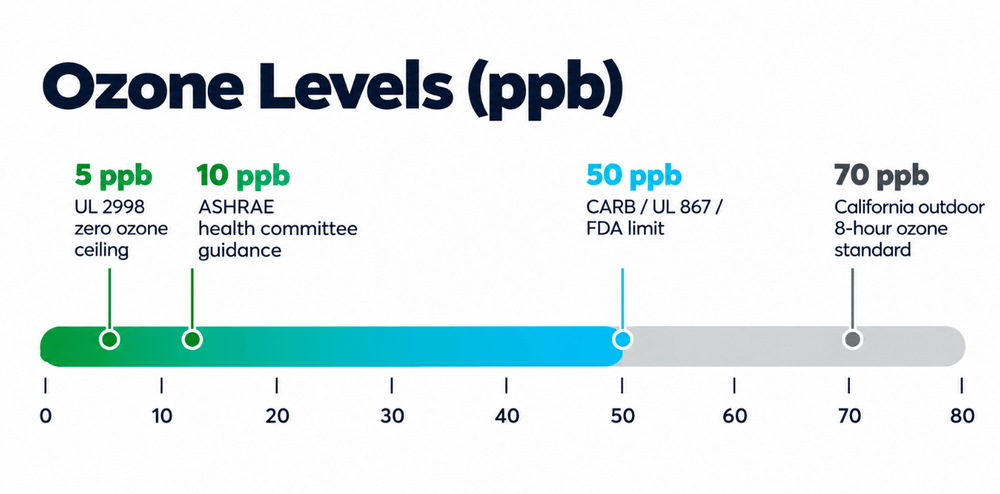
A UL 2998 mark means an independent lab tested the device and found its ozone output too low to measure. The pass line sits at 5 parts per billion, ten times lower than the limit California allows under CARB. Check for it on electronic air cleaners such as ionizers, since those can produce ozone.
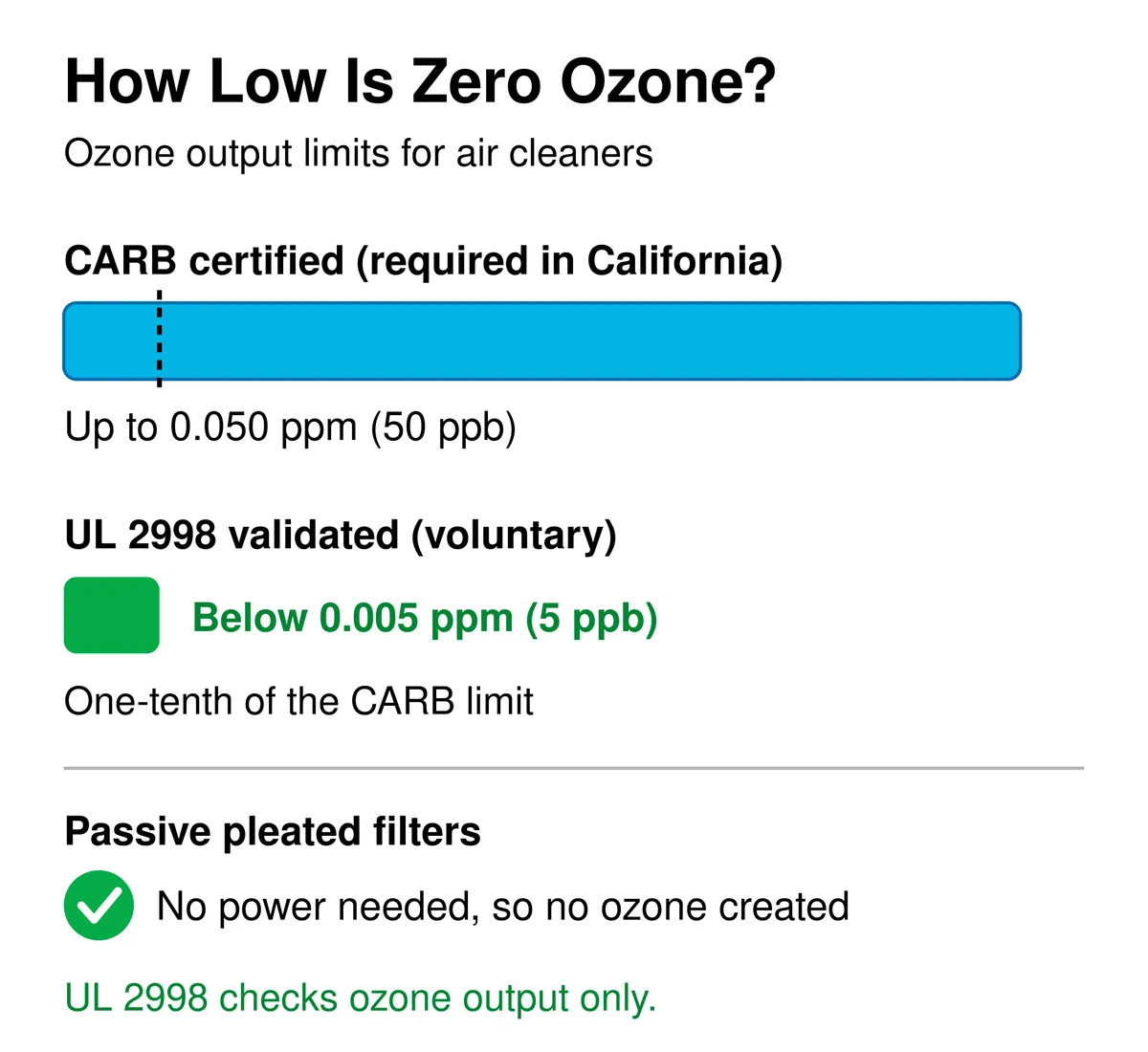
CARB certified: ozone up to 0.050 ppm, required for air cleaners sold in California
UL 2998 validated: ozone below 0.005 ppm, retested at least every three years
Passive pleated filters: no power needed, so no ozone created
Our MERV 8, 11, and 13 pleated filters work without power, so they create no ozone. Take the quick quiz below to find your match.
Not sure which filter fits your system? Answer a few quick questions and we'll match you to one.
TL;DR
UL 2998 is a voluntary, third-party validation from UL Solutions confirming that an air cleaner's ozone output stays below 0.005 ppm (5 parts per billion), the lowest level the test can reliably quantify. That's one-tenth of the 0.050 ppm limit required for CARB certification in California. The mark covers ozone only, not cleaning performance.
Key Takeaways
UL 2998 sets a 5 ppb ozone ceiling. "Zero ozone" means below what the test can measure.
CARB certification allows up to 50 ppb. It's required in California, while UL 2998 is voluntary.
For portable units, both rely on UL 867's ozone test. Only the pass line is different.
A CARB label doesn't always mean ozone was measured. Filter-only purifiers are certified on electrical safety alone.
UL 2998 matters most for ionizers, electrostatic precipitators, and some UV or PCO units.
Passive HVAC filters don't produce ozone. Like every passive filter, Filterbuy pleated filters need neither mark.
What Is UL 2998 Certification?
UL 2998 certification confirms that an air cleaner keeps its ozone output below 0.005 ppm (5 ppb), the lowest level UL Solutions says the test can quantify. UL Solutions (formerly Underwriters Laboratories) publishes it as the Environmental Claim Validation Procedure (ECVP) for Zero Ozone Emissions from Air Cleaners. If you want a zero ozone certified air purifier, this zero ozone validation is the claim to look for.
UL 2998 is a validation rather than a safety certification, meaning an independent lab checks a single claim: "zero ozone." Products that pass can carry the UL Environmental Claim Validation badge and appear in UL's public SPOT product database.
The procedure covers any air cleaner that could generate ozone, from standalone electronic purifiers and electrostatic air cleaners to duct-mounted ionizers and UV systems. UL also reports that ASHRAE Standard 62.1-2019 requires it for air-cleaning devices and that the CDC recommends it, while the EPA recommends it for bipolar ionization.
How Does the UL 2998 Zero Ozone Test Work?
The test borrows its ozone method from UL 867. The air cleaner runs in a controlled chamber while ozone is measured, and it passes only if the reading stays under 5 ppb (ACHR News). Products are then retested at least every three years, with audits in between.
UL 867 vs. UL 2998: What's the Difference?
UL 867 is the baseline safety standard for electrostatic air cleaners. It covers electrical safety and includes an ozone test with a 0.050 ppm (50 ppb) limit. UL 2998 reuses that measurement but sets the pass line ten times lower, at 5 ppb.
The word "electrostatic" trips people up, and we understand why. Filterbuy pleated filters use electrostatically charged media, but that charge lives in the fibers and draws no power, so it makes no ozone. When UL 867 says "electrostatic," it means a powered electronic air cleaner.
UL 2998 vs. CARB Certified: How Do They Compare?
CARB certification is the law in California, while UL 2998 is a voluntary validation recognized nationwide. Under Assembly Bill 2276, the California Air Resources Board (CARB) adopted an air cleaner regulation, and since 2010 every covered model sold there must be tested and certified (CARB FAQ).
Sources: UL Solutions, Zero Ozone Emissions Validation; California Air Resources Board, Air Cleaner Regulation FAQ. Electronic in-duct air cleaners have required CARB certification since October 1, 2022.
Why Can a Product Carry One Mark but Not the Other?
Because the two programs answer different questions, one mark often appears without the other. Most mismatches come down to four situations:
It passes CARB but not UL 2998. An ionizer that measures 20 ppb is legal in California but emits four times the UL 2998 ceiling.
It has no ozone source. A HEPA-and-carbon purifier earns CARB certification on electrical safety alone, which leaves no ozone claim to validate.
It isn't sold in California. A manufacturer can hold UL 2998 without ever applying to CARB.
The model numbers don't match. Listings are model-specific, so a newer version may not be covered.
“The detail I want every homeowner to catch: a CARB sticker on a filter-only purifier usually means no ozone test was run, because there was nothing to test. It reflects the design rather than a measurement. On an ionizer or UV unit, UL 2998 is the label worth looking for.”
— Michelle Wan, Brand Manager and Air Quality Writer, Filterbuy
Which Air Cleaning Technologies Need a Zero Ozone Check?
Ozone becomes possible once a device charges the air or uses short-wave UV light, so those are the products to check for UL 2998. Mechanical filtration can't make ozone. If you're deciding between a purifier and whole-home filtration, Filterbuy's guide to air filters vs. air purifiers compares the two.
Sources: U.S. EPA; California Air Resources Board.
Do HVAC Air Filters Need UL 2998 or CARB Certification?
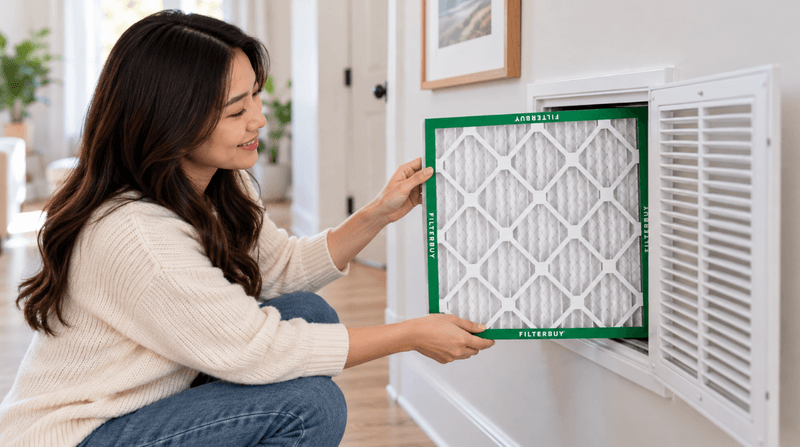
No. A standard HVAC air filter is passive media: it traps particles as the blower pushes air through it, and it creates no ozone. CARB defines a covered air cleaning device as an energy-consuming product, so a standalone filter falls outside the rule entirely.
That includes every Filterbuy filter. We make 100% of our products in the USA, and none of the pleated filters we ship need power to work. A properly sized MERV 8, 11, or 13 filter provides zero-ozone filtration for the whole home. Our sister company, Filterbuy HVAC Solutions, installs in-duct UV systems in Florida, so the label checks below apply to equipment we install as well.
Outdoor smog can also drift indoors on hot summer days, so check live air quality in your area when temperatures climb.
What Does Each Ozone Label Actually Mean?
Each ozone label tells you which test, if any, a product passed. California sets the wording word for word, so a phrase means the same thing on every box. The Filterbuy decoder below draws on CARB's labeling rules and UL's program terms.
How Do You Verify a "Zero Ozone" Claim?
Search UL's SPOT database for the exact model number and confirm it has a UL 2998 listing.
Check CARB's certified list and read the Type column. "Mechanical" means filter-only, so no ozone test was needed; "Electronic" means it passed CARB's 50 ppb test.
Read the technology description. Words like "ionizer," "plasma," "PCO," or "UV" tell you the ozone check matters.
Start with the basics: find your exact filter size and set up Filterbuy auto-delivery so a fresh filter arrives right when you need it.
Filterbuy doesn't make air purifiers or ionizers. We make pleated filters in our own U.S. plants, and none of them plug in. That gives us an outside view of the ozone question, plus one rule of thumb from years of building filters: the question starts when a device adds electricity to the airstream.
Supporting Statistics
1. Americans spend about 90% of their time indoors, where some pollutants run 2 to 5 times higher than outdoors.
The EPA's Report on the Environment names ozone from some air cleaners as a typical indoor pollutant of concern. What it means: an air cleaner runs where you spend most of your time, so its ozone output matters.
2. CARB has certified more than 9,000 air cleaners from over 800 manufacturers since its rule took effect in 2008.
Each one is capped at 0.05 ppm (50 ppb) of ozone, according to CARB, and CARB's certified list points out that certification does not reflect how well an air cleaner works. What it means: CARB sets the legal floor, and UL 2998 is the stricter ozone claim.
3. 152.3 million Americans, 44% of the population, live where ozone or particle pollution earns a failing grade.
The American Lung Association's State of the Air 2026 report also found nearly 4 million more people breathing unhealthy ozone than in the prior year's report. What it means: outdoor ozone already reaches homes, so an indoor device shouldn't add more.
Frequently Asked Questions
Why does indoor ozone matter?
Ozone can inflame and irritate the airways. CARB notes it can worsen asthma and cause coughing, chest tightness, and impaired breathing, so even a small, constant indoor source counts.
Does "zero ozone" mean a device emits no ozone at all?
Not literally. It means ozone stays below 0.005 ppm (5 ppb), the lowest level the test can reliably measure.
Is a UL 2998 air purifier better at cleaning air?
Not necessarily. UL 2998 speaks only to ozone. To judge cleaning performance, look at the clean air delivery rate (CADR) and the type of filter inside.
Can I use air fresheners with an ionizer?
Be careful. CARB notes that ozone reacts with terpenes, the compounds behind lemon and pine scents, to form formaldehyde and ultrafine particles. If a device emits any ozone, keep scented sprays and plug-ins out of that room.
Glossary
UL 2998: UL Solutions' zero-ozone validation for air cleaners: ozone below 0.005 ppm (5 ppb).
UL 867: UL's safety standard for powered electrostatic air cleaners, with a 0.050 ppm ozone limit.
UL 507: UL's electrical safety standard for electric fans, used for mechanical-filtration-only purifiers.
CARB: The California Air Resources Board, the state agency that certifies indoor air cleaners sold in California.
Ozone (O₃): A reactive lung irritant and the main ingredient in smog. CARB notes it cleans air only at levels several times above health standards.
Bipolar ionization: Technology that releases charged ions into the air and can produce ozone.
ASHRAE: The American Society of Heating, Refrigerating and Air-Conditioning Engineers, author of ventilation Standard 62.1.
PCO: Photocatalytic oxidation, which uses UV light and a catalyst to break down pollutants.
MERV: Minimum Efficiency Reporting Value, a 1–16 scale rating how well an HVAC filter captures particles. Filterbuy makes MERV 8, 11, and 13.