
In-Duct UV vs. Portable Air Purifier: How the Two Approaches Compare
October 14, 2026
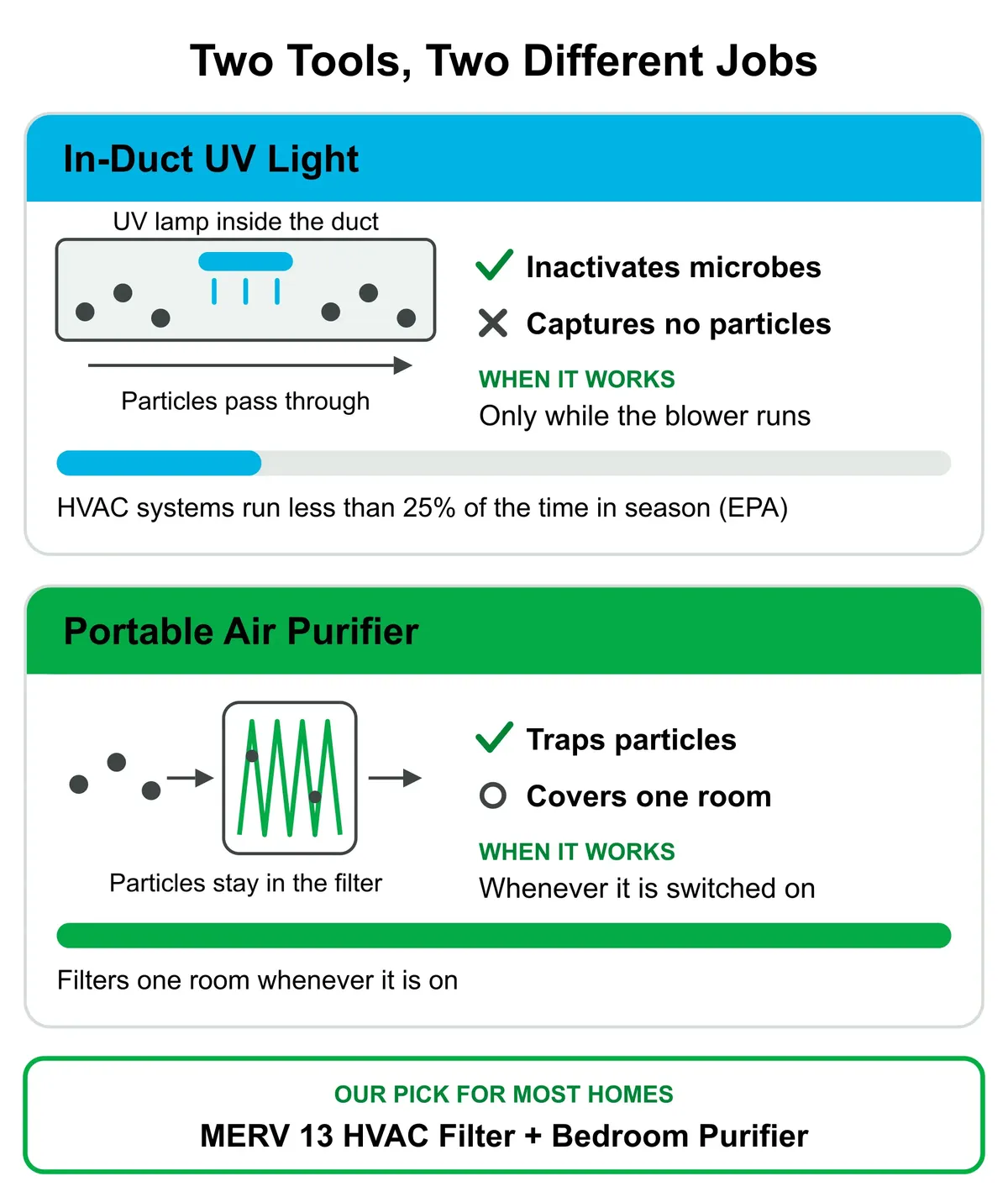
For most homes, the better first step is a MERV 13 HVAC filter plus a right-sized bedroom purifier, not in-duct UV. In-duct UV inactivates microbes but captures no particles, and it only works while your HVAC blower runs. The EPA notes that home systems run less than 25% of the time in season. UV earns a spot later, as a coil light, if a musty smell keeps coming back after drain and humidity fixes.
MERV 13 HVAC filter: Captures microscopic particles across your duct system while the blower runs.
Portable air purifier: Traps particles in a filter and covers one room whenever it is on.
In-duct UV light: Inactivates microbes in the lamp's path but captures no particles.
Check your HVAC manual to confirm your system supports MERV 13, then take the quick quiz below.
Answer a few quick questions to find your MERV match.
Why we wrote this comparison: Filterbuy has made pleated HVAC filters in our own U.S. plants since 2013, and our sister company, Filterbuy HVAC Solutions, installs UV lights in South Florida homes. We don't make or sell portable purifiers, so everything here comes from published data or what our installers see on the job.
"Most people do not need a better filter. They need the right one. Once someone tells me what the equipment in their house actually looks like, the decision takes about ten seconds."
Michelle Wan, Brand Manager, Filterbuy
TL;DR
An in-duct UV light and a portable air purifier solve different problems. In-duct UV inactivates germs and mold, but it removes no dust, pollen, dander, or smoke, and only works while the blower runs. A portable purifier keeps filtering one room for as long as it's on. For most homes, Filterbuy recommends pairing a MERV 13 HVAC filter with a right-sized bedroom purifier.
Key Takeaways
In-duct UV inactivates microbes but captures no particles, so it can't replace a filter or purifier.
Home HVAC systems run less than 25% of the time in season, per the EPA, which limits every in-duct device.
By Filterbuy's estimate, a right-sized portable purifier cleans a bedroom about 9 times faster than a MERV 13 filter with the fan on AUTO.
Over five years, a MERV 13 filter costs about $205–$220, while in-duct UV runs about $420–$1,650+.
What Is the Difference Between In-Duct UV and a Portable Air Purifier?
An in-duct UV light, one type of HVAC air purifier, is a UV-C lamp mounted in the ductwork or beside the coil, where it inactivates germs and mold. A portable air purifier, also called a room or standalone air purifier, is a plug-in fan-and-filter unit that cleans one room. UV controls germs; a purifier removes particles.
The distinction matters because dust, pollen, dander, and smoke pass right through UV-C. Filterbuy's installation team sums it up this way: "Air filters are not replacements for UV lights, and UV lights are not replacements for air filters." See whether UV lights work in air ducts and coil-mounted vs. in-duct UV lights.
Why Does HVAC Run Time Change the Comparison?
Any in-duct air purifier, whether a UV lamp or a filter, can only treat air while the blower moves it, which the EPA puts at under 25% of the time in season and near zero in mild weather. A portable purifier doesn't depend on the blower.
Running the fan longer costs more and can weaken summer humidity control, per the EPA, whose smoke guidance says portable cleaners may cost less to run nonstop.
The exception is a coil-mounted UV light, which shines on the damp coil around the clock. That's why Filterbuy technicians mount most lamps there.
How Much Clean Air Does Each Setup Actually Deliver?
By Filterbuy's estimate, a right-sized portable purifier delivers about 4.9 clean air changes per hour in a 300-square-foot bedroom, compared with about 0.6 from a MERV 13 HVAC filter on a normal fan schedule. That's roughly 9 times more clean air where you sleep.
No ranking page we found compares the two on one scale, so Filterbuy, which builds filters for these systems every day, ran the numbers.
Filterbuy analysis. Assumes a 2,000 sq ft home, 8-foot ceilings, 1,200 cfm (400 cfm per ton), 15% to the bedroom, 50% small-particle capture (EPA's MERV 13 minimum), 25% run time. Variable-speed blowers often slow on fan-only, roughly halving the fan-ON figures.
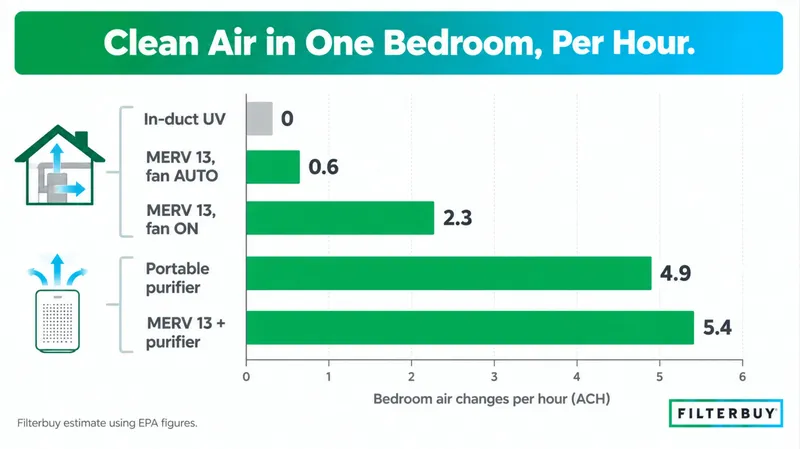
At home: the purifier filters the bedroom's air about every 12 minutes; the HVAC filter on AUTO takes closer to 100 but reaches every room. Using both covers each one's weak spot.
What Does Each Option Cost to Buy and Run?
A MERV 13 filter is the cheapest way to clean the whole house, at about $41 to $44 a year. In-duct UV costs $350 to $1,000+ installed and a good purifier under $350, yet five years of filters cost less than one UV install. Filterbuy's South Florida installers currently offer a $299 special, parts and labor included.
Sources: Filterbuy pricing, UV installation costs, Consumer Reports, and Angi. Fan: 18 extra hours daily at 100–500 watts (ACEEE), 18.2 cents per kWh.
What Are Your Whole-Home Air Purification Options?
Whole-home air purification options range from a free filter fix to a $2,400 media cabinet. UV lights don't capture particles; filters do. If you're upgrading in stages, Filterbuy suggests this order:
Free: fix the filter you have. Buy the printed size and replace it on schedule.
About $45 a year: upgrade to MERV 13. It's the EPA's pick. See Filterbuy's guide to MERV ratings.
Under $350: add a bedroom purifier. Look for 65 cfm of CADR per 100 square feet, the EPA's minimum.
$500–$2,400: add a media cabinet. A 4-inch or 5-inch filter holds more media. Filterbuy also makes replacement pads for Dynamic and Respicaire cabinets.
$350–$1,000+: add coil UV only if coil mold keeps returning. Keep it away from the filter; UV breaks down synthetic media like ours.
Check electronic air cleaners against the CARB certified list, since some emit ozone.
Is a Whole-House Air Purifier Worth It?
A whole-house air purifier pays off if you want lower particle levels in every room and your system runs often. A UV-only system bought for allergies rarely does. Angi puts the average install near $2,610, so match the tool to the problem:
"Before I recommend a coil lamp, I check the coil and drain pan for growth and make sure the filter fits snugly. If the real complaint is dust or allergies, I start with the filter."
David Clark, Licensed HVAC Technician and President, Filterbuy HVAC Solutions (via Filterbuy's UV running-cost guide)
For cooking, pet, or smoke odors, Filterbuy's Odor Eliminator filter adds carbon to capture the gases that particle filters and UV miss. On smoky days, check your local air quality index (AQI) first.
What Do the Numbers Say About Home Air Cleaning?
Three national datasets support this advice.
Most homes have AC, but not every home has ducts.
88% of U.S. homes use air conditioning.
In Florida, 90% of homes use central AC.
In New York, 61% use window or wall units instead.
Source: U.S. Energy Information Administration, 2020 Residential Energy Consumption Survey
Most of our exposure happens indoors.
Americans spend about 90% of their time indoors.
Some pollutants run 2 to 5 times higher inside than out.
Allergies are common, and particles drive them.
More than 106 million people in the U.S. have asthma or allergies.
About 82 million (1 in 4) have nasal allergies.
Why it matters: UV-C removes none of the particles behind these symptoms.
Source: Asthma and Allergy Foundation of America, citing 2024 CDC data
Frequently Asked Questions
Does an In-Duct UV Light Replace My Air Filter?
No. UV-C captures no particles, so your filter still does that job. Fit matters: Filterbuy cuts every filter half an inch under its nominal size so it slides in and seals. Any gap lets dusty air slip past.
Should I Run My HVAC Fan All the Time for Better Air?
During smoke events, yes. The EPA reports that a high-efficiency filter with the fan on continuously can cut indoor PM2.5 about 50%. Change the filter first. As David Clark puts it, "The mistake I see most often is the fan setting getting flipped to On with the same filter that has been in the slot since spring." See our fan cost math.
Should I Get a Room Air Purifier or an HVAC Air Purifier?
Choose an HVAC air purifier upgrade, like a MERV 13 filter, for cleaner air in every room. Choose a standalone room air purifier for the room you use most, or if you have no ducts. Filterbuy recommends both for most homes.
Can One Portable Air Purifier Clean a Whole House?
Usually not. Start where you sleep, using our purifier sizing guide.
What Should I Buy First to Clean My Home's Air?
Start with a Filterbuy MERV 13 air filter, add a right-sized purifier where you sleep, and bring in coil UV only if mold keeps returning. Filterbuy makes pleated filters in Alabama, Florida, Pennsylvania, and Utah in 600+ sizes, and filter auto-delivery keeps them on schedule.
The 25% run-time figure explains why in-duct UV and portable purifiers aren't interchangeable: anything in the ducts only works while the blower does. As the Filterbuy team puts it, "We make the filter and we install the lamp, so we'd rather tell you which one solves the problem than sell you both."
Glossary
In-duct UV light: A UV-C lamp in HVAC ductwork that treats passing air.
Coil UV light: A UV-C lamp aimed at the evaporator coil and drain pan.
UV-C: Short-wave ultraviolet light, near 254 nanometers in HVAC lamps.
Portable air purifier: A plug-in fan-and-filter unit that cleans one room.
CADR: Clean air delivery rate, AHAM's rating of a purifier's clean airflow in cubic feet per minute.
MERV: Minimum Efficiency Reporting Value, the 1–16 scale for filter efficiency.
ASHRAE 185.1 / 185.2: Lab tests of UV-C devices against airborne and surface microbes.
CARB: California Air Resources Board, which certifies air cleaners for low ozone.
UL 2998: A UL Solutions validation that ozone emissions stay below 5 parts per billion.
Filterbuy: A U.S. maker of MERV 8, 11, and 13 pleated air filters in 600+ sizes, based in Talladega, Alabama.
Filterbuy HVAC Solutions: Filterbuy's licensed HVAC team in South Florida, which installs UV lights.