
How to Choose an HVAC UV Light: The Specs That Actually Matter
October 14, 2026
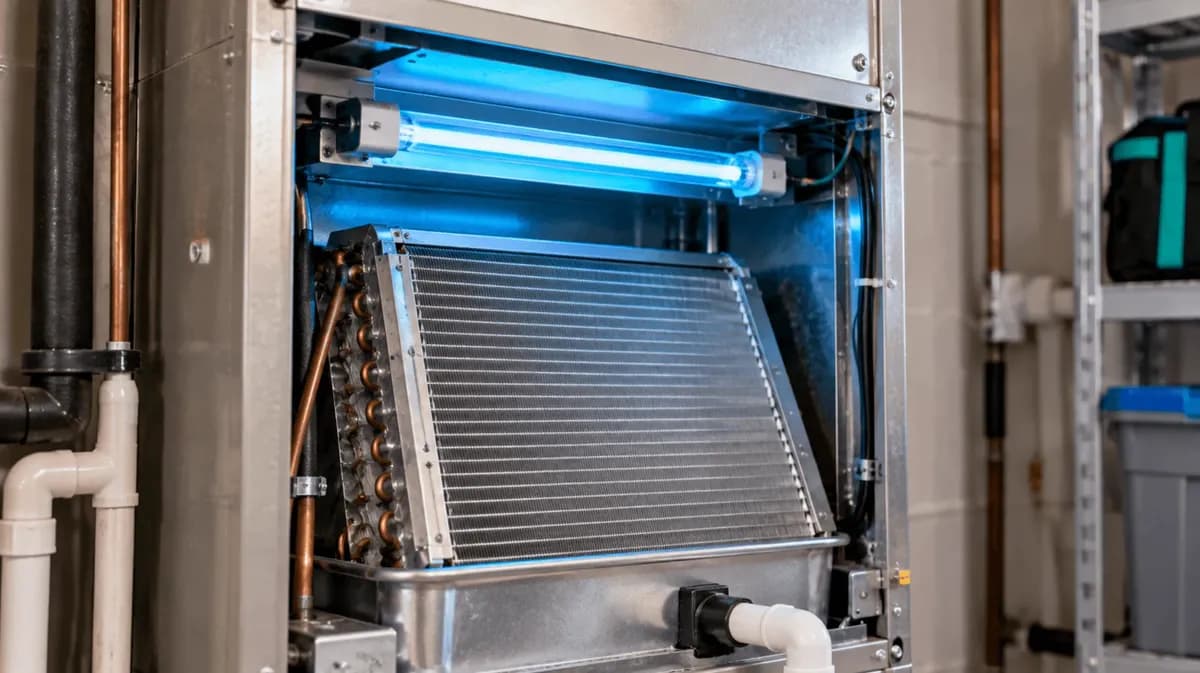
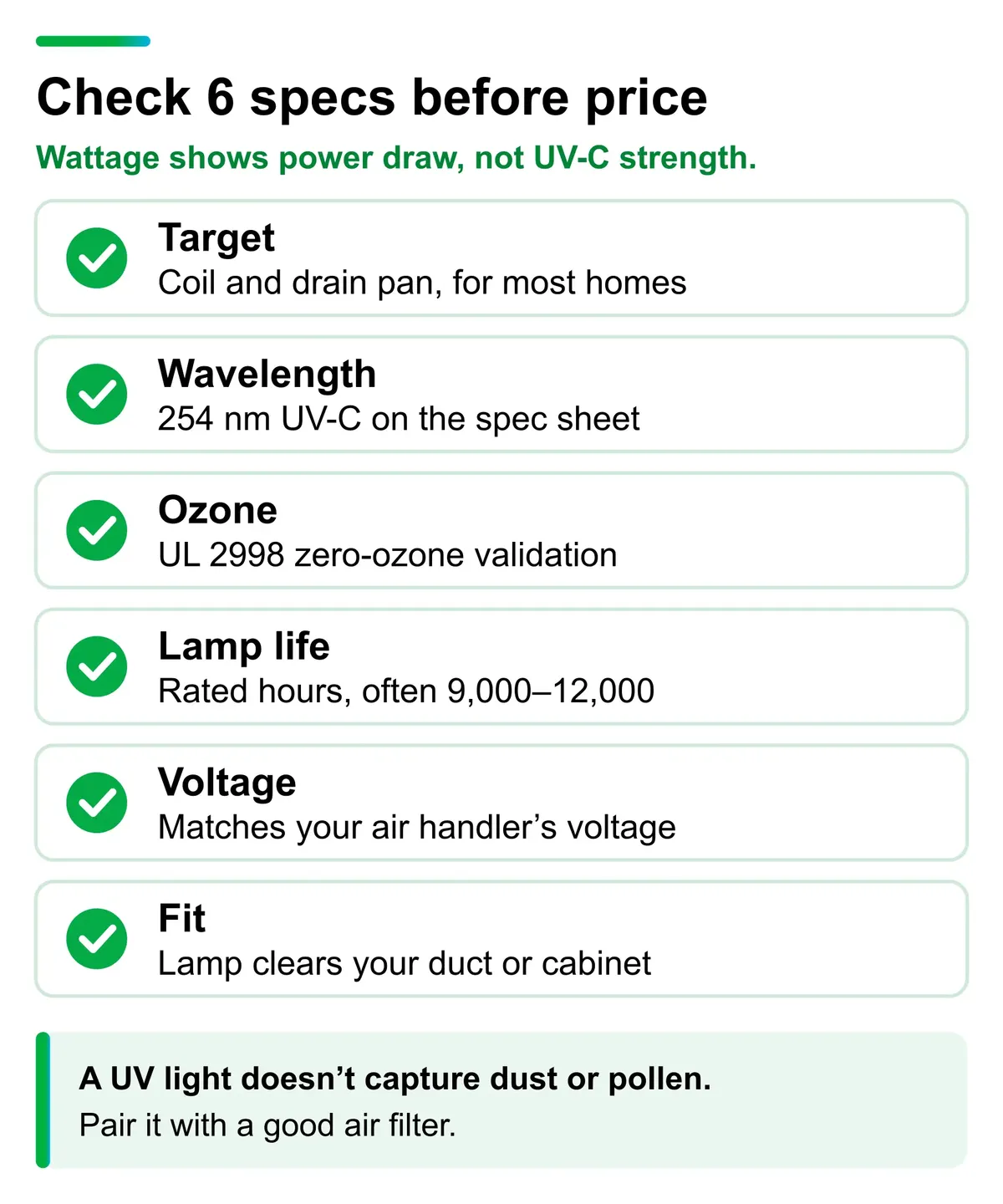
Choose an HVAC UV light by its specs, not its price or wattage. Check six things: the target, a 254 nm UV-C lamp, UL 2998 ozone validation, rated lamp life, voltage, and the lamp length your system can hold. For most homes, we recommend a coil-mounted unit that works alongside your air filter, since UV light doesn’t capture dust or pollen. Take the quick quiz below to find your filter match.
Answer a few quick questions and we’ll match you to the right filter to pair with your UV light.
Already know your filter size?
Shop Air Filters at FilterbuyFilterbuy makes air filters, and our service brand, Filterbuy HVAC Solutions, installs UV lights. The best HVAC UV light is the one that fits your system and does the job you need. Before you compare brands or prices, check six specs: the target (coil or airstream), a 254 nm UV-C lamp, ozone certification, rated lamp life, voltage, and the lamp length your duct or air handler can hold.
TL;DR
Choose an HVAC UV light by its specs, not its price or wattage. For most homes, Filterbuy recommends starting with a coil-mounted unit, provided the lamp carries UL 2998 zero-ozone validation and its length, voltage, and mounting needs match your system. Because a UV light does not remove dust or pollen, it works alongside a good air filter instead of replacing one.
Key Takeaways
AHRI, the Air-Conditioning, Heating, and Refrigeration Institute, names the coil and drain pan as the preferred location for HVAC UV lights.
Germicidal HVAC lamps work at 254 nm. Lamps that also emit 185 nm create ozone unless doped quartz blocks it.
Wattage measures power draw, not germicidal strength. Compare UV-C intensity at a stated distance instead.
A lamp running 24/7 logs 8,760 hours a year, so one rated for 9,000 to 12,000 hours needs replacing about once a year.
UV-C light can degrade plastics, wire insulation, and non-fiberglass filter media, so Filterbuy recommends aiming the lamp at the coil, away from the filter.
Start With The Job: Coil Treatment Or Airstream Treatment
Every HVAC UV light treats one of two targets. A coil-mounted lamp shines continuously on the damp evaporator coil and drain pan, the surfaces where mold and bacterial growth tends to build up. An in-duct lamp treats the moving airstream instead, so each pocket of air gets only a fraction of a second of exposure.
AHRI's guidance on air filtration and UV light treatment names the coil and drain pan as the preferred location and notes limited effectiveness in the return air duct. Filterbuy follows the same logic: filter first, coil UV second, and in-duct UV only when a unit is engineered for your system's airflow and backed by published test data. See coil-mounted vs. in-duct UV lights for the tradeoffs.
The HVAC UV Light Spec Checklist
Filterbuy built this checklist from the specs on spec sheets and installation manuals. Treat any value a seller cannot supply as a red flag.
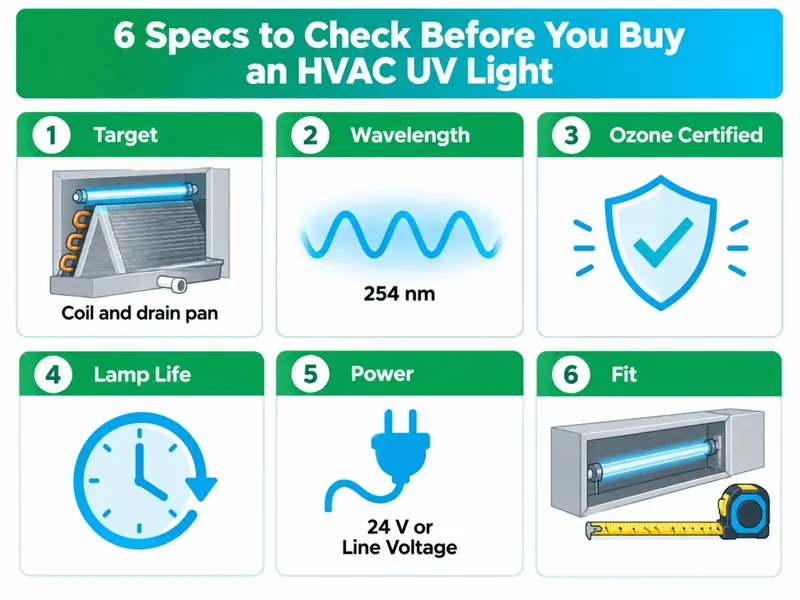
HVAC UV Light Spec Checklist
Wavelength And Ozone: What The Label Should Say
A germicidal HVAC lamp should list 254 nm, the UV-C line that low-pressure mercury lamps emit most strongly. The same lamps can also emit at 185 nm, which splits oxygen molecules and forms ozone, so ozone-free lamps use doped quartz glass to block it. Clear and doped quartz look identical, so only the spec sheet can tell them apart. Here is why 254 nm keeps coming up.
UL 2998 is an independent validation of zero ozone emissions. ASHRAE's 2024 position document on filtration and air cleaning says electrically powered air-cleaning devices should only be used when tested and labeled for ozone emission under UL 2998 or an equivalent standard. In California, electronic in-duct air cleaners must be certified by the California Air Resources Board to an ozone limit of 0.050 parts per million, as CARB's air cleaner information for consumers explains, so buyers there should check CARB's certified list.
Wattage Vs. UV-C Output: What The Numbers Mean
Wattage tells you how much electricity a UV lamp draws, not how much germicidal UV-C reaches the coil. Same-wattage lamps can still differ in output by design, distance, temperature, and airflow. A better comparison is UV-C intensity in microwatts per square centimeter (µW/cm²), measured at a stated distance.
Wattage does still set your running cost. Multiply a lamp's wattage by 8.76 to get kilowatt-hours per year of nonstop use, so a 24-watt lamp uses about 210 kWh a year (24 x 8.76 = 210.24). Multiply that by your electric rate, or see what an HVAC UV light adds to your electric bill. AHRI recommends running UV lights 24/7 rather than cycling them with the fan.
Lamp Life And Replacement Cost
Most HVAC UV-C lamps are rated for 9,000 to 12,000 hours, or about a year of nonstop use. Our Filterbuy HVAC Solutions team recommends two-year lamps wherever a unit accepts them. Our 5-year parts warranty on UV installations excludes bulbs, so price the replacement lamp before you buy the fixture. Up front, Filterbuy HVAC Solutions puts UV light installation costs at roughly $60 to $1,500, depending on the system. Your true yearly cost is electricity plus one lamp, or half a lamp on a two-year schedule.
A lamp can keep glowing after its UV-C output fades, so for replacement timing and safe handling, see how long HVAC UV bulbs last and our HVAC UV light maintenance checklist. UV lamps also contain a small amount of mercury, so follow the National Electrical Manufacturers Association's guidance on recycling mercury-added lamps.
Duct Clearance And Fit: Measure Before You Buy
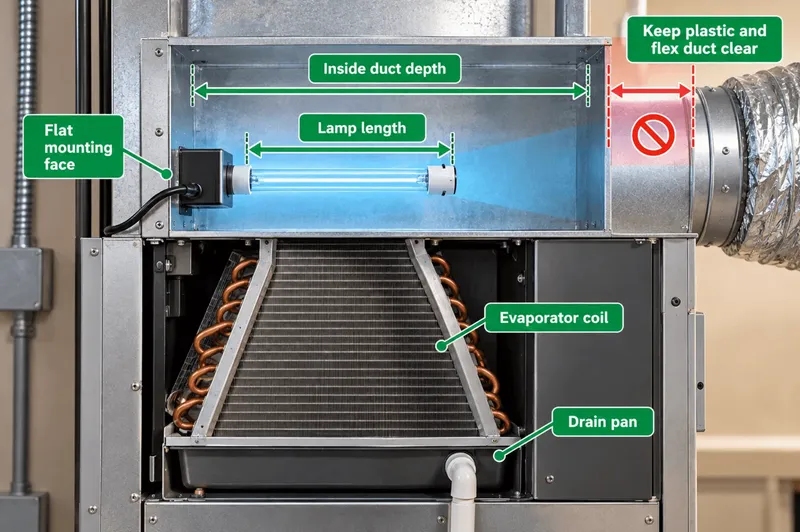
An HVAC UV light fits only when its lamp clears the inside of the duct or cabinet and there is a flat sheet-metal face to hold the base. When Filterbuy compared three manufacturers' installation manuals, minimum duct sizes ranged from 8 to 22 inches. Measure before you shortlist anything:
Measure the inside depth or width of the plenum or air handler cabinet at the mounting point. The lamp and its holder must clear the opposite wall.
Find a flat sheet-metal face free of seams, flanges, and access panels. The units we compared mount through a 1-inch or 2-inch hole.
Check the distance to flexible duct and plastic parts. Those manuals set clearances from 30 inches to 6 feet, or called for shielding.
Confirm the power source. Low-voltage 24 V units draw from the air handler's transformer, while 120 V or 240 V units need a line-voltage connection on unswitched power.
Leave room to pull the lamp out for replacement.
For example, a 14-inch plenum rules out a unit that calls for 16 inches of duct depth, whatever its price, while a 12-inch lamp with a 9-inch minimum stays on the list. For model-by-model figures, see whether a UV light will fit your ductwork.
When A UV Light Is The Wrong Fix
A UV light does not remove particles. Dust, pollen, pet dander, and smoke pass the lamp untouched, so your air filter still does the capture work. Even against microbes, EPA's answer on UV lamps and mold notes that typical home UVGI cleaners have limited effectiveness against bacteria and molds, and our review of whether UV lights work in air ducts covers the test data. Hold off if any of these apply:
Your goal is dust, pollen, or pet dander. That is a filter job.
Your coil is already caked with dirt. Have it cleaned first, because UV does not remove buildup.
Moisture is the real problem. Clear a clogged condensate drain and keep indoor humidity in the 30 to 50% range EPA recommends.
As a filter maker, Filterbuy flags one more issue. AHRI warns that UV light can damage non-fiberglass filter media, and our pleated filters are not fiberglass. Aim the lamp at the coil, away from the filter rack, and fit any shield the manufacturer specifies. The lamp and a pleated filter such as Filterbuy MERV 11 air filters then each handle their own job, with filter auto-delivery keeping replacements on schedule. Check your HVAC manual before moving to a higher tier, and review how MERV ratings work. In Filterbuy HVAC Solutions' service area, you can book professional UV light installation.
The Filterbuy Team's Take
"We make the filters, and our HVAC Solutions team installs the lamps, so we see both halves of this job. A UV light keeps the coil clean, but it does nothing for dust or pet dander. Buy the lamp for the coil and a good filter for the air. Just measure your duct first."
Michelle Wan, Brand Manager, Filterbuy
Supporting Statistics
89% of U.S. homes used air conditioning in 2020.
67% had central air, which has the coil and drain pan a UV lamp treats.
Source: U.S. Energy Information Administration's data on electricity use in homes.
Fungal growth near the coils was about 98.6% lower with UV.
Lamps ran 24/7 for about four months in office air handlers, versus an untreated floor.
We calculated the percentage from Table 1 of Levetin et al.'s 2001 air-handling unit study.
About two minutes of direct exposure can hit the daily UV-C limit.
The National Institute for Occupational Safety and Health (NIOSH) recommends a 6 mJ/cm² limit for 254 nm UV-C over an 8-hour day.
An eye-level reading of 49.9 µW/cm² reaches it in about 120 seconds.
Frequently Asked Questions
What Is The Best UV Light For An HVAC Or AC System?
In Filterbuy's view, the best UV light for an HVAC or AC system is a 254 nm UV-C unit that aims at the evaporator coil and drain pan, is validated ozone-free, fits your duct or cabinet, and runs on your air handler's voltage.
Is A Coil UV Light Or An In-Duct UV Light Better?
For most homes, a coil UV light is the better choice because it exposes the damp coil and drain pan continuously. An in-duct lamp gives moving air only brief exposure.
Do HVAC UV Lights Produce Ozone?
Some HVAC UV lights do. Clear quartz lamps pass the 185 nm line that forms ozone, while ozone-free lamps use doped quartz to block it. Look for UL 2998 validation, and in California, CARB certification for electronic in-duct air cleaners.
How Often Should You Replace An HVAC UV Bulb?
Replace a standard HVAC UV bulb about once a year if it runs continuously, or every two years if your unit takes a two-year lamp.
Can You Install An HVAC UV Light Yourself?
Some low-voltage UV lights are sold for DIY installation, but the job means cutting sheet metal and wiring near a lamp that can injure eyes and skin. A licensed HVAC technician can confirm the fit and handle the wiring safely.
Glossary
UV-C: Ultraviolet light from 100 to 280 nm, the band germicidal HVAC lamps use.
254 nm: The main germicidal wavelength of low-pressure mercury lamps. It does not form ozone.
Doped Quartz: Lamp glass that blocks the 185 nm mercury line, which forms ozone, making a UV lamp ozone-free.
UL 2998: A UL Solutions validation of zero ozone emissions from an air cleaner.
CARB: The California Air Resources Board, which certifies air cleaners sold in California for ozone emissions.
UVGI: Ultraviolet germicidal irradiation, the use of UV-C light to inactivate microorganisms. See how UV lights work in an HVAC system.
µW/cm²: Microwatts per square centimeter, the unit for UV-C intensity on a surface.
Evaporator Coil: The indoor HVAC coil that cools and dehumidifies air, leaving its surface damp.
Plenum: The sheet-metal box joining the air handler to the ductwork.
AHRI: The Air-Conditioning, Heating, and Refrigeration Institute, the U.S. HVAC manufacturers' trade group.
ASHRAE: The American Society of Heating, Refrigerating and Air-Conditioning Engineers, an HVAC standards body.
MERV: Minimum Efficiency Reporting Value, a 1 to 16 scale rating how well a filter captures particles.