
How Do UV Lights Work in an HVAC System?
September 30, 2026
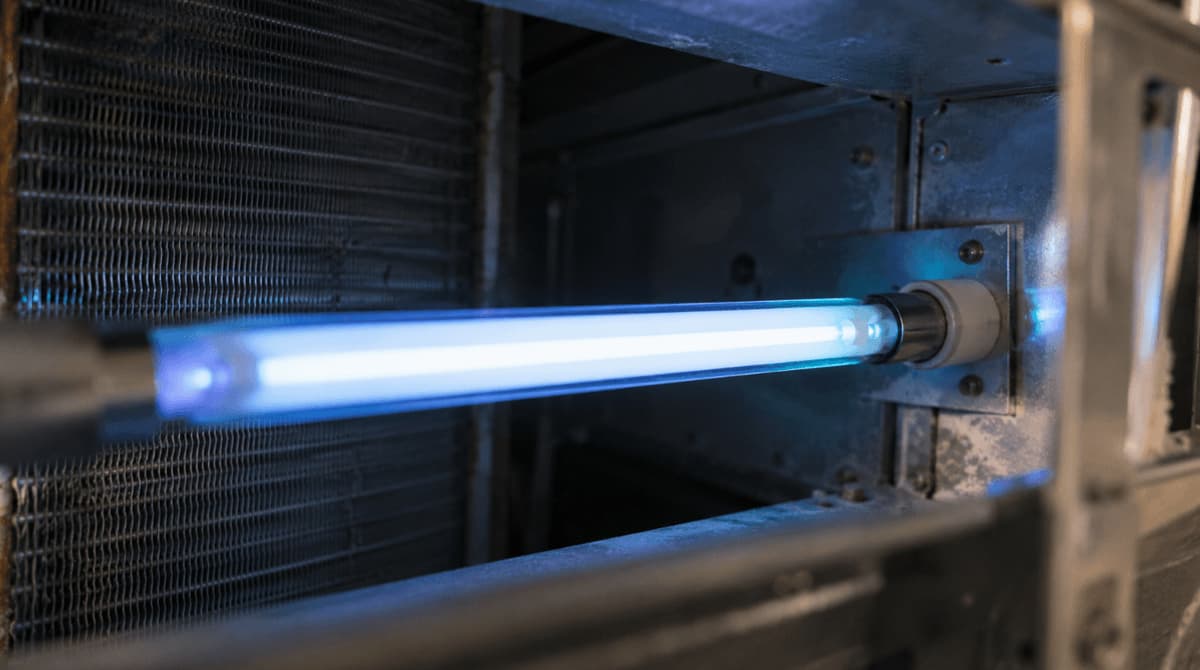
UV lights work by shining UV-C light inside your HVAC system, which damages the DNA microbes need to multiply. The longer a surface sits in that light, the stronger the effect, so the lamp does its real work on the parts it faces nonstop. It can’t catch particles, though. That job stays with your air filter.
- Coil lamp: shines 24/7 on the wet coil and drain pan, where mold and bacteria tend to grow.
- In-duct air lamp: treats moving air, but microbes pass the lamp in a split second.
- Air filter: the only part that physically traps dust, pollen, and pet dander.
Not sure which filter your system needs? Take the quick match quiz below.
Find My Filter Shop Air Filters
Made in the USA · 600+ sizes · Free shipping
Answer a few quick questions and we’ll match you to the right filter for your system.
TL;DR
An HVAC UV light is a UV-C lamp inside your air handler or ductwork that damages microbial DNA so germs can't reproduce. It works best on surfaces it lights all day, like the evaporator coil and drain pan, and far less on germs in the moving air. The lamp captures no dust or dander, so Filterbuy, which makes filters and installs UV lights, recommends it as a coil protector and never as a filter substitute.
Key Takeaways
Coil lamps shine continuously on the wet evaporator coil and drain pan, where mold and bacteria tend to grow.
In-duct air lamps try to treat moving air, but airborne microbes pass the lamp in a split second.
A UV lamp traps no dust or dander, so you still need a good air filter.
Ask for an ozone-free lamp, and make sure its light never shines on the filter or into the room.
Why We Can Speak to Both Sides of the Air Handler
Filterbuy makes air filters at company-owned plants in Alabama, Florida, Pennsylvania, and Utah. Our Florida service team, Filterbuy HVAC Solutions, installs UV lights. Since we sell both, we have no reason to oversell either, and our Florida team's customer guidance puts it plainly: "Air filters are not replacements for UV lights, and UV lights are not replacements for air filters."
How Does a UV Light Work in an HVAC System?
A UV light in an HVAC system is a sealed ultraviolet lamp installed inside the air handler or the supply or return ductwork. So how do UV lights work in HVAC? They shine short-wave UV-C light on microbes long enough to disable them, and exposure time decides most of what the lamp can do.
Ultraviolet Germicidal Irradiation Explained
Ultraviolet germicidal irradiation (UVGI) is the use of short-wave UV-C light to inactivate microorganisms. According to the U.S. Environmental Protection Agency (EPA), most home germicidal lamps emit UV at 253.7 nanometers, a wavelength that alters microbial DNA. UVGI works like this:
The lamp emits UV-C inside the sealed cabinet.
The microbe absorbs the energy. DNA and RNA absorb UV-C strongly near 254 nm.
The genetic code breaks. Damaged DNA can't copy itself, so the organism can't reproduce or cause infection.
The deciding factor is dose, meaning light intensity multiplied by exposure time. Mold growing on a lit coil soaks up hours of exposure, while a spore flying past at duct speed gets very little.
Where Does the UV Lamp Sit? Coil Lamps vs. In-Duct Air Lamps
HVAC UV lights come in two main types: coil lamps, aimed at the evaporator coil and drain pan, and in-duct air lamps, placed in the path of moving air. Placement matters because UV dose depends on exposure time.
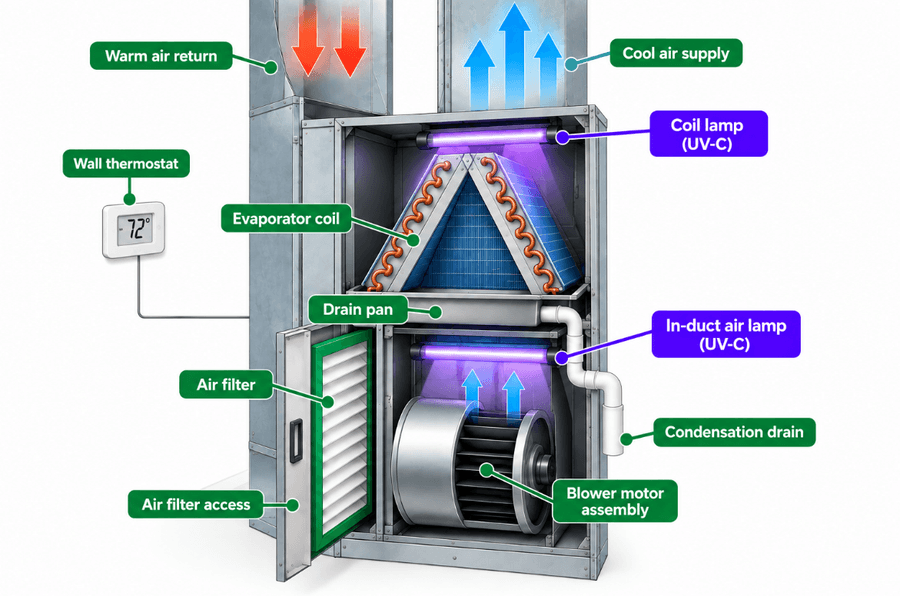
Sources: U.S. EPA residential air cleaner guidance; Trane UV light glossary.
Filterbuy HVAC Solutions installers usually mount the lamp at the evaporator coil, since that is where moisture and growth concentrate, and sometimes add a second lamp in the supply plenum. So if your contractor is proposing UV because your coil or drain pan keeps growing mold, a coil lamp is the type built for that problem. If the pitch is "it sterilizes all the air in your home," ask more questions.
How an HVAC UV Light Works, Step by Step
Here is how UV light works in an air conditioner, following one breath of air through a system with a filter and a coil lamp:
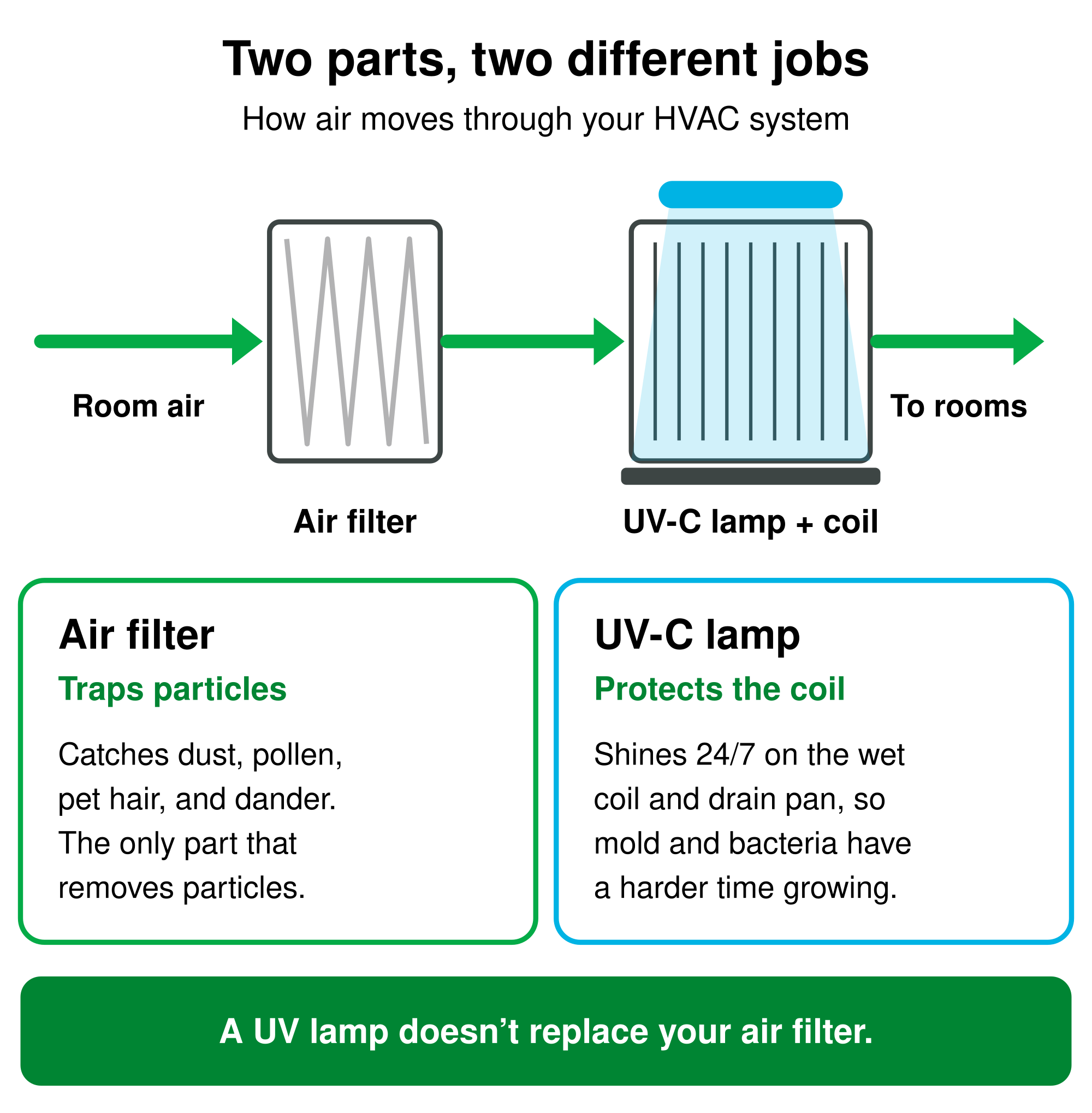
Air enters the return grille. Room air carrying dust, pet dander, and a few microbes is pulled toward the air handler.
The air filter captures particles. A pleated filter in the return or air-handler slot traps them. This is the only step that physically removes anything from the air.
The air crosses the lit evaporator coil. In cooling mode the coil is cold and wet, but the lamp keeps constant light on it, so mold and bacteria have a harder time taking hold.
Conditioned air returns to your rooms, cooler and drier than it left.
What Does a UV Light Do in HVAC, and What Doesn't It Do?
A UV light in HVAC helps keep internal surfaces, especially the evaporator coil and drain pan, free of microbial growth. It does not remove particles, and it can't reliably disinfect all the air moving through your home.
The EPA's mold guidance says typical UVGI cleaners used in homes have limited effectiveness in killing bacteria and molds, because most spores need far more UV exposure than a home unit delivers. ASHRAE, the heating and air-conditioning engineering society, adds that treating air "on the fly" in a duct takes a higher dose. You will still see UV sold as whole-home disinfection. At Filterbuy, we don't think the evidence supports that, and neither does the EPA.
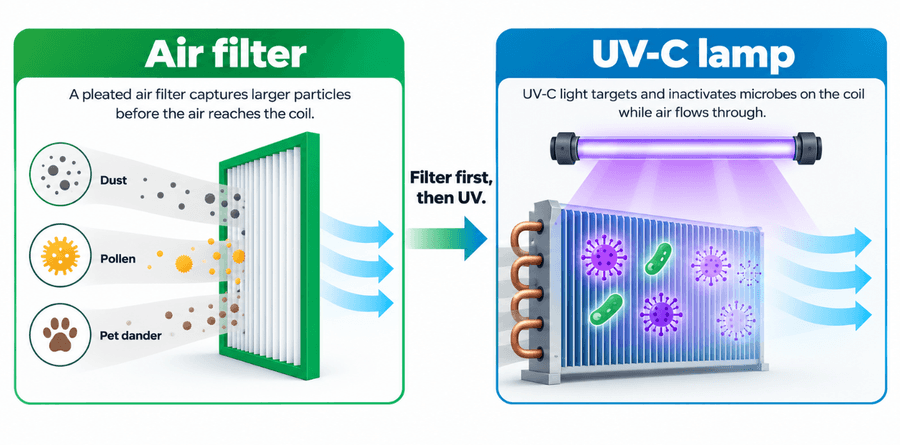
Here is how the work splits between the lamp and the filter:
A UV lamp and an air filter do different jobs. Most homes that add UV still need a filter changed on schedule.
Why Your Air Filter Still Does the Heavy Lifting
In more than a decade of manufacturing air filters in the U.S., Filterbuy has heard one misconception again and again: that a UV light makes filter changes less important. The opposite is true. A clean filter upstream keeps dust off the bulb, and a dusty bulb sends less light to the coil.
Fit matters just as much as the rating. Filterbuy cuts every filter half an inch under its nominal size so it slides in snugly. A filter that rattles in its slot lets dusty air slip around the edges to the coil and bulb.
Pro Tip: If you're adding UV, pair it with a pleated Filterbuy filter in the right MERV rating for your system and keep filter changes on schedule. Start by finding your exact filter size, then set up auto-delivery.
Is an HVAC UV Light Safe?
An HVAC UV light is safe when installed properly, because the lamp sits fully enclosed inside the air handler or duct, where people and pets can't see it. Three risks are worth checking:
Ozone: Some mercury lamps also emit 185 nm light, which turns oxygen into ozone, a lung irritant. Ozone-free lamps block that line, so ask for one. In California, the California Air Resources Board (CARB) regulates air cleaners, including UV units, for ozone and electrical safety.
Eyes and skin: UV-C can injure both, which is why technicians switch the lamp off before opening the cabinet.
Materials: UV-C can break down some plastics and wire insulation. Trane, a residential HVAC manufacturer, cautions that a lamp aimed at your air filter will degrade it, so shielding and aim matter.
5 Questions to Ask Before You Approve the Install
Is this a coil lamp, an air lamp, or both, and why does my system need it?
Is the lamp ozone-free and certified or listed for in-duct use?
Where exactly will it mount, and will any UV reach my air filter?
Is there a safety shut-off switch when the cabinet door opens?
What does a replacement bulb cost, and how often will I need one?
"Before I recommend a coil lamp, I check the coil and drain pan for growth and make sure the filter fits snugly. If the real complaint is dust or allergies, I start with the filter."
— David Clark, Licensed HVAC Technician and President of Filterbuy HVAC Solutions
Supporting Statistics
Two-thirds of U.S. households cool with central AC or a central heat pump. That equipment has the indoor evaporator coil a coil lamp mounts on. Source: U.S. Energy Information Administration, 2020 Residential Energy Consumption Survey.
The EPA advises keeping indoor humidity below 60%, ideally 30–50%. The same guidance warns that HVAC drain pans can become reservoirs for mold and bacteria, the surfaces a coil lamp targets. Source: U.S. EPA, Mold Course Chapter 9: Prevention.
Replacing or cleaning air filters can lower an air conditioner's energy use by 5–15%. Source: U.S. Department of Energy, Energy Saver 101: Home Cooling.
Frequently Asked Questions
How long do HVAC UV light bulbs last?
Most HVAC UV-C bulbs are rated for 9,000 to 12,000 hours, or roughly a year of continuous use, according to HVAC manufacturer Daikin. Filterbuy's Florida service team recommends two-year bulbs to cut down on changes. Replace bulbs on schedule, since a bulb can keep glowing after its germicidal output has faded.
How much does a replacement UV bulb cost?
Replacement bulbs typically run about $10 to $100 depending on the bulb type, according to home-services company HomeServe.
Will a UV light raise my electric bill?
Barely. Filterbuy's Florida service team puts a standard lamp's running cost at 5 to 10 cents a day.
Is an HVAC UV light worth it?
It usually is if your coil or drain pan keeps growing mold or your system smells musty, especially in a humid climate. If your goal is allergy relief or cleaner air, a higher-MERV filter will do more.
Does a UV light help with allergies?
Possibly a little, if mold on your coil is a trigger. The EPA notes that dead mold spores can still cause reactions, so a higher-efficiency filter does more for airborne allergens.
Can I install an HVAC UV light myself?
No. The job involves electrical wiring and shielding UV-C light, so hire a licensed HVAC technician.
Glossary
UV-C: Short-wave ultraviolet light (roughly 200–280 nm) with germicidal properties.
UVGI (ultraviolet germicidal irradiation): The use of UV-C light to inactivate bacteria, viruses, and mold by damaging their DNA or RNA.
Evaporator coil: The cold, wet indoor coil in an air conditioner or heat pump that absorbs heat from indoor air.
Air handler: The indoor HVAC cabinet that houses the blower, the coil, and often the filter.
Ozone (O₃): A reactive gas and lung irritant that some 185 nm UV lamps create by splitting oxygen molecules.
MERV: Minimum Efficiency Reporting Value, the 1–16 scale that rates how well an air filter captures particles. Filterbuy makes pleated filters in MERV 8, 11, and 13.
The Bottom Line
If a contractor recommends UV, think of it as a way to keep the coil and drain pan clean, and keep changing your filter on schedule. You can shop Filterbuy's 600+ air filter sizes, made in the USA and shipped free to your door, and check your local air quality on our live map.
About the reviewer: David Clark is President of Filterbuy HVAC Solutions, an EPA-certified HVAC technician, and a graduate of the South Florida Academy of Air Conditioning.