
Does a UV Light Damage Your Air Filter, Ductwork, or Gaskets?
October 14, 2026
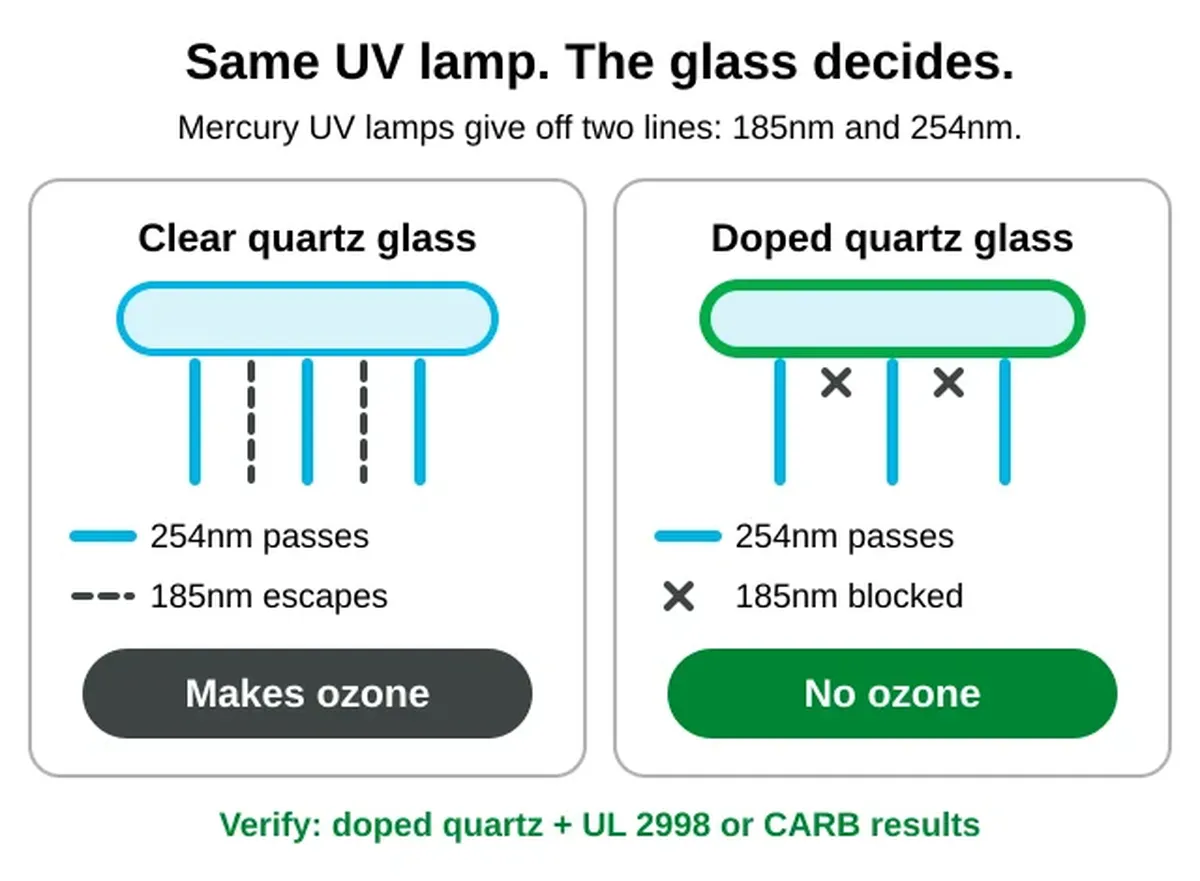
Some do, and the lamp's wavelength decides it. UV light below about 200nm, especially the 185nm line, makes ozone, while the 254nm germicidal line doesn't. Ozone-free lamps use doped quartz glass to block 185nm, so look for UL 2998 or CARB results on the exact model. A UV light can't capture dust or pollen, though. That's your air filter's job, and the quick quiz below will match you to the right one.
Find Your Filter Match
Answer a few quick questions and we'll match you to the right MERV rating for your home. Already know your size? Shop air filters at Filterbuy.
TL;DR
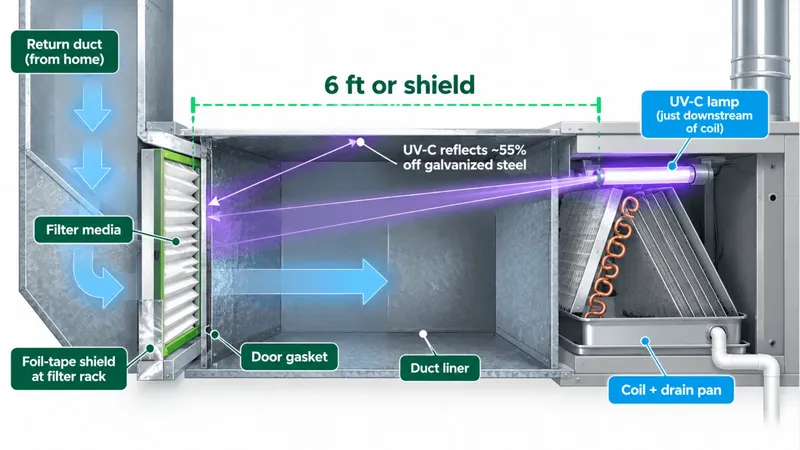
Yes. UV-C from an HVAC germicidal lamp slowly breaks down synthetic filter media, paperboard frames, foam gaskets, duct insulation, and mastic, while metal ductwork and glass stay unaffected, per the ASHRAE Handbook. Filterbuy makes synthetic pleated filters, and its sister company installs UV lamps. Our advice: keep the lamp 6 feet from your filter, or shield it.
Key Takeaways
In ASHRAE-funded lab tests, synthetic filter media, neoprene gaskets, and foam insulation suffered structural damage.
Because galvanized steel reflects about 55% of UV-C, a lamp aimed away from your filter can still reach it.
Filterbuy filters use UV-vulnerable synthetic media too, so our fix is to move or shield the lamp.
Does UV Light Damage Air Filters?
Yes, over time. HVAC germicidal lamps emit UV-C light near 254 nanometers, which breaks chemical bonds in plastics and other organic materials, a process called photodegradation. The ASHRAE Handbook warns that certain filter media and gasket foams can degrade rapidly and severely, singling out synthetic media filters. The Air-Conditioning, Heating, and Refrigeration Institute (AHRI) reaches the same conclusion: non-fiberglass media filters would be damaged by UV light.
Which HVAC Materials Does UV-C Damage?
UV-C attacks thin, porous, organic materials and leaves metal and glass alone. To see what that means inside a home, Filterbuy compared ASHRAE research projects RP-1509 and RP-1724, led by Robert Kauffman, against the parts in a typical HVAC system. Porous and fibrous materials degraded fastest because UV-C reaches deeper into them.
Source: ASHRAE Handbook (2020), Chapter 17, Table 2, summarizing Kauffman (2011–2017). "Structural damage" means samples crumbled or lost fibers. Home lamps usually run at lower doses, so real-world damage is slower.
What Does a UV Light Do to a Filterbuy Filter?
Our filters are not UV-proof, and we would rather say so. Filterbuy has built pleated filters in its Alabama, Florida, Pennsylvania, and Utah plants since 2013, and its sister company, Filterbuy HVAC Solutions, installs UV lights in Florida homes. Because we make one and install the other, we checked each part of our filters against ASHRAE's results.
Every Filterbuy pleated filter, MERV 8 through 13, uses the same build: electrostatically charged synthetic media, a beverage-board frame, and aluminum dual wire backing, as our MERV 13 filter page details.
Risk levels are Filterbuy's reading of ASHRAE Handbook (2020) Table 2 results for comparable materials.
"We make the filter and we install the lamp, so we'd rather tell you which one solves the problem than sell you both."
The Filterbuy team, in our review of whether UV lights work in air ducts
Does UV Light Damage Ductwork?
Metal ductwork, no, but what is attached to it sometimes. ASHRAE rates sheet metal and aluminum foil tape as unaffected by UV-C, so the risk is the nonmetal parts near a lamp: duct liner, foam insulation, mastic, and flex-duct jackets.
Lamp makers treat flex duct as off-limits. The Field Controls UV-Aire manual requires 30 inches of clearance from flex duct, and the Honeywell UV100E manual bars any UV exposure to plastic flex duct liner. Filterbuy's guide to whether a UV light will fit your ductwork shows how to measure.
Reflection is the risk most clearance rules skip. Galvanized duct reflects about 55% of UV-C, according to an ASHRAE Journal best-practices review, so light can bounce off duct walls onto a filter the lamp was never aimed at.
Can UV Light Damage HVAC Gaskets and Seals?
Yes, and a failed seal undercuts the filter you paid for. Gaskets on blower doors and filter-rack covers are often foam or neoprene, and neoprene door gaskets suffered structural damage in ASHRAE's lab tests. Once UV-C hardens or cracks a gasket, unfiltered air slips around the filter, a problem called filter bypass.
How Far Should a UV Light Be from Your Air Filter?
Keep a UV lamp at least 6 feet from synthetic filter media, or shield the filter. When Filterbuy lined up six clearance sources, no two agreed. Manufacturer manuals ask for 20 inches to 3 feet, while ASHRAE guidance stretches that to 5 or 6 feet. We recommend the strictest, since a manual lists only the minimum.
Distances apply to anything the lamp can see, directly or by reflection.
Short on space? AHRI recommends shielding nearby materials with foil tape, sheet metal, or conduit. To choose a spot, compare coil-mounted vs. in-duct UV lights or read where to install a UV light in your HVAC system.
What Does UV Damage Look Like? A 10-Minute Inspection
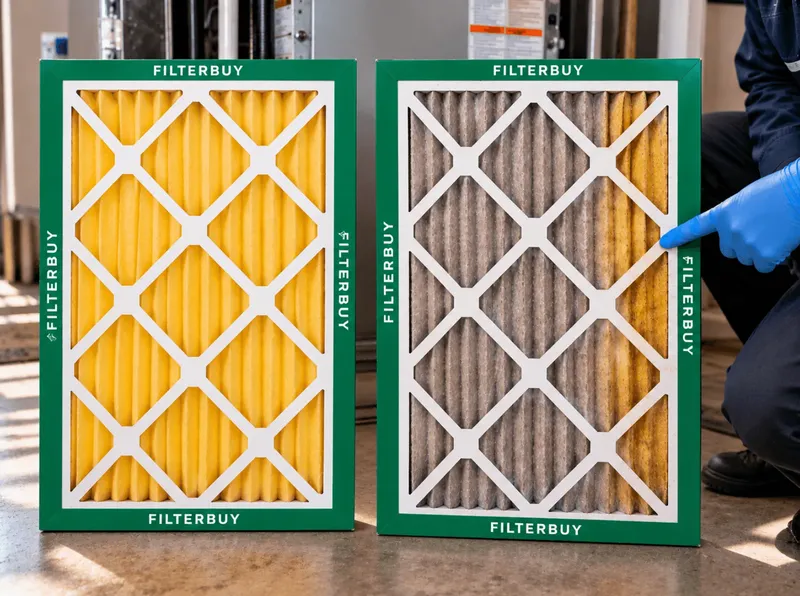
UV damage shows up first on whichever side of a part faces the lamp. The Honeywell UV100E manual calls it color shift or structural degradation. These are the six checks Filterbuy would run, starting with one rule: never look at a lit UV-C lamp.
Cut the power. Switch off the furnace or air handler and unplug the UV lamp, as the Field Controls manual directs.
Pull the filter and compare both faces. Dust usually grays the air-entering side evenly; UV discoloration is yellow or brown and strongest where the lamp could see it.
Pinch a pleat. Healthy synthetic media flexes; UV-damaged media feels brittle and may shed fibers.
Press the gaskets. Check the seals on the filter-rack cover and blower door for hard or cracked foam.
Scan the duct near the lamp. Look for flaking liner, chalky residue on flex duct, or cracked mastic at the joints.
Leave wiring to a pro. If wire insulation near the lamp looks cracked, call a licensed technician.
Then match each finding to a next step:
After that, stay on a regular schedule for how often to change your air filter.
"Before I recommend a coil lamp, I check the coil and drain pan for growth and make sure the filter fits snugly. If the real complaint is dust or allergies, I start with the filter."
David Clark, President of Filterbuy HVAC Solutions, in Filterbuy's guide on where to install a UV light
Is There a UV-Safe Air Filter?
Glass-fiber media resists UV-C, but switching to it usually trades away filtration. ASHRAE says woven or laid glass media, such as HEPA, holds up under intense UV-C, while lofted glass filters may not, because UV-C breaks down their binders.
Performance is the bigger issue with fiberglass. AHRI describes basic panel filters as capturing particles down to about 5 microns, compared with about 1 micron for media filters. Swapping to fiberglass to suit a badly placed lamp is the one trade we would talk you out of.
Filterbuy's take: fix the lamp and keep the filter. Moving or shielding a lamp is a one-time job, but a weaker filter costs you fine-particle capture every day. If allergies or wildfire smoke call for a MERV 11 or MERV 13 filter, keep it and protect it. David Clark puts it this way:
"The best filter is the highest rating your system can move air through, changed on schedule."
David Clark, on Filterbuy's MERV 13 air filters page
Supporting Statistics
UV-C cut the strength of some filter layers by over 90%.
NIOSH exposed charged synthetic filter material to 120–950 J/cm² of UV-C.
Filtration barely changed, with particle penetration rising 1.25% at most.
Takeaway: damage shows up as brittleness first, so pinch a pleat.
Source: CDC Stacks, NIOSH, 2015
A 10 mm gap made a MERV 11 filter perform like a MERV 8.
The same 3/8-inch gap dropped a MERV 15 to an effective MERV 8.
Takeaway: a failed gasket can erase a filter upgrade.
Source: Ward and Siegel, filed with the California Energy Commission
60 seconds to reach NIOSH's daily UV-C limit.
NIOSH's daily eye and skin limit at 254 nm is 6.0 mJ/cm².
At 100 µW/cm², the top of ASHRAE's coil-lamp range, you hit it in 60 seconds.
Takeaway: cut power before inspecting.
In filter terms, here is our math:
Filterbuy calculation: dose = intensity × time, lamp on nonstop. NIOSH tested respirator media; treat this as a guide.
Frequently Asked Questions
Is My UV Light Compatible with My Air Filter?
Only if the lamp cannot see it. A synthetic pleated filter needs your lamp manual's clearance, ideally the 6 feet Filterbuy recommends, or a shield.
Can UV Light Damage a Plastic Drain Pan?
Yes, slowly. Field Controls lists drain pans among the plastics that need 30 inches of clearance, though ASHRAE notes a thick pan may take years to develop fissures.
Should a UV Light Go Before or After the Air Filter?
After. The Field Controls UV-Aire manual prefers a spot downstream of the filter, and AHRI notes that bulbs upstream of it collect dust.
Does UV-C Light Damage Fiberglass Filters?
Rarely. ASHRAE rates glass fibers as unaffected, and American-Lights exempts fiberglass filters from its 36-inch clearance rule.
How Often Should I Check My Filter If I Have a UV Light?
At every filter change. Look at the lamp side of the old filter for yellowing or brittle pleats; this one-minute check shows whether UV-C reaches the rack.
Glossary
Filterbuy: A family-owned U.S. maker of pleated MERV 8, 11, and 13 air filters since 2013.
UV-C: Short-wave ultraviolet light, near 254 nm in HVAC germicidal lamps.
µW/cm²: Microwatts per square centimeter, a measure of UV intensity.
J/cm²: Joules per square centimeter, the total UV dose over time.
Filter bypass: Air flowing around a filter instead of through it.
MERV: Minimum Efficiency Reporting Value, ASHRAE's 1 to 16 filter efficiency scale.
ASHRAE: The American Society of Heating, Refrigerating and Air-Conditioning Engineers.
AHRI: The Air-Conditioning, Heating, and Refrigeration Institute, an HVAC manufacturers' trade group.
NIOSH: The National Institute for Occupational Safety and Health, part of the CDC.
About the Author and Reviewer
Michelle Wan is Filterbuy's Brand Manager. She works with Filterbuy's manufacturing teams and writes from how filters are built and used.
David Clark is President of Filterbuy HVAC Solutions. He is an EPA-certified HVAC technician who graduated from the South Florida Academy of Air Conditioning.