
Do UV Lights Actually Work in Air Ducts? What the Evidence Shows
October 1, 2026
TL;DR
UV lights in air ducts can work, but only when germs absorb enough UV light, and the fast-moving air in a duct rarely gives them time to. In lab tests sponsored by the U.S. Environmental Protection Agency (EPA), in-duct systems reliably killed a common bacterium, yet results against hardy spores ranged from 4% to nearly 100%. Filterbuy, a filter maker whose sister company installs UV lights, sees UV doing its best work on a damp evaporator coil. UV can't stand in for a filter, because it traps no particles.
Key Takeaways
Coil-mounted UV lights have the strongest evidence because they light the same wet surface nonstop.
UV light damages synthetic pleated filter media like Filterbuy's, so where the lamp points matters.
UV-C removes no particles, so a pleated MERV 11 or MERV 13 filter still does that job.
Why Does A Filter Company Have A View On UV Lights?
Filterbuy has manufactured pleated air filters in the USA since 2013, and our sister company, Filterbuy HVAC Solutions, installs UV lights across Florida. That shows us what UV does to filter media and where installers mount lamps. Since we sell both, our conclusions rest on EPA data and peer-reviewed studies.
The Filterbuy team: "We make the filter and we install the lamp, so we'd rather tell you which one solves the problem than sell you both."
Do UV Lights In Hvac Systems Actually Work?
HVAC UV lights do work against germs that absorb a large enough dose, but many home installations never deliver that dose to moving air. UV-C light near 254 nanometers damages a microbe's DNA and RNA so it can't reproduce, while air rushes past a duct lamp in well under a second. That's why Filterbuy HVAC Solutions treats the evaporator coil, rather than the open duct, as the best place for a lamp.
What Decides Whether A Duct UV Light Works?
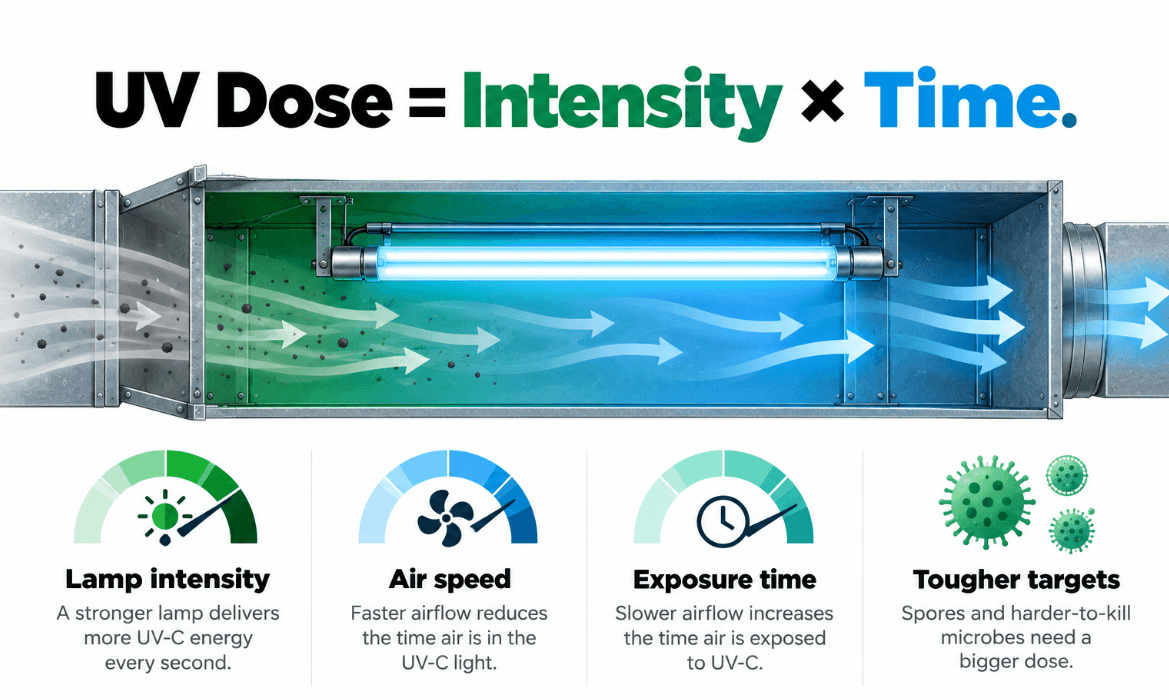
A duct lamp's success comes down to dose, or lamp intensity multiplied by exposure time. So a strong lamp in fast air can deliver less energy than a modest lamp in slow air.
Intensity, measured in microwatts per square centimeter (µW/cm²), falls with distance and lamp age, while exposure time depends on air speed. By Filterbuy's math, air moving 500 feet per minute, about the speed in the EPA's test duct, crosses a 2-foot lamp zone in roughly a quarter second.
Spores are the hardest target. Killing them reliably takes minutes to hours of exposure, not the few seconds most UV air cleaners provide, according to the EPA's technical guide to residential air cleaners.
What Did Independent Testing Find?
Independent EPA testing found in-duct UV systems reliably kill ordinary bacteria, while results ran from 4% to 99.89% against spores and from 39% to 99.88% against a virus stand-in. In the EPA's mid-2000s Environmental Technology Verification (ETV) program, RTI International, an independent research institute, ran several systems through identical tests.
Airborne results from U.S. EPA ETV reports. Spores = Bacillus atrophaeus; Bacteria = Serratia marcescens; MS2 = virus surrogate. Irradiance measured 4–5 feet upstream. Several are multi-lamp commercial units.
When Filterbuy lined up four of those reports side by side, something we haven't seen done elsewhere, two patterns stood out.
Intensity tracked spore kill. At the same airflow, the lamp with the weakest measured output (310 µW/cm²) inactivated 4% of spores, while the strongest (6,800 µW/cm²) inactivated 96%.
Slower air helped. The one system tested in a smaller 12-by-12-inch section moved air about 40% slower and posted the best spore result, 99.89%, though different hardware shares the credit.
Coil UV Lights Vs. Air UV Lights: Which Type Helps More?
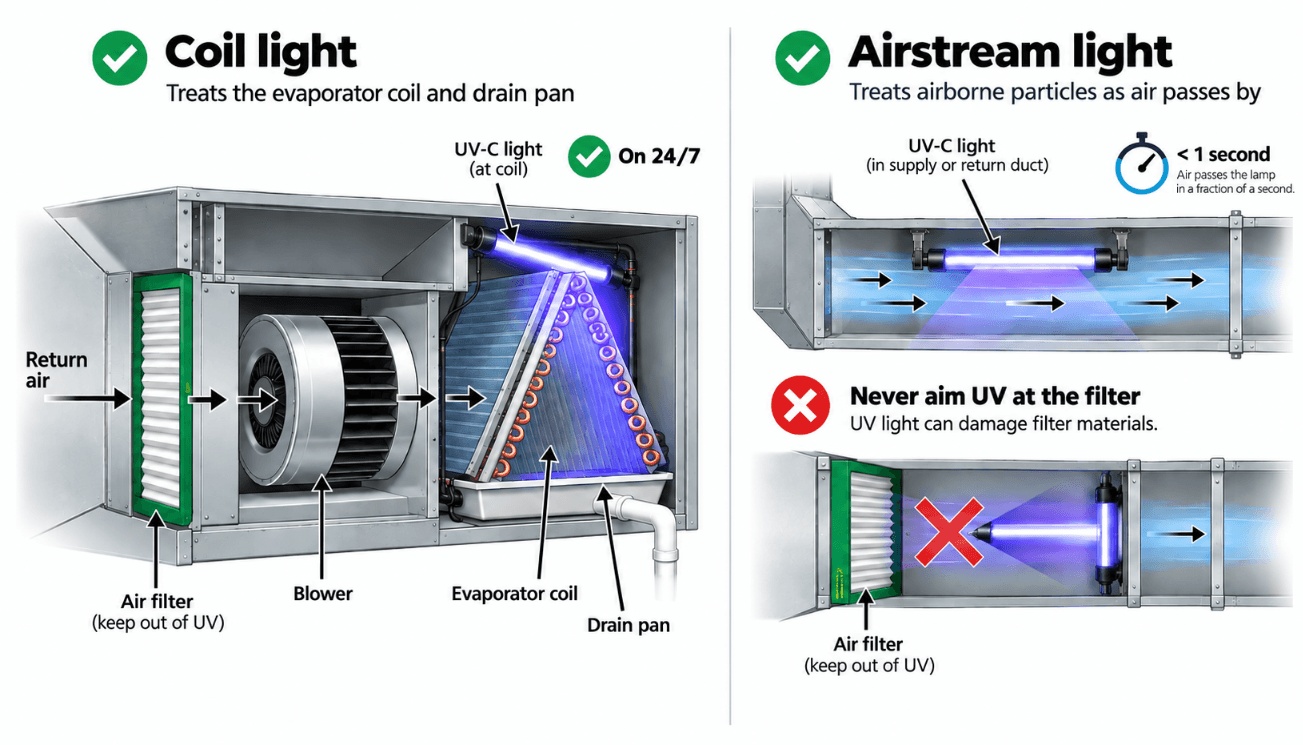
Coil lights have the stronger case. A coil light mounts beside the evaporator coil and drain pan, where condensation feeds mold and bacterial biofilm, and keeps those surfaces lit around the clock. In one study the EPA cites, UV cut microbes growing on HVAC surfaces by 99% but airborne bacteria by only 25% to 30%.
Coil studies show modest efficiency gains: 3% to 7% better heat transfer in a 2017 lab study partly funded by UV makers (Luongo et al.), and 13% on a fouled commercial coil in an ASHRAE-funded field study (Science and Technology for the Built Environment). Filterbuy found no large independent study of savings in homes.
What Can't UV Lights In Air Ducts Do?
UV-C only inactivates living microbes in its line of sight, so particles and allergens pass straight through. Dust, pollen, pet dander, and wildfire smoke need a filter, as our guide to air filters vs. air purifiers explains. On smoky days, check your local AQI.
UV can also work against your filter. Filterbuy's MERV 13 filters use electrostatically charged synthetic media, the non-fiberglass type that UV light damages, according to AHRI. If a lamp shines on your filter rack, ask your installer to move it.
Are HVAC UV Lights Worth It?
For healthy homes with a well-kept system and a good filter, a UV light is optional, paying off mainly in humid climates where coil growth returns after the moisture fixes below.
What Does A UV Light Cost To Own Compared With Filters?
Running a UV lamp around the clock costs nearly as much as a year of Filterbuy MERV 11 filters, before installation or bulbs. Filterbuy built it from its HVAC team's operating figures and current filter prices.
Filterbuy analysis. Filter prices: 20×25×1 six-packs with the 5% auto-delivery discount, verified August 2026, changed every 90 days.
What Should You Try Before Buying A UV Light?
Most coil growth and musty smells start with trapped moisture, and these fixes cost less than a UV lamp.
Flush the condensate drain line. A clogged line backs water into the drain pan, where mold takes hold. Filterbuy's guide to a musty smell from the AC walks through a 30-minute vinegar flush.
Keep indoor humidity between 30% and 50%. Mold grows far more easily above 60%, as our guide to black mold in the AC unit explains.
Replace a dirty filter and set the fan to AUTO. A clogged filter keeps the coil wet longer, while AUTO lets it dry out between cycles. Then stick to a schedule for how often you should change your air filter.
If growth still returns after all three, ask an installer about a coil UV light.
What Should You Check Before Buying An HVAC UV Light?
Before buying an HVAC UV light, confirm test data, ozone certification, and lamp placement with the installer.
Test results. Ask for ASHRAE 185.1 or 185.2 data, and check which organisms were tested.
Ozone safety. The EPA notes uncoated lamps can emit ozone, so look for UL 2998 validation. In California, electronic in-duct cleaners have fallen under CARB certification rules since October 2020.
Placement. AHRI recommends mounting the lamp at the coil and drain pan, running it 24/7, and never aiming it at the filter.
What Do The Numbers Say About UV Lights And Home Air?
National data shows where coil UV helps most and why allergy households need better filtration.
88% of U.S. households use air conditioning. In Florida, 96% do, and 90% use central AC. Source: U.S. Energy Information Administration, 2020 Residential Energy Consumption Survey. That includes Florida, the humid market Filterbuy HVAC Solutions serves.
More than 106 million Americans have asthma and/or allergies, including about 82 million (1 in 4) with nasal allergies. Source: Asthma and Allergy Foundation of America, citing 2024 CDC data. Dead mold spores still trigger allergies, the EPA notes, so these households get more from a higher-MERV pleated filter than from UV.
Home HVAC systems usually run less than 25% of the time during heating and cooling seasons. Source: U.S. EPA Guide to Air Cleaners in the Home. An airstream light treats air only while the fan runs, but a coil light keeps working between cycles.
Frequently Asked Questions
Do UV lights in air ducts kill mold?
UV lights kill mold on surfaces they light continuously, like the coil and drain pan, but not spores drifting through the ducts. AHRI advises leaving lamps on 24/7, since mold grows most when air sits still. For visible mold, see David Clark's Filterbuy HVAC Solutions guide to mold in HVAC systems and air ducts.
Do HVAC UV lights kill viruses?
Only partly. The EPA's technical guide says a well-designed airstream UV light gives only low to moderate virus reductions, and that adding UV to a MERV 13 or better filter gives little infection-control benefit beyond the filter alone.
Can a UV light damage my HVAC system?
A UV light can degrade some plastics, such as wiring insulation, so AHRI recommends UV-resistant parts or shielding with foil tape or sheet metal.
Can I install an HVAC UV light myself?
Only if you know HVAC systems well, says David Clark's cost guide. AHRI warns that UV exposure irritates eyes and skin, so cut power before service, and that bulbs contain mercury, so recycle old lamps like fluorescent bulbs.
How do I know if my UV light still works?
You can't tell by looking, and UV-C can harm your eyes. Output fades before a bulb burns out, so a glowing lamp isn't proof it works. Replace bulbs every one to two years, per David Clark.
Glossary
UV-C: Short-wave ultraviolet light; HVAC lamps emit near 254 nm.
Coil light: A UV lamp aimed at the evaporator coil and drain pan.
Airstream (in-duct) light: A UV lamp that treats air as it passes.
Evaporator coil: The indoor cooling coil, where condensation forms.
ASHRAE 185.1 / 185.2: Lab tests of HVAC UV-C lights against airborne (185.1) and surface (185.2) microbes, from ASHRAE, the HVAC engineering society.
MS2: A harmless lab stand-in virus.
CARB: California Air Resources Board, which caps air-cleaner ozone.
UL 2998: UL validation of no measurable ozone from an air cleaner.
MERV: Minimum Efficiency Reporting Value, the 1–16 scale for filter particle capture.
Filterbuy HVAC Solutions: Filterbuy's sister company, a Florida HVAC and UV light installer.
AHRI: Air-Conditioning, Heating, and Refrigeration Institute, an HVAC trade group.
The Bottom Line
Do duct UV lights do anything? Yes, mostly on a wet coil, and far less on moving air than most ads suggest. As a company that sells both, Filterbuy would put the filter first. We make pleated MERV 11 and MERV 13 filters in the USA in 600+ sizes, and filter auto-delivery keeps replacements on schedule.
Sources
U.S. EPA: Does ultraviolet (UV) radiation from UV lamps kill mold?
U.S. EPA: Residential Air Cleaners, A Technical Summary, 3rd Edition (2018)
EPA ETV verification reports: Dust Free Bio-Fighter 4Xtreme, Lumalier ADPL-60-8, Steril-Aire SE 1 VO, Novatron BioProtector BP114i
ASHRAE RP-1738 field study, Science and Technology for the Built Environment (2018)
California Air Resources Board: Air Cleaner Information for Consumers
U.S. Energy Information Administration: 2020 RECS state-level release
Asthma and Allergy Foundation of America: Asthma and Allergy Facts