
Do HVAC UV Lights Produce Ozone? What The Wavelength Tells You
October 8, 2026
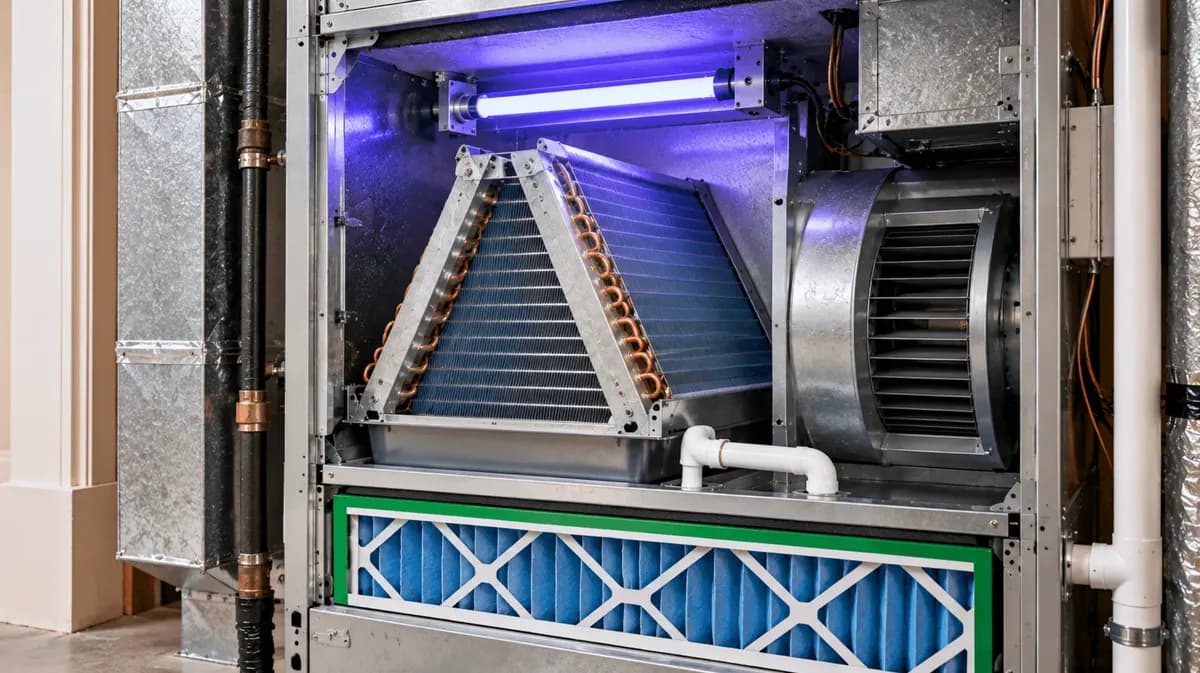
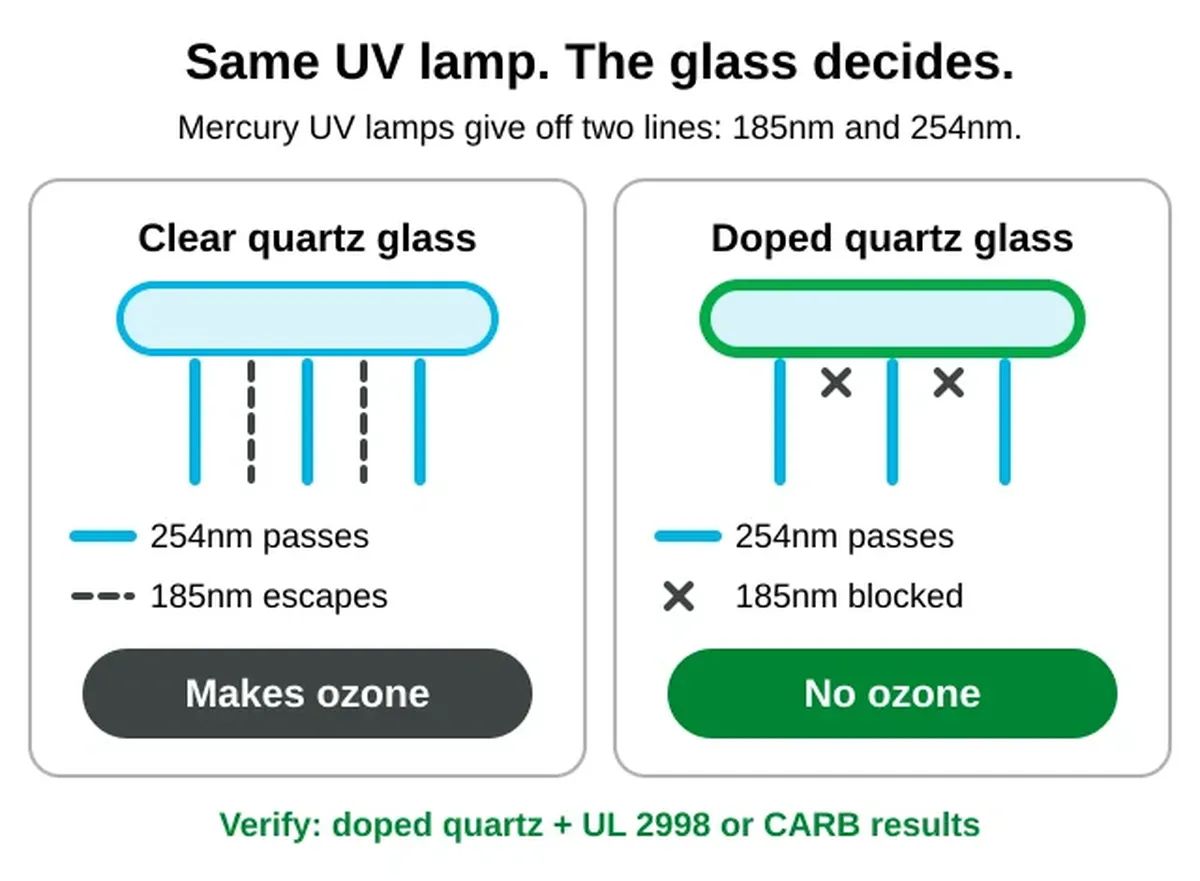
Some do, and the lamp's wavelength decides it. UV light below about 200nm, especially the 185nm line, makes ozone, while the 254nm germicidal line doesn't. Ozone-free lamps use doped quartz glass to block 185nm, so look for UL 2998 or CARB results on the exact model. A UV light can't capture dust or pollen, though. That's your air filter's job, and the quick quiz below will match you to the right one.
Find Your Filter Match
Answer a few quick questions and we'll match you to the right MERV rating for your home. Already know your size?
Some HVAC UV lights produce ozone and some don't, and the wavelength is what decides it. Lamps that emit below roughly 200 nanometers (nm), especially the 185nm line from a mercury lamp, split oxygen molecules and create ozone. The 254nm germicidal line doesn't. Because many mercury lamps emit both lines, the lamp glass and a third-party ozone test tell you more than the word "UV-C" on the box.
Filterbuy makes pleated air filters, and our service team, Filterbuy HVAC Solutions, installs germicidal UV lights in customers' homes. Our advice: verify the lamp, not the label.
TL;DR
An HVAC UV light makes ozone only when its lamp lets 185nm light escape. Ozone-free lamps use doped quartz glass, which blocks that line while passing the 254nm germicidal light. To check a claim, confirm the wavelength and glass type, then look for UL 2998 validation from UL Solutions or California Air Resources Board (CARB) certification.
Key Takeaways
Ozone forms when UV light shorter than about 240nm reaches the air, and in HVAC lamps the 185nm mercury line is the usual culprit.
The 254nm line makes no ozone, yet a lamp labeled "254nm" can still emit 185nm if its glass is clear quartz.
In Filterbuy's view, the riskiest moment comes at lamp replacement, when one wrong bulb can turn an ozone-free system into an ozone source.
Why 185nm Light Makes Ozone And 254nm Light Doesn't
Ozone (O3) forms when ultraviolet light splits an oxygen molecule (O2) and the freed atoms latch onto nearby O2. Oxygen only absorbs UV light below about 240nm, so a lamp has to emit in that short band to make ozone.
Most HVAC UV lights use low-pressure mercury lamps, which give off two strong lines. The 254nm line does the germicidal work, while the 185nm line makes ozone. ASHRAE, the engineering society behind U.S. ventilation standards, classes lamps under 200nm as ozone generating in its position document on filtration and air cleaning.
Whether that 185nm light escapes comes down to the glass. Clear quartz lets it through, while doped quartz, made with additives such as titanium, blocks it and still passes 254nm. On a shelf, the two lamps look identical. Our explainer on how UV-C light and the 254nm line work covers the germicidal band.
What The Wavelength On A UV Light Spec Sheet Tells You
A UV light's spec sheet should name its peak wavelength. Below 200nm, the lamp is built to make ozone. Between 200nm and 240nm, it can make smaller amounts. Above 240nm, the light can't form ozone, as long as nothing shorter slips through the glass.
Sources: ASHRAE and CARB.
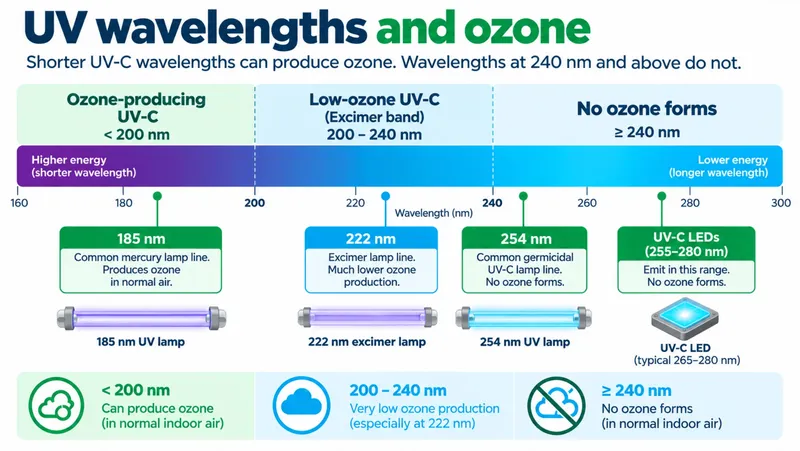
The most common trap is a lamp sold as "254nm germicidal" that also emits 185nm through clear quartz. A lamp's part number often gives it away. In widely used GPH germicidal lamp part numbers, a VH suffix marks the ozone-producing version and an L suffix marks the ozone-free one.
Filterbuy's take is that "254nm" on a box is half an answer until you know the glass. The same check applies to coil-mounted and in-duct UV lights, since both use the same lamps.
How To Know If A UV Light Makes Ozone: A Five-Step Check
To know if a UV light makes ozone before you buy, confirm its wavelength and glass type, then find a third-party ozone result for that model. Filterbuy recommends these five checks.
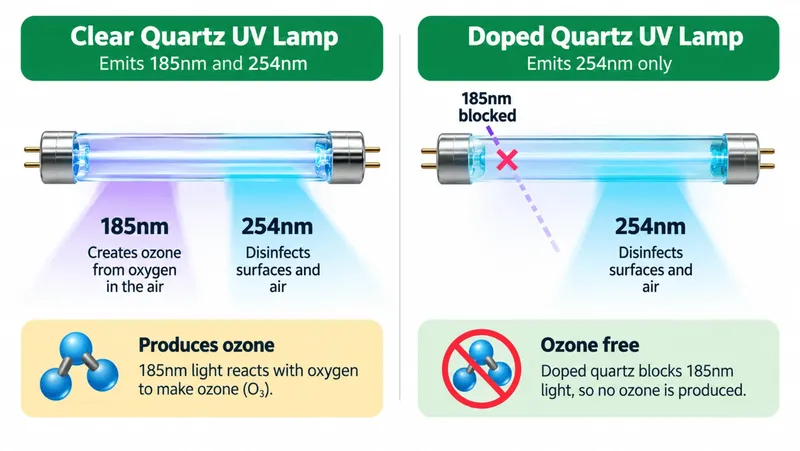
Read the wavelength. Look for a specific number, such as 254nm. "UV-C" alone leaves it open.
Confirm the glass. The specs should say "doped quartz" or "ozone free."
Look for third-party ozone results. UL 2998 validation means an outside lab measured the ozone, and CARB certification confirms the device meets California rules. "Ozone safe" on its own is a claim, not a test.
Check the replacement-lamp instructions. CARB requires certified ultraviolet germicidal irradiation (UVGI) devices to warn owners that non-UVGI replacement lamps may produce harmful ozone.
Rule out add-on technology. Some UV systems pair the lamp with an ionizer or a photocatalytic oxidation catalyst, and that add-on needs its own ozone test data.
Step 4, the replacement-lamp check, deserves the most attention. As our guide to how UV lights work in an HVAC system notes, UV-C bulbs last about a year, so every replacement is another chance at the wrong glass.
Marketing Phrases That Signal Ozone
Packaging rarely says "makes ozone" outright. These marketing phrases on a UV light box usually signal an ozone-producing lamp or an unverified claim.
Sources: EPA and Filterbuy analysis.
Which Certifications Actually Verify An Ozone-Free Claim
Two benchmarks can actually verify an ozone claim. UL 2998, a validation from UL Solutions, confirms emissions at or below 0.005 parts per million (ppm), or 5 parts per billion (ppb). CARB certification caps air cleaners sold in California at 0.050 ppm, though portable UV-only units can qualify on wavelength alone, without an ozone test. Neither measures how well a device cleans.
CARB counts a lamp as UVGI only if it emits above 240nm with no measurable ozone. Under CARB's air cleaner regulation, electronic in-duct air cleaners have needed CARB certification since October 1, 2020.
Sources: UL Solutions, CARB, and OSHA.
The OSHA ozone exposure limit applies to workplaces, not homes. A genuine ozone result names the exact model.
What An HVAC UV Light Ozone Smell Means
Ozone has a sharp smell, a bit like chlorine. If you notice it near your vents after a UV install or a lamp swap, the lamp may be emitting 185nm light. A missing smell does not prove a UV light is ozone free. Federal medical device labeling rules note that the nose tires of ozone quickly.
Ozone from any source irritates the airways, which makes an ozone-producing UV light a poor fit for a home. According to the EPA's guidance on ozone generators sold as air cleaners, relatively low amounts can cause chest pain, coughing, shortness of breath, and throat irritation, and may worsen asthma.
If you suspect ozone, switch the light off and work through the checklist below. A licensed technician can confirm the source of any odor.
Already Have A UV Light? How To Check It
To check an installed UV light for ozone, find the lamp's part number and match it to an ozone-free spec sheet or certification.
Turn the UV light off first. Never look at a lit UV-C lamp, because it can injure eyes and skin.
Find the part number. It is printed on the lamp or in the owner's manual.
Match it to a spec sheet. Confirm the wavelength and the glass, or check for a VH or L suffix.
Look up the model. Search CARB's certified list or ask the maker for its UL 2998 result.
Swap an ozone-producing lamp. Fit the maker's ozone-free version, or have a licensed technician do it.
Where Air Filters Fit Alongside An HVAC UV Light
The UV lamp in your system treats microbes on surfaces or in passing air, but it can't capture dust or pollen. That job belongs to the filter, which is why Filterbuy builds pleated filters from MERV 8 to MERV 13.
Filterbuy's review of what the evidence shows about UV lights in air ducts backs up this split between UV treatment and filtration. Coil lamps keep the damp coil and drain pan clean, which is where mold in an AC unit often starts, while the filter keeps dust off both.
For most homes, that means checking a 1- or 2-inch pleated filter monthly and changing it about every 90 days, as our guide on how often to change your HVAC filter explains. Choose a MERV rating your HVAC equipment manual approves.
Expert Insight
ASHRAE's position is plain: devices that use ozone to clean the air "should not be used in occupied spaces because of negative health effects that arise from exposure to ozone and its reaction products." ASHRAE's guidance is why Filterbuy recommends only verified ozone-free lamps for home HVAC systems.
Michelle Wan, Brand Manager at Filterbuy, says: "A UV light and an air filter do different jobs, and only one can add a pollutant if it's built wrong. Before you buy, get the wavelength and glass type in writing, and ask for a third-party ozone result on that exact model."
Supporting Statistics
27.8 million Americans had current asthma in 2023.
That is 8.4% of the population, and ozone can make asthma worse.
Ozone generators pushed indoor ozone as high as 650 ppb.
Most tests topped 100 ppb.
That peak is 13 times CARB's 50 ppb limit for air cleaners.
44% of Americans live in places with failing air quality grades.
That is 152.3 million people, graded on ozone or particle pollution.
Source: American Lung Association's State of the Air 2026 report
Frequently Asked Questions
Do UV Lights In HVAC Systems Produce Ozone?
Only some. Lamps emitting below about 240nm, mainly at 185nm, make ozone, while doped quartz lamps block that line.
Is A 254nm UV Light Ozone Safe?
The 254nm wavelength itself doesn't create ozone. A lamp is only ozone free if its glass also blocks 185nm, so confirm doped quartz and look for UL 2998 validation.
Do UV-C LED Lights Produce Ozone?
No. UV-C LEDs typically emit about 265nm to 280nm, above the 240nm point where oxygen absorbs UV light.
Does CARB Certification Mean A UV Light Is Ozone Free?
Not quite. CARB certification means low ozone, at or below 0.050 ppm, while UL 2998 sets the zero-ozone bar at 0.005 ppm.
Pair Your UV Light With The Right Air Filter
You can find your exact size in the Filterbuy air filter shop, with fast and free 2-day delivery to most US states, or set up filter auto-delivery so replacements arrive on schedule, or browse our UV lights resource hub.
How We Researched This Guide
The Filterbuy content team built this guide from primary sources, including CARB's regulation text and the National Institute of Standards and Technology (NIST) 222nm lamp study. David Clark, a licensed HVAC technician, reviewed the technical claims.
Glossary
Ozone (O3): A reactive gas that forms when high-energy UV light splits oxygen (O2).
Vacuum UV: UV light below about 200nm, including the 185nm mercury line, which makes ozone.
Doped quartz: Lamp glass that blocks ozone-forming wavelengths and passes 254nm light.
UL 2998: A UL Solutions validation that an air cleaner emits 0.005 ppm of ozone or less.
MERV: Minimum Efficiency Reporting Value, the ASHRAE 52.2 scale for filter particle capture.