What Is HSPF2? Heating Efficiency Ratings Explained (With Conversion Chart)
October 31, 2026

HSPF2 is the federal rating for how efficiently a heat pump heats your home over a full winter. The higher the number, the less electricity it uses for the same heat. For a split-system heat pump, a good HSPF2 rating is 7.8 or higher, or 8.1 or higher if your winters get cold.
- 7.5 HSPF2: the federal minimum for new split systems.
- 7.8 HSPF2: meets ENERGY STAR, a good rating for most homes.
- 8.1+ HSPF2: the cold-climate pick (8.5+ for ductless systems).
Not sure what size system your room needs? Take the quick match quiz below.
Ductless mini splits change the least when old HSPF ratings convert to HSPF2, because they have no long duct runs. Filterbuy’s single-zone systems are 17 SEER2, ETL and AHRI certified, and ship free in 2 days.
Shop Ductless Mini Split SystemsWhat’s a good HSPF2 rating?
Higher HSPF2 = less electricity, same heat
minimum
ducted
ductless
Electricity per 10 million Btu of heat
Find Your Mini Split Match
Answer a few quick questions, and we’ll point you to the right mini split for your space.
TL;DR
HSPF2 (Heating Seasonal Performance Factor 2) is the federal rating for how efficiently a heat pump keeps your home warm across a full winter, and a higher number means lower heating bills. It replaced the older HSPF rating on January 1, 2023, under a tougher lab test, so ducted equipment now scores about 15% lower. For most split systems, a good HSPF2 rating is 7.8 or higher; in cold climates, look for 8.1 or more.
Key Takeaways
Every new split-system heat pump must reach at least 7.5 HSPF2, and every new packaged unit at least 6.7 HSPF2.
A good HSPF2 rating meets ENERGY STAR: 7.8 or higher for split systems and 7.2 or higher for packaged units.
To turn an old HSPF rating into HSPF2 for a ducted split system, multiply by about 0.85. To go back, divide by 0.85.
What Is HSPF2?
HSPF2 is the total heat a heat pump delivers over a heating season, measured in Btu (British thermal units), divided by the electricity it uses in watt-hours. The U.S. Department of Energy (DOE) requires the rating, and it appears on every new heat pump's yellow EnergyGuide label.
A heat pump rated 8.5 HSPF2 delivers about 8,500 Btu of heat for every kilowatt-hour it draws, averaged across the whole winter.
Because a heat pump also cools, it carries a second rating, SEER2 (Seasonal Energy Efficiency Ratio 2), and Filterbuy's guide to heat pump efficiency ratings explains how the two work together. Divide HSPF2 by 3.412 to get the average seasonal coefficient of performance (COP): an 8.5 HSPF2 unit delivers about 2.5 units of heat per unit of electricity.
How Is HSPF2 Tested, and What Changed in 2023?
HSPF2 comes from DOE's Appendix M1 test procedure, which replaced the older Appendix M test on January 1, 2023. Because M1 tests heat pumps under tougher, more realistic conditions, the same equipment earns a lower number.
Most of that difference comes from airflow resistance. A regulatory brief from HVAC manufacturer Daikin (Goodman) summarizes how the test conditions changed:
| Test Condition | Old Test (HSPF, Appendix M) | New Test (HSPF2, Appendix M1) |
|---|---|---|
| External static pressure (duct resistance) | 0.1–0.2 in. w.c. | 0.5 in. w.c. for most ducted units |
| Coldest test temperature | 17°F | 5°F |
HSPF vs. HSPF2: What's the Difference?
HSPF and HSPF2 measure the same thing, seasonal heating efficiency, under different test rules. For a ducted split system, the HSPF2 number lands about 15% below the old HSPF for identical equipment.
That is also why the federal minimum seems to have dropped when it actually rose. The split-system minimum moved from 8.2 HSPF to 7.5 HSPF2, and 7.5 HSPF2 works out to roughly 8.8 HSPF on the old scale, reports the HVAC trade publication ACHR News.
Quick conversion formulas (approximate):
Ducted split system: HSPF2 = HSPF × 0.85, and HSPF = HSPF2 ÷ 0.85
Packaged (single-cabinet) unit: HSPF2 = HSPF × 0.84
Ductless mini-split: HSPF2 = HSPF × 0.95
Ductless systems, including Filterbuy's single-zone mini-split systems, change the least in conversion. With no long duct runs, they barely feel the new test's higher static pressure. DOE never published an official conversion formula, so treat any converted number as an estimate.
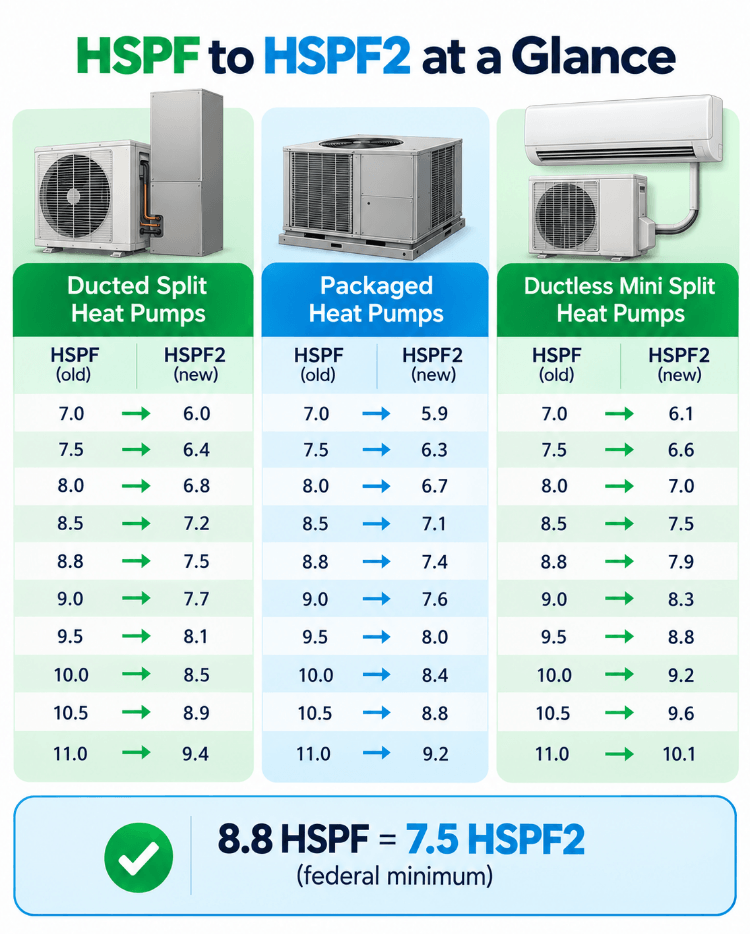
HSPF to HSPF2 Conversion Chart
Use this HSPF2 chart to translate an older HSPF rating into today's HSPF2 rating for your type of system. The values come from a Daikin/Goodman cross-reference, which the manufacturer notes are approximate.
HSPF to HSPF2 Conversion by System Type
| Old HSPF | Ducted Split HSPF2 | Packaged HSPF2 | Ductless Mini-Split HSPF2 |
|---|---|---|---|
| 8.0 | 6.8 | 6.7 | 7.7 |
| 8.2 | 7.0 | 6.9 | 7.9 |
| 8.8 | 7.5 | 7.4 | 8.4 |
| 9.0 | 7.7 | 7.6 | 8.6 |
| 9.5 | 8.1 | 8.0 | 9.1 |
| 10.0 | 8.5 | 8.4 | 9.5 |
| 11.0 | 9.4 | 9.2 | 10.4 |
Source: Daikin Comfort Technologies 2023 regulatory brochure. Filterbuy is not affiliated with or endorsed by Daikin or Goodman.
What Is a Good HSPF2 Rating?
For a split-system heat pump, a good HSPF2 rating is 7.8 or higher, the ENERGY STAR threshold, and 8.1 or higher if your winters get cold. Packaged heat pumps qualify for ENERGY STAR at 7.2 HSPF2.
The ENERGY STAR Cold Climate tier asks for more than a high HSPF2. A qualifying unit must also keep a coefficient of performance (COP) of at least 1.75 at 5°F and hold at least 70% of its 47°F heating capacity at 5°F.
HSPF2 Rating Tiers and Heating Energy Use
| Tier | Min. HSPF2 | Old HSPF (Ducted) | kWh per 10M BTU | Vs. Federal Split Min. |
|---|---|---|---|---|
| Federal minimum, packaged | 6.7 | 8.0 | 1,493 | 12% more |
| Federal minimum, split | 7.5 | 8.8 | 1,333 | Baseline |
| ENERGY STAR, split | 7.8 | 9.2 | 1,282 | 4% less |
| ENERGY STAR Cold Climate, ducted split or packaged | 8.1 | 9.5 | 1,235 | 7% less |
| ENERGY STAR Cold Climate, ductless | 8.5 | 10.0 | 1,176 | 12% less |
| High-efficiency variable-speed | 9.0 | 10.6 | 1,111 | 17% less |
| Premium variable-speed | 10.0 | 11.8 | 1,000 | 25% less |
Sources: DOE 2023 standards via ACHR News; ENERGY STAR Key Product Criteria. kWh = 10,000 ÷ HSPF2
Estimate Your Own Savings in Three Steps
Your utility bills are all you need:
Find your heating electricity. Subtract a mild month's kWh (April or October) from each winter month's kWh, then add up the differences.
Find your savings rate. Convert your current unit to HSPF2 using Table 1, divide that number by the new unit's HSPF2, and subtract the result from 1.
Multiply. Multiply your heating kWh by your savings rate, then by your electric rate.
Example (illustrative): Say a home uses 6,000 kWh a year for heat and replaces an 8.2 HSPF unit (about 7.0 HSPF2) with an 8.5 HSPF2 system. The savings rate is about 18%, or roughly 1,060 kWh. At the 2026 U.S. average of 18.2 cents per kWh, forecast by the U.S. Energy Information Administration, that comes to about $190 a year.
What HSPF2 Rating Do You Need for Your Climate?
The colder your winters, the more a higher HSPF2 rating pays off. Filterbuy's rule of thumb:
Warm climates (Gulf Coast, Florida, desert Southwest): 7.5 to 7.8 HSPF2 is usually enough.
Mixed climates (Mid-Atlantic, Pacific Northwest, Upper South): aim for 7.8 to 8.5 HSPF2, balanced with a strong SEER2.
Cold climates (Northeast, Upper Midwest, Mountain West): choose 8.1 HSPF2 or higher, and insist on ENERGY STAR Cold Climate certification.
Three HSPF2 Mistakes to Avoid on a Quote
Most HSPF2 confusion shows up when comparing quotes.
Comparing "up to" ratings. Brochures often list a model's best-matched rating. According to the Air-Conditioning, Heating, and Refrigeration Institute (AHRI), a split system earns its certified rating only as a matched pair, so ask for the AHRI reference number for your exact pairing.
Mixing old and new labels. Heat pumps built before January 1, 2023, can still be installed, because the standard applies by date of manufacture. Their labels may show HSPF, so convert before you compare.
Skipping 5°F capacity in cold climates. HSPF2 is a whole-winter average. Heating capacity at 5°F tells you whether the unit can carry your coldest nights without leaning on backup heat.
Why Your Heat Pump May Not Reach Its HSPF2 Rating
An HSPF2 rating is a lab result for a correctly installed, well-maintained system, and real homes can fall short. The U.S. Department of Energy estimates that energy use can differ by 10% to 25% between a well-maintained heat pump and a severely neglected one.
Restricted airflow. A dirty air filter or a clogged indoor coil forces the blower to push against more resistance than the M1 test assumed.
Backup heat running too often. Deep thermostat setbacks can kick on electric heat strips, which deliver far less heat per kilowatt-hour.
Missed annual service. DOE recommends a professional tune-up at least once a year, and Filterbuy's heat pump maintenance checklist covers what to do in between.
Pro Tip: Because a heat pump runs year-round, its filter loads faster. DOE recommends a fresh filter every 3 months, and Filterbuy suggests checking your heat pump filters monthly during peak seasons.
Why a Filter Maker Wrote This Guide
Filterbuy makes air filters to order in our own U.S. plants in Alabama, Florida, Pennsylvania, and Utah, and we test how much airflow each one resists.
“I don’t want anyone to feel like they need an HVAC license just to pick the right filter. My job is to give you the straight answer, explain why it matters, and let you get back to your day,” says Michelle Wan, Brand Manager & Copywriter, Filterbuy.
Supporting Statistics
Space heating is the largest energy use in U.S. homes, at 42% of residential energy in 2020. New Hampshire households spent $981 on heating that year, compared with $244 in Louisiana. Source: U.S. Energy Information Administration, 2020 Residential Energy Consumption Survey.
U.S. manufacturers shipped 3,644,596 air-source heat pumps in 2025, about 12% more than gas furnaces (3,247,426). Source: AHRI monthly shipment data, December 2025 release.
DOE projected the 2023 standards behind HSPF2 will save households $2.5 billion to $12.2 billion on energy bills over 30 years. Source: U.S. Energy Information Administration, citing DOE.
Protect the HSPF2 Rating You Paid For
Your heat pump's efficiency starts with airflow, and airflow starts with the filter. Find your exact size among Filterbuy's 600+ air filter sizes, or order custom air filters cut to the eighth of an inch. Then let Filterbuy auto-delivery send a fresh filter before the old one starts costing you.
Glossary
AHRI certificate: An Air-Conditioning, Heating, and Refrigeration Institute record of certified ratings for a matched indoor and outdoor pair.
External static pressure: The airflow resistance from ducts, coils, filters and grilles, measured in inches of water column.
HSPF2: The current heat pump heating efficiency rating: seasonal Btu of heat divided by watt-hours used, tested under Appendix M1.
Sources
ENERGY STAR, Heat Pump Equipment Key Product Criteria
U.S. Department of Energy, Operating and Maintaining Your Heat Pump
Daikin Comfort Technologies (Goodman), 2023 Regulations: What You Need to Know
ACHR News, New Year, New HVAC Efficiency Standards
Air-Conditioning, Heating, and Refrigeration Institute (AHRI), Air Conditioners and Heat Pumps
U.S. Energy Information Administration, Short-Term Energy Outlook: Electricity, Coal, and Renewables (October 2026)
U.S. Energy Information Administration, Space Heating Consumed the Most Energy of Any End Use in Homes (2020 RECS)
U.S. Energy Information Administration, Efficiency Requirements for Residential Central AC and Heat Pumps to Rise in 2023
Air-Conditioning, Heating, and Refrigeration Institute (AHRI), Monthly Shipments
U.S. Environmental Protection Agency, Guide to Air Cleaners in the Home