Mini Split vs. Baseboard Heat: Cost, Comfort & Payback (2026)
October 15, 2026
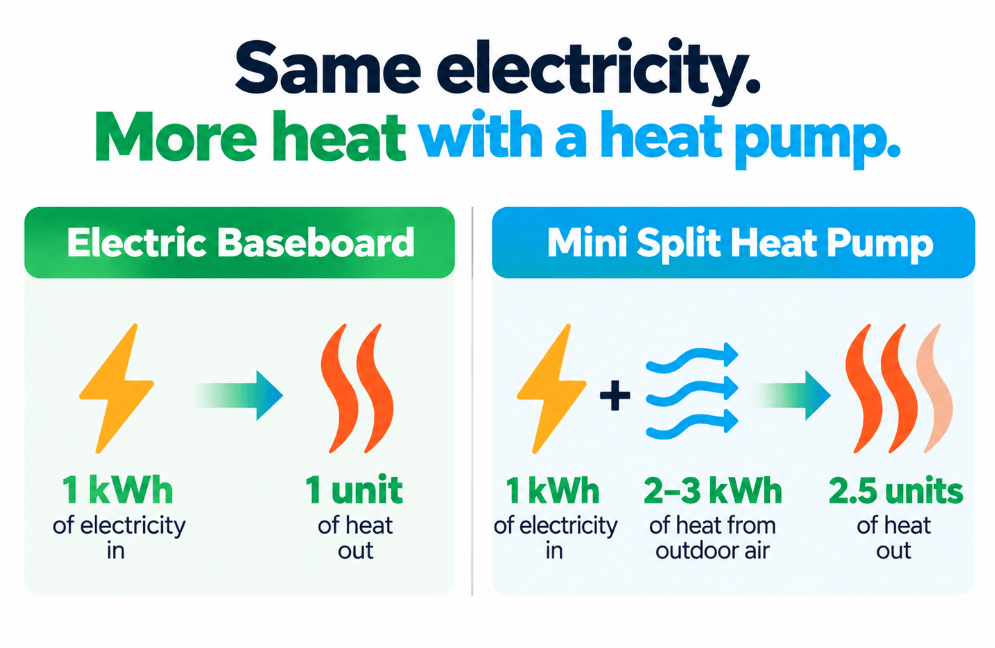
A mini split costs less to run. It typically uses 50% to 60% less electricity than baseboard heat for the same warmth. A baseboard heater turns each kWh into one kWh of heat. A mini split moves heat in from outdoor air, so it delivers about 2 to 3 kWh of heat per kWh. It cools in summer, too.
Upfront cost: Baseboard runs about $400 to $900 per heater installed. A mini split runs about $2,000 to $7,000 per zone.
Monthly cost: One 1,500 W baseboard heater used 8 hours a day costs about $66. A mini split delivers the same heat for about $26.
Where each fits: A mini split pays off in rooms you heat every day. Baseboard can stay the cheaper pick in rooms you rarely use.
Filterbuy mini splits start at $749 with fast and free 2-day delivery to most US states, plus a 7-year compressor and 3-year parts warranty. A licensed installer handles setup, arranged separately.
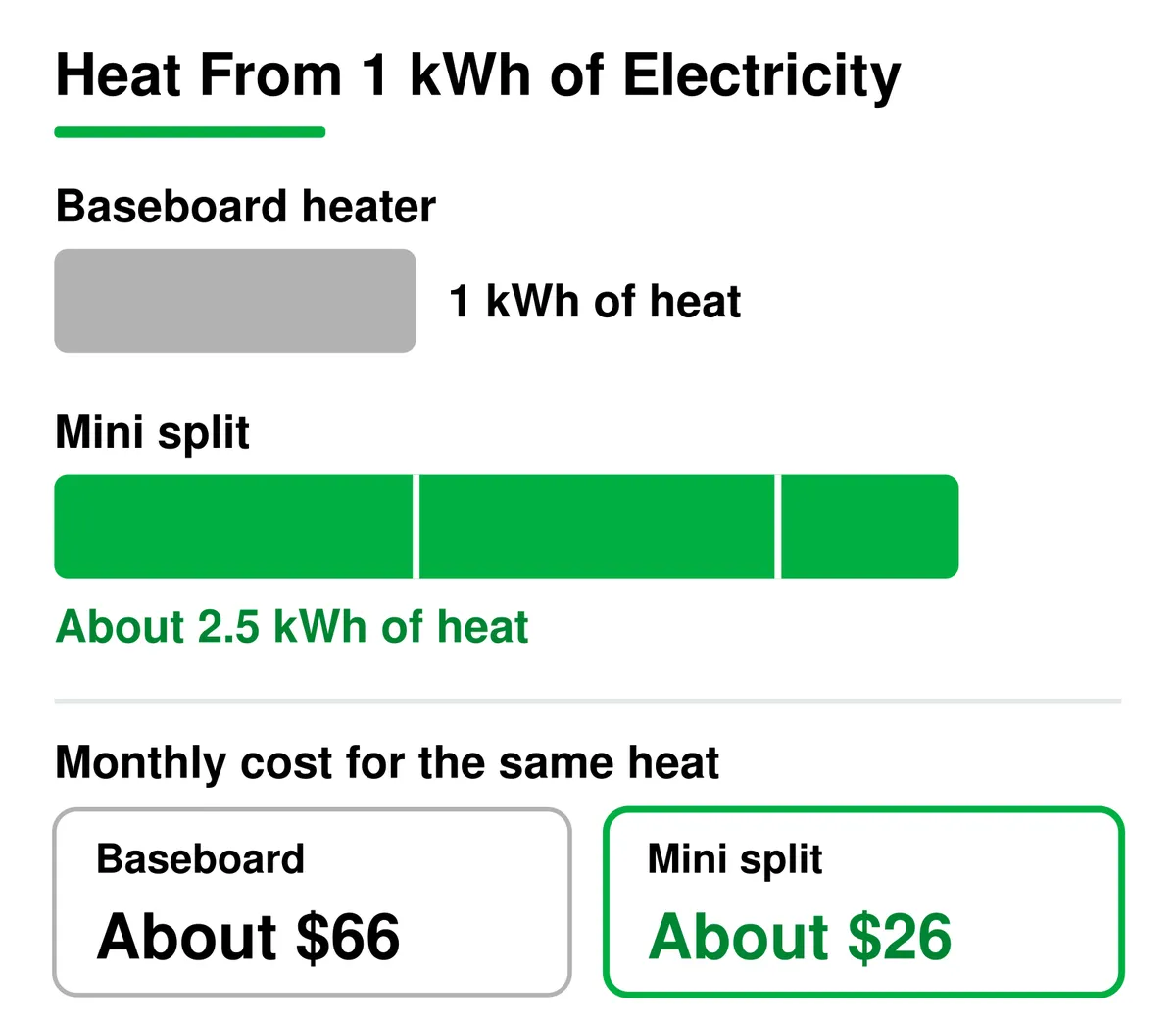
Example: one 1,500 W heater, 8 hours a day, at the 2026 EIA U.S. average rate of 18.2 cents per kWh and a mini split seasonal COP of 2.5. Your costs will vary.
Compare Mini Split Sizes and Prices
Not sure which size fits your space? Answer a few quick questions and we'll match you to the right mini split.
TL;DR
Electric baseboard heat costs little to install but a lot to run, because every kilowatt-hour of electricity becomes just one kilowatt-hour of heat. A ductless mini split moves heat from outdoor air instead of making it, so it typically uses 50% to 60% less electricity for the same warmth, with summer cooling included. If baseboards are your main heat source, Filterbuy's payback math shows the switch usually recovers its cost in about 4 to 13 years. For a room you rarely use, baseboards often remain the cheaper choice.
Key Takeaways
Electric baseboard heat is 100% efficient yet expensive to run. Each kilowatt-hour becomes roughly 3,412 Btu of heat, per the U.S. Department of Energy.
A mini split heat pump can deliver up to two to four times more heat than the electricity it uses, according to the DOE.
Installation flips the cost picture: baseboard heaters run roughly $400 to $900 each installed, while mini splits run $2,000 to $7,000 per zone.
The federal 25C heat pump credit ended for systems installed after December 31, 2025.
Mini Split vs. Baseboard Heat at a Glance
In short, a mini split costs more up front and less every month. This page covers electric baseboards, not hydronic (hot-water) baseboards heated by a boiler.
Sources: Homewyse, Filterbuy mini split cost guide, how long mini splits last, DOE, ENERGY STAR.
How Much Does Each System Cost to Install?
Baseboard heat is the cheapest system to install, at roughly $400 to $900 per heater. A mini split costs $2,000 to $7,000 per zone, per Filterbuy's mini split cost guide.
With baseboards, most of the bill goes to an electrician running a 240-volt circuit and thermostat. Homewyse estimated the national average at $479 to $570 per heater in May 2026.
Each mini split needs a dedicated circuit, so an older 100-amp panel may need an evaluation (see Filterbuy's mini split electrical requirements), although retiring baseboard circuits can free up capacity.
Incentives also changed. The federal 25C credit was terminated for heat pumps placed in service after December 31, 2025, as Filterbuy's heat pump tax credit guide details. HEEHRA rebates of up to $8,000 for income-qualified households and many utility rebates remain; our 2026 heat pump rebates guide tracks them, and DSIRE and the ENERGY STAR Rebate Finder let you search by ZIP code. Confirm eligibility with a tax professional.
"If you are holding a 2026 quote with a $2,000 credit written into it, the install date is the only number that matters." — Michelle Wan, Brand Manager, Filterbuy
Mini Split vs. Electric Baseboard: Monthly Cost to Run
A mini split typically costs 50% to 60% less to run than electric baseboard heat. The DOE says heat pumps cut electricity use by 50% versus resistance heating, and ENERGY STAR puts certified mini splits at up to 60% less.
The difference is the coefficient of performance (COP). Baseboard heat has a COP of 1.0, while a mini split's seasonal COP usually lands between 2 and 3.
Filterbuy's bill math, one room: A 1,500-watt baseboard heater running 8 hours a day costs roughly $66 a month at the U.S. Energy Information Administration's 2026 average of 18.2¢/kWh. A mini split delivers the same heat for about $26.
Filterbuy's bill math, whole home: Picture a 1,200-square-foot home whose baseboards use 9,000 kWh each winter.
Savings rise with your electricity rate and shrink in very cold climates.
Ductless vs. Baseboard Heating: Comfort, Cooling & Cold Weather
Ductless mini splits win on comfort because one system heats in winter and cools in summer, though baseboards are quieter.
Cooling is the hidden tiebreaker. Most baseboard homes cool with window units. A mini split replaces them, and that avoided cost belongs in your payback math.
Dust works differently, too. Baseboard fins gather dust that smells burnt at the first cold snap. A mini split pulls room air through a washable pre-filter that protects the coil, while your whole-home filter does the heavy lifting for air quality. See how mini split filtration works.
Cold climates are no longer a dealbreaker. ENERGY STAR's cold-climate certification requires verified heating at 5°F, and certified units keep running below that. We're upfront about our own line: Filterbuy mini splits heat reliably down to 5°F and operate to -4°F. In climate zones 5 through 8, we recommend keeping backup heat or choosing a cold-climate model. See how mini splits perform in cold weather.
"We publish both our -4°F operating range and our 5°F heating rating because the first tells you when the unit stops running, and the second tells you when you need a backup plan." — Michelle Wan, Brand Manager, Filterbuy
If you keep baseboards as backup, set their thermostats a few degrees below the mini split's setpoint so the heat pump runs first. Filterbuy's mini split backup heat guide shows backup needs by climate zone.
When Does Replacing Baseboard Heat With a Mini Split Pay Off?
The switch pays off fastest when baseboards are your main heat and your electricity rate is at or above the national average, often within 4 to 9 years. Filterbuy's grid below assumes an $8,000 three-zone mini split that uses 60% less electricity (a seasonal COP of 2.5), before any rebates.
Filterbuy's take: For main heat at average rates or more, buy the mini split; for a rarely heated guest room, keep the baseboard.
Run Your Own Payback In 60 Seconds
To check your numbers: payback years = install cost ÷ (annual baseboard heating kWh × 0.6 × your rate in $/kWh). For example, a home that uses 6,000 kWh of baseboard heat at 22¢ saves $792 a year, so an $8,000 quote pays back in 10.1 years. In a typical 8,000 kWh home, the same quote pays back within 10 years at any rate above about 17¢/kWh.
The Budget Path: One Head, Baseboards As Backup
You don't have to convert every room. In the Northwest Energy Efficiency Alliance's (NEEA) 95-home study, most homes added a single indoor head in the main living area, kept their baseboards, and still saved 3,049 kWh a year on average. At 18.2¢, that comes to roughly $555 a year, so a $4,000 single-zone install pays back in about 7 years (about 4 at 30¢, 10 at 13¢). This supplemental-zone setup is where value single-zone systems, Filterbuy's included, fit best.
How To Replace Baseboard Heat With A Mini Split
Estimate your heating kWh. Subtract summer usage from winter bills, then use the formula above.
Get three itemized quotes from licensed installers, each with a Manual J load calculation. See Filterbuy's mini split sizing guide.
Map your zones, with one indoor head per room you want fully heated.
Decide what happens to the baseboards. In cold climates, keep one or two as backup and have an electrician disconnect the rest.
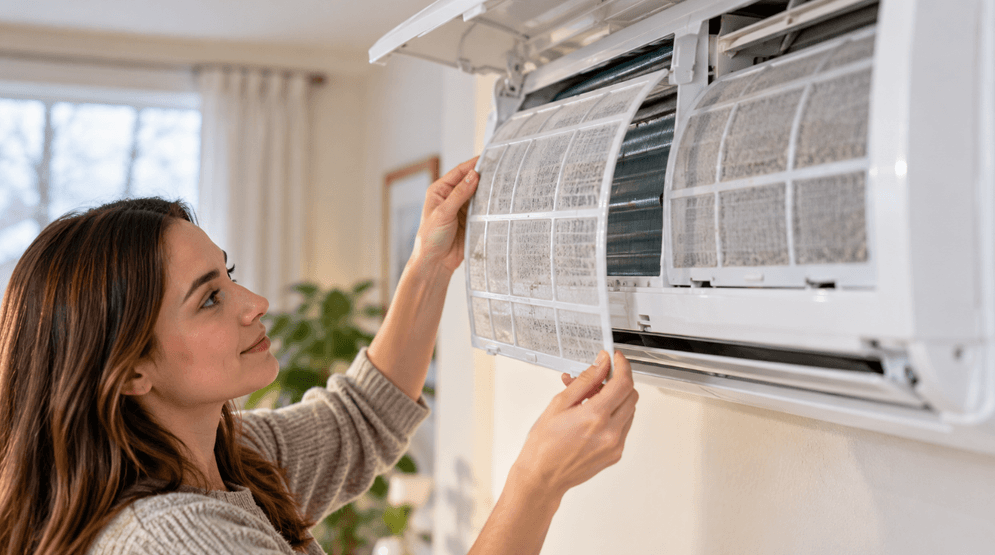
Set a filter-cleaning schedule before the installer leaves. See how to clean mini split filters.
Protecting Your Savings: Mini Split Maintenance
A mini split's savings depend on a clean filter, an upkeep task baseboards never had. In Filterbuy's service data, an unchecked filter is the most common cause of ductless problems, and a dirty filter cuts efficiency by 5% to 30%. In the whole-home example above, that would erase roughly $35 to $280 of the $983 in yearly savings, and restoring a dust-coated coil adds $350 to $600.
Pro Tip: Filterbuy's factory testing found fine dust under 10 microns is harder on a system than visible dirt. Wash each head's pre-filter every 2–4 weeks during heating season, or every 1–2 weeks if you have pets.
Beyond filters, keep the outdoor unit clear of snow and book annual service; our complete mini split maintenance guide covers the rest. Filterbuy mini split systems are single-zone and ship with free 2-day delivery on in-stock systems and a 7-year compressor / 3-year parts warranty. Professional installation is required, and the warranty is void if self-installed. If a furnace stays on as backup, an air filter subscription keeps its filter changes on schedule.
How we built this comparison: Filterbuy manufactures air filters in the USA, and our HVAC Solutions team services ductless systems in Florida and Texas homes. We also sell single-zone mini splits, so we say plainly where our units fit and where they don't. Licensed HVAC technician David Clark reviewed our cost math, built from federal energy data.
Supporting Statistics
42% of U.S. households now heat mainly with electricity. Source: U.S. Energy Information Administration (2025)
Mini splits cut heating use by an average of 3,049 kWh a year in baseboard-heated homes. Units in this 95-home metering study averaged a seasonal COP of 3.0. Source: Northwest Energy Efficiency Alliance (2012)
Poor installation can raise heating and cooling energy use by about 30%. Source: National Institute of Standards and Technology (2014)
Frequently Asked Questions
When is baseboard heat cheaper than a mini split?
Usually in rooms you rarely use, or in mild climates with low electricity rates, where a mini split can take 15 years or more to pay back.
Do mini splits work in cold weather?
Yes. ENERGY STAR cold-climate models are verified to heat at 5°F; keep backup heat in very cold regions.
Can a mini split completely replace baseboard heat?
In most U.S. climates, yes, if it's sized with a Manual J load calculation and each main room gets a dedicated indoor head.
How many mini split heads do I need to replace baseboard heat?
One per room you want fully heated, because warm air doesn't travel well through closed doors. See Filterbuy's mini split sizing guide.
Are there tax credits for mini splits in 2026?
Not at the federal level. The 25C credit ended for heat pumps installed after December 31, 2025, but HEEHRA and utility rebates remain in many areas.
Glossary
Electric baseboard heater: A wall heater that warms a room with an electric resistance element.
Ductless mini split: A heat pump with an outdoor unit and one or more ductless indoor heads.
Heat pump: Equipment that moves heat with refrigerant instead of generating it.
Coefficient of performance (COP): Heat delivered divided by electricity used; 1.0 for baseboards, 2 to 3 for mini splits.
Cold-climate heat pump: A heat pump ENERGY STAR verifies to heat at 5°F.
Zone: An area, usually one room, served by one indoor head.
Manual J: The standard load calculation for sizing heating and cooling equipment.
Btu (British thermal unit): A unit of heat; one kilowatt-hour (kWh) equals roughly 3,412 Btu.
25C tax credit: A federal heat pump credit that ended after December 31, 2025.
DSIRE: A ZIP-code database of state and utility incentives.
HEEHRA: A federally funded, state-run rebate of up to $8,000 toward a heat pump for income-qualified households.