Mini Split Outdoor Unit Keeps Icing Over? A Step-by-Step Troubleshooting Guide
October 31, 2026
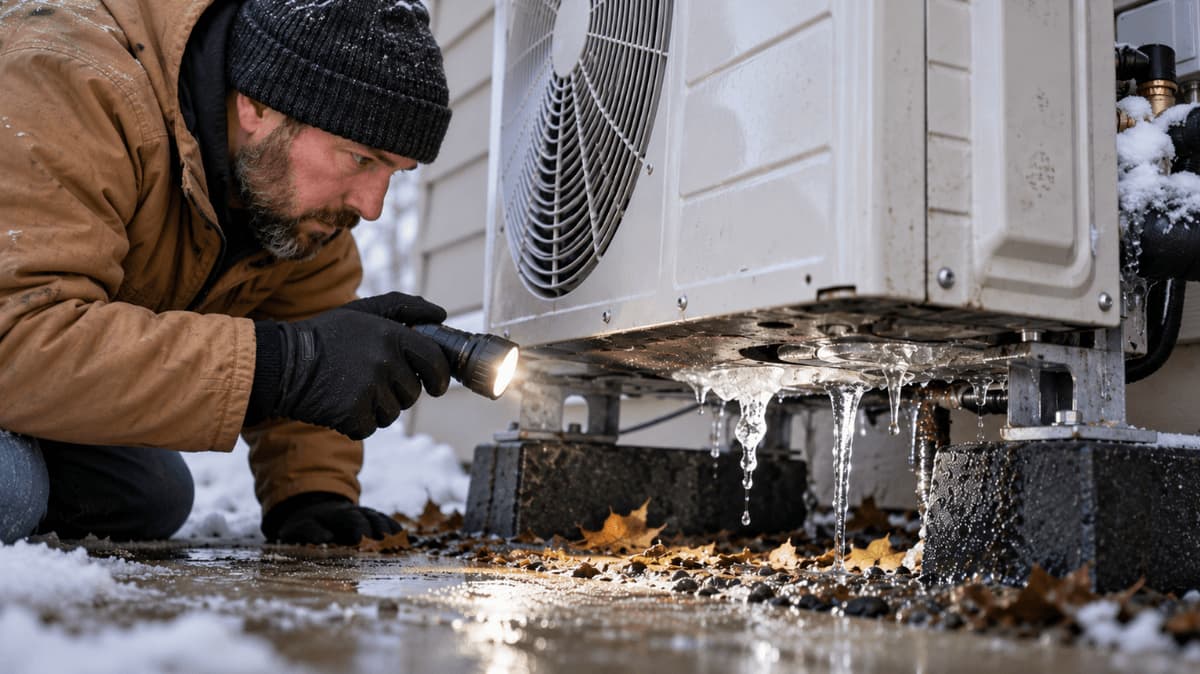
Light frost in heat mode is normal, but ice that keeps coming back has a cause. It’s usually snow blocking airflow, meltwater that can’t drain, roof runoff refreezing on the cabinet, or a failed defrost cycle. You can often fix the first three yourself. A failed defrost, an iced fan, or frost on the refrigerant lines needs a licensed HVAC technician.
Thinking about a replacement? Take the quick match quiz below to find the right mini split for your space.
Take the Mini Split Quiz Shop Mini Split Systems
Read where the ice sits
Light frost is normal. Ice that keeps returning has a cause.
- 1Ice on top or fan grilleRoof runoff or freezing rainYOU CAN CHECK
- 2Snow packed on the sidesSnow is blocking airflowYOU CAN CHECK
- 3Ice mound under the unitMeltwater can’t drain and refreezesYOU CAN CHECK
- 4Whole coil iced, no steamDefrost cycle isn’t workingCALL A PRO
- 5Frost on refrigerant linesLikely low refrigerantCALL RIGHT AWAY
- 6Fan frozen or grindingIced fan or failing fan motorCALL A PRO
Never chip, scrape, or heat the ice. Let it melt.
Find Your Mini Split Match
Answer a few quick questions and we’ll match you to the right single-zone mini split for your space.
Every Filterbuy mini split has intelligent defrost and a chassis heating belt. Browse all mini split systems. Professional installation required.
TL;DR
Light frost is normal in heat mode; ice that keeps coming back has a cause. If the coil never clears or the fan or refrigerant lines ice up, turn the system off and call a licensed HVAC technician.
Key Takeaways
Light frost is normal; returning ice isn't.
Drainage is the most overlooked cause. Trapped meltwater refreezes and creeps into the coil.
Avoid drain hoses in cold climates when you can, since they can freeze shut.
Never chip, scrape, or heat the ice. Let it melt.
A failed defrost cycle is a job for a technician, not a home fix.
Why Does My Mini Split Outdoor Unit Keep Icing Over?
When a mini split outdoor unit keeps icing over, the cause is usually snow blocking airflow, meltwater that can't drain, roof runoff refreezing on the cabinet, or a failed defrost cycle. You can often fix the first three; a failed defrost or iced fan or refrigerant lines need a licensed technician.
Start Here: Read Where the Ice Sits
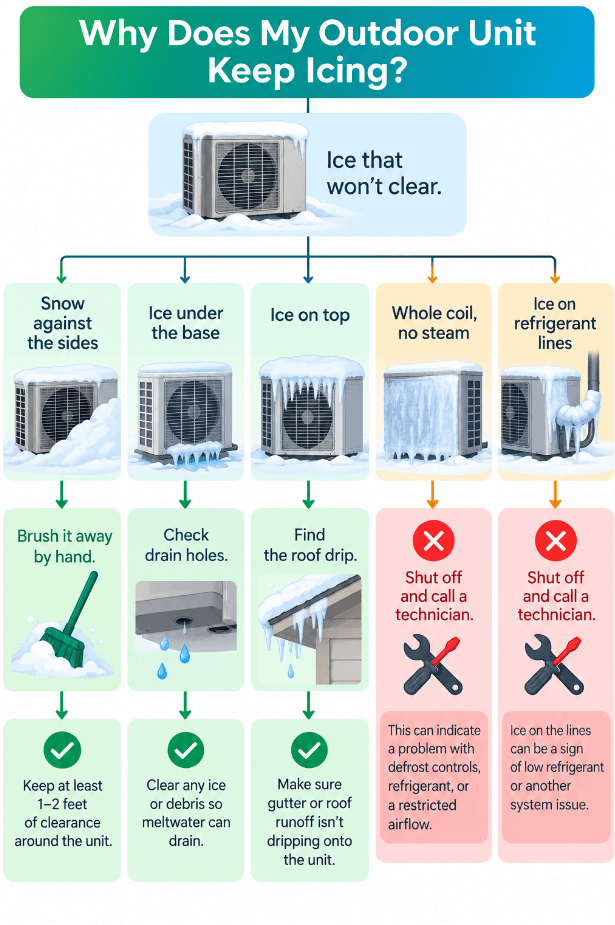
If your outdoor unit keeps freezing, where the ice sits is the fastest clue to its cause, so Filterbuy built this table around location. Ice on the indoor unit is a different problem; Filterbuy's guide to why a mini split freezes up covers it.
| What You See | Most Likely Cause | Safe Homeowner Check | Stop and Call? |
|---|---|---|---|
| Snow packed against the back or sides | Blocked airflow | Brush snow away by hand | Only if ice stays after clearing |
| Ice mound under the unit, bottom coil rows frozen | Blocked drainage or refreezing meltwater | Check drain holes and the ground below | If ice reaches the fan or coil |
| Ice on the top or fan grille | Roof runoff or freezing rain | Look for drips from a gutter or roof edge | If the fan is frozen still |
| Whole coil iced, no steam for 2+ hours | Defrost cycle failure | Check for a code | Yes |
| Frost on one section of the coil or on the refrigerant lines | Low refrigerant | None | Yes, right away |
| Fan not spinning, or grinding noise | Iced fan or failing fan motor | Power off; look for blade ice | Yes |
Cause 1: Snow Accumulation Is Blocking Airflow
Snow is the most common reason a mini split or heat pump outdoor unit ices over after a storm. Packed against the coil, it starves the unit of air, and frost builds faster than defrost can melt it. NB Power, the New Brunswick utility, warns snow buildup can freeze the unit or cause fan motor failure (NB Power).
Safe check: After each snowfall, brush snow off by hand or with a soft broom.
Long-term fix: Filterbuy recommends raising the base pan at least 12 inches above your deepest typical snow; see our guide to how high a mini split outdoor unit should be for snow.
Cause 2: Drainage Blockage Is Trapping Meltwater
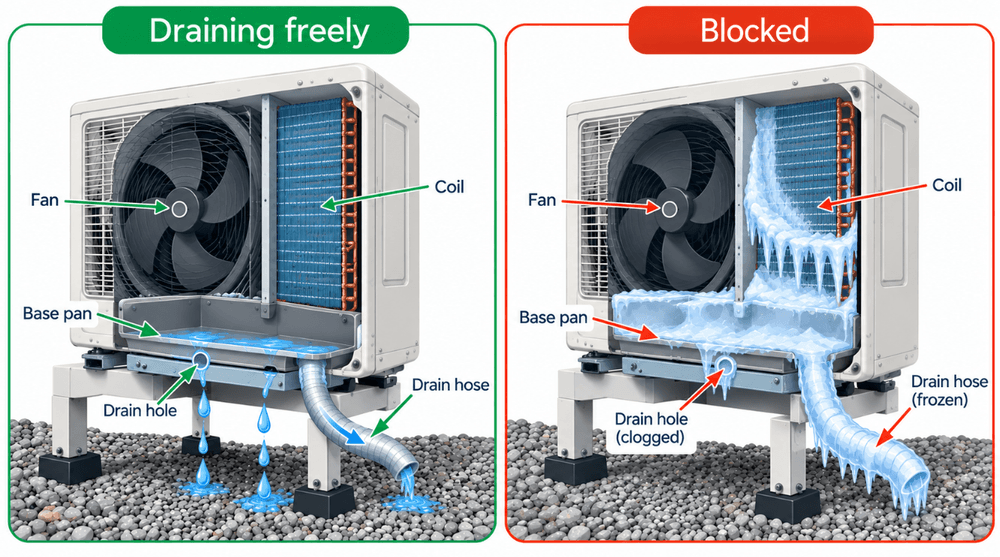
Drainage problems build ice from the bottom up. Defrost meltwater drains through holes in the base pan, and when those holes clog or the ground below is frozen, it refreezes and climbs into the lower coil rows and fan.
Drain hoses can make this worse. Mitsubishi Electric's drain socket manual warns against using one in cold areas because the tube can freeze (Mitsubishi Electric).
Safe check: With the power off, check under the unit for clogged drain holes, a hose, or piled-up ice.
When to call: If ice fills the base pan or reaches the coil or fan, call a technician. Every Filterbuy mini split has a chassis heating belt and intelligent defrost, so on our units we check height and drainage first. In NREL testing, one mini split's drain pan heater ran half the time at 14°F (U.S. DOE). Our mini split winterizing guide explains this ice collar.
Cause 3: Roof Runoff or Freezing Rain Is Icing the Unit
Ice on the cabinet top or fan grille usually comes from above: water drips from a roof edge or gutter onto the cold unit and freezes, and freezing rain glazes it the same way. Efficiency Maine, a state program, warns this water can freeze on the fan and send the unit into defrost (Efficiency Maine).
Safe check: During a thaw, watch the roof edge for icicles or dripping.
Long-term fix: Add a diverter or open-sided snow hood, or move the unit.
Cause 4: The Defrost Cycle Isn't Working
When defrost stops working, frost never leaves the coil. Normally the reversing valve sends hot refrigerant to the outdoor coil while the outdoor fan stops (Natural Resources Canada); on Filterbuy units, the indoor fan pauses too. A failed sensor, control board, or reversing valve breaks that cycle, and in worst-case conditions, defrost can cut heating capacity by up to 29% (ACEEE). Our mini split defrost mode guide shows a healthy one.
| Behavior | Normal Defrost | Failing Defrost |
|---|---|---|
| Frequency | About every 30–90 minutes in cold, damp weather | Never, or every few minutes |
| What you see outside | Steam, dripping water, frost clearing | No steam; ice keeps thickening |
| Indoor unit | Fan pauses 5–15 minutes, then heat resumes | Cold or lukewarm air for long stretches |
| Error code | None | Sometimes a sensor or system code |
Safe check: Watch two hours of heating. If the coil never clears or the ice keeps thickening, note any error code and stop. In a DOE field study, one problem site spent 16% of its cold hours in defrost (PNNL).
Why it's a technician job: In the Filterbuy owner's manual, E3 flags the outdoor pipe temperature sensor and E7 the outdoor ambient sensor. Look up any code in Filterbuy's mini split blinking light guide before resetting; repeated resets can turn a sensor repair into a compressor repair. Controls matter too: in NREL testing, a mini split spent about 60% of its time defrosting or recovering, and revised settings cut defrost time 65% to 85% (U.S. DOE).
Cause 5: Airflow or Refrigerant Faults
A failing outdoor fan motor can't move enough air, so frost outpaces defrost. Low refrigerant, usually from a leak, makes the coil run too cold and often frosts one coil section or the refrigerant lines first.
Safe check: With the power off, clear matted leaves by hand; don't straighten fins.
When to call: Call right away for frost on the refrigerant lines, hissing, or a fan that won't spin once free of ice. On Filterbuy units, EF flags an outdoor fan motor fault and E4 a refrigerant leak. Opening the refrigerant circuit requires EPA Section 608 certification, so leak repair is never DIY.
Check the Weather Before You Worry
About 17.2 million U.S. homes heat mainly with a heat pump or mini split (U.S. EIA), so winter frost is common. Frost depends on both temperature and moisture (Natural Resources Canada), and in DOE field data, defrost activity dropped off sharply above 40°F (PNNL). Use this quick filter:
Foggy or drizzly, 20°F to 40°F: Frequent frost and defrost are expected.
Dry and well below freezing: Frost builds slowly, so heavy ice is worth a closer look.
Above 40°F: Heavy ice is unusual. Check airflow and drainage first, then refrigerant.
Safe Homeowner Checks for an Iced Outdoor Unit
Stop at any step that points to a technician.
Read the indoor unit first and note any error code.
Turn the system off at the remote, then the breaker.
Clear snow by hand, leaving bonded ice in place.
Check the drainage for blocked holes, a hose, or an ice mound.
Look up for a roof edge or gutter dripping onto the unit.
Run heat for two hours. A healthy unit clears its coil at least once.
If the unit is already frozen solid, follow Filterbuy's guide to a mini split outdoor unit iced over.
When to Stop the System and Call a Technician
Call a licensed technician when ice points to a failed part, refrigerant leak, or electrical risk, using backup heat until then.
| Sign | What to Do |
|---|---|
| Frost or ice on the refrigerant lines | Shut off now and call |
| Burning smell, smoke, or a tripping breaker | Shut off now and call |
| Fan frozen still or grinding | Shut off now and call |
| Coil fully encased after 2 hours of heating | Shut off and call |
| Ice that comes back within a day of clearing | Schedule service this week |
| Ice mound under the unit every cold snap | Schedule service; ask about height and drainage |
Keep a Two-Day Ice Log Before You Call
A log turns "it keeps icing" into evidence. For two days, note at each check:
The time, outdoor temperature, and weather.
Where the ice sits.
Any steam or dripping since your last check.
Any error code.
Photograph the same spot each time; side by side, photos show whether ice is clearing or growing. Share the log, photos, and model number with your technician or Filterbuy's Mini Split Support Center.
For Filterbuy owners, the visit also documents the problem: warranty claims require a certified technician's diagnostic report.
Replacing an older unit? Filterbuy single-zone mini splits ship free in 2 days on in-stock systems, with a 7-year compressor / 3-year parts warranty and reliable heating down to 5°F. Where winters run well below that, choose a model rated lower. Shop Mini Split Systems. Professional installation required; warranty is void if self-installed.
Why Filterbuy Looks Under the Unit First
Filterbuy sells single-zone ductless mini splits and manufactures air filters in the USA, so when a unit ices up, we look at airflow and drainage first. That's why every Filterbuy outdoor unit has intelligent defrost and a chassis heating belt. Our rule: read where the ice sits before you touch it.
"Most people check the coil. We check under it. Frost on the fins clears itself; meltwater that can't drain turns into a repair bill." — Filterbuy
Supporting Statistics
Up to 29% Less Heating Capacity
In worst-case conditions, defrost can cut heating capacity up to 29% and efficiency up to 17.4%.
Source: ACEEE 2024, PNNL
16% of Cold Hours in Defrost
In a DOE study of 22 cold-climate heat pumps, one site spent 16% of its time below 40°F in defrost.
Source: PNNL-37127
17.2 Million Heat Pump Homes
About 17.2 million U.S. homes heat mainly with a heat pump or mini split.
Source: U.S. EIA, 2020 RECS
Frequently Asked Questions
Is ice on a mini split outdoor unit normal?
Light frost in heat mode is normal and clears during defrost. Ice that keeps returning points to a problem.
How do I thaw a frozen mini split outdoor unit safely?
Turn it off, brush away loose snow, and let the ice melt. Never chip, scrape, heat, or pour water on it.
Why does my mini split freeze at the bottom?
Defrost meltwater can't drain, usually from clogged drain holes, a frozen hose, or a unit mounted too low.
Should I cover my mini split outdoor unit in winter?
Not with a full cover, which traps moisture and blocks airflow; see Filterbuy's guide to covering a mini split in winter.
When should I call a technician about an iced outdoor unit?
Call if the coil stays iced after two hours of heating, the fan won't spin, or frost forms on the refrigerant lines.
Glossary
Mini split (ductless mini split): A ductless heat pump linking an indoor unit to an outdoor unit.
Defrost cycle: An automatic pause in heating that warms the outdoor coil to melt frost.
Base pan: The outdoor unit's bottom tray, with holes that drain meltwater.
Base pan heater: A small heater that stops meltwater refreezing in the base pan.
EPA Section 608 certification: Federal certification required to handle refrigerant.
Written by Michelle Wan, Brand Manager & Copywriter, who works with Filterbuy's U.S. manufacturing team. Reviewed by David Clark, EPA-certified HVAC technician, Filterbuy HVAC Solutions. Filterbuy is not affiliated with or endorsed by Mitsubishi Electric.