Does a Mini Split Dry Out the Air in Winter? Humidity, Comfort & Health
October 31, 2026

Your mini split isn’t pulling water out of the air while it heats. The dry feeling comes from cold outdoor air leaking in and losing relative humidity as it warms up.
Set your remote to Heat, not Dry or Auto. Then seal air leaks and run a humidifier to keep indoor humidity between 30% and 50%.
Shopping for a ductless system? Take the quick match quiz below.
Find Your Mini Split Match
Answer a few quick questions and we’ll match you to a ductless system that fits your space.
Already know what you need? Browse Filterbuy mini split systems, built with multi-layer filtration and a filter-cleaning reminder.
TL;DR
Not in heat mode. A mini split's indoor coil runs hot in winter, so no water condenses on it and nothing drains away. The dryness comes from cold, low-moisture outdoor air leaking in and warming until its relative humidity falls. Filterbuy recommends sealing air leaks and running a humidifier to keep indoor humidity between 30% and 50%, then easing that target down on the coldest days to protect your windows.
Key Takeaways
Winter dryness starts with cold air leaking in. Building scientist Bruce Harley notes that 40°F air at 40% humidity drops to about 10% once it's heated to 70°F.
Dry and Cool modes do remove moisture, so a remote left on "Dry" or "Auto" can make a winter room even drier.
On very cold days, keep humidity lower (25-30% near 0°F) to prevent window condensation.
Limiting air exchange by sealing leaks is the best way to keep winter humidity up, according to Harley.
Does a Mini Split Dry Out the Air in Heat Mode?
A mini split does not dry out the air in heat mode. The indoor unit's coil becomes the hot side of the heat pump, so water vapor has nothing cold to condense on and no moisture drains away. The dryness you notice is still real, though, and it comes from the outdoor air your home takes in. Dry air is one of the most common winter complaints Filterbuy hears from homeowners, and ductless owners tend to blame the heat pump first.
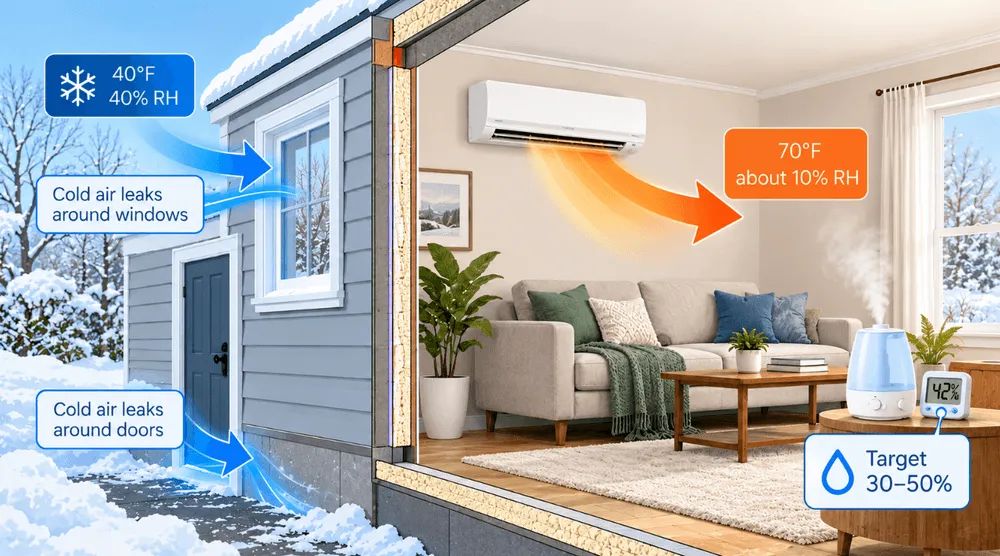
Relative humidity (RH) compares the water vapor in the air with the most that air could hold at its current temperature, and warm air can hold far more than cold air. So when 30°F air leaks in and your mini split warms it to 70°F, the amount of water stays the same while the air's capacity to hold it grows, so relative humidity plunges.
Building-science engineer Bruce Harley gives a clear example in Fine Homebuilding: outdoor air at 40°F and 40% relative humidity drops to about 10% once it's heated to 70°F with no moisture added. Homes usually read higher than that because cooking, showering, and breathing add moisture back.
That example explains why the same dry winter air complaints turn up with every heat source, heat pumps included.
Why Does My Mini Split Make the Air Feel So Dry?
A mini split usually feels drier than a furnace for one of four reasons: air leaks, moving air on your skin, the wrong mode, or a missing furnace humidifier.
| Cause | What's Happening | Quick Check |
|---|---|---|
| Air leakage | Cold, dry outdoor air infiltrates and gets heated, lowering RH | Drafts near outlets, doors, attic hatches; RH drops on windy days |
| Dry or Auto mode | Dry mode and cooling cycles condense moisture on a cold coil and drain it outside | Water dripping from the condensate line in winter; mode icon on the remote |
| Airflow on skin | Steady moving air speeds evaporation from skin, eyes, and lips | Discomfort worst when sitting in the unit's airstream |
| No humidifier hookup | Ductless heads can't host a whole-home humidifier like a ducted furnace can | You had a furnace humidifier before switching |
Air leakage is the main driver. The leakier the home, the drier it runs, which is why the U.S. Department of Energy's air sealing guide ranks sealing among the most cost-effective comfort upgrades.
Dry mode removes water on purpose. In Dry mode, the fan slows down so air lingers on a cold coil and sheds its moisture. That's handy on a muggy day (Filterbuy's mini split dry mode guide explains when to use it), but in January it only makes things worse. If you're unsure which icon is showing, Filterbuy's mini split remote symbols guide decodes them; you want the sun. ENERGY STAR's ductless heating and cooling guidance also recommends skipping Auto mode, since it can switch into cooling on mild afternoons.
Heat pumps also aren't inherently "dry heat." A mini split burns no fuel, so unlike older natural-draft furnaces, it never sends indoor air up a flue and pulls in dry outdoor air to replace it.
Filterbuy's take: We make air filters and sell our own ductless mini split systems, and to us, winter dryness is a moisture and air-leak issue first. Turning up the setpoint or trading a mini split for a furnace adds no water to the air, so the better place to start is sealing leaks and running a humidifier where you sleep.
Can Dry Mini Split Air Cause Dry Skin and Sinus Problems?
Yes. Low winter humidity can dry out your skin, lips, and eyes, along with the lining of your nose and throat. The Mayo Clinic connects dry indoor air to irritated sinuses, nosebleeds, and cracked lips, and it recommends keeping home humidity between 30% and 50%. For dry skin in particular, the American Academy of Dermatology suggests running a humidifier in your bedroom overnight.
Almost every winter complaint we hear, whether it's static shocks, dry sinuses, or cracked wood, traces back to that one reading falling below 30 percent.
— Filterbuy Air Quality Team
Watch for these signs that a room is too dry:
Itchy, flaky, or tight-feeling skin and chapped lips
Scratchy throat or stuffy nose, especially after sleeping
Dry, irritated eyes, worse for contact lens wearers
Static shocks from doorknobs, blankets, and pets
Moisture has an upper limit, too. The EPA advises keeping indoor humidity below 60%, and ideally between 30% and 50%, to limit mold growth.
If symptoms linger after humidity is back in range, talk with a doctor, since ongoing nosebleeds, eczema flares, or breathing trouble can have other causes.
How to Keep Indoor Humidity at 30-50% With Mini Split Heat
Start by measuring, because it's hard to fix a number you haven't seen. From there, add moisture where you spend the most time and stop dry air from leaking in.
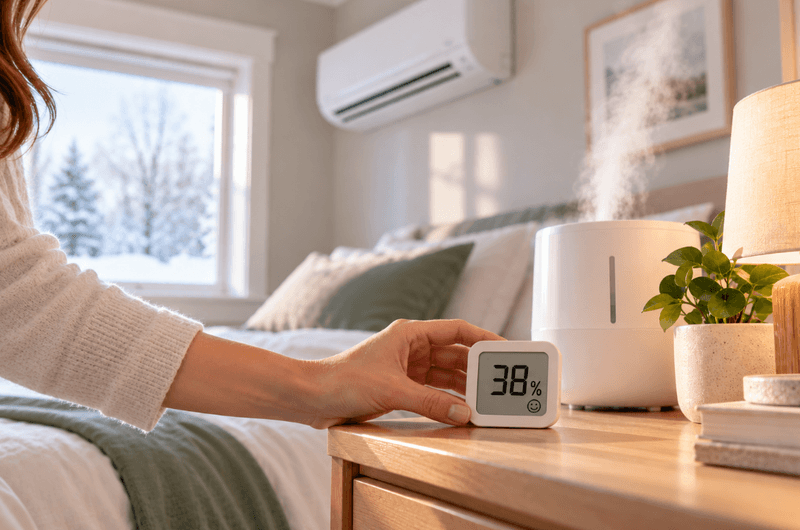
Measure before you add. Set a hygrometer at seated height in your main living area and bedroom, away from the mini split's airflow and the kitchen, and check it morning and evening. Filterbuy's guide on how to measure humidity covers placement.
Confirm heat mode. On cold days, set the unit to Heat, never Dry or Auto.
Add a room humidifier. Place an evaporative or ultrasonic humidifier in the zones you use most, sized for the room's square footage. A built-in humidistat lets it shut off at your target. Fill it with distilled water and clean it every three days, as the Mayo Clinic advises.
Seal the leaks. Weatherstrip doors, caulk around window trim, add gaskets to exterior outlets, and seal the attic hatch.
Ventilate smartly. An energy recovery ventilator (ERV) brings in fresh air while holding on to some indoor moisture.
Redirect the airflow. Aim the louvers toward the ceiling or away from beds and sofas.
Lower the target on frigid days. If fog or frost forms on the inside of your windows, humidity is too high for the outdoor temperature.
We publish air quality guides year-round, and when a reader says their hygrometer is wrong, it almost never is. It is on a windowsill or over a vent, describing six inches of air.
— Michelle Wan, Brand Manager and Air Quality Writer, Filterbuy
When it gets truly cold, use this ceiling from the Fenestration and Glazing Industry Alliance (FGIA) to avoid window condensation in a 70°F home:
How to Size a Humidifier for a Mini Split Room
Match the humidifier to the room, not to a gallons-per-day guess. How much moisture a room loses depends on how leaky the home is, so no single output figure fits every space.
Check the coverage area printed on a humidifier's box against your room's size, and choose a model with a built-in humidistat so it shuts off at your target. Sealing leaks first makes any humidifier's job easier, since less dry outdoor air is replacing the moist air you've added.
Keep Your Mini Split Filters Clean All Winter
Filterbuy mini splits use multi-layer filtration with a filter-cleaning reminder, and like most ductless units, they have a washable mesh pre-filter. Filterbuy's mini split maintenance guide explains how to rinse it; follow the cleaning schedule in your owner's manual. The pre-filter protects the coil; your whole-home filter does the heavy lifting for air quality. We don't stock brand-specific mesh panels, so if yours is torn or warped, our guide to mini split replacement filters walks you through ordering one by part number.
If part of your home still runs on a ducted furnace or air handler, keep a fresh pleated filter in it, especially in winter. Filterbuy manufactures air filters in the USA. Find your filter size or set up auto-delivery so a replacement arrives before you need it.
Supporting Statistics
About 2 million U.S. homes use a ductless mini split as main or secondary heat, according to the 2020 Residential Energy Consumption Survey, and 29.25 million homes run a humidifier.
Source: U.S. Energy Information Administration
About 5 times more flu virus stays infectious in dry air. In a CDC/NIOSH lab study, 70.6-77.3% of airborne flu viruses remained infectious at 23% humidity or lower, compared with 14.6-22.2% at 43% or higher.
Source: CDC/NIOSH, 2013
47% of U.S. homes show signs of dampness or mold, so adding moisture is only half the job; keeping it under 50% is the other half.
Source: Lawrence Berkeley National Laboratory
Frequently Asked Questions
Does a heat pump lower humidity in winter?
No. In heating mode, the heat pump's indoor coil is hot, so no moisture condenses or drains. Humidity drops in winter because cold outdoor air enters the home and its relative humidity falls as it warms.
Is it normal for my mini split to drip water in winter?
Yes. As Filterbuy's guide to defrost cycles explains, it's normal for the outdoor unit to drip, since that water comes from frost melting off the outdoor coil. If the indoor unit's drain line is running in winter, though, the system is probably in Dry, Cool, or Auto mode.
Can I put a whole-house humidifier on a ductless mini split?
No. Whole-house humidifiers mount on ductwork, which ductless systems don't have. Room humidifiers are the simplest option, or you can ask an HVAC pro about a standalone steam unit or an ERV.
Glossary
Mini split (ductless heat pump): A heating and cooling system that links an outdoor unit to one or more wall, ceiling, or floor units without ductwork.
Dry mode: A mini split setting that runs a cold coil at low fan speed to remove moisture, mainly for humid weather.
Relative humidity (RH): The water vapor in the air as a percentage of the most the air can hold at its temperature.
Hygrometer: A device that measures relative humidity.
Infiltration: Outdoor air leaking into a home through gaps, cracks, and openings.
Defrost cycle: A routine where a heat pump briefly reverses to melt frost off the outdoor coil.
ERV (energy recovery ventilator): A system that swaps stale indoor air for fresh outdoor air while recovering some heat and moisture.
Sources
U.S. Energy Information Administration: 2020 RECS Table HC6.1, Space heating in U.S. homes
CDC/NIOSH: High Humidity Leads to Loss of Infectious Influenza Virus from Simulated Coughs (2013)
Lawrence Berkeley National Laboratory: Prevalence of Building Dampness
American Academy of Dermatology: Dermatologists' top tips for relieving dry skin
U.S. Department of Energy: Consumer Guide to Air Sealing the Home
Fine Homebuilding: Where Is the Humidity Going? (Bruce Harley)