Mini Split Defrost Mode Explained: Steam, Clicks, and Pauses Are Normal
September 29, 2026

Mini Split Defrost Mode: What's Normal And When To Call A Pro
Mini split defrost mode is normal. It's an automatic cycle that melts frost off the outdoor coil in cold, damp weather, and it usually lasts 3 to 15 minutes. While it runs, the indoor unit pauses its heat and the outdoor unit may whoosh or give off white steam. Call a licensed technician if ice survives a full cycle or defrosts run back to back for hours. Weighing a new system for your home? The quick quiz below will match you to one.
Adding heat to a room this winter? Filterbuy single-zone mini splits come with fast and free 2-day delivery to most US states and a 7-year compressor, 3-year parts warranty. Each system uses intelligent defrost, and professional installation is required.
Shop Mini Split Systems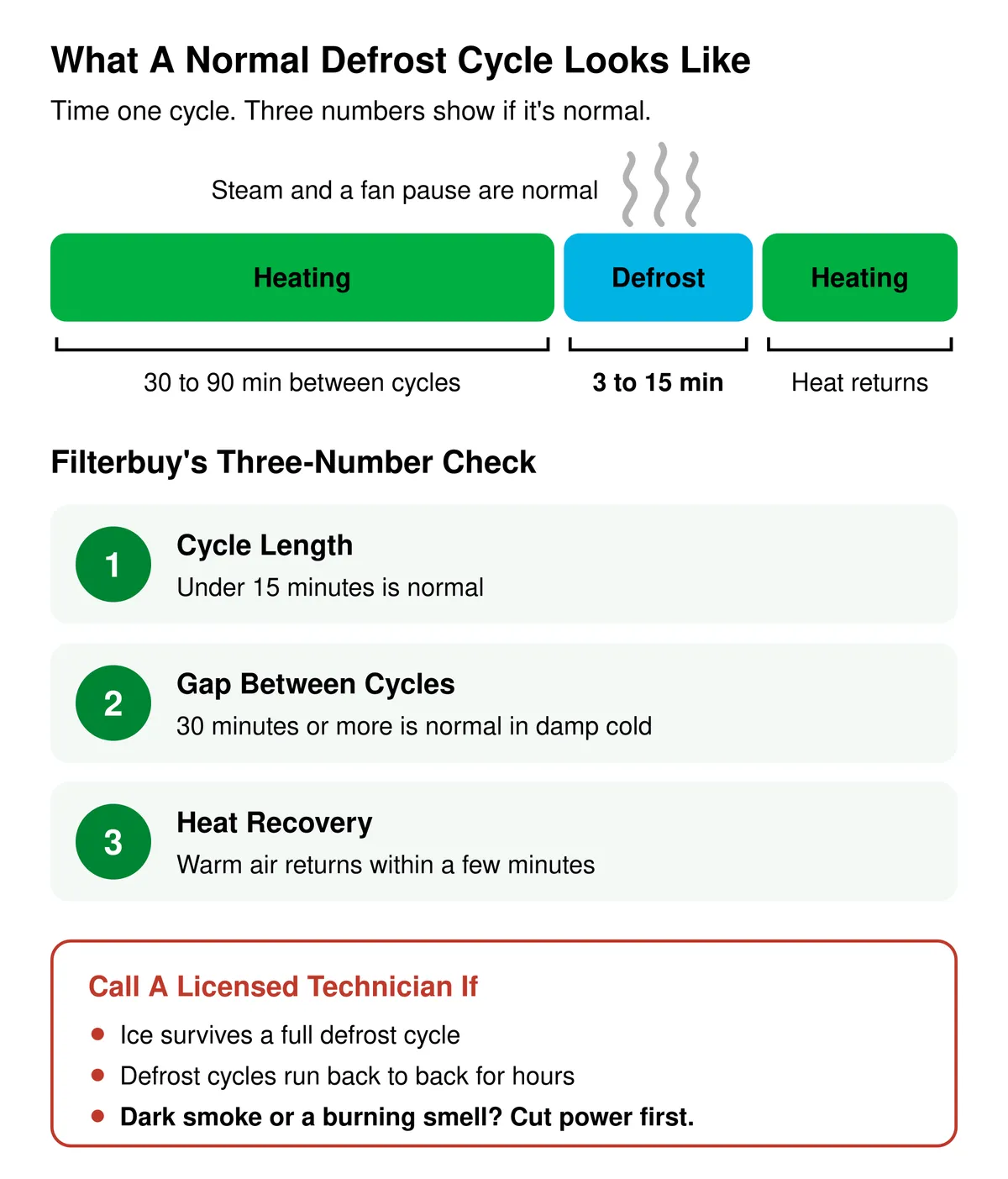
Answer a few quick questions and we'll match you to the right mini split for your space.
TL;DR: Mini split defrost mode is an automatic cycle that melts frost off the outdoor coil while your ductless heat pump runs in cold, damp weather. For 3 to 15 minutes, the indoor unit stops blowing heat and the outdoor fan goes still. A whoosh or a plume of white steam is normal too. Call a licensed technician if ice survives a full cycle or defrosts run back to back for hours. If you see dark smoke or smell burning, cut power first.
Key Takeaways
A normal mini split defrost cycle lasts 3 to 15 minutes and can repeat every 30 to 90 minutes in cold, humid weather.
Steam from a mini split outdoor unit is white and fades within a few feet. Smoke is gray or dark and smells like burning.
A slowly blinking operation light or a "dF" code usually signals defrost, though indicators vary by brand.
Ice becomes a problem when it survives a full cycle or keeps the fan from spinning.
Filterbuy recommends rinsing the indoor pre-filter every 2 to 4 weeks, since it protects the coil and keeps air moving.
If your mini split is steaming outside on a cold morning, you're not alone. Filterbuy manufactures air filters in the USA and sells single-zone ductless mini split systems,. Every January, homeowners tell our team they found frost or ice on their unit.
What Is Mini Split Defrost Mode?
Mini split defrost mode is an automatic heating-mode cycle that briefly reverses the ductless heat pump, sending hot refrigerant to the outdoor coil to melt frost. The frost forms because heating your home pulls warmth out of cold outdoor air, which leaves the outdoor coil colder than the air around it. Moisture then freezes on the fins.
Natural Resources Canada explains that frost insulates the coil and cuts its ability to transfer heat, so the heat pump has to clear it periodically.
Units trigger a cycle through demand defrost, when sensors detect frost, or time-temperature defrost, on a preset timer typically set to 30, 60, or 90 minutes.
What Happens During A Mini Split Defrost Cycle?
When a defrost cycle starts, the indoor unit stops blowing warm air and the outdoor fan shuts off. The reversing valve clicks or whooshes as refrigerant changes direction, and steam and meltwater come off the outdoor coil. Once the coil is clear, the valve switches back, and heat returns as the fans restart.
Filterbuy's guide to mini split noise in winter breaks down each sound.
How Long Does A Mini Split Defrost Last?
Most mini split defrost cycles last 3 to 15 minutes. In cold, damp weather, the system may run one every 30 to 90 minutes. Cycles that run longer, or come closer together for hours, are worth a technician's look.
To check your unit, use Filterbuy's three-number check. Time one cycle with your phone and note:
Cycle length. Under 15 minutes is normal.
Gap between cycles. 30 minutes or more is normal in damp cold.
Heat recovery. Warm air should return within a few minutes.
According to heat pump manufacturer Trane, the outdoor coil runs 10 to 20°F colder than the air, so defrost can start above freezing. Humidity matters too:
Is It Steam Or Smoke? Filterbuy's 60-Second Check
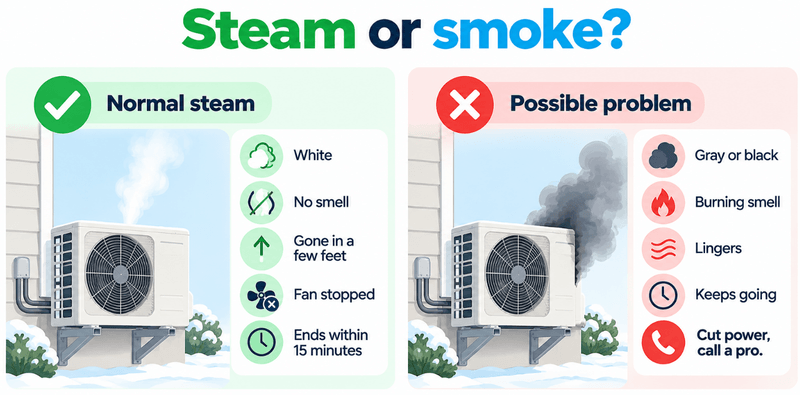
Steam from a mini split outdoor unit in winter is white and odorless. It fades within a few feet and is heaviest while the outdoor fan is stopped. Smoke is gray or black and keeps going after the cycle ends.
What looks like a mini split outdoor unit smoking in winter is almost always steam. Trane senior product manager Mark Woodruff describes that cloud as "the ice melting and evaporating." Check from a few feet away:
Color and movement. White vapor that vanishes is steam. Gray or black haze that lingers is smoke.
Smell. Steam has no odor. Smoke smells like burning plastic or hot wiring.
Fan. Steam is heaviest while the outdoor fan is stopped and may puff out as the fan restarts. Anything still pouring out minutes later isn't defrost.
Timing. Steam fades when the cycle ends, usually within 15 minutes.
If the signs point to smoke, cut power at the breaker if it's safe. Then stay back and call a licensed HVAC technician (or 911 for flames).
"Defrost is the moment a mini split looks most broken while it's actually doing its job. Give it fifteen minutes before you worry, and spend that time on the two things you control: the filter and the space around the outdoor unit." — Michelle Wan, Brand Manager and Air Quality Writer, Filterbuy
What does the defrost light on a mini split mean?
The mini split defrost light is usually the operation light blinking slowly, or a display code such as "dF," while the unit clears frost. A slow blink means the system paused heating on purpose. A fast blink or a counted flash pattern points to a fault, as does any code that stays on after heat returns.
Air conditioner manufacturer GENERAL (formerly Fujitsu General) notes that most units flash a red or green LED during defrost, while units with a wall controller show a defrost icon. If your pattern doesn't match, Filterbuy's guide to a mini split blinking light explains fault codes. Filterbuy system owners can also have our customer service team read the code with them.
When Is Ice On A Mini Split Outdoor Unit A Problem?
A thin, even layer of white frost that clears by itself is normal. Ice becomes a problem when it encases the coil in a solid sheet or builds up in the base pan and around the fan. Either way, defrost isn't clearing the coil, and heating capacity drops.
Repairs belong with a pro, since EPA refrigerant rules require Section 608 certification to add or remove refrigerant. Indoor-side ice is a separate issue covered in Filterbuy's guide to heat pump filter freezing.
How To Help Your Mini Split Defrost Properly
Most defrost problems trace back to airflow: a blocked outdoor unit or a clogged indoor filter.
Let it finish. Switching modes or cutting power mid-cycle can leave frost on the coil.
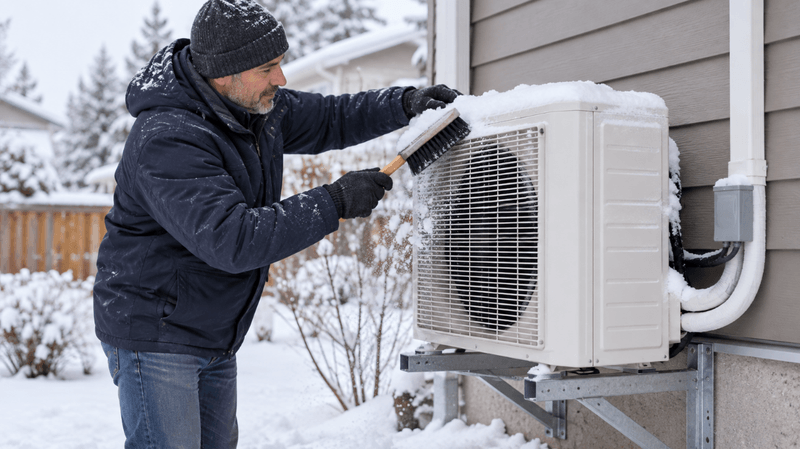
Clear the space. Keep 18 to 24 inches open and brush snow away with a soft broom. Never chip at ice; bent fins restrict airflow.
Stop the drip. Gutter overflow above the unit refreezes on the coil.
Keep it raised. A bracket or riser holds the unit above the snow line so meltwater can drain.
Don't wrap it. A heat pump needs outdoor air all winter; see how to winterize a mini split.
Rinse the indoor filters every 2 to 4 weeks. Filterbuy makes filters for these systems, and this is the part homeowners touch least. The mesh pre-filter protects the coil; your whole-home HVAC filter does the heavy lifting for air quality. See how to clean mini split filters.
Book a fall tune-up. Have the defrost sensor and base pan heater checked; our mini split service schedule covers timing.
Filterbuy single-zone mini splits ship free in 2 days on in-stock systems and carry a 7-year compressor / 3-year parts warranty. They provide reliable heating down to 5°F with intelligent defrost and a chassis heating belt. Professional installation is required, and the warranty is void if self-installed. If this unit would be your only heat source where winters stay well below zero, choose a colder-rated model.
Supporting Statistics
Up to 29% less heating capacity during defrost. In an American Council for an Energy-Efficient Economy paper on a Department of Energy field study, Pacific Northwest National Laboratory researchers note that reverse-cycle defrost can cut heating capacity up to 29% and efficiency up to 17.4% in worst-case conditions.
Up to 60% less energy than electric radiators. ENERGY STAR reports that certified mini split heat pumps use up to 60% less energy than standard electric radiators.
5% to 15% lower energy use with a clean filter. According to a U.S. Department of Energy estimate cited by Pacific Northwest National Laboratory, replacing a dirty, clogged air-conditioner filter with a clean one can lower the system’s energy consumption by 5% to 15%.
Frequently Asked Questions
Is it normal for my mini split to blow cold air in heat mode?
Yes, briefly. The indoor fan usually pauses during defrost, then warm air returns. If it stays cold past 15 minutes, check the mode and filters before calling for service.
Can I turn off mini split defrost mode, or turn the unit off while it steams?
No. Defrost runs automatically to protect the outdoor unit. Switch it off only for signs of burning or a fan grinding against ice.
Why does my mini split defrost so often?
In damp weather near freezing, frequent defrosting is normal. GENERAL also lists clogged indoor filters, a fan locked on low, a very high thermostat setting, and blocked outdoor coils. Clean the filters and set the fan to Auto first. If cycles still come less than 30 minutes apart, have a technician check the sensors and refrigerant.
Is water or ice under the outdoor unit normal?
Dripping during defrost is normal meltwater that should drain away. ENERGY STAR warns it can refreeze into icy patches near doors. Ice building up in the base pan or under the fan is not normal and needs a technician.
What should I tell a technician?
Share the outdoor temperature, your three check numbers, any display code, and both model numbers. A coil photo taken right after a cycle shows whether ice is clearing. Filterbuy owners can also ask our Mini Split Support Center to help find an installer.
Glossary
Mini split (ductless mini split): A ductless heat pump with an outdoor unit piped to one or more indoor units.
Defrost mode (defrost cycle): An automatic cycle that reverses refrigerant flow to melt frost off the outdoor coil.
Reversing valve: Switches refrigerant direction and causes the defrost whoosh.
Demand defrost: Sensor-triggered defrost that runs only when frost is building.
Time-temperature defrost: Defrost on a preset timer when the coil is cold.
Base pan heater: Keeps meltwater from refreezing in the outdoor unit's base.
"dF" code: A defrost display code on some mini splits; meanings vary by brand.
EPA Section 608 certification: The federal credential required to handle refrigerant.
About The Author
Michelle Wan is Brand Manager and Air Quality Writer at Filterbuy, working directly with its U.S. manufacturing teams. Read more from Michelle Wan.