Best Mini Split Settings for Winter: Temperature, Mode & Fan
September 29, 2026
What Temperature Should You Set Your Mini Split To In Winter?
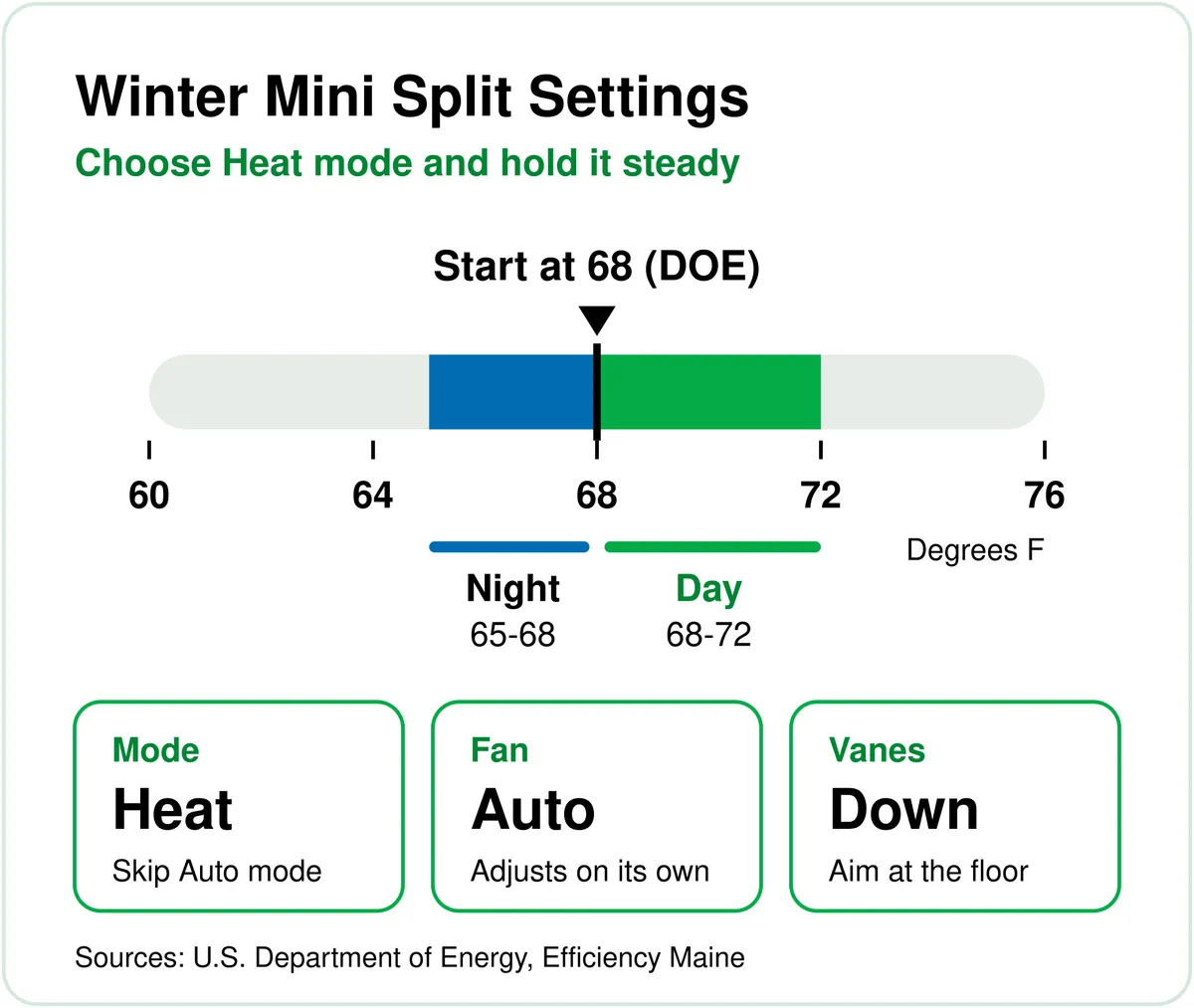
The best temperature for a mini split in winter is 68–72°F (20–22°C) in Heat mode. Start at 68°F, the U.S. Department of Energy's recommended setting for when you're home and awake. Raise it a degree or two only if the spot where you sit still feels cool.
- Mode: Heat, not Auto, which can switch to cooling on a sunny afternoon.
- Night: 2–4°F below your daytime setting, or about 65–68°F.
- Fan: Auto, with the vanes pointed down.
- Eco mode: Off during cold snaps, since many versions cap heating output.
Shopping for a new mini split? Starting at $799, Filterbuy single-zone mini splits come with fast and free 2-day delivery to most US states and a 7-year compressor warranty. Professional installation is required. Browse the lineup now or take the quick match quiz below.
Answer a few quick questions and we'll match you to a mini split for your space.
TL;DR: Pick a temperature between 68°F and 72°F in Heat mode and mostly leave it there. Mini splits are heat pumps, which work best holding a steady temperature, so deep overnight setbacks rarely pay off. On cold days, keep Auto and eco mode off.
Filterbuy manufactures air filters in the USA, and our HVAC Solutions team services ductless systems in Florida and Texas homes. This guide pairs that experience with DOE and Efficiency Maine guidance.
Key Takeaways
68–72°F in Heat mode works for most homes, with 68°F as the Department of Energy's starting point.
Choose Heat mode over Auto, which can flip into cooling on a sunny afternoon.
Keep night setbacks to 2–4°F, which lands bedrooms in the range sleep experts recommend.
Leave the fan on Auto and point the vanes down.
Trust a thermometer over the remote, since the unit senses warm ceiling air.
Mini Split Winter Settings at a Glance
Sources: U.S. Department of Energy; Efficiency Maine.
What Temperature Should I Set My Mini Split to in Winter?
For most homes, the sweet spot is 68–72°F in Heat mode. The Department of Energy recommends 68°F while you're home and awake. Where you end up in that range depends mostly on where your indoor unit measures temperature.
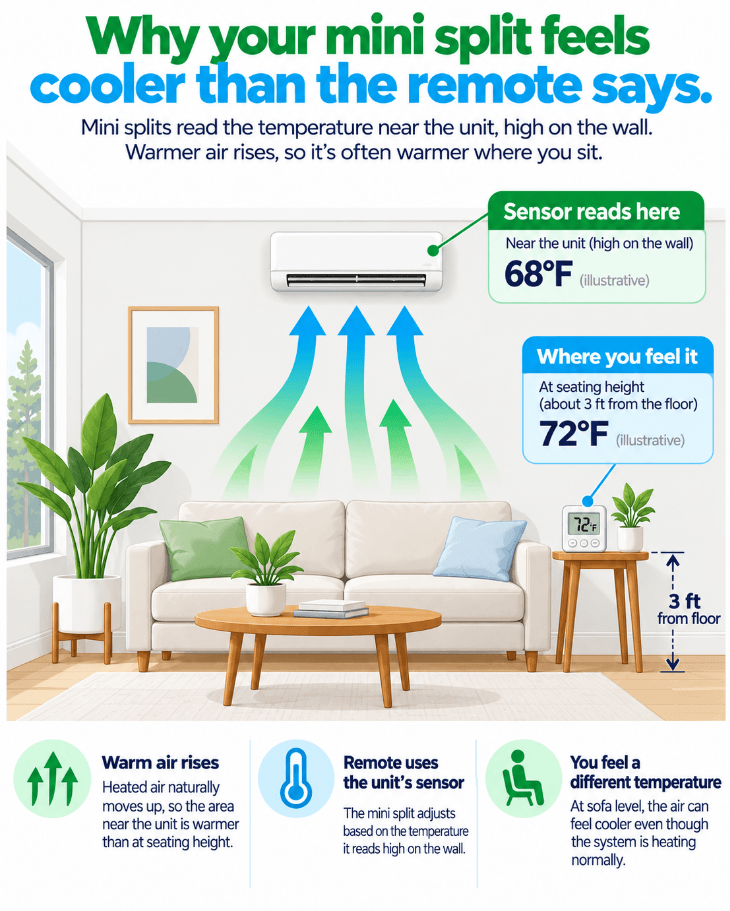
Most wall-mounted mini splits sense temperature high on the wall, where warm air collects, so when the unit reads 70°F and eases off, the air at your feet can still be cooler. Efficiency Maine, the state's efficiency program, notes that high-mounted units often need a higher setting than a wall thermostat did.
Dry air also feels cooler, so keeping indoor humidity in the 30% to 50% range the EPA recommends helps 68°F feel like 68°F.
Try the 3-Foot Thermometer Test
Before changing the setpoint again, try this quick check Filterbuy recommends:
Set the mini split to Heat at 68°F and give it an hour to settle.
Place a digital thermometer about 3 feet off the floor where you sit (or at mattress height), away from windows and the unit's airflow.
Compare its reading with the temperature on your remote or app.
If it reads 2°F or more below the unit, angle the vanes down. If the gap remains, raise the setpoint to match or turn on Follow Me or I Feel (Filterbuy mini splits include Follow Me).
Winter Mini Split Settings by Situation
The best setting depends on the room: bedrooms run a little cooler, and unused rooms can drop to 60–62°F.
Sources: U.S. Department of Energy; Efficiency Maine; Sleep Foundation.
Mini Split Auto Mode vs. Heat Mode: Which Is Better in Winter?
Heat mode is the better choice all winter. Auto mode heats or cools to hold a single setpoint, so a sunny afternoon or a wood stove can trigger cooling in January.
Source: Efficiency Maine heat pump user tips.
On multi-zone systems, keep every indoor unit on the same mode.
What Should You Set Your Mini Split to at Night?
At night, set your mini split no more than 2–4°F below your daytime setting, which for most homes means about 65–68°F. The Department of Energy's 7–10°F setback advice is written for furnaces; the agency notes heat pump setbacks can wipe out savings. Efficiency Maine suggests skipping them altogether, so treat 2–4°F as a limit.
The Sleep Foundation puts the ideal sleep temperature at about 65°F and suggests 65–68°F for most adults. A small setback from a 68–70°F daytime setting lands right in that window, without a hard morning recovery.
Sleep mode. On many models it eases the setpoint down overnight and quiets the fan.
A wake-up schedule. Start warming 30–60 minutes before you get up.
Should You Use Eco Mode on a Mini Split in Winter?
Eco mode is fine on mild days, but switch it off in a cold snap. "Eco" also means something different on almost every brand's remote:
Daikin's ECONO function caps the unit's maximum power draw, which also lowers its heating capacity.
Mitsubishi Electric's Econo Cool works only in cooling mode, so it won't change anything in winter.
Filterbuy's Eco Mode reduces power draw; other brands' eco settings shift the setpoint or slow the fan.
3,900 W TO 2,500 W On Daikin's FTXS30H mini split, ECONO mode lowers the maximum heating power draw from 3,900 W to 2,500 W, according to the model's service manual.
Which Fan Setting Saves the Most Energy in Winter?
Auto fan is the most efficient choice for most mini splits, running harder while the room warms and slowing once it's reached the setpoint. Efficiency Maine suggests a fixed speed only if heat isn't reaching the far side of the room, and the DOE also recommends auto fan for heat pumps.
How to Prepare Your Mini Split for a Cold Snap
A mini split puts out the least heat on the coldest mornings. When the forecast nears your unit's rated minimum, prepare the day before:
Cancel any scheduled setbacks and keep your daytime setpoint overnight.
Turn eco mode off so the unit can use its full capacity.
Clear snow drifts from around the outdoor unit, but leave any ice on the coil alone, since heat pumps defrost automatically.
Check your unit's rated minimum (Filterbuy mini splits deliver reliable heating down to 5°F), and have backup heat ready if lows will fall below it.
See Filterbuy's guide to mini splits in cold weather.
Winter Habits That Keep Your Mini Split Heating Efficiently
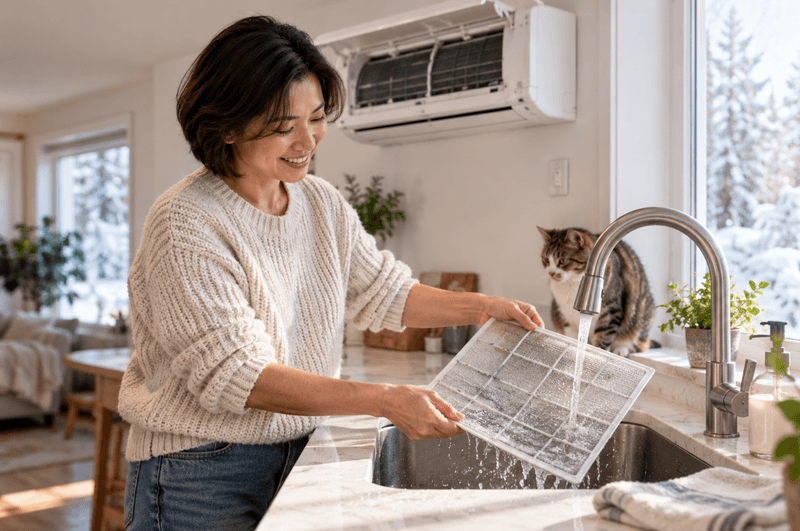
Clean the mesh filter every two weeks during heating season. A badly clogged unit can even shut down until it's cleaned. Filterbuy mini splits include a filter-cleaning reminder, but check the mesh yourself between reminders. Filterbuy's guide to cleaning mini split filters walks through every major brand, and our maintenance guide covers the rest.
Don't forget your backup system's filter. If a furnace backs up your mini split, keep its filter fresh. Filterbuy's auto-delivery means the next one shows up on schedule.
Expect the occasional defrost cycle. In cold, damp weather, the indoor fan may pause 3 to 15 minutes while the outdoor coil melts frost. Our guide to mini split noise in winter explains the sounds.
5–30% EFFICIENCY LOSS In Filterbuy HVAC Solutions service data, a dirty, restricted filter cuts a mini split's efficiency by 5–30%.
PRO TIP “The number-one callback we could prevent is the damp-filter mold call. A mesh that goes back in even slightly wet is how mold gets started inside the head. Give it the full drying time. A few extra minutes beats a service visit.” David Clark, Licensed HVAC Technician, Filterbuy
Supporting Statistics
42%
Space heating was the largest energy use in U.S. homes in 2020, at 42% of residential energy consumption.
Source: U.S. Energy Information Administration, 2020 Residential Energy Consumption Survey
10–25%
A well-maintained heat pump can use 10% to 25% less energy than a severely neglected one.
Source: PG&E, Heat Pump Buyer's Guide (PDF)
59%
Median heating savings after inverter-driven ductless mini splits were added to 10 Central Florida homes, six of which had electric resistance heat.
Frequently Asked Questions
Is 72°F too high for a mini split in winter?
No. It's within the recommended range, and a high-mounted unit may need it to feel warm where you sit. It does cost more: Filterbuy's mini split running cost guide estimates each extra degree adds roughly 3–5% to the monthly bill.
Why is my mini split blowing cold air in Heat mode?
Usually it's a defrost cycle, which ends within minutes. Otherwise, check whether Auto mode switched to cooling or the setpoint slipped below room temperature; a dirty filter can also weaken airflow. If it persists, see our mini split troubleshooting guide.
Should I use my mini split or my furnace in winter?
Let the mini split carry the rooms it serves and keep the furnace as backup. Boulder County's heat pump owner's guide suggests setting the backup system's thermostat 5–10°F below the heat pump's.
Should I cover my mini split's outdoor unit in winter?
No. The outdoor unit needs open airflow to heat, and Boulder County's guide advises against covering or hiding it. Clear snow drifts and leaves, but leave ice to the defrost cycle. Filterbuy's guide to winterizing a mini split covers the rest.
Can one mini split heat my whole house?
Usually not. A single-zone mini split heats one room or open area; Filterbuy's 12,000 BTU model covers up to 550 sq ft, and its 24,000 BTU model up to 1,200 sq ft. Closed-off rooms need their own units or a multi-zone system, which Filterbuy doesn't make.
Your Next Step
Tonight, switch from Auto to Heat, set 68°F, put the fan on Auto, and angle the vanes down. Tomorrow, run the 3-foot test and adjust once.
Shopping for a new system? Filterbuy's single-zone mini splits start at $799 with free 2-day delivery to most U.S. states and a 7-year compressor warranty. They deliver reliable heating down to 5°F; if this will be your main heat source where winters get colder, a cold-climate model is the better fit. Professional installation is required, and the warranty is void if self-installed.
Michelle Wan is Filterbuy's Brand Manager and air quality writer. She works directly with Filterbuy's U.S.-based manufacturing team.
Glossary
Mini split: A ductless heat pump with a wall-mounted indoor unit and an outdoor unit.
Eco or Econo mode: A setting that varies by brand and may cap power or shift the setpoint.
Follow Me / I Feel: Reads temperature from the remote instead of the unit.
Defrost cycle: A 3- to 15-minute heating pause while the outdoor coil melts frost.