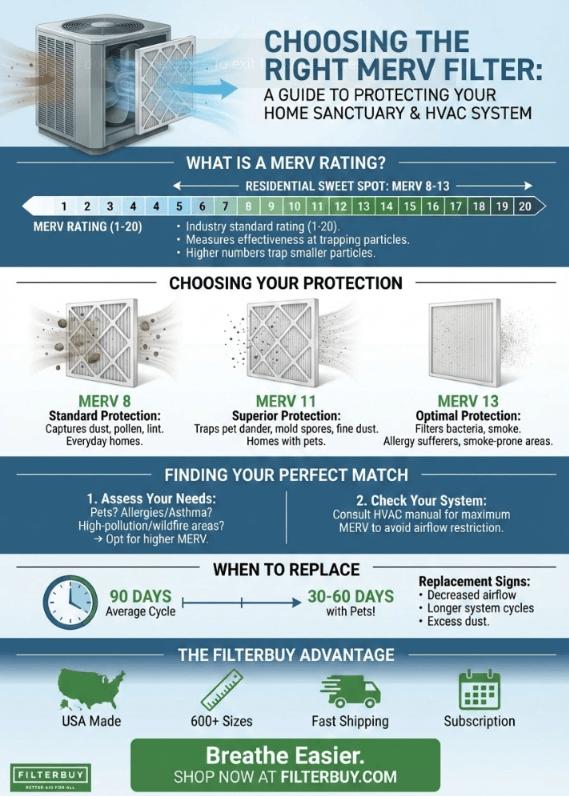
How to Choose the Best MERV Filter for Your Home: MERV 8, 11, or 13
August 18, 2026
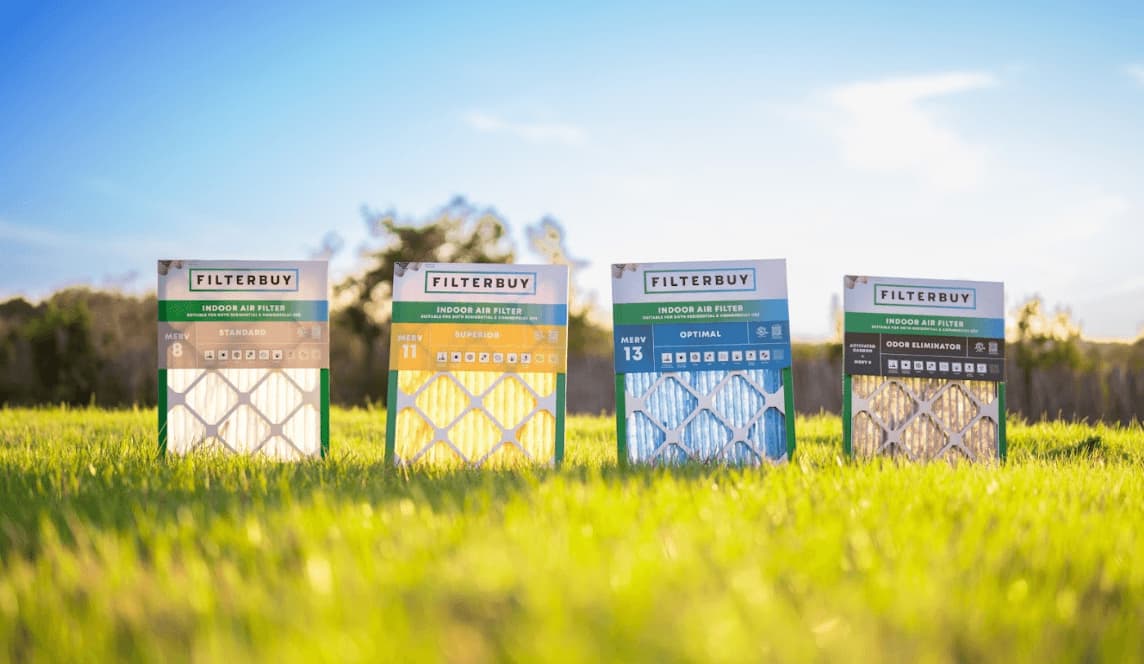
MERV 8 is the standard choice for most homes. Step up to MERV 11 or 13 to capture finer particles, or pick the Odor Eliminator for odors. Before you order, check your HVAC manual for the MERV rating it lists.
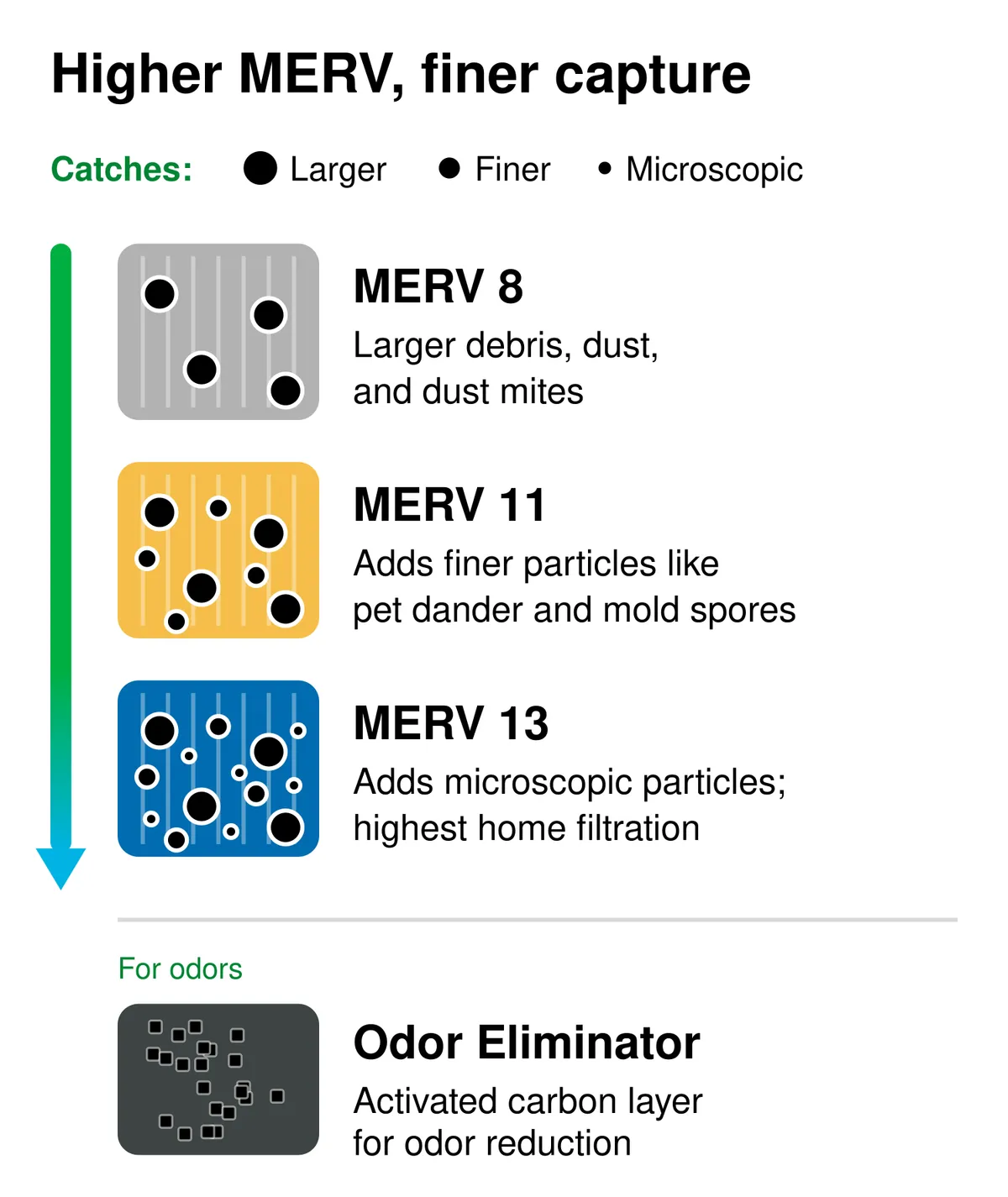
MERV 8: Larger debris, dust, and dust mites. Captures 90% of airborne particles.
MERV 11: Adds finer particles like pet dander and mold spores. Captures 95%.
MERV 13: Adds microscopic particles, our highest residential filtration. Captures 98%.
Odor Eliminator: An activated carbon layer for odor reduction.
Not sure which one fits your home? Take the quick match quiz below.
Over 600 sizes plus custom, made to order in our own U.S. plants, with free 2-day delivery to most U.S. states.
Find your filter match
Answer a few quick questions and we'll match you to your filter.
TL;DR
MERV 8 is the standard choice for most homes. Step up to MERV 11 if someone in the house has allergies or asthma, or if you’ve got pets and pollen coming in. MERV 13 is the one to pick for smoke. If it’s odors you’re fighting, the Odor Eliminator adds a carbon layer instead. Whichever you land on, check your HVAC manual for the MERV rating it lists, the same quick check as confirming your size.
Key Takeaways
MERV is the industry rating for how much airborne dust and debris a filter captures. Higher numbers capture more.
Filterbuy MERV 8 captures 90% of airborne particles, MERV 11 captures 95%, and MERV 13 captures 98%. The Odor Eliminator adds carbon for smells.
Your HVAC manual lists the MERV rating your system takes. Check it the way you’d check your filter size.
MPR and FPR are rating systems from other companies. Our filters list comparable numbers so you can shop across brands.
Most homes change a filter every 90 days. Hold it up to a light, and if light doesn’t come through the pleats, it’s time.
Which MERV Rating Should You Choose?
Start with what you’re trying to catch. MERV 8 handles everyday dust and debris, and it’s the standard choice for most homes. MERV 11 is built for allergy sufferers, and it’s also the one to pick if you’ve got pets or pollen. MERV 13 is the step up for smoke. And if the problem is odors, the Odor Eliminator adds a carbon layer that pleated media alone doesn’t give you.
Check your HVAC manual for the MERV rating your system lists before you order.
Filterbuy makes all three ratings, plus the Odor Eliminator, in over 600 sizes. MERV 8 air filters / MERV 11 air filters / MERV 13 air filters / Odor Eliminator filters.
What Is A MERV Rating?
MERV stands for Minimum Efficiency Reporting Value, which is the industry’s way of scoring how much airborne dust and debris a filter catches. Higher numbers catch more. It’s the rating manufacturers report against the same industry standard, which makes it the useful one to compare across brands when you’re shopping.
What About MPR And FPR On The Box?
Those are rating systems from other companies rather than industry standards. MPR comes from 3M for its Filtrete line, and FPR is used by The Home Depot. The scales are built differently, so any comparison between them is approximate. Our filters list comparable numbers anyway, so you can cross-shop: MERV 8 is comparable to MPR 600 and FPR 5, MERV 11 to MPR 1000–1200 and FPR 7, and MERV 13 to MPR 1500–1900 and FPR 10.
Filterbuy is not affiliated with or endorsed by 3M or The Home Depot.
What Does Filter Depth Change?
Depth changes how much a filter holds, and how often you’ll be back at the return grille. A four-inch filter carries the same media as a one-inch; it’s just folded into more surface area, so there’s more of it to fill before the filter is used. Deeper filters usually stretch further between changes for that reason. Filterbuy cuts every rating in 1, 2, 4 and 5 inch depths, so you can pick the depth your slot takes and the rating you want separately.
How Do You Find Your Filter Size?
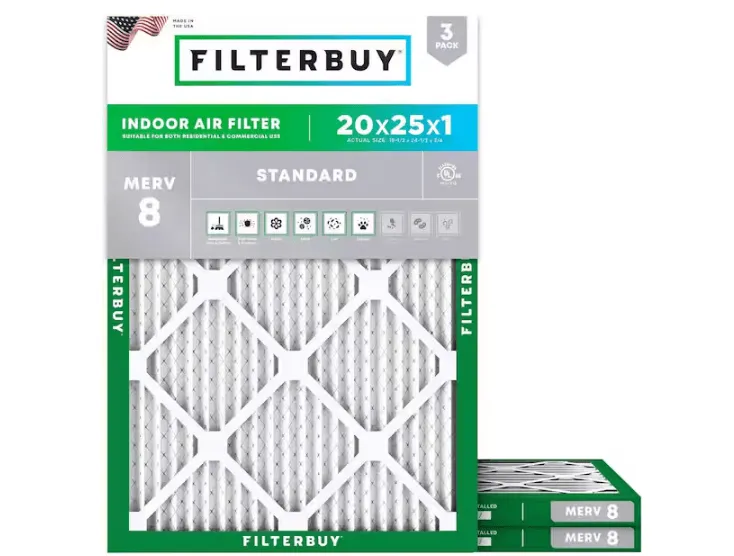
Start with the filter that’s already in there, because the size is usually printed right on the frame in the form 20x25x1. That’s the number you order. If there’s no old filter to go by, measure the slot instead. The size you order is the nominal size, and the filter itself is cut a little smaller on purpose; that bit of clearance is what lets it slide in and sit properly. If your size isn’t on the list, we cut custom sizes to the eighth of an inch. How To Measure Your Air Filter Size | Custom Air Filters
When Should You Replace Your Filter?
Every 90 days for most homes, and sooner if you’ve got pets or a lot of dust. The EPA says manufacturers typically recommend 60 to 90 days, and sooner still if the filter looks dirty. The surest check doesn’t need a calendar at all. Hold the filter up to a light. If light doesn’t come through the pleats, replace it. EPA Guide to Air Cleaners in the Home | Air Filter Auto-Delivery
Supporting Statistics
Frequently Asked Questions
What MERV rating is best for a home?
MERV 8 is the standard choice for most homes. If someone in the house has allergies or asthma, MERV 11 is the one built for them, and MERV 13 is the step up for smoke. Check your HVAC manual for the rating your system lists.
What’s the difference between MERV 8, 11 and 13?
How much they capture. MERV 8 captures 90% of airborne particles, MERV 11 captures 95%, and MERV 13 captures 98%.
Does a thicker filter last longer?
Usually, yes. A four-inch filter has more surface area than a one-inch, so it holds more before it’s spent. You’ll need a slot that takes that depth.
What if my size isn’t listed?
We cut custom sizes to the eighth of an inch. Measure your old filter, or the slot if there isn’t one, and order those numbers.
Find Your Size And Rating
Filterbuy makes MERV 8, MERV 11, MERV 13 and Odor Eliminator filters in over 600 sizes, plus custom. They’re cut, pleated and framed to order in our own US plants, with fast and free 2-day delivery to most US states. Breathe easy. Shop Air Filters By Size
Glossary
MERV: Minimum Efficiency Reporting Value, the industry rating for how much airborne dust and debris a filter captures.
MPR and FPR: Rating systems from 3M and The Home Depot. Different scales, so comparisons to MERV are approximate.
Nominal and actual size: Nominal is the size you order, such as 20x25x1. The filter is cut a little smaller so it slides in and seats properly.
Pleated media: The folded material that does the filtering. More folds mean more surface area in the same opening.
Odor Eliminator: A Filterbuy pleated filter with a carbon layer added for smells.