
Air Filter Fit & Sizing Guide: How to Find Your Size and Make Sure It Fits
August 4, 2026

What Size Air Filter Do I Need, and How Should It Fit?
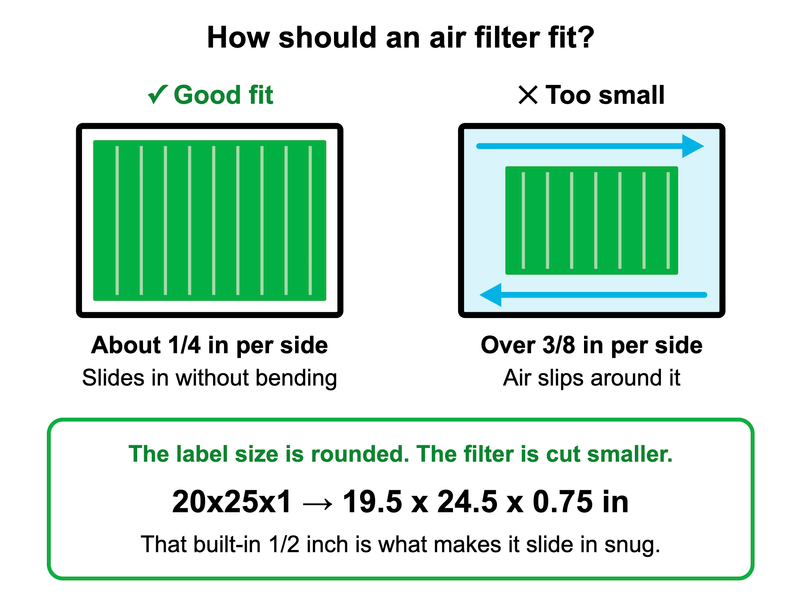
Your size is the three numbers printed on your current filter’s frame, like 16x25x1. No label? Measure the empty slot and round each side to the nearest inch. A filter that fits slides in without bending and leaves about 1/4 inch of space per side. Not sure what to order? The quick match quiz below will point you to the right filter.
Answer a few quick questions and we’ll match you to your filter.
TL;DR
To find your air filter size, check the frame of your current filter for three numbers like 16x25x1, or measure the empty slot and round each side to the nearest inch. A well-fitted filter slides in without bending and leaves about 1/4 inch of clearance on each side, while a gap much wider than that lets air slip around it. If the slot lands on a fraction, you’ll need a custom air filter. Filterbuy manufactures every filter it sells, so the sizes here are numbers we cut to, not numbers we looked up.
Key Takeaways
The size on the label is rounded: a Filterbuy 20x25x1 actually measures 19.5 x 24.5 x 0.75 inches.
About 1/4 inch of clearance per side is normal, but more than about 3/8 inch lets air bypass the filter.
A slot that measures on a true fraction, like 22.25 inches, needs a custom air filter.
What Size Air Filter Do I Need?
The air filter size you need is the nominal size of your filter slot, written as length x width x depth in inches and printed on the frame of your current filter. If the print has worn off, measure the empty slot instead.
In a forced-air home the furnace and air conditioner share one filter slot, so furnace filter sizes, AC filter sizes, and HVAC filter sizes are the same measurement, and “what size furnace filter do I need?” has the same answer. Many homes have more than one return, so check where your air filter is located and size each one.
How to Measure an Air Filter or Furnace Filter Slot
To measure an air filter or furnace filter slot, measure the opening itself, not the old filter. A filter that has spent a season in the airflow is often bowed, so it reads short. It takes a tape measure and five minutes.
Homeowners bring me the old filter and ask what to buy. I ask for a photo of the empty slot instead. Half the time the filter they had been using was never right for the opening it sat in.
David Clark, Licensed HVAC Technician, Filterbuy HVAC Solutions
Turn the system off at the thermostat.
Snap a photo of the old filter’s airflow arrow, then pull it out.
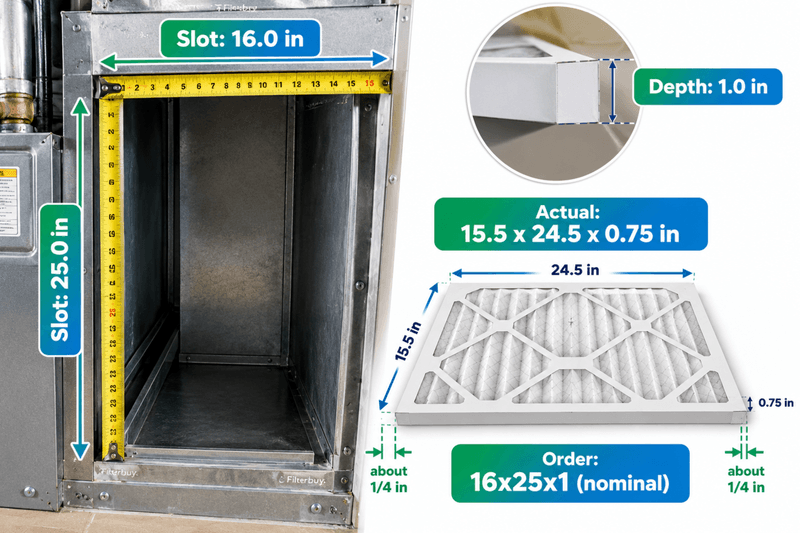
Measure the slot’s short side and long side to the nearest tenth of an inch.
Measure the depth from front to back. Filterbuy’s manufacturing team sees depth ordered wrong more often than any other dimension.
Round each number to the nearest whole inch and write the size as short x long x depth, such as 16x25x1. If you measured an old filter instead of the slot, round up, so 19.5 becomes 20.
Two sample readings show the cases that trip people up:
19.9 x 21.6 x 0.8 inches: 21.6 sits on a true fraction, which makes this a custom slot.
20.1 x 25.1 x 4.4 inches: order a 20x25x4. A Filterbuy 4-inch filter is 3.63 inches deep and fits, while a 5-inch (4.75 inches) won’t.
Measuring a ceiling return? Our guide on how to measure your air filter covers that too.
Nominal vs. Actual Filter Size: What’s the Difference?
Every air filter has two sizes. The nominal size is the rounded number printed on the frame, and it’s the one you order. The actual size is what the filter really measures. Filterbuy cuts length and width 0.5 inch under nominal on purpose: any tighter and the filter binds, any looser and air leaks past it. That half inch leaves about 1/4 inch of clearance on each side.
Common Air Filter Sizes Chart (Furnace, AC & HVAC)
Filterbuy order data shows the most common air filter sizes in American homes are 20x20x1, 16x25x1, 16x20x1, and 20x25x1. The furnace filter size chart below lists standard air filter sizes in 1-inch, 4-inch, and 5-inch depths, along with the actual air filter dimensions Filterbuy manufactures to.
Don’t see yours? The full Filterbuy air filter size chart covers all 600+ standard sizes, or shop 1-inch air filters and 4-inch air filters.
How Should an Air Filter Fit?
Correct air filter sizing only pays off if the filter seals, with a small, even gap around the frame that air can’t route around. The U.S. Environmental Protection Agency (EPA) advises a snug fit, with no air leaking around the edges and no bending to force the filter in (EPA, Guide to Air Cleaners in the Home).
The question I get most is which MERV to buy. The one to ask first is whether the filter you are holding actually fills the slot. A rating describes the media, not the gap around it.
Michelle Wan of Filterbuy
How Do I Check If My Air Filter Fits?
A fit check takes five minutes with a tape measure and a flashlight, and it belongs in every filter change.
Turn the system off and open the filter door or return grille.
Make sure the frame sits flat, with the arrow pointing toward the furnace.
Press gently on the center. The filter should stay seated in its track.
Measure the widest gap. About 1/4 inch is normal; more than 3/8 inch means the filter is too small.
Shine a flashlight along the frame. A bright, continuous line of light means there’s a gap.
Turn the blower on and hold a tissue near each edge. If air pulls around the frame or you hear a whistle, air is bypassing the filter.
Ceiling returns deserve a second look. In Filterbuy’s experience, gravity works against the seal, and a flush filter can sag off an edge within months.
What Are the Signs of Air Filter Bypass?
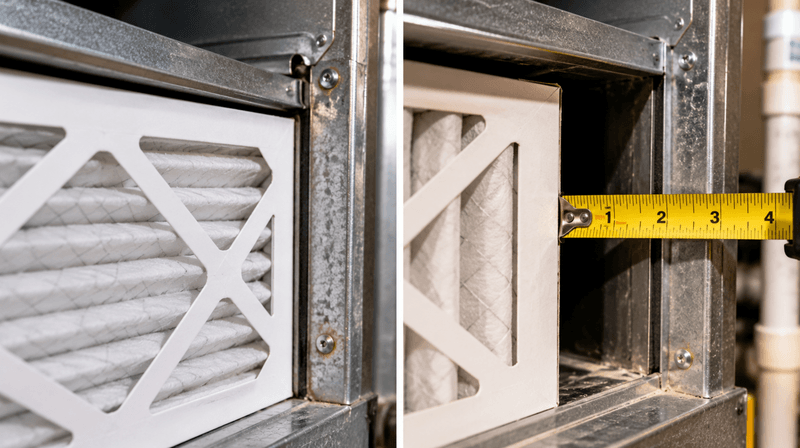
Air filter bypass is return air that travels around a filter instead of through it. The usual tells are gray streaks on the frame and a whistle or rattle at the slot. It’s also the fit failure Filterbuy hears about most: the right filter, installed correctly, in a rack it doesn’t quite fill.
A loose filter can let roughly 10% of the air bypass it, and a filter with a large gap can let 25% past. In a Lawrence Berkeley National Laboratory model of cooling-coil dust buildup, bypass at those levels could largely cancel a MERV 12 filter’s extra efficiency (Siegel, Walker and Sherman, ACEEE Summer Study, 2002).
ASHRAE, which writes the MERV test standard, is blunter: air that goes around a filter is never cleaned (ASHRAE Filtration FAQ).
How Do I Fix an Air Filter That Doesn’t Fit?
Start with what you’re noticing and work back to the cause, but never cut or force a filter to fit, or stack two; each breaks the seal.
Media cabinets often take fractional sizes, so read the size off the cabinet label or shop brand-specific replacement filters. If the filter door leaks, the U.S. Department of Energy’s Building America guidance calls for a gasket to seal it. Once everything fits, write the size and arrow direction on the cabinet in permanent marker.
Why Does My New Filter Fit Differently Than My Old One?
Nominal sizes are shared across the industry, but actual sizes aren’t, so a new brand can bind or leave a gap even when the label matches your old one. Of the three brands below, Filterbuy filters are cut furthest under nominal, and we publish that because you can’t check a fit nobody told you about.
Actual sizes from MERV 11 retail listings, verified September 2026; Filtrete sizes vary by product line.
When Do You Need a Custom Air Filter Size?
You need a custom air filter when your slot measures on a true fraction, such as 17.5 or 22.25 inches, instead of landing within about 1/4 inch of a whole number. Round down and you leave a gap; round up and the filter may bind.
Odd size air filters turn up most often in older homes, where compartments were framed to the ductwork, not a catalog size. About 36 million of the 82.7 million U.S. homes cooled mainly by central air or a heat pump (43%) are in houses built before 1980, according to the U.S. Energy Information Administration’s 2020 Residential Energy Consumption Survey.
Filterbuy cuts each custom air filter to order, within an eighth of an inch of the measurements you enter. Because we cut custom filters down from larger stock, the frame may still carry the label of the size it started as. Go by your tape measure, not that label.
Supporting Statistics
1. Airflow problems can cut a heating and cooling system’s efficiency by up to 15%. Source: ENERGY STAR (EPA and Department of Energy), Maintenance Checklist.
2. More than 82 million Americans were diagnosed with seasonal allergies in 2024. The Asthma and Allergy Foundation of America (AAFA), citing Centers for Disease Control and Prevention data, links those allergies to tree, grass, and weed pollen. Pollen that slips through a gap never reaches the media. Source: AAFA, Allergy Facts and Figures (April 2026).
3. A MERV 13 filter must capture at least 50% of particles between 0.3 and 1 micron; MERV 8 carries no rating in that range. Filterbuy makes MERV 8, 11, and 13 in every standard size, and each rating covers only air that passes through the media. Source: EPA, What Is a MERV Rating?.
Frequently Asked Questions
Is a Small Gap Around My Air Filter Normal?
Yes. Filterbuy builds in about 1/4 inch of clearance per side so the filter slides in easily. More than about 3/8 inch on any side means it’s too small.
Can I Put a 4-Inch Filter in a 1-Inch Slot?
No. Depth must match the slot, so a 4-inch filter needs a media cabinet an HVAC technician can install. Size and MERV rating are separate choices.
Glossary
Nominal size: The rounded size printed on a filter frame; the size you order.
Actual size: A filter’s true measured dimensions, slightly under nominal.
Media cabinet: A ductwork housing for a 4- or 5-inch filter.
Filter bypass: Air that slips around a filter instead of through it.
HVAC: Heating, ventilation, and air conditioning: the forced-air system that heats and cools a home.
MERV: Minimum Efficiency Reporting Value, an ASHRAE-based rating of how well a filter captures particles from 0.3 to 10 microns (EPA).
Ready to order? Find your size in the Filterbuy air filter size chart, or order a custom air filter.