
Heat Pump Cycle Explained: Thermodynamics, Working Principle, Refrigerant Flow, and What Powers a Heat Pump
October 22, 2026
TL;DR
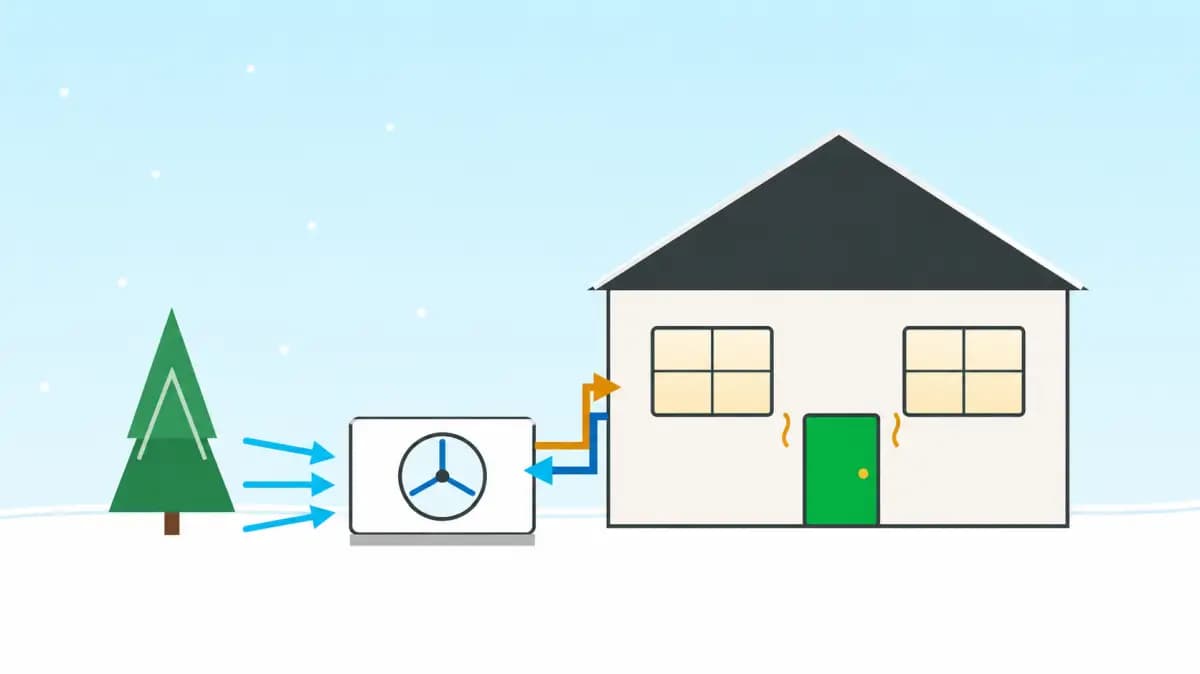
A heat pump uses electricity to run a compressor that moves refrigerant through four stages: evaporation, compression, condensation, and expansion. It moves heat instead of burning fuel, so it delivers more heat than the electricity it uses.
Key Takeaways
The heat pump cycle repeats four stages in a sealed refrigerant loop: evaporation, compression, condensation, and expansion.
A heat pump runs on electricity. Its refrigerant circulates without being burned or used up.
Coefficient of performance (COP) measures efficiency. A COP of 3 means 3 units of heat for every unit of electricity.
The air filter is the one part of the heat pump cycle most homeowners can check and change themselves.
What Is The Heat Pump Cycle?
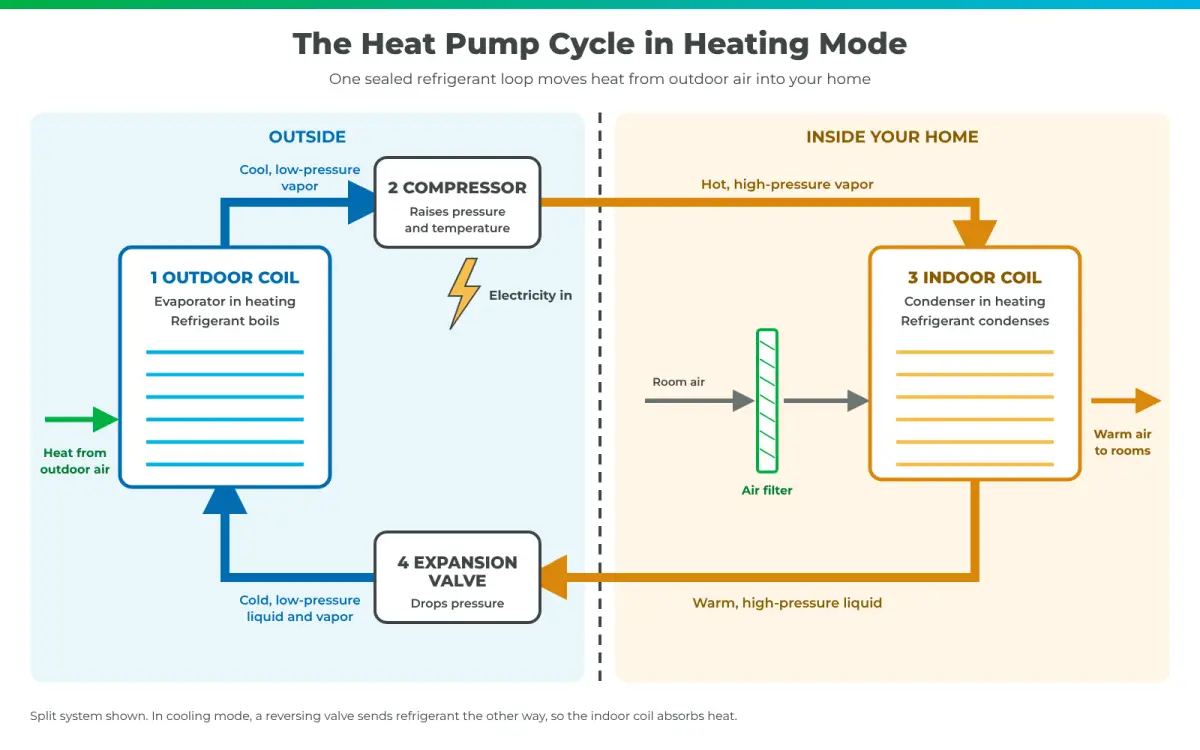
The heat pump cycle is the vapor-compression refrigeration cycle, the same process your refrigerator uses, run in the direction that warms your home. A heat pump repeats four stages in a sealed refrigerant loop, collecting heat outdoors and releasing it indoors in heating mode.
Evaporation. Cold, low-pressure liquid refrigerant enters the outdoor coil. At that pressure it boils below the outdoor air temperature, so it absorbs heat and becomes vapor.
Compression. The electric compressor squeezes the vapor into a smaller volume, raising its pressure and temperature above your indoor air temperature.
Condensation. The hot vapor reaches the indoor coil. Your blower pushes room air across the coil, the refrigerant gives up its heat, and it condenses into a high-pressure liquid.
Expansion. An expansion valve drops the liquid's pressure. The refrigerant cools below the outdoor temperature and returns to the outdoor coil to start over.
The U.S. Department of Energy's air-source heat pump guide describes the same sequence. Filterbuy built the diagram below to add the step many cycle diagrams leave out: the air filter that room air passes through before it reaches the indoor coil.
How Does Refrigerant Flow Through A Heat Pump?
Refrigerant flows through a heat pump in one continuous loop, switching between liquid and vapor as its pressure changes. The low-pressure side absorbs heat, the high-pressure side releases it, and the compressor and expansion valve divide the two.
Most heat moves during the two phase changes, when boiling or condensing refrigerant absorbs or releases latent heat at a nearly steady temperature.
What Thermodynamics Principles Make A Heat Pump Work?
Two laws of thermodynamics explain how a heat pump works: energy is conserved, and heat needs work to flow from cold to warm.
The First Law: Where The Extra Heat Comes From
Heat delivered to your home (Qh) equals heat absorbed outdoors (Qc) plus work input (W). OpenStax College Physics, a peer-reviewed open textbook from Rice University, writes this as Qh = Qc + W in its chapter on heat engines, heat pumps, and refrigerators.
We ran the energy ledger ourselves. One kilowatt-hour of electricity equals about 3,412 BTU. At a COP of 3, a heat pump turns it into roughly 10,236 BTU of heat. The Filterbuy shortcut: the share of your heat that comes from outdoor air equals 1 minus 1 divided by COP. That is two-thirds at a COP of 3 and about 43% at the 1.75 cold climate floor. See the Filterbuy heat pump heating cost guide for running costs.
The Second Law: Why A Heat Pump Needs A Compressor
Heat naturally flows from warm to cool. A heat pump moves heat from 30°F outdoor air into a 70°F living room. That runs the opposite way, so the second law of thermodynamics requires work. The compressor supplies it by making the refrigerant hotter than your indoor air.
Why Pressure Controls The Refrigerant's Boiling Point
A refrigerant's boiling point rises with pressure, and that relationship is the working principle behind the heat pump cycle. Low pressure lets refrigerant boil below the outdoor temperature, and high pressure lets it condense above the indoor temperature. Water follows the same rule, which is why a pressure cooker cooks hotter than an open pot.
How Efficient Is A Heat Pump? Coefficient Of Performance Explained
Heat pump efficiency is measured by coefficient of performance (COP), the ratio of heat delivered to electricity used. Electric resistance heat has a COP of 1. An air-source heat pump can deliver up to three times more heat energy to a home than the electrical energy it consumes, according to the U.S. Department of Energy.
The ideal (Carnot) heating COP equals the hot-side temperature divided by the hot-to-cold temperature difference, both in kelvins. A bigger lift means a lower ceiling. Filterbuy calculated these ceilings for heat delivered at 95°F.
Ideal COP: Filterbuy Carnot calculation for heat delivered at 95°F.
The ENERGY STAR cold climate floor at 5°F, a COP of 1.75, is about 28% of the ideal ceiling we calculated. Compressors and fans lose energy, and every coil needs a temperature difference to move heat. ENERGY STAR requires certified cold climate heat pumps to reach a COP of at least 1.75 at 5°F while keeping at least 70% of their 47°F heating capacity, per its cold climate heat pump criteria. See our guides to heat pump efficiency ratings like SEER2 and HSPF2 and how heat pumps perform in cold climates.
How Does A Heat Pump Switch Between Heating And Cooling?
A heat pump switches between heating and cooling with a reversing valve, a four-way valve near the compressor that changes the direction of refrigerant flow.
The same valve handles defrost. When frost builds on the outdoor coil, the heat pump briefly shifts into cooling mode to melt it. Learn how backup and auxiliary heat work.
What Is Normal When A Heat Pump Is Running?
A heat pump looks and sounds different from a furnace. Here is how Filterbuy matches what you notice to the cycle stage behind it.
Normal signs:
Cold air blowing from the outdoor unit in winter. The outdoor coil is absorbing heat (evaporation).
Lukewarm air from your vents. Heat pumps deliver lower-temperature air than gas furnaces over longer run times.
A whoosh, a pause, then steam outside. The reversing valve is switching for defrost.
An aux heat indicator during defrost or a cold snap. Backup heat is helping the cycle.
Call a licensed technician for:
Thick ice that covers the outdoor coil for hours. Our winter heat pump prep checklist explains the difference.
A hissing sound or heat output that fades over weeks, which can point to a refrigerant leak.
Backup heat running most of the time in mild weather.
Before you call, run the Filterbuy three-step airflow check:
Check the air filter for signs it's time to change your air filter.
Open any closed supply registers and clear furniture from return grilles.
Clear snow and leaves away from the outdoor unit, and trim back nearby shrubs.
What Does A Heat Pump Run On?
A heat pump runs on electricity. Electricity powers the compressor, outdoor fan, indoor blower, controls, and any backup heat strips. The heat itself comes from outdoor air or the ground, and the refrigerant only carries it, circulating in a sealed loop without being burned or used up.
Electricity. Most central heat pumps use a dedicated 240-volt circuit.
Refrigerant. Many existing systems use R-410A. New residential heat pumps manufactured or imported since January 1, 2025 must meet a global warming potential (GWP) limit of 700, per the EPA's HFC restrictions by sector. R-454B and R-32 are common examples.
Heat source. Air-source models pull heat from outdoor air, and geothermal models pull it from the ground. Compare system types in the Filterbuy heat pump basics guide.
How A Clean Air Filter Keeps The Heat Pump Cycle On Track
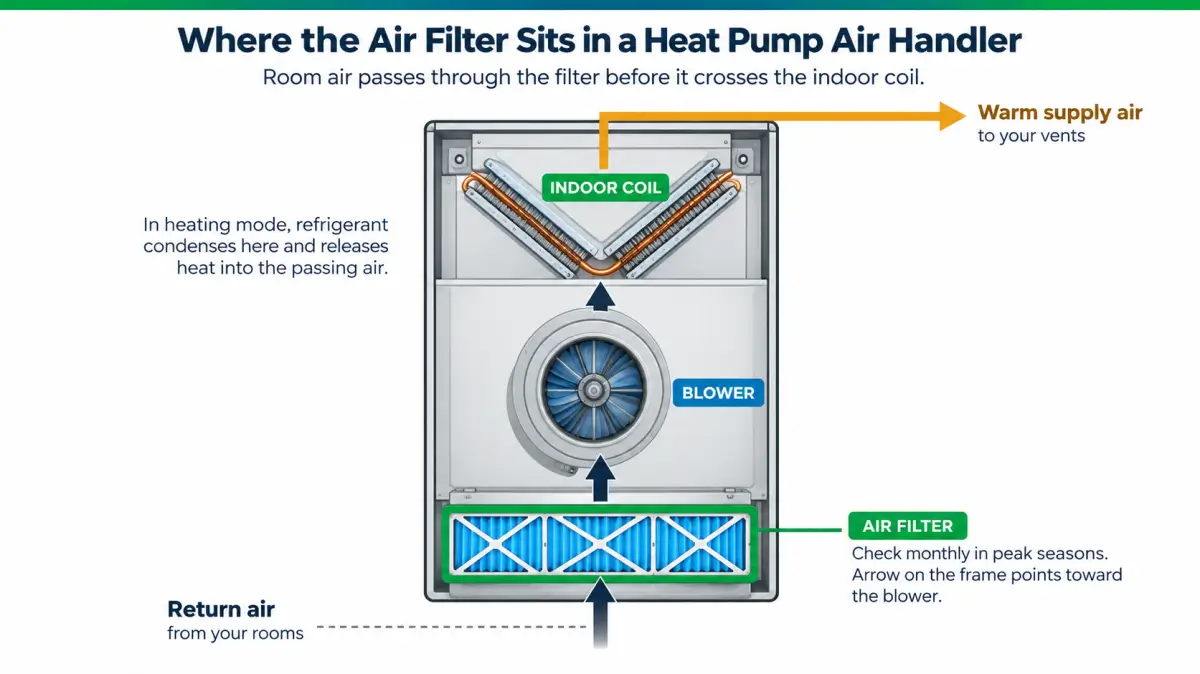
The indoor coil can only exchange heat with the air that crosses it. A dirty air filter cuts that airflow, which works against condensation in heating mode and evaporation in cooling mode. The U.S. Department of Energy notes that heat pump efficiency and performance deteriorate when airflow falls much below 350 cubic feet per minute (cfm) per ton.
At Filterbuy, we manufacture pleated MERV 8, MERV 11, and MERV 13 air filters, so we look at this cycle from the air handler side. Refrigerant charge and ductwork belong to a licensed technician. The heat pump filter belongs to you. To keep airflow steady:
Check a 1-inch filter monthly in peak seasons.
Match the size printed on your current filter frame, or order custom air filters built to your dimensions.
Filterbuy MERV 11 air filters capture finer particles than MERV 8, including pet dander. Always check your HVAC system's manual for the MERV rating it is designed to handle.
Set up filter auto-delivery so a fresh filter arrives on time.
For rooms without ductwork, Filterbuy ductless mini split systems carry a 7-year compressor and 3-year parts warranty with fast and free 2-day delivery to most US states.
"A heat pump transfers heat rather than converting it from a fuel like combustion heating systems."
U.S. Department of Energy
The Filterbuy take: Because a heat pump can only move the heat its coils trade with the surrounding air, we treat airflow as part of the cycle itself.
Supporting Statistics
About 13% of U.S. homes heated mainly with a heat pump in 2020. Source: U.S. Energy Information Administration's Energy Explained guide to energy use in homes.
Heat pumps could cut average home energy use by 31% to 47%. The National Renewable Energy Laboratory simulated 550,000 U.S. homes in 2024, as reported by the American Public Power Association.
Poor installation can add about 30% to heating and cooling energy use. Refrigerant undercharge and incorrect indoor airflow are among the faults studied. Source: NIST research on HVAC installation faults.
Frequently Asked Questions
What Are The 4 Stages Of The Heat Pump Cycle?
The four stages of the heat pump cycle are evaporation, compression, condensation, and expansion. In that order, refrigerant absorbs heat, gains pressure, releases heat, and loses pressure.
Does A Heat Pump Use Gas?
A heat pump does not burn gas. It runs on electricity and moves heat with refrigerant. Only dual-fuel systems add a gas furnace for backup, covered in the Filterbuy HVAC heat pump guide.
Why Does A Heat Pump Lose Efficiency In Cold Weather?
The temperature gap between outdoor air and delivered heat widens, so each unit of heat takes more compressor work and COP drops. See the disadvantages of a heat pump.
Is A Heat Pump The Same As An Air Conditioner?
A heat pump and an air conditioner share the same refrigeration cycle. An air conditioner only moves heat out. A heat pump adds a reversing valve so it can also move heat in. Compare heat pump vs furnace and AC systems.
Glossary
Coefficient of performance (COP): Heat delivered divided by electrical energy used.
Carnot COP: The theoretical maximum COP between two temperatures, measured in kelvins.
MERV: Minimum Efficiency Reporting Value, a filter's particle-capture rating on a 1 to 16 scale.
Keep your heat pump's airflow on track. Find your exact size at Filterbuy and shop American-made air filters by size with fast and free 2-day delivery to most US states.