
True HEPA vs MERV 13 Furnace Filters: Which Works Best for Allergies?
August 19, 2026

If you suffer from allergies, you want your home to be a sneeze-free sanctuary. But poor indoor air quality can turn that haven into a source of congestion. While it might seem logical to grab the "strongest" furnace filter you can find, like a True HEPA filter, this can often cause more harm than good in a standard residential HVAC system.
This leads many homeowners to debate between True HEPA and MERV 13 furnace filters. While HEPA filters are powerful, they can restrict airflow and strain your furnace. In this guide, we’ll explain the technical differences between these filters, why a higher rating isn't always better, and how to choose the right filter to balance effective allergy relief with your HVAC system's health.
TL;DR Quick Answers
HEPA Furnace Filters
True HEPA filters capture 99.97% of particles down to 0.3 microns — but here's the thing most people don't realize: standard residential HVAC systems aren't built to handle them. HEPA filters are so dense they restrict airflow, which can strain your blower motor, spike energy bills, and even damage your system over time.
What actually works for home furnaces? A high-quality MERV 13 pleated filter. It captures the stuff you care about — pollen, pet dander, mold spores, bacteria, and fine dust — without choking your HVAC system. That's the sweet spot between clean air and system performance.
Quick breakdown:
True HEPA → Best for standalone air purifiers, not standard furnaces
MERV 13 → Highest rating most residential systems can handle efficiently; traps up to 98% of airborne particles
MERV 11 → Great mid-range option for pet owners and allergy sufferers
MERV 8 → Solid everyday protection against dust, pollen, and lint
The bottom line: You don't need a HEPA furnace filter to breathe noticeably cleaner air at home. A properly rated pleated filter — changed every 60–90 days — protects your family, your HVAC system, and your wallet. No overcomplicating it.
Key Takeaways
True HEPA vs. MERV 13: True HEPA filters offer exceptional filtration but can significantly restrict airflow in standard residential HVAC systems. MERV 13 filters provide a strong balance of filtration and airflow, making them a practical choice for most homes.
MERV 13 Filters for Cleaner Air: MERV 13 filters strike the perfect balance by effectively capturing harmful contaminants like pollen, dust, and bacteria, helping to improve indoor air quality and create a healthier home environment.
Choose the Right Balance: Consider both your allergy relief needs and the health of your HVAC system when selecting a filter. A Filterbuy MERV 13 pleater filter is often sufficient for reducing allergens without compromising system performance.
Are Pleated Furnace Filters Bad for Allergies?
Before diving into the technical ratings, let’s address a common misconception: that standard pleated filters are "bad" or ineffective for allergies. This couldn't be further from the truth.
In the past, many homes used cheap fiberglass filters (often called "spun glass"). These flimsy filters were only designed to protect the furnace motor from large dust bunnies, doing almost nothing for the air you breathe. However, modern pleated furnace filters are the industry standard for a reason.
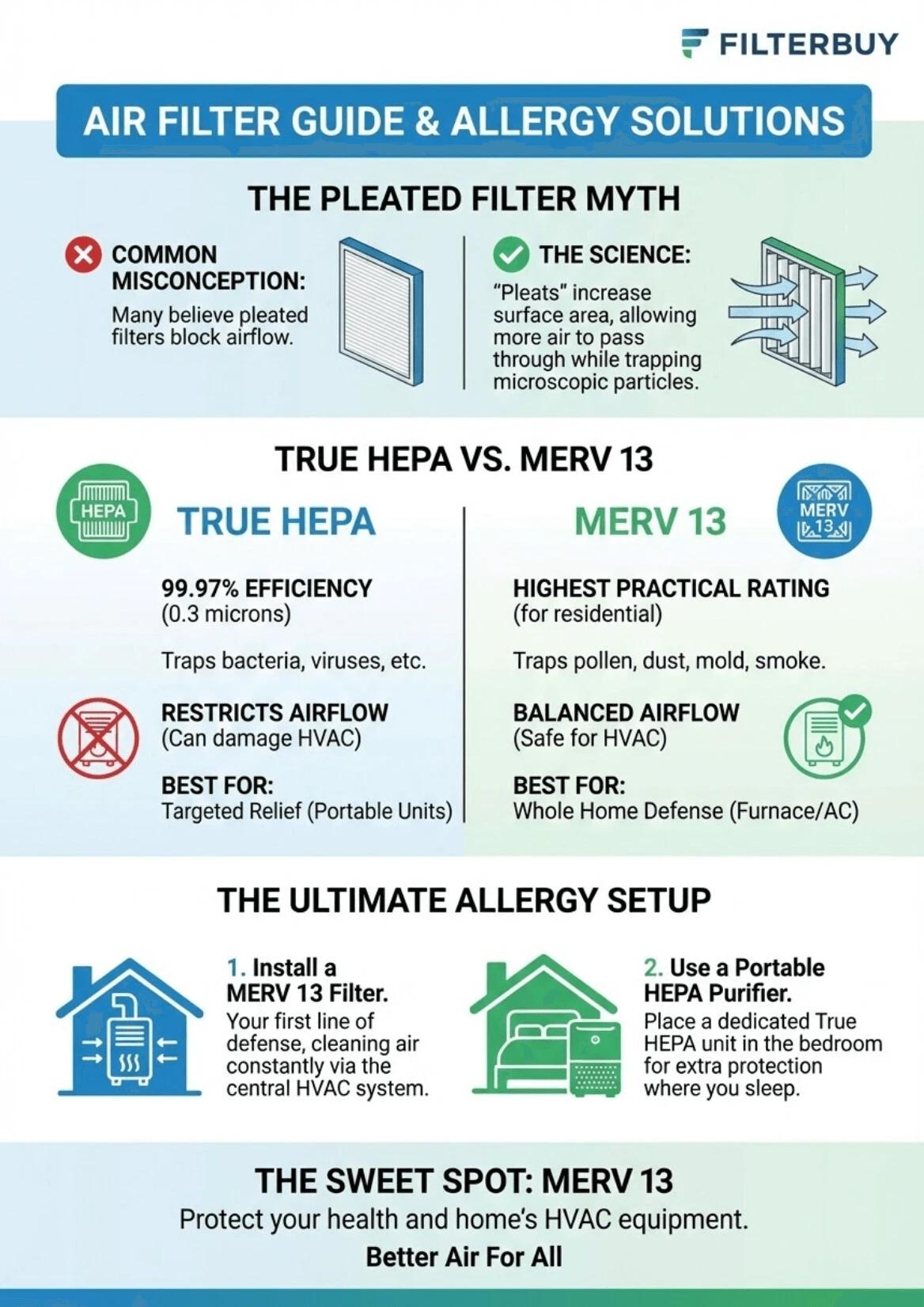
The "pleats" (the accordion-style folds in the material) drastically increase the surface area of the filter. This allows them to trap significantly more microscopic particles—like pollen, dust mites, and pet dander—without blocking the airflow your system needs to run efficiently. For most allergy sufferers, upgrading to a high-quality pleated filter is the single most effective step toward cleaner indoor air.
What Is a True HEPA Filter?
To understand the difference between filters, we need to define what "True HEPA" actually means. HEPA stands for High Efficiency Particulate Air.
By definition, a True HEPA filter must capture at least 99.97% of particles that are 0.3 microns in diameter. To put that in perspective, a human hair is roughly 50 to 70 microns thick. HEPA filters are dense enough to trap bacteria and even some viruses.
Because of this incredible efficiency, HEPA filters are the gold standard in specific environments:
Hospitals and surgical suites
Clean rooms for manufacturing electronics
Nuclear facilities
Portable air purifiers
However, that density comes with a major catch: airflow resistance. Pushing air through a material that dense requires a specialized, high-powered motor—one that is very different from the blower found in a standard residential furnace.
What Is a MERV 13 Furnace Filter?
For central heating and cooling systems, we use the MERV (Minimum Efficiency Reporting Value) scale. This rating system, developed by ASHRAE, measures how effectively a filter traps particles of various sizes. The scale ranges from 1 to 16 for residential use.
A MERV 13 filter is widely considered the highest practical rating for residential HVAC systems. Here is what a MERV 13 filter effectively captures:
Pollen and dust mites
Pet dander
Mold spores
Bacteria and virus carriers
Smoke and smog
Fine dust
While it doesn't hit the 99.97% efficiency rate of a HEPA filter at 0.3 microns, it captures a vast majority of the airborne agitators that trigger allergy symptoms, all while allowing air to pass through at a rate that keeps your home comfortable.
True HEPA vs MERV 13: What’s the Real Difference?
When you compare True HEPA vs MERV 13, you are essentially comparing a specialized medical-grade tool against a high-performance residential solution. Here is how they stack up:
People often search for "merv 13 filter vs HEPA 13" or "true HEPA filter vs HEPA 13", trying to find a middle ground. The reality is that "HEPA 13" is a marketing term often found on European appliances, but in the context of American central air systems, you are usually choosing between a high-MERV filter installed in your vents or a standalone HEPA unit plugged into a wall outlet.
Why True HEPA Doesn’t Work in Most Furnaces
If HEPA filters are so effective, why can't you just slide one into your furnace slot?
Residential HVAC systems are designed to heat and cool your home by circulating a specific volume of air. This is measured in CFM (Cubic Feet per Minute). Because True HEPA filters are made of extremely dense mats of fibers, they create a massive amount of static pressure.
If you force a standard residential blower to push air through a True HEPA barrier, several problems occur:
Reduced Airflow: Your home won't heat or cool properly, leaving you with hot and cold spots.
Increased Energy Bills: Your system has to run longer and work harder to satisfy the thermostat.
System Damage: The lack of airflow can cause air conditioner coils to freeze over or the furnace heat exchanger to overheat.
Motor Failure: The added strain can burn out your blower motor, leading to expensive repairs.
HEPA filtration belongs in systems designed to handle that level of resistance—like MERV 13 air purifiers or dedicated bypass filtration units—not in your central furnace.
Best Setup for Severe Allergies (Whole-Home Approach)
If you have severe allergies or asthma and are looking for the absolute best air quality possible, the answer isn't choosing between True HEPA vs MERV 13—it's using them together in the right places.
Here is the ultimate setup for allergy relief:
In your Furnace/AC: Install a high-quality MERV 13 pleated filter. This acts as your first line of defense, cleaning the air constantly as it circulates through your entire home.
In the Bedroom: Place a portable True HEPA air purifier. Since we spend about eight hours a night in this room, having that extra layer of "scrubbing" can significantly improve sleep quality.
By letting the MERV 13 handle the heavy lifting for the whole house and using HEPA for targeted, single-room purification, you get the best of both worlds: maximum filtration and a healthy, efficient HVAC system.
Why MERV 13 Is the Sweet Spot for Allergy Sufferers
For homeowners looking for relief without risking their HVAC equipment, MERV 13 is the ideal solution. It sits at the "sweet spot" of filtration technology.
A MERV 13 filter from Filterbuy is tight enough to trap the tiny particles that bypass lower-rated filters—including smoke from cooking or wildfires and microscopic allergens—but it is engineered to maintain sufficient airflow. This ensures your system runs efficiently while effectively scrubbing the air in every room of your house, not just one.
So, if you're looking for allergy relief without damaging your HVAC system, MERV 13 filters are the ideal solution. They provide a "sweet spot" by trapping tiny particles like smoke and microscopic allergens that lower-rated filters miss.
Unlike restrictive HEPA filters, MERV 13s are engineered to maintain sufficient airflow, allowing your system to run efficiently while effectively cleaning the air in every room. By choosing a MERV 13 filter, you can protect both your health and your home's HVAC equipment.
Frequently Asked Questions
Is MERV 13 good enough for allergies?
Yes, MERV 13 is highly effective for allergies. It captures pollen, dust mites, pet dander, mold spores, and even smoke and virus-carrying particles. For most residential homes, it offers the highest level of filtration without restricting airflow to the point of damaging the HVAC system.
What’s the difference between true HEPA vs MERV 13?
The main difference is efficiency and airflow. A True HEPA filter captures 99.97% of particles at 0.3 microns but is too dense for standard residential furnaces. A MERV 13 filter is slightly less efficient at that microscopic level but is designed to work safely with central heating and cooling systems to filter the air in the entire home.
Can I put a HEPA filter in my furnace?
Generally, no. Most residential furnaces are not built to push air through the dense material of a True HEPA filter. Installing one can restrict airflow, leading to higher energy bills, frozen AC coils, and potential burnout of your blower motor.
Are pleated furnace filters bad for airflow?
No, high-quality pleated filters are designed to balance filtration and airflow. The "pleats" increase the surface area of the filter material, allowing more air to pass through while still trapping dust and allergens. They are significantly better for your system than cheap fiberglass filters that let dirt coat your motor.
What does "true HEPA filter vs HEPA 13" mean?
"HEPA 13" is often a European standard (H13) roughly equivalent to True HEPA. In the US, people sometimes search for "hepa 13" when comparing portable air purifier filters. However, neither should be confused with a MERV 13 furnace filter, which is designed for central air ducts.
Is MERV 13 better than HEPA for whole-home air?
For a central HVAC system, MERV 13 is better because it is compatible with the equipment. A HEPA filter would block airflow, effectively stopping the circulation of air (heated or cooled) throughout the house.
Will a higher MERV rating damage my HVAC system?
It can if the rating is too high for your specific unit. Most modern homes can handle MERV 11 or MERV 13 without issue. However, using a HEPA filter (which is far beyond the MERV 16 scale) in a standard slot will likely cause damage. It is always smart to check your manual or use a clean MERV 13 filter and change it regularly.
Do MERV 13 filters help with pet allergies?
Absolutely. MERV 13 filters are excellent at trapping pet dander and the microscopic proteins found in pet saliva that often cause allergic reactions.
How often should I replace a MERV 13 pleated filter?
To maintain optimal airflow and filtration, we recommend checking your filter every 30 days and replacing it at least every 90 days. If you have pets or severe allergies, you may need to replace it more frequently (every 45-60 days).