
Propane House Furnace Guide: Residential Propane Heating, Cost Analysis, Efficiency Ratings, Installation Tips, and Filter Care
October 6, 2026
Furnace Filters & Winter guides
Propane House Furnace: What It Costs and How to Keep It Efficient
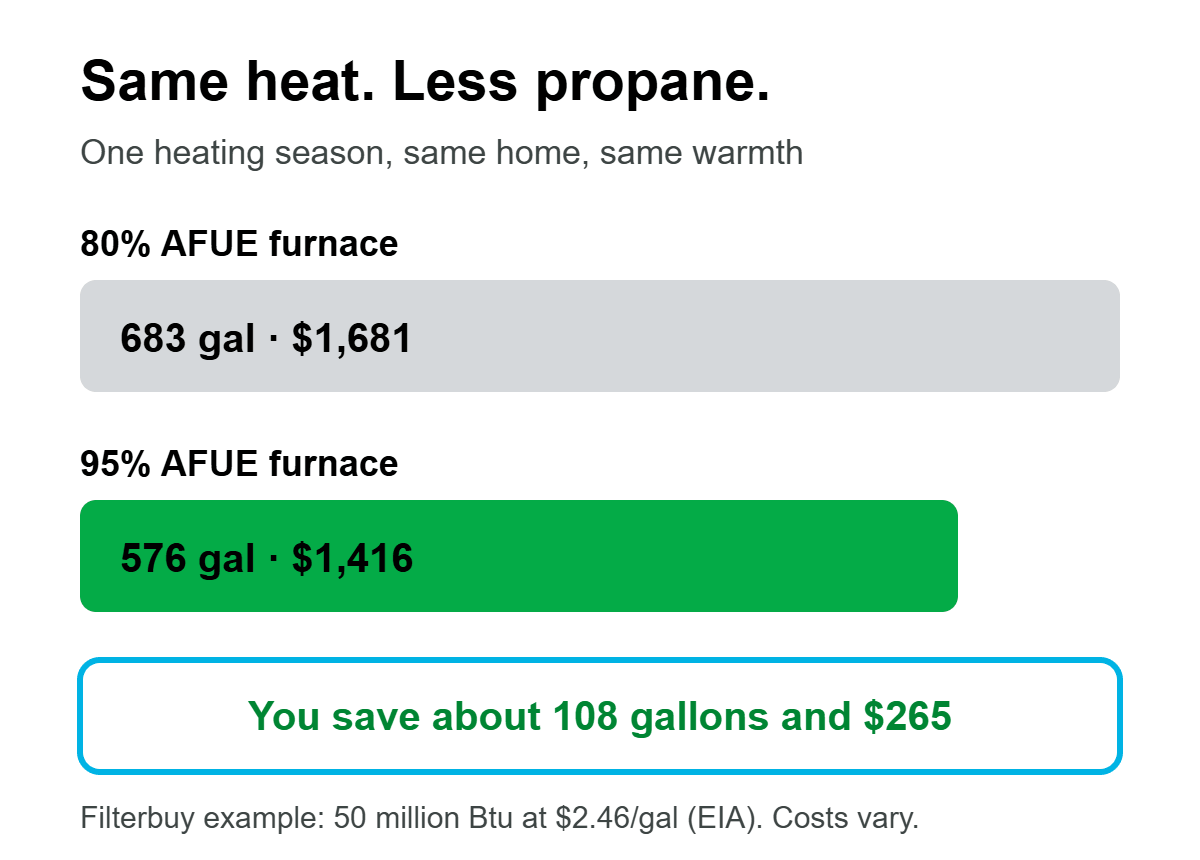
A propane house furnace typically costs $3,000–$8,000 installed, and a high-efficiency model burns noticeably less fuel. In our example, a 95% AFUE furnace uses about 108 fewer gallons a season than an 80% model, roughly $265 saved at $2.46 a gallon.
AFUE is the share of fuel that turns into heat. Whichever furnace you have, a clean filter that fits your slot helps it run efficiently. The quick quiz below matches you to the right one.
Answer a few quick questions and we'll match you to the right filter for your furnace.
Want more cold-weather help? Browse all furnace and winter filter guides.
TL;DR
A propane house furnace is a forced-air furnace that burns liquefied petroleum (LP) gas from a tank on your property. It's common in homes without natural gas service. A high-efficiency model turns about 95% of its fuel into heat, so it burns noticeably less propane than an 80% model. Either way, a clean filter that fits your slot keeps it running efficiently.
Key Takeaways
• Who uses it: About 6.3 million U.S. households heat mainly with propane, mostly in rural areas (EIA).
• Installed cost: Most homeowners pay 3,000–8,000; the national average is around $4,800 (Fixr, 2026).
• Fuel math: A gallon of propane holds roughly 91,452 Btu, the standard unit of heat (EIA). At $2.46 a gallon, a million Btu of heat costs $33.62 from an 80%-efficient furnace and $27.73 from a 97% one.
• Filter care: Propane furnaces use standard HVAC filters. Filterbuy recommends checking monthly in winter and replacing 1-inch filters every 1–3 months.
What Is a Propane House Furnace and How Does It Work?
A propane house furnace is a gas-fired, forced-air heating appliance that burns propane (also called LP gas or LPG) stored in a tank on your property. The burners heat a metal heat exchanger. A blower pushes household air across it, then ductwork carries the warm air to every room. Return air passes through your filter before the cycle repeats.
An LP gas furnace is mechanically almost identical to a natural gas furnace. The difference is fuel delivery: propane arrives by truck and is stored as a pressurized liquid, while natural gas comes through a utility pipeline. Because propane is supplied at higher pressure, the furnace's gas valve and burner orifices have to be set up for LP.
Homeowners choose a residential propane furnace because it needs no gas line and delivers strong heat in deep cold. One tank can also run a water heater, range, fireplace, or generator.
Why Filterbuy Wrote This Guide
Filterbuy is a manufacturer, not a reseller: our filters are cut, pleated, and framed to order in our own US plants. Propane homes stand out to us. The EIA reports they're mostly rural and concentrated in some of the coldest regions (EIA). That means long heating seasons and heavy blower runtime. So this guide pairs fuel math with the one job you fully control: the filter.
How Much Does a Propane Furnace for a House Cost?
A new propane furnace for a house costs roughly 3,000–8,000 installed, with a national average near $4,800, according to Fixr's 2026 propane furnace cost guide. Converting from another fuel adds 275–13,300, mostly depending on whether you lease or buy the tank.
What It Costs to Run a Propane Home Heating Furnace
Operating cost depends on your propane price and your furnace's AFUE. The EIA forecast an average residential propane price of $2.46 per gallon for winter 2025–2026 (EIA Winter Fuels Outlook). Prices vary widely by region. On March 30, 2026, the season's last weekly reading, propane averaged $2.67 a gallon nationally, $3.60 on the East Coast, and $2.18 in the Midwest (EIA Heating Oil and Propane Update).
Use this formula to estimate your own season:
Gallons per season = Heat your home needs (Btu) ÷ (91,452 × AFUE)
Filterbuy ran the numbers so you can see what each efficiency level costs per unit of heat.
Table 1: Filterbuy propane cost-of-heat comparison by furnace efficiency
Filterbuy calculation using EIA's 91,452 Btu per gallon, a $2.46 per gallon propane price, and an example home that needs 50 million Btu of delivered heat per season. Your costs will vary with local prices, climate, and insulation.
In this example, going from 80% to 95% AFUE saves roughly 108 gallons and $265 a season.
How Long Does a Full 500-Gallon Tank Last in Winter?
A 500-gallon tank holds roughly 400 gallons, because tanks are filled to roughly 80% for safety (Fixr). We divided that by EIA's November–March consumption estimates for propane-heated homes (EIA), which cover all household propane use:
• Midwest (639 gallons a winter): one fill lasts roughly 95 days.
• Northeast (512 gallons): about 118 days.
• South (365 gallons): about 165 days, longer than the 151-day season.
Filterbuy's takeaway: in the Midwest and Northeast, one full tank won't cover an average winter. Schedule automatic delivery, or check your gauge weekly in January, when EIA's monthly estimates peak. That three-month cycle matches a 90-day filter change.
Tax credit note: The federal energy efficient home improvement credit, which covered up to $600 for qualifying propane furnaces, can't be claimed for property placed in service after December 31, 2025 (IRS Form 5695 instructions). Ask your state energy office and propane supplier about local rebates.
Propane Furnace Efficiency Ratings: What AFUE Means for Your Home
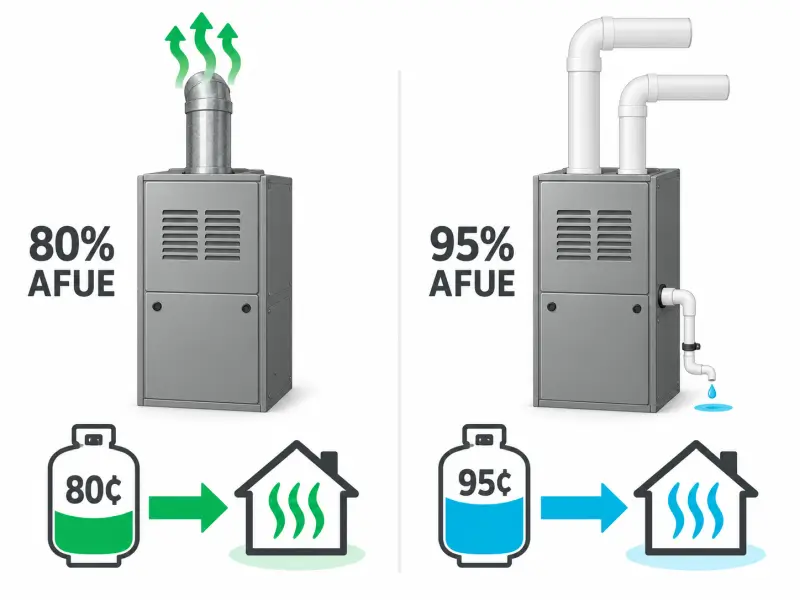
AFUE (Annual Fuel Utilization Efficiency) is the share of a furnace's fuel that becomes usable heat over a typical year. A 95% AFUE propane furnace turns 95 cents of every propane dollar into heat; an 80% model turns 80 cents into heat and sends the rest up the vent. Every new furnace must display its AFUE (U.S. Department of Energy).
Table 2: Furnace efficiency comparison by AFUE range
AFUE ranges from the U.S. Department of Energy.
ENERGY STAR requirements. An ENERGY STAR certified gas furnace must reach at least 97% AFUE in the U.S. North and 95% AFUE in the U.S. South, with no more than 2% cabinet air leakage (ENERGY STAR furnace criteria). These levels took effect July 31, 2026.
Federal minimums are in flux. A Department of Energy rule would require new indoor gas furnaces to reach 95% AFUE starting in late 2028. In June 2026, the U.S. Supreme Court vacated the appeals-court ruling that upheld it and sent the case back for review (trade publication Butane/Propane News). For now, 80% propane furnaces remain on the market.
Is high efficiency worth it? Usually in cold climates. The Department of Energy notes that in milder climates, the extra cost of 90%–95% efficiency may be hard to justify.
Residential Propane Furnace Installation Tips
Hire a licensed HVAC contractor who works with your propane supplier. ENERGY STAR reports that improper installation can cut system efficiency by up to 30% (ENERGY STAR).
1. Insist on a load calculation. Ask for an ACCA Manual J calculation, a room-by-room estimate of how much heat your home needs. For scale, Fixr lists 60,000–120,000 Btu for a 2,000-square-foot home. An oversized furnace short-cycles and wastes propane.
2. Confirm LP setup. Many furnaces ship set for natural gas and need the manufacturer's LP conversion kit, installed and tested by a qualified technician.
3. Plan the tank with your supplier. Whole-home heating commonly uses a 500-gallon tank. Under NFPA 58, the national propane safety code, above-ground tanks of 125–500 gallons must sit at least 10 feet from buildings and property lines (Propane Education & Research Council).
4. Match venting to the furnace. Condensing models, the 90%+ units that pull extra heat from their exhaust, need PVC venting and a condensate drain; 80% models use a metal flue or lined chimney.
5. Check the filter slot. Make sure it's easy to reach and fits a standard size. Ask if it can take a 4" or 5" media filter. Filterbuy makes 1", 2", 4", and 5" depths.
6. Add CO and gas safety. The U.S. Consumer Product Safety Commission recommends carbon monoxide alarms on each level of the home and outside sleeping areas. If you smell propane's rotten-egg odor, leave the house and call your supplier or 911 from outside.
Filter Care for Your Propane Home Furnace
Check your filter every month in winter and change it at least every 3 months. That's ENERGY STAR's guidance, and it's the maintenance job you control. A dirty filter slows airflow and makes the system work harder. That wastes fuel and can lead to expensive repairs.
How Often to Replace It
• 1-inch filters: every 1–3 months. Homes with pets often need the shorter end.
• 4- and 5-inch media filters: these often last 6–12 months (Filterbuy).
Not sure? Hold the filter up to a light. If light barely passes through the pleats, replace it. Your furnace manual has the final word.
Which MERV Rating Fits a Propane Furnace?
MERV is a filter's capture rating; higher numbers catch smaller particles. Pick the tier that matches your home:
• MERV 8: the standard choice for most homes. Captures 90% of Airborne Particles.
• MERV 11: for homes with allergy sufferers, asthma, pets, or pollen. Captures 95% of Airborne Particles.
• MERV 13: the pick for smoke. Captures 98% of Airborne Particles.
• Odor Eliminator: a carbon filter for odors.
Check your HVAC manual for compatibility, the same way you confirm the size. Compare all four in our MERV rating chart guide.
How to Change a Propane Furnace Filter in 5 Steps
1. Turn the thermostat off so the blower isn't running.
2. Find the filter slot. It usually sits on the return-air side, beside or below the furnace.
3. Read the size printed on the old filter's frame (for example, 16x25x1). That's the size you order. Double-check the depth, since our manufacturing team sees it ordered wrong more than any other dimension. No filter or no label? Measure the slot with our air filter measuring guide. If your size isn't listed, we cut custom sizes to the eighth of an inch.
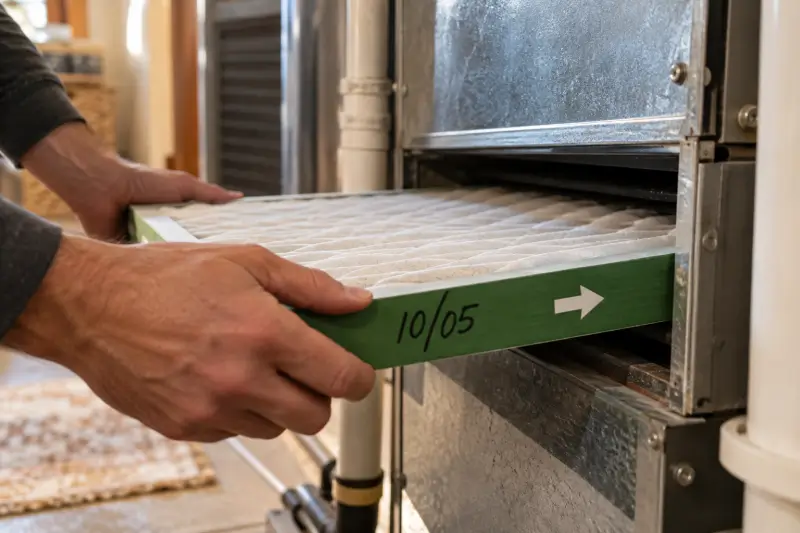
4. Slide the new filter in with the airflow arrow pointing toward the furnace blower.
5. Write the date on the frame and turn the system back on.
"Homeowners bring me the old filter and ask what to buy. I ask for a photo of the empty slot instead. Half the time the filter they had been using was never right for the opening it sat in."
David Clark, Licensed HVAC Technician, Filterbuy HVAC Solutions
"The question I get most is which MERV to buy. The one to ask first is whether the filter you are holding actually fills the slot. A rating describes the media, not the gap around it."
Michelle Wan, Brand Manager and Air Quality Writer, Filterbuy
Our Tip for Propane Homes: Sync Filters With Fuel
Most propane homes already run on a delivery schedule, so use it. When the propane truck comes, change the filter. Set Filterbuy auto-delivery to every 30, 60, or 90 days to match, and a fresh filter arrives before each fill. Our filters are cut to order in our US plants, in standard and custom sizes, with fast and free 2-day delivery to most US states. Breathe easy.
Supporting Statistics
Three federal findings back this guide.
1. Propane-heated homes spent $1,286 on propane in winter 2025–26.
– That is EIA's final estimate of the average November–March bill.
– Source: EIA Winter Fuels Outlook 2025–26
2. Faulty furnaces were linked to 18.5% of CO exposures in a CDC study.
– Scope: non-fire CO cases treated in U.S. emergency rooms, 2001–2003.
– Cases peaked in January: 69 deaths and 2,511 nonfatal cases a year.
– Patients who had a home CO detector reported that it alerted them.
– Source: CDC Morbidity and Mortality Weekly Report
3. Filter efficiency is the top factor in how fast HVAC coils clog.
– Typical indoor coils double their airflow resistance in about 7.5 years, well short of a 15–30 year life.
– What this means: a good filter protects shared furnace and AC equipment.
– Source: Lawrence Berkeley National Laboratory via OSTI.gov
Propane House Furnace FAQ
How Long Does a Propane Furnace Last?
A well-maintained gas furnace typically lasts 15–20 years, and ENERGY STAR suggests considering replacement once a furnace passes 15 years. Filterbuy's gas furnace lifespan guide covers the warning signs.
How Much Propane Does a House Furnace Use Per Winter?
A propane furnace used for whole-home heating typically burns roughly 500–900 gallons a year, according to New England propane supplier Dead River Company, depending mostly on climate and insulation.
Glossary
• Propane (LP gas, LPG): A liquefied petroleum gas stored under pressure in a tank and burned for home heating.
• AFUE (Annual Fuel Utilization Efficiency): The percentage of a furnace's yearly fuel that becomes usable heat.
• Btu (British thermal unit): The heat needed to raise one pound of water by 1°F.
• Condensing furnace: A 90%+ AFUE furnace that recovers exhaust heat with a second heat exchanger.
• LP conversion kit: Manufacturer parts that adapt a natural gas furnace to burn propane.
• ENERGY STAR: The U.S. EPA program that certifies energy-efficient products.
• NFPA 58: The National Fire Protection Association's Liquefied Petroleum Gas Code, which governs propane tank placement.
• Manual J: The Air Conditioning Contractors of America (ACCA) method for calculating a home's heating and cooling load.
• MERV (Minimum Efficiency Reporting Value): A rating of how well an air filter captures particles. Filterbuy makes MERV 8, 11, and 13.
Sources
• U.S. Energy Information Administration – British thermal units (Btu)
• U.S. Energy Information Administration – Heating Oil and Propane Update
• LP Gas magazine – Lower propane prices drive winter outlook (EIA Winter Fuels Outlook)
• Fixr – How Much Does a Propane Furnace Cost? [2026 Data]
• U.S. Department of Energy – Furnaces and Boilers
• ENERGY STAR – Furnaces Key Product Criteria
• ENERGY STAR – Heat & Cool Efficiently
• Butane/Propane News – U.S. Supreme Court Furnace Rule Decision
• IRS – Instructions for Form 5695 (2025)
• Propane Education & Research Council – Propane tank placement and NFPA 58
• U.S. Consumer Product Safety Commission – CO Alarms
• Dead River Company – How Much Propane Does a Home Use?
• U.S. Energy Information Administration – Winter Fuels Outlook 2025–26
• CDC – Unintentional Non-Fire-Related Carbon Monoxide Exposures, United States, 2001–2003 (MMWR)
• Lawrence Berkeley National Laboratory – Dirty Air Conditioners: Energy Implications of Coil Fouling (OSTI.gov)