
Current Temperature Map of the USA
October 22, 2026
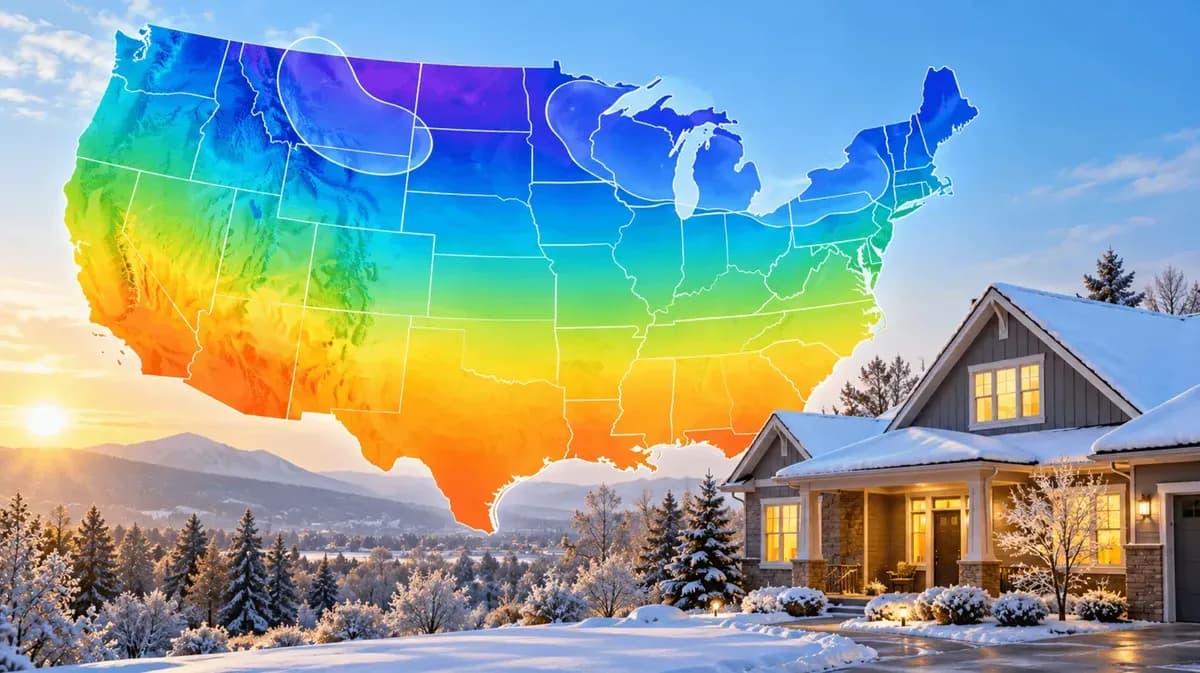
Your temperature right now is on the live map: find your city or ZIP code to see the latest local reading in °F. If an alert outline covers your county, the National Weather Service considers that cold dangerous where you live.
A cold reading is also a cue for your home. The colder it gets, the longer your furnace runs and the faster your filter fills up. In a hard winter, that can mean a fresh filter every month instead of every few months.
Deep cold loads filters faster
How long a furnace filter can last
Find Your Filter Match
Not sure which filter fits your system? Answer a few quick questions and we’ll match you to the right MERV rating for your home.
This live map shows the current temperature across the USA today in degrees Fahrenheit, drawn from National Weather Service surface observations, with active cold weather alerts layered on top. Because Filterbuy makes air filters, we read every cold reading as a forecast for your furnace and pair each band and alert with a home check.
TL;DR
The Filterbuy Current Temperature Map shows real-time air temperatures across the United States in Fahrenheit, with National Weather Service cold alerts on a separate layer. The colors show the actual air temperature, and the alert outlines show where wind chill makes that cold dangerous outdoors. When temperatures drop, your furnace runs longer and pushes more air through your filter, which is why Filterbuy treats every cold snap as a filter check.
Key Takeaways
The Filterbuy map shows the latest air temperature observed at U.S. weather stations, in Fahrenheit.
The National Weather Service issues three cold alerts: the Cold Weather Advisory, Extreme Cold Watch, and Extreme Cold Warning.
Wind chill is how cold the air feels on your skin. Wind can't push pipes or outdoor HVAC units below the actual air temperature.
At 0°F with a 15 mph wind, the wind chill drops to -19°F, cold enough to freeze exposed skin in 30 minutes.
Days of nonstop heating can load a furnace filter in about 30 days instead of the usual 60 to 90, so check it monthly all winter.
What Is the Current Temperature Across the USA Right Now?
The current temperature across the USA is the live reading on the interactive Filterbuy map above, updated as new station observations come in. Colors run from deep purple at the coldest to red at the warmest, so the coldest and warmest spots in the country stand out at a glance. Select any location to see its exact reading and observation time. For tonight's low, check your local National Weather Service forecast.
How to Read the Live Temperature Map
The map lays National Weather Service cold alerts, drawn by county and forecast zone, over a Fahrenheit color scale. Together they show how cold it is and whether the NWS considers that cold dangerous where you live.
Highs and Lows
Select a location and you'll see its current reading alongside the day's observed high and low so far.
Cold Weather Alert Layer
Active cold alerts show up as outlined shapes. Select one to see the alert type and when it expires. For snow and ice, switch over to the Filterbuy winter storm tracker.
Cold Weather Alerts on the Map: Advisory, Watch, and Warning
The National Weather Service issues three cold weather alerts, and the map shows each one. Table 1 compares them side by side, including how confident forecasters need to be before they issue one.
Table 1: NWS Cold Weather Alerts Shown on the Map
Source: National Weather Service. Alert criteria vary by region.
NWS cold alert criteria are set locally. The National Weather Service office in Lincoln, Illinois, for example, issues an Extreme Cold Warning when the temperature or wind chill reaches -25°F or colder in the north of its area and -20°F farther south. For more, see Filterbuy's guides to the Extreme Cold Warning and the Cold Weather Advisory, or read what replaced wind chill warnings.
Temperature vs. Wind Chill: What the Map Number Means
The temperature on the map is the actual air temperature. Wind chill is a separate number that estimates how cold that air feels on exposed skin once wind speeds up heat loss, and the National Weather Service wind chill chart only applies when it's 50°F or colder with wind faster than 3 mph.
Wind can make pipes and outdoor HVAC equipment lose heat faster, but it can't push them below the actual air temperature. That's why our rule at Filterbuy is simple: read the map temperature for your pipes and the wind chill for your skin. If you head out, the CDC lays out steps for preventing hypothermia and frostbite, and our guide to how cold is too cold for your home and pipes covers the indoor thresholds.
What Each Temperature Band Means for Your Home
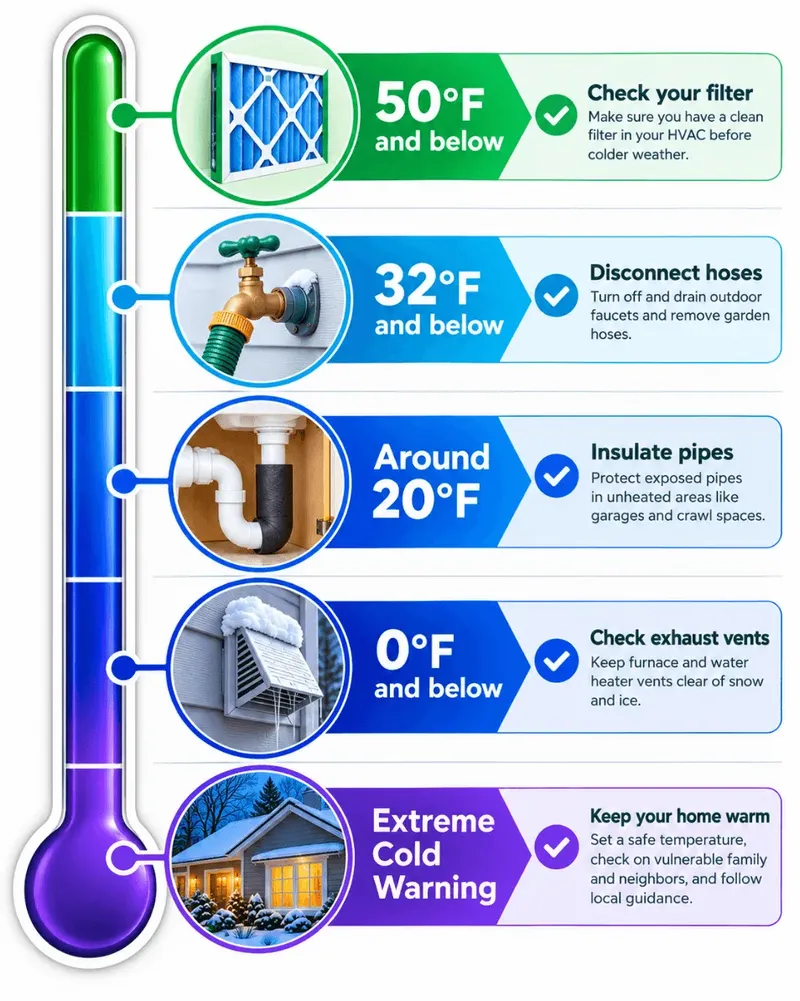
Each temperature band on the map asks something different of your home. Filterbuy built the Temperature-to-Home Checklist below to match the map's colors to what's worth checking, and we treat any forecast low near 20°F or below as a pipe-protection night.
Table 2: Filterbuy Temperature-to-Home Checklist
Wind chill figure: National Weather Service wind chill chart.
In deep cold, snow or ice at a high-efficiency furnace's outdoor vent can shut it down. Here's how to clear a frozen furnace vent pipe safely, and if the power goes out, Filterbuy's guide to heating your home in a winter power outage covers what still works.
How to Turn a Map Reading Into a Plan
Before a cold night, the Filterbuy team runs through three quick steps.
Find your spot. Note the current reading and whether an alert outline covers your county.
Work out the wind chill if you'll be outside. Plug the temperature and wind speed into the NWS chart. At 10°F with a 20 mph wind, for example, the wind chill comes out to about -9°F.
Match the reading to the checklist. A low near 20°F calls for protecting pipes, and any cold alert means pets come inside.
After tonight, look a few days ahead. Heating degree days, which count how far a day's average temperature falls below 65°F, show how hard the cold will work your furnace. A day averaging 15°F adds 50 heating degree days, while a 45°F day adds only 20, so the colder day calls for about 2.5 times the heat. For our team, a week of 15°F days is the cue to pull the filter and look.
How Cold Weather Affects Your Furnace and Air Filter
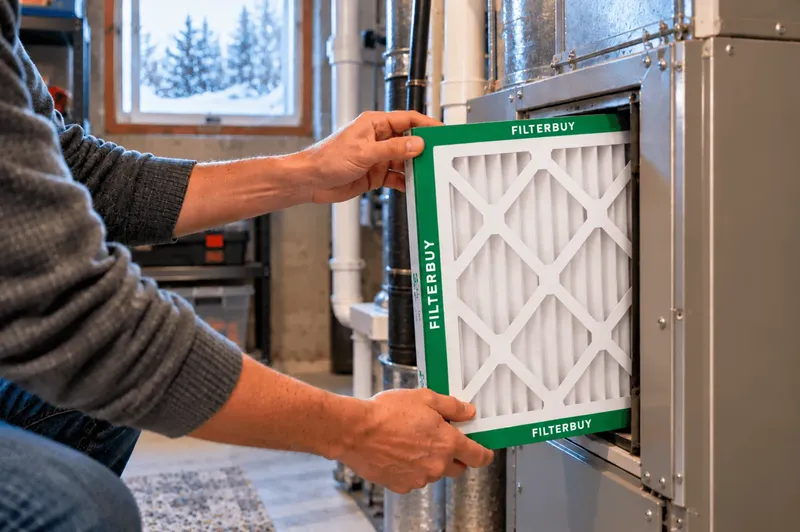
Every extra heating cycle pulls more household air through your filter. Days of nonstop heating can load a filter in about 30 days instead of the usual 60 to 90, and the Filterbuy team has pulled February filters from customers' systems that were black after 30 days of heavy run time.
Most homes should change a 1-inch or 2-inch pleated filter every 90 days and check it monthly, per Filterbuy's guide on how often to change your air filter. During a long cold stretch, check sooner and swap it out if it looks gray. Stick with the MERV rating your HVAC system's manual allows, and if you're unsure, see which MERV rating you should use.
"Most of the time, I find a filter that hasn't been touched since the kids went back to school," says a Filterbuy HVAC-certified technician with more than 10 years of residential and commercial service.
Winter also keeps windows shut, so the same indoor air circulates for months at a time, which is why indoor air quality gets worse in winter.
Why a Filter Company Built a Temperature Map
Filterbuy makes MERV-rated air filters, and winter is when they work hardest. Any temperature map can tell you how cold it is, but we wanted this one to also tell you what that cold means for your home.
"The systems that quit on the coldest night of the year are rarely the oldest ones. In our experience, they're the ones that went into winter with a dirty filter," says the Filterbuy Team.
"I don't want anyone to feel like they need an HVAC license just to pick the right filter. My job is to give you the straight answer, explain why it matters, and let you get back to your day," says Michelle Wan, Brand Manager and Air Quality Writer at Filterbuy.
Supporting Statistics
Heating uses 42% of home energy.
Space heating is the largest single energy use in U.S. homes.
Water damage and freezing claims average $15,400.
They made up 22.6% of U.S. homeowners insurance losses in 2023.
The $15,400 average covers claims from 2019 to 2023.
Source: Insurance Information Institute
January is the peak month for home heating fires.
The U.S. averaged 34,200 residential heating fires a year from 2017 to 2019.
Heating is the second leading cause of residential fires, after cooking.
Source: U.S. Fire Administration
Frequently Asked Questions
How Often Does the Current Temperature Map Update?
The Filterbuy map refreshes whenever new readings arrive from National Weather Service reporting stations. Most of those are Automated Surface Observing System stations, which report at least hourly.
Is This a Weather Radar Map?
No. Radar tracks precipitation, while this map shows the measured air temperature near the ground. For snow and ice, pair it with the winter storm tracker and local radar, and for outdoor air pollution, use the Filterbuy live AQI map.
Can I See Current Temperatures by State?
Yes. Zoom into any state to see readings from its cities and towns, or search for a city or ZIP code.
Why Doesn't the Map Match My Phone's Weather App?
Weather apps often show a model estimate for your exact spot, while the map shows a reading from the nearest station, which is often at an airport. Elevation and pavement can easily put your street a few degrees off.
What Temperature Should I Keep My Home at During Extreme Cold?
Keep the thermostat at a steady setting day and night, and don't let it drop below 55°F, even when you're away. The American Red Cross frozen pipe guidance sets 55°F as the minimum for an empty home.
Get Your Home Ready for the Cold
When the map turns blue over your state, a fresh filter is the five-minute job we'd do first. Find your size and MERV rating in Filterbuy air filters with fast and free 2-day delivery to most US states, or set up Filterbuy auto-delivery so new filters arrive on schedule all winter.
Glossary
Air Temperature: The temperature of the air, measured by a shaded thermometer near the ground. It's the number on this map.
Wind Chill: An estimate of how cold the air feels on exposed skin when wind increases heat loss.
National Weather Service (NWS): The federal agency within the National Oceanic and Atmospheric Administration (NOAA) that issues official U.S. forecasts and alerts.
Cold Weather Advisory: An NWS alert for cold that can cause frostbite or hypothermia without precautions. It replaced the Wind Chill Advisory.
Extreme Cold Watch: An NWS alert meaning dangerously cold temperatures or wind chills are possible. It replaced the Wind Chill Watch.
Extreme Cold Warning: An NWS alert meaning life-threatening cold temperatures or wind chills are expected or occurring. It replaced the Wind Chill Warning.
Heating Degree Day (HDD): A measure of how far a day's average outdoor temperature falls below 65°F.
MERV: Minimum Efficiency Reporting Value, an ASHRAE test-based rating that shows how well an HVAC air filter captures airborne particles. The EPA explains what a MERV rating is.