
Understanding Cabin Air Filter Ratings: A MERV-Inspired Guide To Automotive Filtration
August 26, 2026
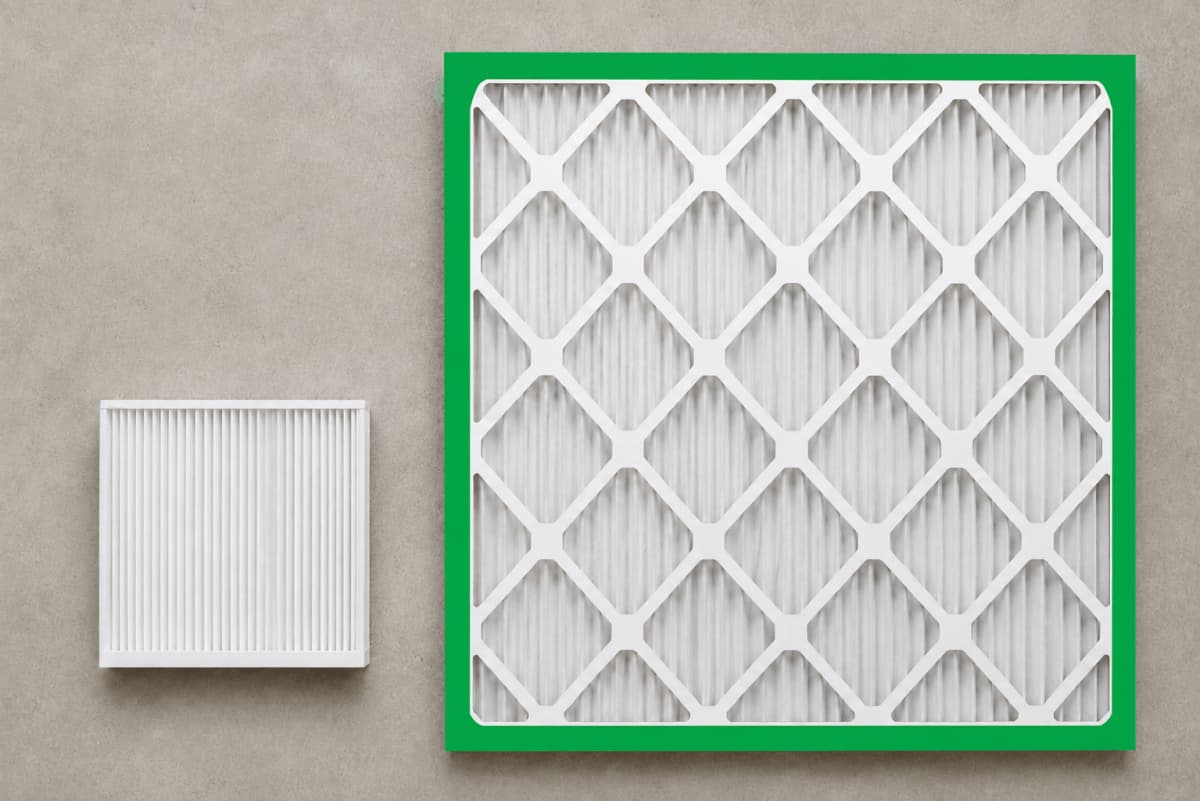
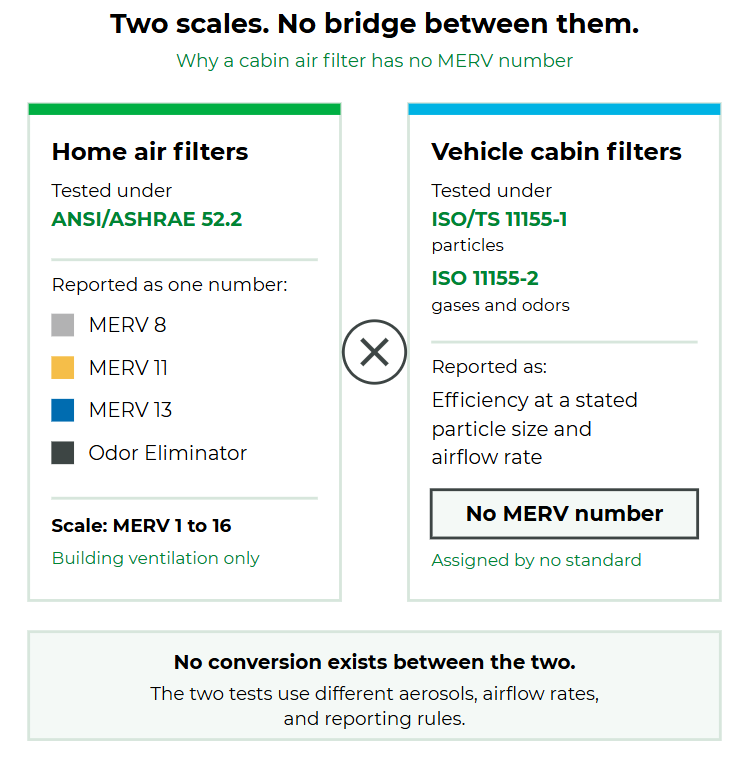
No. Cabin air filters do not have MERV ratings. MERV is assigned only under ANSI/ASHRAE Standard 52.2, a test method written for building ventilation. Vehicle cabin filters are tested under two different standards, ISO/TS 11155-1 and ISO 11155-2, which report efficiency at a stated particle size rather than one summary number.
Here is what each scale actually covers:
MERV 1 to 16 (ANSI/ASHRAE 52.2) rates home and building filters. It does not cover vehicles.
ISO/TS 11155-1 tests cabin filters for particles: dust, pollen, and road debris.
ISO 11155-2 tests cabin filters for gases and odors, the job an activated carbon layer does.
No conversion exists between them. Any chart calling a cabin filter "MERV 13 equivalent" is an estimate, not a test result.
So the useful question is not which MERV number to buy. It is which cabin filter fits your vehicle and the problem you are solving. Take the quick match below and we will point you to it.
Answer 3 quick questions and we will match you to the right cabin filter.
Already know your vehicle? Find the cabin air filter for your year, make, and model.
TL;DR
Cabin air filters do not carry MERV ratings. MERV comes from ANSI/ASHRAE Standard 52.2, a test method written for building ventilation, and no United States standard assigns MERV numbers to automotive filters. Cabin filters are tested instead under ISO/TS 11155-1 and ISO 11155-2, which report efficiency at named particle sizes rather than one summary number. Filterbuy manufactures cabin air filters in the United States and still declines to print a MERV number on the box.
Key Takeaways
MERV is defined by ANSI/ASHRAE Standard 52.2 for building ventilation air cleaners, and that standard does not cover automotive passenger compartment filters.
Cabin air filters are tested under ISO/TS 11155-1 for particles and ISO 11155-2 for gases and odors, with DIN 71460 as the German equivalent.
No conversion table exists between MERV and cabin filter efficiency, because the two test methods use different ducts, aerosols, airflow rates, and reporting rules.
MERV reports a minimum efficiency measured across a dust-loading run, while cabin filter specifications commonly report initial efficiency on a clean element.
A cabin air filter efficiency claim is only readable when it names three things together: a particle size range, an airflow rate, and the test method behind the number.
Filterbuy manufactures cabin air filters in the United States and prints no MERV rating on them, because the number would not come from a test the product took.
Do Cabin Air Filters Have A MERV Rating?
Cabin air filters do not have MERV ratings. MERV, short for Minimum Efficiency Reporting Value, is assigned only under ANSI/ASHRAE Standard 52.2, whose title names general ventilation air-cleaning devices as its subject. Automotive passenger compartment filters sit under a separate family of standards maintained by ISO Technical Committee 22, the committee for road vehicles. A cabin filter box printing a MERV number borrows a term from a test the product did not take.
The confusion is fair. Both products are pleated media in a frame and both sit inside something called an HVAC system. Drivers reach for MERV because it is the only filtration scale most American households know, which makes it a reasonable way to think about cabin filtration and a poor way to describe one. Filterbuy sells MERV-rated filters for homes and unrated filters for vehicles, and that split reflects the standards rather than a marketing decision.
Which Standards Actually Rate Cabin Air Filters?
Two international test methods govern automotive cabin filtration. ISO/TS 11155-1 measures particulate efficiency above 0.3 microns, along with pressure loss and dust-holding capacity. ISO 11155-2 measures dynamic gas adsorption for odors and vapors. German industry uses the parallel DIN 71460 series. None produce a single-integer rating, which is why no cabin filter can be labeled the way a furnace filter is.
| Standard | What It Measures | Applies To |
|---|---|---|
| ISO/TS 11155-1:2001 | Particulate efficiency, pressure loss, dust-holding capacity above 0.3 microns | Road vehicle passenger compartments |
| ISO 11155-2:2009 | Dynamic gas adsorption for odors and vapors, plus pressure loss | Road vehicle passenger compartments |
| DIN 71460-1 and DIN 71460-2 | German national equivalents for particulate and gaseous filtration | Road vehicle passenger compartments |
| ANSI/ASHRAE 52.2 | Particle size efficiency from 0.30 to 10 microns, reported as MERV 1 to 16 | Home and building ventilation systems |
Both documents remain in force. The ISO/TS 11155-1 technical specification was published in 2001 and confirmed current in 2024, and the ISO 11155-2 gaseous filtration standard was confirmed in 2023. No United States regulation requires a cabin filter to meet a stated efficiency, and no independent body audits what a brand prints on the box. Manufacturers run these tests internally, and very few publish the results. Filterbuy is in that group, which is the uncomfortable part of writing this page.
Particles And Odors Are Two Different Tests And Two Different Problems
ISO/TS 11155-1 and ISO 11155-2 exist as separate documents because particle filtration and gas filtration are separate jobs done by separate materials. Pleated media traps particles. Activated carbon adsorbs gases and odors by a mechanism that has nothing to do with pore size. Neither substitutes for the other, and a filter tested under one standard has not necessarily been tested under the other.
What a driver notices tells them which they need. Dust on the dash points to the particle phase. Diesel and traffic fumes point to the gas phase, and no particle efficiency figure however high will address them. The most common way we see people waste money is a very efficient particulate filter bought to fix an exhaust smell.
Carbon carries a limit worth knowing before you pay for it. The carbon layer adsorbs odors until it saturates, then stops, while the particulate layer keeps catching dust. A carbon filter can look serviceable and have quietly stopped doing half of what you bought it for. Change on schedule rather than on appearance.
Why MERV And Cabin Ratings Cannot Be Converted
MERV and cabin filter efficiency cannot be converted, because the two tests disagree on nearly every variable that produces the number: duct geometry, challenge aerosol, airflow rate, and reporting rules. Any chart claiming a cabin filter equals MERV 13 is an estimate built by eye.
Per the published text of ANSI/ASHRAE Standard 52.2, the lab loads the filter with dust until resistance reaches at least twice its clean value, and the figure it reports is the worst reading taken along the way. A cabin filter specification usually captures the opposite moment, the element at its cleanest. A cabin filter advertising very high capture and a MERV 13 filter guaranteeing 50 percent in its finest range are not two points on one scale. They are two different questions answered on two different days.
Where We Stand
Filterbuy manufactures and sells cabin air filters, so this page argues against a shortcut we could take ourselves. We could print a MERV number on a cabin filter box tomorrow and no regulator would stop us, but that number would not come from any test the product actually took, so we leave it off.
The same rule applies to our own listings. Where we publish a capture percentage, it is a manufacturer figure rather than a published ISO/TS 11155-1 result, and we say so.
How To Read A Cabin Air Filter Efficiency Claim
Read a cabin air filter efficiency claim by looking for three things, then ask a fourth question.
Find the particle size range. A filter that captures 99 percent at 3 microns and one that does it at 0.3 microns are separated by an order of magnitude in difficulty.
Find the airflow rate. Efficiency rises as air slows through media, so a number quoted without a flow rate can be produced at whatever speed flatters it.
Find the test method. ISO/TS 11155-1 and DIN 71460-1 are the names worth seeing. HEPA-grade describes media, not a cabin filter test result.
Ask whether the number is clean or loaded. Almost every published cabin figure describes a new filter, which is why the replacement interval matters more than the headline percentage.
A Salt Lake City commuting study shows the honest format. Researchers documenting their test vehicles listed the original equipment Toyota cabin filter as 20 plus or minus 10 percent at 0.3 to 0.5 microns at 240 cubic meters per hour. That single line tells a shopper everything needed to judge the filter, which is more than almost any retail listing manages. For the same four checks applied brand by brand, see how cabin air filter brands compare.
Using MERV As A Benchmark Rather Than A Rating
MERV still helps as a reference point, provided nobody treats the comparison as equivalence. ANSI/ASHRAE 52.2 groups its twelve particle channels into three ranges. E1 covers 0.30 to 1.0 microns, E2 covers 1.0 to 3.0 microns, and E3 covers 3.0 to 10.0 microns. Once you know what each tier requires, you have a sense of scale for judging a cabin filter claim.
Matching A Cabin Filter To What You Actually Breathe
The useful question is not which cabin filter is best. It is which problem you are solving. The table below maps what a driver notices to the phase it belongs to and the specification worth looking for. It is a judgment framework built from the two ISO test methods above, not a lab result.
| What You Notice | What It Points To | What To Look For |
|---|---|---|
| Dust, pollen, allergy symptoms | Particle phase | Efficiency stated at 0.30 to 1.0 microns with a named airflow rate |
| Exhaust or traffic fumes | Gas phase | An activated carbon layer, ideally with ISO 11155-2 results |
| Musty smell returning after a change | Moisture on the evaporator, not the filter | Service the vehicle HVAC system. A new filter will not fix it |
| Weak vent output after an upgrade | Media resistance above what the blower can push | Step back to a lower resistance media rather than a higher grade |
A musty smell returning within weeks of a fresh filter is usually moisture on the evaporator, and no cabin filter reaches that part of the system. Weak airflow after an upgrade means the media is finer than the blower was built for. In both cases the honest answer costs Filterbuy a sale.
What Testing Shows About Cabin Filtration In Real Vehicles
Field research consistently finds that cabin filtration reduces driver exposure to traffic pollution, and that the filter already in most vehicles underperforms what better media can do. Both studies below measured real cars on real roads. Filterbuy funded neither and no Filterbuy product was tested in either, which is why they carry more weight here than anything from our own lab.
A 2017 study in PLOS One instrumented 17 taxis and measured pollutant levels inside and outside each vehicle while driven. Against no mitigation, closing the windows and fitting a high-efficiency cabin air filter cut in-cabin fine particulate matter by 37 percent and ultrafine particles by 47 percent.
Earlier work points the same way. A 2013 conference abstract archived by NIOSH tested 12 vehicles across stationary, roadway, and freeway conditions. In-use original equipment filters cut ultrafine particle counts by 41 to 65 percent on average. HEPA-grade media cut them by 93 percent. That record is a conference abstract rather than a peer-reviewed paper, so treat the figures as indicative.
Supporting Statistics
Cabin air filtration matters because of where Americans drive and what they are driving through. The three figures below come from a US federal agency, a state agency, and a national public health nonprofit. None originate with Filterbuy, and each measures something this page has argued from other evidence.
45 Million People Live Within 300 Feet Of A Major Road
Source: the Environmental Protection Agency air research program.
Motor vehicle pollutants concentrate near major roads, and exposure can cause lung and heart problems and premature death.
It counts where people live, not the larger number who drive those corridors daily.
High-Efficiency Cabin Filters Cut In-Cabin Particles 55 To 90 Percent
Source: a California Air Resources Board research synthesis on near-roadway exposure, covering passenger vehicles and school buses.
Roughly twice the reduction achieved by filters typically found in cars and buses.
It corroborates the 41 to 65 versus 93 percent vehicle testing figures above.
44 Percent Of Americans Live Where Air Quality Earns A Failing Grade
Source: the 2026 American Lung Association State of the Air report, using federal monitoring data from 2022 through 2024.
152.3 million people live in counties graded F for ozone or particle pollution.
A cabin filter cannot change outside air. It decides how much of that air reaches the people inside.
Cabin Air Filter Sizes And How To Find Yours
Cabin air filters are sized by vehicle, not by the nominal dimension system used for home filters. A furnace filter is ordered as 20x25x1. A cabin filter is ordered by year, make, and model, or by an interchange number such as a CF or CP code. No universal cabin air filter size chart exists, because housings differ between manufacturers and often between trim levels of one model.
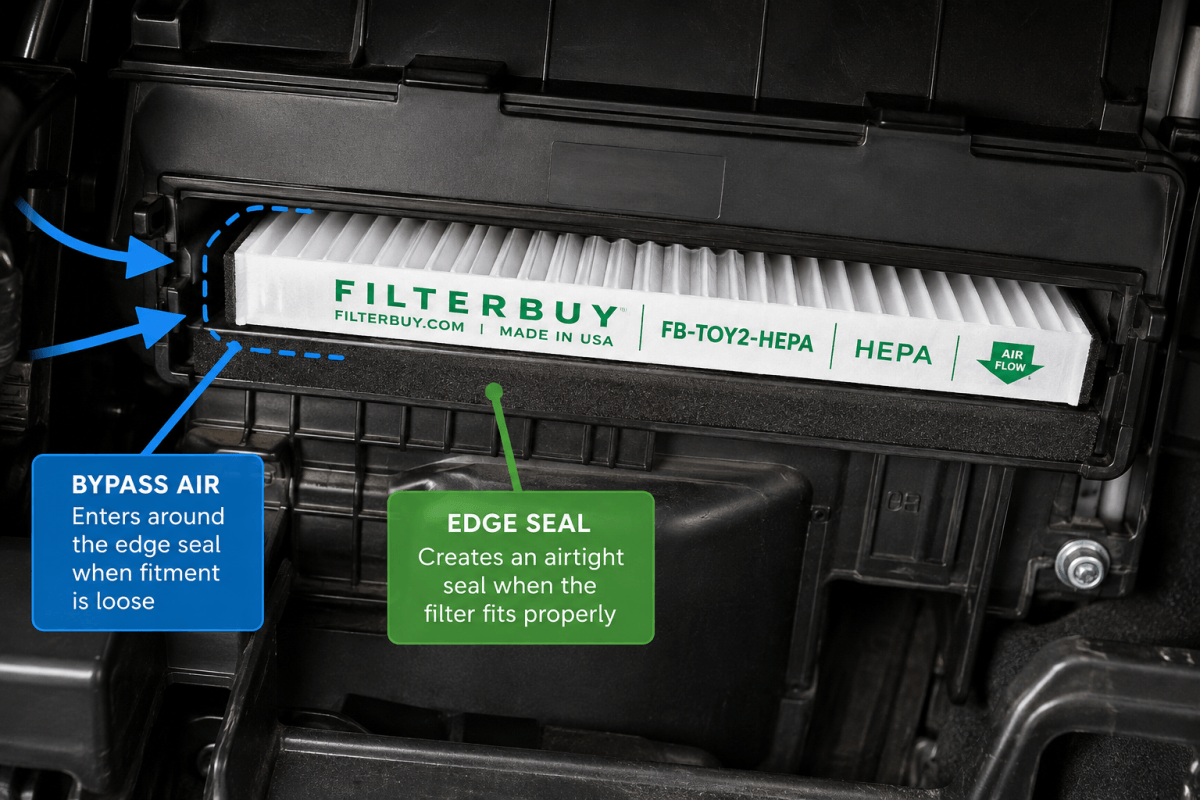
Check the owner's manual, or pull the existing element from behind the glove box and measure length, width, and depth in millimeters, then look up the cabin air filter that fits your vehicle. A filter leaving a few millimeters of gap lets air slide around the edges, carrying the particles the media was bought to stop. That is why Filterbuy indexes its cabin filters to vehicle fitment data rather than to nominal dimensions. The Filterbuy complete buyer's guide to cabin air filters covers media grades and replacement intervals.
How Cabin Air Filters Are Made
Filterbuy manufactures its American-made cabin air filters at plants in Alabama, Florida, Pennsylvania, and Utah. Domestic production covers the media, frame, carbon layer, and adhesives rather than assembly alone, the distinction the Federal Trade Commission draws under 16 C.F.R. Part 323.
Frequently Asked Questions
What MERV Rating Is A Cabin Air Filter?
A cabin air filter MERV rating does not exist as a certified figure. MERV is assigned only under ANSI/ASHRAE Standard 52.2, which covers building ventilation. Cabin filters are tested under ISO/TS 11155-1 and ISO 11155-2, which report efficiency at stated particle sizes rather than a single number.
Can I Compare A Cabin Air Filter To A MERV 13 Filter?
Loosely, as a sense of scale, but not as a conversion. MERV 13 requires at least 50 percent capture in the 0.30 to 1.0 micron range, measured at the filter's weakest point during dust loading. A cabin filter percentage usually describes a clean element. The two are not interchangeable.
How Often Should A Cabin Air Filter Be Replaced?
Most vehicle manufacturers specify every 12 months or 12,000 to 15,000 miles, and the owner's manual is the authority for your vehicle. Shorten it for heavy traffic, dust, or wildfire smoke. Because published efficiency figures describe clean filters, replacement timing affects real performance more than the headline percentage.
Is A Higher Efficiency Cabin Air Filter Always Better?
Not automatically. Finer media raises airflow resistance, which can weaken vent output and load the blower motor. Fit matters more, because a high-efficiency filter that seals poorly performs worse than a modest one that seals well. Match the filter to the problem you actually have.
Glossary
MERV: Minimum Efficiency Reporting Value, a 1 to 16 scale assigned under ANSI/ASHRAE Standard 52.2 to building ventilation air-cleaning devices.
ANSI/ASHRAE Standard 52.2: The American laboratory test method for building ventilation air cleaners, which produces the MERV scale.
ISO/TS 11155-1: The international technical specification for particulate filtration testing of road vehicle passenger compartment air filters, published in 2001 and confirmed current in 2024.
ISO 11155-2: The companion standard covering gas and odor adsorption testing for cabin air filters.
DIN 71460: The German national standard series for cabin air filter testing, with Part 1 covering particles and Part 2 covering gases.
E1, E2, E3: The three particle size ranges reported under ANSI/ASHRAE 52.2: 0.30 to 1.0, 1.0 to 3.0, and 3.0 to 10.0 microns.
Cabin air filter: The replaceable filter that cleans outside or recirculated air before it enters a vehicle's passenger compartment.
HEPA: High Efficiency Particulate Air, a specification requiring at least 99.97 percent capture of 0.3 micron particles under its own test method, separate from MERV and ISO 11155.
Bypass air: Air that passes around a filter's edges instead of through the media, caused by a gap between frame and housing.
Ultrafine particles: Airborne particles smaller than 0.1 microns, abundant in vehicle exhaust and not reported separately by MERV.
Activated carbon: A treated layer that adsorbs gases and odors, a different mechanism from physical particle capture.
Original equipment filter: The cabin filter specified by the vehicle manufacturer and fitted at the factory, often abbreviated OEM.
Pressure loss: The resistance a filter adds to airflow, reported alongside efficiency by both test methods.
Interchange number: A cross-reference code such as CF or CP used to match a cabin filter to a vehicle across brands.