filterbuy
 

Shop by

resources
>
brand comparisons
>
What's the Difference Between Filterbuy vs Filter King HVAC and Furnace Air Filters?

What's the Difference Between Filterbuy vs Filter King HVAC and Furnace Air Filters?

On this page

Filterbuy.com's Expert Guide to Choosing the Right Brand

After manufacturing millions of air filters since 2013, we've learned exactly what makes one brand outperform another—and it's not always what you'd expect.

Customers frequently ask how Filterbuy compares to Filter King. Rather than marketing claims, we'll share what we've observed firsthand: the manufacturing differences that affect filtration performance, the sizing gaps that leave some homeowners without options, and why MERV ratings only tell part of the story.

This comparison covers what actually matters for your indoor air quality, your HVAC system's lifespan, and your wallet.

Quick Answers

Filterbuy vs Filter King

The short answer: Filterbuy offers American-manufactured filters with consistent quality control. They last for the full service of their cycle, which makes their high upfront cost worth it. Meanwhile, Filter King offers lower upfront prices with variable construction quality, and oftentimes, consumers report that it clogs prematurely, which will eventually require you to purchase more frequently.

What we've learned after manufacturing millions of filters:

Bottom line: Choose Filter King if price is your only concern. Choose Filterbuy if consistent quality, size availability, and true MERV performance matter to your household.

Top Takeaways

1. Manufacturing matters more than marketing.

2. MERV ratings only mean something when construction backs them up.

3. The cheapest filter usually isn't the cheapest choice.

Filter King's lower upfront price often leads to:

Customers who switch to Filterbuy report filters lasting the full service cycle.

4. Size availability separates the brands.

If your home requires an unusual size, availability often makes the decision for you.

5. Your air filter affects more than air quality.

Every filter impacts:

A clogged or poorly constructed filter can increase energy use by 15%—compounding across thousands of operating hours annually.

Manufacturing Origin and Quality Standards

Filterbuy manufactures all air filters in American facilities located in Alabama, Florida, Pennsylvania, and Utah. This domestic production allows for direct quality control at every stage—from raw materials to the finished filter that arrives at your door.

Filter King sources filters through various manufacturing channels, which can create inconsistencies in frame durability and media density between batches. We hear from customers who switched to Filterbuy after receiving Filter King products with loose-fitting frames or media that separated from the cardboard housing prematurely.

Our electrostatically charged pleated media undergoes testing before leaving the facility. This matters because a filter's particle capture ability depends entirely on consistent pleat spacing and proper media tension—details that suffer when production oversight is limited.

MERV Rating Options and Filtration Performance

Both brands offer filters across standard MERV ratings, but the performance behind those numbers varies based on construction quality.

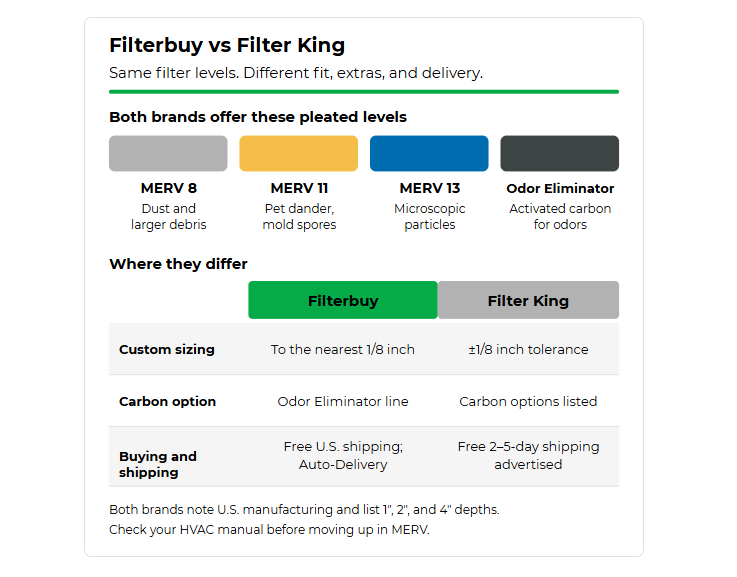
Filterbuy provides MERV 8, MERV 11, and MERV 13 options, plus an Odor Eliminator line with activated carbon. Each rating targets specific particle sizes: MERV 8 captures dust, pollen, and lint; MERV 11 adds pet dander and mold spores; MERV 13 filters bacteria, smoke, and microscopic allergens.

Filter King offers similar MERV tiers. However, customers tell us their MERV 11 filters from Filter King sometimes underperform compared to our MERV 8—suggesting the rated efficiency doesn't always match real-world results. True MERV performance requires precise pleat counts and media weight that budget manufacturing often sacrifices.

Size Availability and Custom Options

Finding your exact filter size determines whether a brand works for your home. Standard sizes like 20x20x1 or 16x25x1 are widely available from both companies.

Filterbuy stocks over 600 different sizes and maintains a dedicated custom filter team for non-standard dimensions. Older homes, commercial buildings, and certain HVAC units require unusual measurements—and we've built our inventory specifically to serve those customers other brands overlook.

Filter King carries a more limited size selection. If your system requires an uncommon dimension like 21.5x24x1 or 10x14x2, availability becomes unpredictable. We regularly welcome customers who couldn't find their size elsewhere.

Pricing Structure and Long-Term Value

Filter King often appears less expensive at first glance. Single-filter pricing tends to run slightly lower than Filterbuy's comparable products.

However, filter cost means little if replacement frequency increases. Cheaply constructed filters clog faster, restrict airflow sooner, and force your HVAC system to work harder—raising energy bills and accelerating wear on expensive components. One customer shared that switching to Filterbuy's MERV 11 from Filter King's equivalent extended their replacement cycle from 6 weeks to the full 90 days.

Filterbuy's subscription program delivers filters on your schedule at reduced pricing, eliminating the hassle of remembering replacements while lowering per-filter costs below most competitors.

The Bottom Line: Which Brand Fits Your Needs

Choose Filter King if budget represents your only consideration and your size requirements are standard. The filters function adequately for basic dust capture in systems without demanding filtration needs.

Choose Filterbuy if you prioritize consistent quality, need uncommon sizes, have allergy concerns, or want filters that perform to their rated MERV level throughout their lifespan. Our American manufacturing, extensive size library, and subscription convenience serve homeowners who view air filtration as genuine home protection rather than a commodity purchase.

Your air filter works invisibly around the clock. The difference between adequate and excellent shows up in your family's respiratory health, your energy bills, and the longevity of your HVAC investment.

"After manufacturing filters for over a decade, we've seen firsthand that the MERV number on the label only tells half the story—what actually protects your family is the consistency behind that rating, and that's something you can only guarantee when every filter is built and inspected under your own roof."

— Filterbuy Team

Essential Resources on Filterbuy vs Filter King

We believe informed customers make the best decisions—for their homes, their HVAC systems, and their families. That's why we're pointing you toward the same independent resources our own team references when developing filters and advising customers.

1. EPA Guide to Air Cleaners and Air Filters in the Home

This is the resource we recommend most often to customers asking how air filtration actually works. The EPA explains particle capture, filter types, and what to look for when evaluating any brand's claims—including ours.

https://www.epa.gov/indoor-air-quality-iaq/air-cleaners-and-air-filters-home

2. ASHRAE MERV Rating Standards

MERV ratings only mean something if they're earned through standardized testing. ASHRAE created the system, and its resources explain exactly what each rating level captures. When we say our MERV 13 filters perform to spec, this is the standard we're measured against.

https://www.ashrae.org/technical-resources/filtration-disinfection

3. EPA Indoor Air Quality Overview

Most families don't realize indoor air can be two to five times more polluted than outdoor air. This EPA resource breaks down common household pollutants and why proper filtration matters—context that helps explain why we're so obsessed with getting the details right.

https://www.epa.gov/indoor-air-quality-iaq

4. Department of Energy HVAC Maintenance Guide

Customers often ask us how filter choice affects their energy bills and system lifespan. Energy.gov provides the independent data: a clogged or poorly constructed filter can increase energy consumption by up to 15%. This is why we emphasize both filtration quality and proper airflow in every filter we manufacture.

https://www.energy.gov/energysaver/maintaining-your-air-conditioner

5. American Lung Association Clean Air Resources

For households with allergies, asthma, or respiratory concerns, filter selection becomes a health decision. The American Lung Association offers guidance we often share with customers who need filtration that goes beyond basic dust capture.

https://www.lung.org/clean-air/at-home/indoor-air-pollutants

6. Energy Star Heating and Cooling Efficiency

Your filter works around the clock alongside your HVAC system. Energy Star explains the relationship between filter quality, system efficiency, and long-term costs—the same factors we consider when engineering filters that protect both your air and your equipment.

https://www.energystar.gov/products/heating_cooling

7. HUD Healthy Homes Program

The Department of Housing and Urban Development researches what makes homes healthier for families. Their findings on indoor air quality align with what we hear from customers every day: the right filter makes a noticeable difference in how your home feels.

https://www.hud.gov/program_offices/healthy_homes

Why we share these resources:

At Filterbuy, we'd rather you verify our claims against independent standards than take our word for it. These government and nonprofit sources have no stake in which brand you choose—they simply want you breathing cleaner air. Review them, compare what you learn to what we've shared in this guide, and make the decision that's right for your household.

Supporting Statistics

After over a decade of manufacturing air filters and talking with thousands of customers, we've seen these statistics play out in real households every day.

Indoor air pollutants are typically 2 to 5 times higher than outdoor levels—and occasionally exceed 100 times outdoor concentrations.

This EPA finding matches what customers describe when they first contact us: stuffy rooms, lingering odors, and dust that reappears hours after cleaning. Most people assume closing the windows keeps pollution out. In reality, indoor air traps and concentrates pollutants that proper filtration should capture. We've built our entire product line around solving this invisible problem—because once you understand what's actually circulating through your home, filter quality stops feeling optional.

Source: U.S. Environmental Protection Agency, "Why Indoor Air Quality is Important"

A clogged or low-quality air filter can increase your HVAC system's energy consumption by up to 15%.

This Department of Energy statistic explains something we hear constantly: customers who switched to Filterbuy after noticing their energy bills creeping up month after month. Poorly constructed filters either clog prematurely or arrive with inconsistent pleat spacing that restricts airflow from the start. In our facilities, we test media density and pleat uniformity because we've learned that a filter performing at 85% capacity costs you real money—15% more on every heating and cooling cycle, compounding across thousands of hours of annual runtime.

Source: U.S. Department of Energy, Energy Saver Guide

More than 27 million Americans currently live with asthma, and indoor allergens like dust mites, pet dander, and mold spores rank among the most common triggers.

We hear from these households regularly—parents searching for filters after another middle-of-the-night asthma episode, pet owners whose allergies worsened after adopting a dog, families who moved into older homes and suddenly developed respiratory symptoms. The Asthma and Allergy Foundation confirms what these customers already know: indoor triggers matter. It's why we refuse to cut corners on media quality. A filter rated MERV 11 should actually capture MERV 11 particles for its entire service life—not just on day one when it's fresh out of the packaging.

Source: Asthma and Allergy Foundation of America, "Asthma Facts"

What these numbers mean for choosing between Filterbuy and Filter King:

Statistics establish the stakes. First-hand experience determines who meets them. We've spent over a decade refining manufacturing processes specifically because we understand that a 15% energy penalty, elevated indoor pollution, or an avoidable asthma trigger isn't an abstract data point—it's someone's utility bill, someone's air quality, someone's child struggling to breathe. That accountability shapes every filter we produce.

Final Thought & Opinion

After manufacturing millions of air filters since 2013, we've developed a clear perspective on what separates adequate filtration from genuine home protection.

Filter King serves a purpose. For homeowners who view filters as a commodity—something to check off at the lowest cost—their products function. Air moves. Some particles get captured. The box gets checked.

But customers who switch to Filterbuy rarely go back. Here's what they tell us:

These results aren't coincidences—they're predictable outcomes of consistent manufacturing standards.

Our honest assessment:

Choose Filter King if:

Choose Filterbuy if:

The bottom line:

The difference between Filterbuy and Filter King isn't complicated—it's the difference between meeting a price point and meeting a standard.

Your air filter affects:

  1. Every breath your family takes
  2. Every dollar spent on heating and cooling
  3. Every year of service life remaining in your HVAC system

We know which filter we'd choose for our own families. Now you have the information to decide for yours.

A note on transparency:

We're not neutral in this comparison—we manufacture Filterbuy filters. But we've shared independent resources, government statistics, and the evidence behind our claims.

Verify everything against the EPA guidelines, ASHRAE standards, and Department of Energy research linked throughout this guide. If the evidence supports a different conclusion, we'd rather you make the right decision than simply take our word for it.

That's what being "air obsessed" actually means: caring more about whether you end up with the right filter than whether you end up with ours.

Next Steps

Step 1: Find Your Filter Size

Check your current filter's frame for three printed numbers (example: 20x25x1).

No filter installed?

Step 2: Choose Your MERV Rating

Not sure? Start with MERV 11—it handles most household needs.

Step 3: Confirm HVAC Compatibility

Most residential systems handle MERV 8–13 without issue.

If your system is older:

Step 4: Set Your Replacement Schedule

Step 5: Place Your Order

  1. Visit Filterbuy.com
  2. Enter your filter dimensions
  3. Select your MERV rating
  4. Choose one-time purchase or subscription

Subscribers save on every order and receive automatic deliveries on schedule.

Step 6: Set a Reminder

Questions?

Your indoor air quality matters. Take the next step today.

FAQ on "Filterbuy vs Filter King"

Q: Are Filterbuy filters better quality than Filter King filters?

A: After manufacturing filters for over a decade, we've learned quality shows up in details most people never see.

Customers who switch from Filter King describe the same issues:

We test every production run because we've seen what happens when details slip. The difference becomes obvious when you hold both filters side by side.

Q: Why are Filterbuy filters more expensive than Filter King?

A: The upfront price gap typically disappears—or reverses—within a few filter cycles.

What customers tell us about Filter King:

The real cost includes:

  1. Energy consumption
  2. Replacement frequency
  3. HVAC wear and tear

Not just the number on the box.

Q: Does Filter King offer the same MERV ratings as Filterbuy?

A: Both brands list similar MERV options. But the rating on the label doesn't guarantee performance in your home.

What we've observed:

When we rate a filter MERV 13, we've tested it to capture MERV 13 particles consistently—not just on day one.

Q: Can I find my filter size from both Filterbuy and Filter King?

A: Common sizes like 20x25x1 are available from both brands. The difference appears with uncommon dimensions.

Filterbuy's size advantage:

We built our inventory around customers other brands overlook—older homes, commercial buildings, and unusual HVAC configurations.

Don't see your size? Our custom filter team can manufacture it.

Q: Should I switch from Filter King to Filterbuy?

A: We can't decide for you. But here's what triggers most customers to switch.

Signs it's time to change brands:

What customers report after switching:

If none of these issues sound familiar, you may not need to switch. If they do, the change typically pays for itself faster than expected.

Now That You Know the Difference Between Filterbuy and Filter King, Experience It Yourself

See why thousands of customers switched to American-made filters built to perform at their rated MERV level. Find your size at Filterbuy.com and discover what consistent quality feels like in your home.