
Why Does the Air Smell Smoky Outside? How to Identify the Source
July 14, 2026
Author: Michelle Wan | Reviewer: David Clark, Licensed HVAC Technician | Publish Date: July 14, 2026
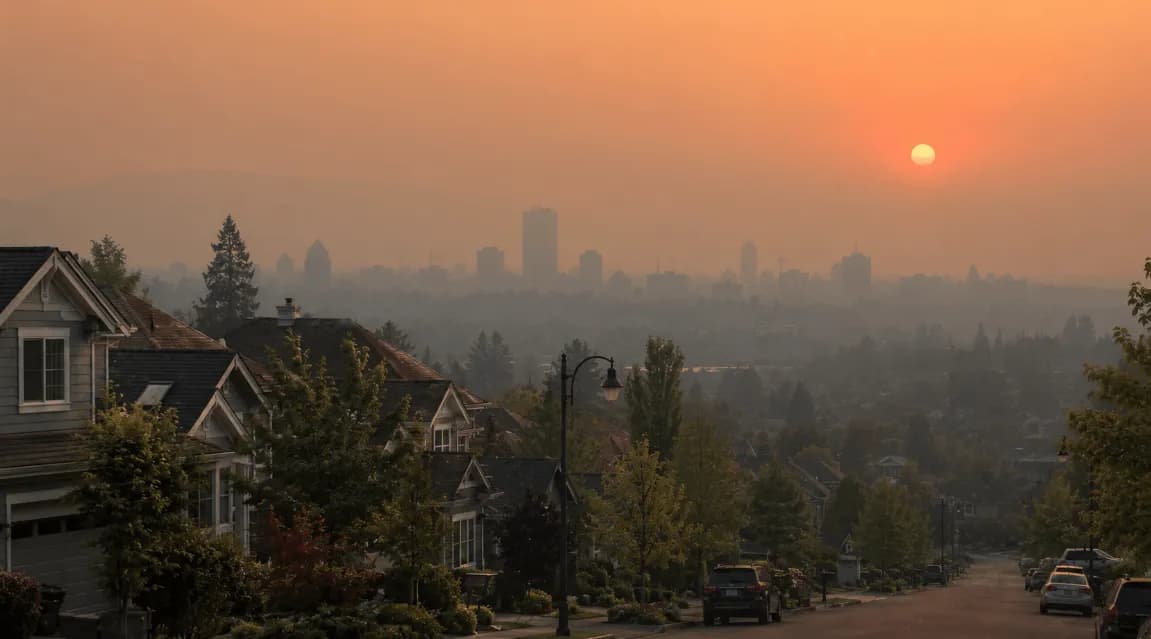
A smoky smell almost always means something is burning upwind, even when you can't see any flames or haze. Smoke can drift hundreds of miles, so the smell on its own won't tell you whether the air is safe. The fastest way to know your real risk is to check a live AQI or smoke map for your location.
The four most common sources:
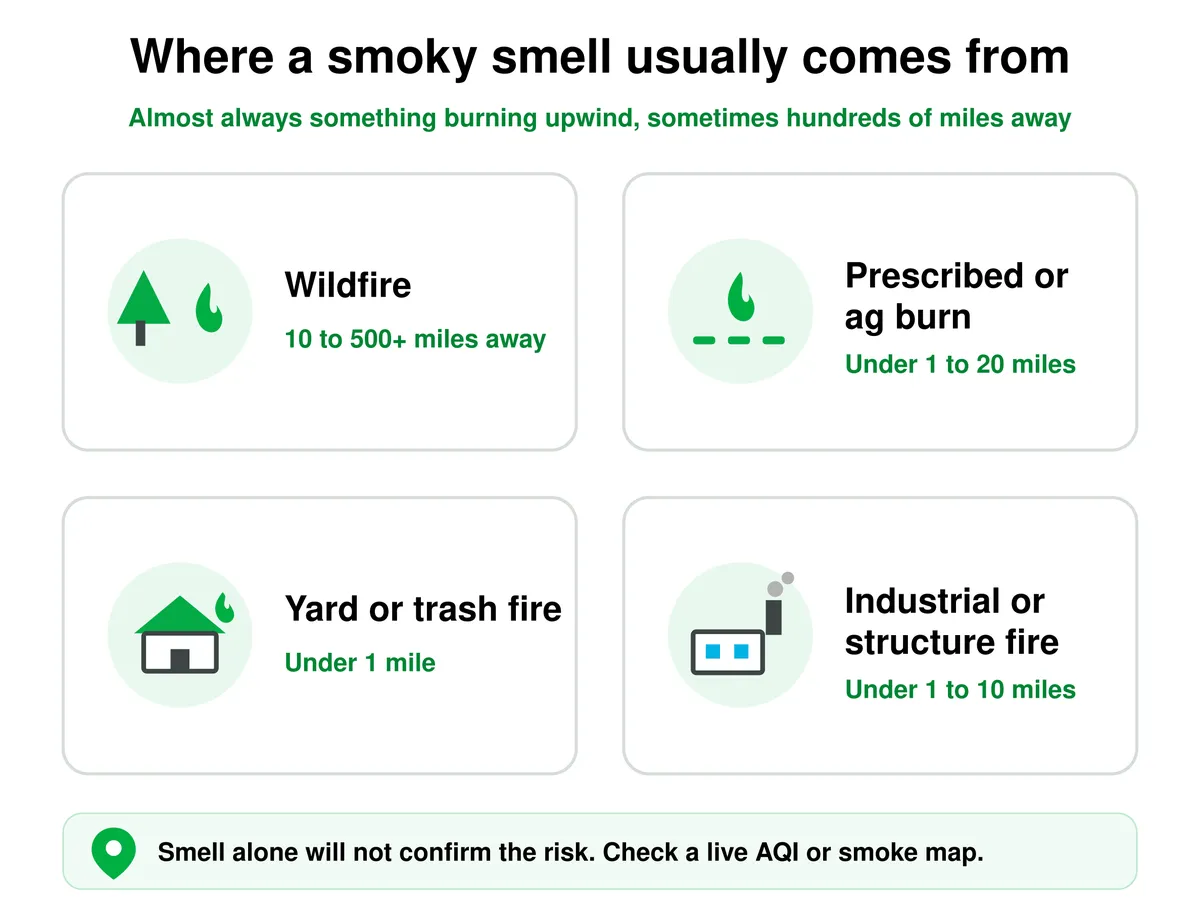
- Wildfire — can travel 10 to 500+ miles and still smell strong.
- Prescribed or agricultural burn — planned fires, usually within about 20 miles.
- Yard or trash fire — close to home, often under a mile away.
- Industrial or structure fire — less common, higher risk, usually within about 10 miles.
Once you know the source, keep windows closed and run a high-efficiency filter that captures fine smoke particles. Not sure which filter fits your system? Take the quick match quiz below.
Answer 3 quick questions and we'll match you to the right filter for your home.
Prefer to browse first? Shop air filters at Filterbuy.
A smoky smell outside almost always comes from something burning upwind, even when there are no visible flames or heavy haze nearby. Wildfires, prescribed burns, agricultural or yard debris fires, and occasionally industrial or structure fires all release the same telltale odor, and smoke can travel hundreds of miles from its original source. The smell alone will not confirm whether the air is safe to breathe, so checking a live air quality or smoke map for your location is the fastest way to protect your family before spending time outdoors.
TL;DR Quick Answers
A smoky smell outdoors is caused by combustion somewhere nearby or far away, most often a wildfire, a prescribed or agricultural burn, an illegal yard or trash fire, or an industrial or structure fire. Wildfire smoke can travel hundreds of miles and still smell strong long after visible haze has faded. A smoky smell does not automatically mean unhealthy air, so a live AQI or smoke map check confirms your actual risk in under a minute. Weather conditions such as a temperature inversion can trap thin smoke close to the ground, producing a strong smell with very little visible haze.
Top Takeaways
Wildfire smoke can travel hundreds of miles and still produce a strong smell long after the fire itself is out of sight.
Prescribed burns and agricultural fires are intentional, managed fires that still release the same recognizable smoky odor as a wildfire.
Illegal open burning of trash or yard debris is a common, close-to-home source of a smoky smell in residential neighborhoods.
A smoky smell with little or no visible haze often points to a temperature inversion trapping thin smoke near the ground.
Smell is not a reliable measure of air quality on its own, so checking a live AQI or smoke map is the most accurate next step.
Sealing windows and running a high-efficiency air filter indoors reduces exposure to smoke particles while outdoor air quality remains poor.
I check live air quality and smoke maps across Filterbuy's coverage areas most mornings during fire season, and “why does it smell smoky outside” is one of the questions our team hears most, usually before anyone has thought to pull up an actual reading. That gap between what your nose knows and what your AQI app says is exactly why I built this guide around the habit I use myself, smell first, verify second, then decide what to do about your indoor air. The source almost always turns out to be one of the four causes below, and the surest way to tell them apart is not to guess, it is to check. - Michelle Wan
What Causes A Smoky Smell Outside?
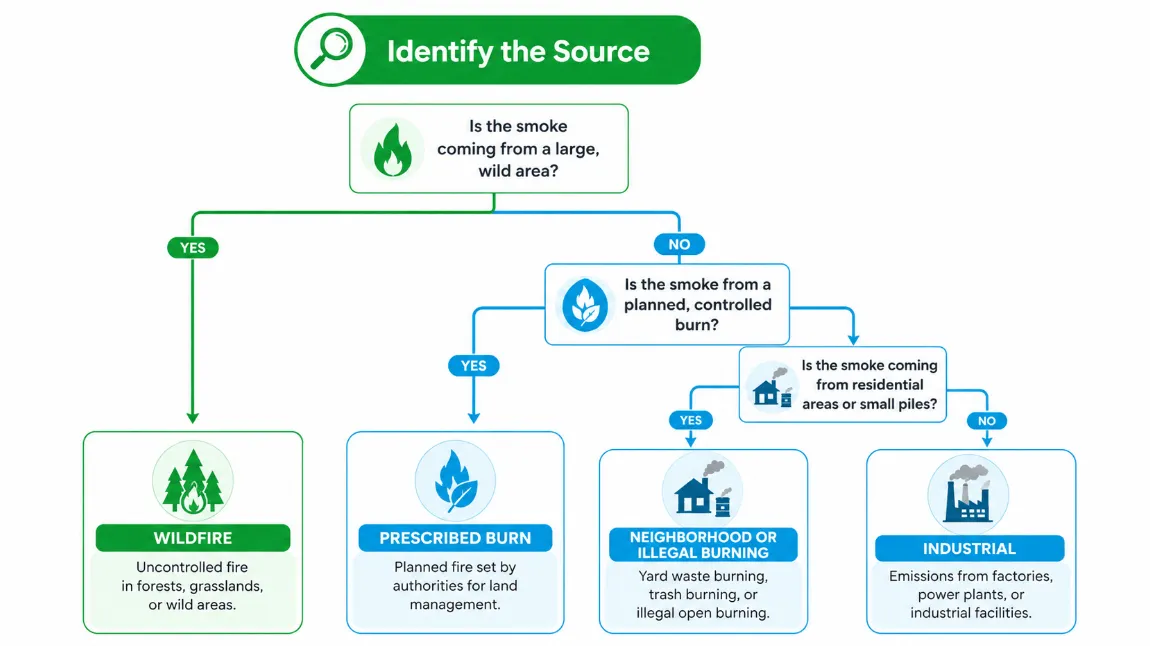
A smoky smell outside is almost always caused by combustion happening somewhere upwind, whether that fire is miles away or in the next neighborhood. The most common sources are wildfires, prescribed or agricultural burns, illegal open burning of trash or yard debris, and less frequently, industrial incidents or structure fires. Each source produces a similar smoky odor, but the distance, duration, and health risk differ significantly.
Wind direction, local weather, and the size of the fire all determine how far the smell travels and how long it lingers in a given area. A small nearby fire can produce an overwhelming smell for a few hours, while a large wildfire hundreds of miles away can produce a persistent smoky odor for days.
Distances and durations are general ranges. Always confirm with a live fire and smoke map for your exact location.
Wildfires: Why Smoke Travels So Far From The Fire
Wildfire smoke is the most common cause of a smoky smell that has no visible source nearby, because wind currents can carry smoke particles hundreds of miles from the actual burn. Large wildfires generate enough smoke to raise regional PM2.5 levels well beyond the immediate fire zone, so a strong smoky smell is possible even under a clear-looking sky.
Wildfires release fine particulate matter, carbon monoxide, and volatile organic compounds when vegetation burns. Some of these compounds create the sharp, campfire-like odor most people associate with wildfire smoke, and the smell can persist even after the visible plume has thinned into a light haze. Checking Filterbuy's live wildfire and smoke map is the most reliable way to trace a distant smell back to its originating fire.
Prescribed And Agricultural Burns: Planned Fires That Still Produce Smoke
Prescribed burns and agricultural fires are intentional, permitted fires set by land managers or farmers to reduce wildfire risk, clear fields, or maintain healthy ecosystems, and they release the same type of smoke as an unplanned wildfire. These burns are typically scheduled around wind and weather conditions, but a smoky smell in the surrounding area is expected and normal during and after the burn.
Land management agencies use prescribed fire because unburned vegetation increases the risk of larger, more destructive wildfires later. Agricultural burning clears crop residue between growing seasons. Both practices are regulated and often announced in advance through state forestry or agriculture department notices, which is one of the simplest ways to confirm a nearby smoky smell has a planned, lower-risk source.
Prescribed burns cluster in late winter and early spring in much of the country, and again in fall, since crews need calm winds and moist ground to keep a burn controlled. Agricultural burning tends to follow the harvest calendar, so it shows up most in spring and fall in farming regions. A smoky smell that repeats around the same time each year in your area is often tied to one of these seasonal windows.
Neighborhood And Illegal Burning: When The Smell Is Close To Home
A smoky smell that is strong, localized, and not linked to any reported wildfire or prescribed burn often traces back to a neighbor burning yard debris, trash, or other materials, sometimes in violation of local burn ordinances. Burning man-made materials like plastic or treated wood produces more toxic smoke than burning natural vegetation.
Most municipalities restrict or ban open burning of trash and certain yard waste because of the health risks these fires create. If a live smoke map shows no fires in the area, the smell is most likely coming from a source within a few blocks. Local air quality or fire departments can typically confirm whether a nearby burn is permitted.
Industrial And Structural Fires: Less Common But Higher Risk
Industrial incidents and structure fires are less frequent causes of a smoky smell, but they carry a higher health risk because they often burn synthetic materials, chemicals, or building components that release more toxic byproducts than a typical wildfire or yard fire. A sudden, sharp, or chemical-smelling odor is more likely to point to this type of source.
Local news alerts, emergency notification systems, and fire department scanners are the quickest way to confirm an industrial or structure fire nearby. If the smell is accompanied by an official shelter-in-place or evacuation notice, that guidance should always take priority over general wildfire smoke precautions.
Why It Can Smell Smoky Without Any Visible Haze
A smoky smell with little or no visible haze usually means a temperature inversion is trapping a thin layer of smoke close to the ground rather than letting it rise and disperse. Cool mornings and calm winds are the conditions most likely to produce this effect, especially in valleys and low-lying areas.
We call this the invisible smoke gap, the period when your nose detects smoke well before your eyes see any haze. During a temperature inversion, a layer of warm air sits above a layer of cooler air near the surface, which prevents normal vertical mixing. Smoke, and the odor compounds it carries, becomes trapped underneath that warm layer instead of rising and dispersing. This is why some of the strongest smoky smells occur on still, clear mornings rather than during heavy visible haze.
What The Smell Itself Can Tell You
The character of the smell is often the fastest clue you have, before you check any map or app. A woodsy, campfire-like smell usually points to a wildfire or a prescribed or agricultural burn, while a sharp, acrid, or plastic-like smell more often points to a structure fire, a vehicle fire, or someone burning trash or treated materials nearby.
Woodsy or campfire-like: most likely a wildfire or a prescribed or agricultural burn, even if the fire itself is far away.
Sharp, acrid, or plastic-like: more likely a structure fire, vehicle fire, or illegal burning of trash or synthetic materials, and worth extra caution.
Faint and stale with no visible haze: often distant wildfire smoke that settled in overnight under a temperature inversion, trapping the smell close to the ground with little visible haze.
Sweet or resinous: common with pine, brush, or agricultural burns, especially during a scheduled burn season.
Smell character is a useful first read, not a diagnosis. Once you have a hunch about the source, the two-check habit, map first and wind second, confirms it in under a minute.
How To Identify The Source Of The Smoky Smell
The quickest way to identify the source of a smoky smell is what our team at Filterbuy calls the two-check habit, checking the map first and the wind second. Most people try to guess the source by sniffing the air harder or scanning the horizon, but learning to read a live fire and smoke map correctly and glancing at wind direction settles it in under a minute.
Check a live smoke or fire map for reported wildfires or prescribed burns in your region.
Check your local AQI to see whether particle pollution is currently elevated.
Note the wind direction. Smoke usually travels from the fire toward you, so an upwind fire is the likely source.
Check for local burn bans, agricultural burn permits, or fire department alerts.
Look for local news or emergency notifications if the smell is sudden, chemical, or accompanied by visible dark smoke.
Does A Smoky Smell Mean The Air Quality Is Unhealthy?
A smoky smell does not always mean the air quality is unhealthy, but it is a reliable signal to check, since human smell is sensitive enough to detect smoke particles well before some monitors register a change. The only accurate way to know your actual risk is to check a live AQI reading for your specific location.
The Air Quality Index translates PM2.5 and other pollutant levels into a color-coded scale, and even moderate levels can affect people with asthma, heart or lung disease, older adults, and children. Fine particulate matter from smoke is small enough to reach deep into the lungs and, for some individuals, the bloodstream, according to the EPA and CDC.
AQI categories reflect standard EPA breakpoints. Check a live AQI reading for your specific location before making outdoor plans.
Is Wildfire Smoke Smell Harmful To Pets Too?
Pets breathe the same smoky air people do, and small animals with fast breathing rates can be even more sensitive to fine particles than adults are. Watch for coughing, wheezing, red or watery eyes, or lower energy in dogs, cats, and other pets whenever the smell outside is strong.
Keep pets indoors during smoky stretches, skip strenuous outdoor exercise until the air clears, and call a veterinarian if symptoms do not improve once the smell and haze are gone. Birds and other small animals with sensitive respiratory systems need extra caution during heavy smoke events.
How To Protect Your Indoor Air When It Smells Smoky Outside
Keeping windows and doors closed, running your HVAC system on recirculate, and using a high-efficiency air filter are the most effective ways to reduce indoor exposure while outdoor air smells smoky. A MERV 13 filter captures a significantly higher percentage of fine smoke particles than a standard MERV 8 filter.
Set your HVAC fan to run continuously rather than cycling on and off, since this keeps air moving through the filter more consistently. Avoid activities that add more particles indoors, like burning candles or using a wood stove, until outdoor air quality improves. Filterbuy carries MERV 8, MERV 11, and MERV 13 pleated filters sized for most residential HVAC systems, so if you are unsure which MERV rating you need, a properly sized, high-MERV filter paired with a clean HVAC system gives your home meaningfully better protection during smoky conditions than an ordinary standard filter.
Particle size ranges and effectiveness ratings are general filtration industry guidance, not lab-tested Filterbuy product data.
We asked David Clark, the licensed HVAC technician who reviews Filterbuy's resource pages, what he sees most often in homes during a smoky stretch.
David Clark, Licensed HVAC Technician: “The households that struggle most once smoke rolls in are almost always the ones running a filter that was already overdue before the smoke ever showed up. I tell homeowners the same thing every fire season, check the rating on what's in your return vent right now, because a clogged or low-rated filter lets far more of those fine particles circulate through the home than most people realize.”
Essential Resources
Supporting Statistics
Wildfire smoke can travel hundreds to thousands of miles from the source fire. That is why a smoky smell can show up with no visible fire nearby. Source: US EPA, Wildland Fires and Public Health Effects.
Smoke exposure is linked to thousands of deaths in the United States every year. Checking a live AQI reading matters even when the smell seems mild. Source: CDC, Climate and Health Program: Wildfires.
Wildfire-specific PM2.5 raised respiratory hospital admissions by 1.3 to 10 percent per 10 micrograms per cubic meter increase, versus about 1 percent for the same increase from non-wildfire PM2.5. Wildfire smoke can be considerably more harmful to respiratory health than everyday air pollution at the same concentration. Source: Aguilera et al. (2021), Nature Communications, PMC7935892.
Final Thoughts
A smoky smell outside is a signal worth taking seriously, even when it turns out to have a low-risk source like a planned burn. Wildfires, prescribed and agricultural burns, neighborhood fires, and industrial incidents all produce a similar odor, and the invisible smoke gap means your nose can pick up on a problem before your eyes ever confirm one. The two-check habit, map first, wind second, is the quickest way to move from smelling smoke to knowing what it actually means for your air. Once you know the source and the risk level, protecting your indoor air comes down to sealing up your home and keeping a high-efficiency filter running in your HVAC system.
At Filterbuy, making an invisible problem like smoke exposure visible, and giving you a clear next step, is the whole point of guides like this one.
Next Steps
Check a live fire and smoke map for your area, then confirm your current AQI reading.
Sign up for local emergency alerts so you are notified quickly if a nearby fire escalates.
Check your HVAC filter's MERV rating and replace it with a higher-rated filter if smoky conditions are frequent where you live. For a full walkthrough, see our guide on how to keep wildfire smoke out of your house.
FAQ
Is It Safe To Open Windows When It Smells Smoky Outside?
A: It is not recommended to open windows when it smells smoky outside, because doing so lets fine smoke particles into your home. Keep windows and doors closed and run your HVAC system on recirculate, checking whether your air conditioner is actually filtering the smoke, until a live AQI reading confirms the air has cleared.
How Long Does A Smoky Smell Usually Last?
A: A smoky smell can last anywhere from a few hours to several days, depending on the size of the fire, wind direction, and local weather. Nearby prescribed burns and yard fires typically clear within hours, while smoke from a large, distant wildfire can linger for days.
Can A Smoky Smell Come From Something Other Than Fire?
A: A smoky smell almost always comes from some type of combustion, whether that is a wildfire, a prescribed or agricultural burn, a yard or trash fire, or an industrial or structure fire. A true smoky odor without any burning source nearby is uncommon.
Does A Smoky Smell Always Mean The Air Quality Is Bad?
A: A smoky smell does not always mean the air quality is unhealthy, since human smell can detect smoke particles at levels below where some monitors register a change. Checking a live AQI reading for your specific location is the only accurate way to confirm your risk.
What Should I Do If I Smell Smoke But See No Fire Nearby?
A: Check a live fire and smoke map to see if a wildfire or prescribed burn is reported upwind, then check your local AQI. If neither shows a source, the smell is most likely coming from a nearby yard or trash fire, and your local fire department can typically confirm whether it is permitted.
Glossary
PM2.5
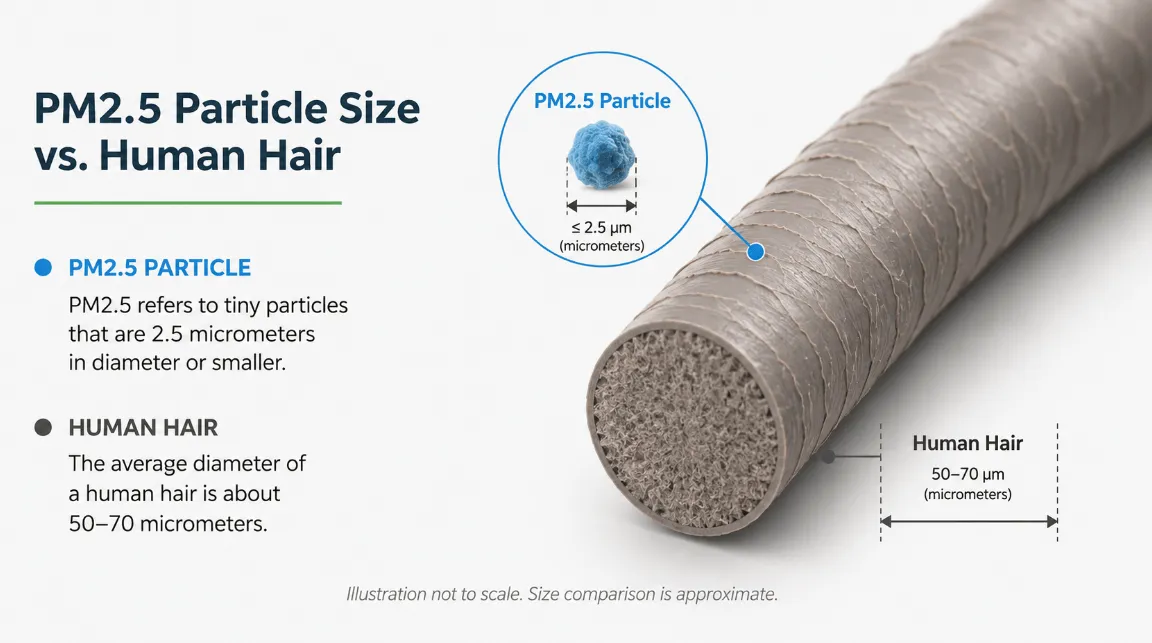
Fine particulate matter measuring 2.5 micrometers or smaller in diameter, the primary health-relevant pollutant in smoke.
AQI
The Air Quality Index, a color-coded scale that translates pollutant levels, including PM2.5, into a public health guide.
Prescribed Burn
A planned, permitted fire set by land managers or agricultural operators under controlled weather conditions to reduce wildfire risk or clear vegetation.
Temperature Inversion
A weather pattern in which a layer of warm air traps cooler air, and the pollutants within it, close to the ground.
VOC
Volatile organic compound, a gas released when vegetation or other materials burn, contributing to the characteristic smell of smoke.
Smoke-Ready Toolbox
An EPA resource collection that helps communities and individuals prepare for and respond to wildfire smoke events.
HEPA
High-Efficiency Particulate Air, a filtration standard capable of capturing very small airborne particles, including many smoke particles.
MERV
Minimum Efficiency Reporting Value, a rating scale describing how effectively an HVAC filter captures airborne particles, including smoke.
Ready to breathe easier the next time smoke rolls through?
Shop Filterbuy's MERV 13 air filters and keep more of those fine particles out of your home.