
Is Today’s AQI Bad Enough to Worry About? A Simple Guide to AQI Levels & What to Do
July 14, 2026
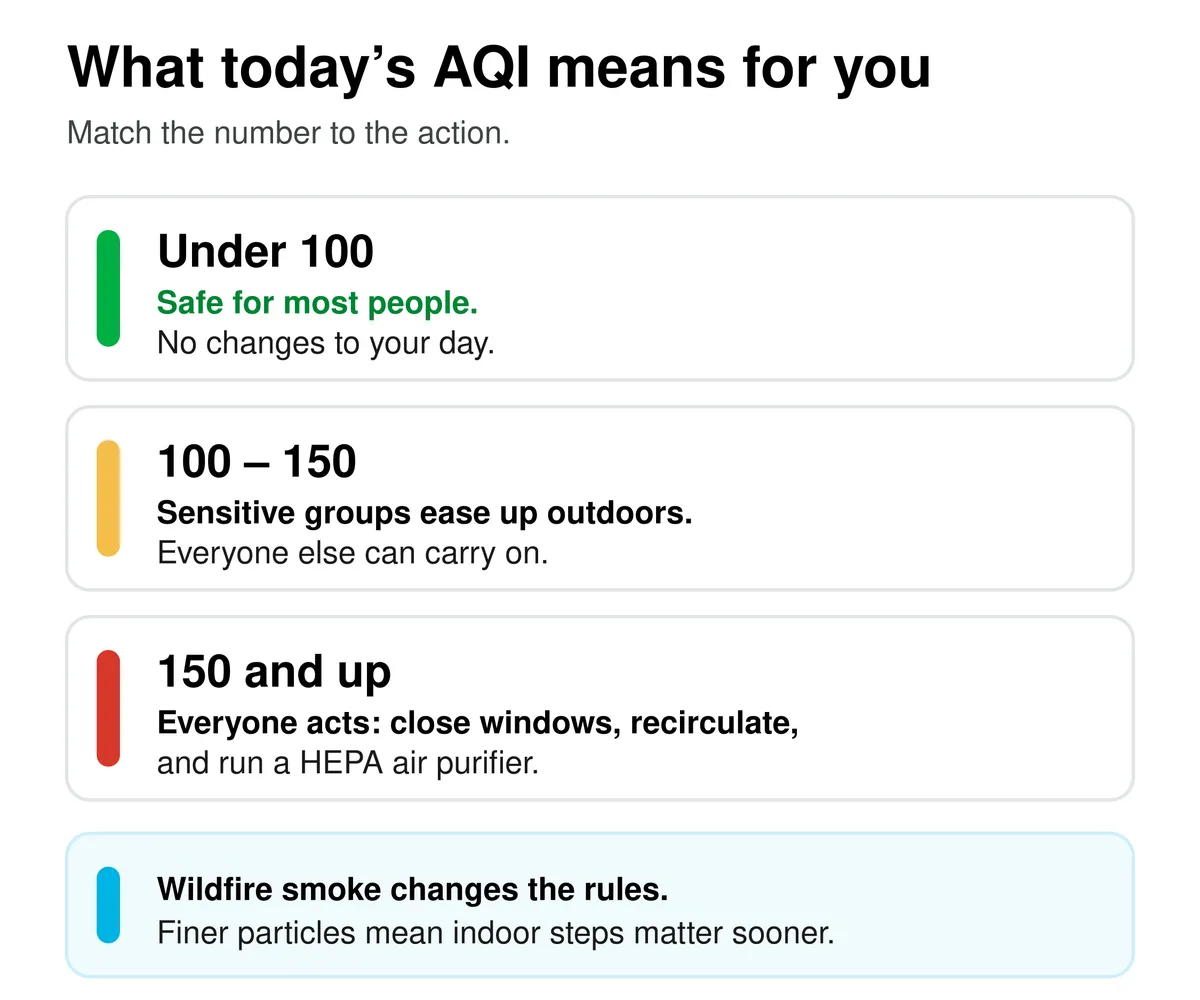
Most days, no — an AQI under 100 is safe for the vast majority of people and needs no changes to your routine. Worry only kicks in higher up the scale, and even then it depends on who you are. Here is the quick version:
- Under 100 — Safe for most people. Live your day as usual.
- 100–150 — Sensitive groups ease up on hard outdoor activity; everyone else can carry on.
- 150 and up — Everyone should cut outdoor time and clean up the air indoors: close windows, set the HVAC to recirculate, and run a HEPA purifier.
Wildfire smoke changes the rules — its finer particles mean indoor steps matter sooner. When the air is unhealthy, your HVAC filter is your first line of defense; a MERV 13 filter is built to capture smaller particles, including smoke and smog.
Not sure which filter fits your home and your air? Answer 3 quick questions and we’ll match you to yours.
You check your weather app in the morning, ready to plan your day. Right below the temperature, you see a number: AQI 85. Or maybe it’s 112.
Is that bad? Should you cancel your run? Keep the kids inside? Or is it safe to ignore it and go about your day?
It’s easy to feel anxious when air quality alerts pop up, but most days in the U.S., the Air Quality Index (AQI) stays below 100. For the vast majority of people, that means no lifestyle changes are needed. However, confusion often stems from not knowing where the real safety thresholds lie and when you actually need to take action.
This guide will translate those confusing numbers into simple, actionable steps, helping you avoid unnecessary stress while knowing exactly when indoor air quality steps truly matter.
Key Takeaways:
AQI under 100: This is safe for most people. No changes to your routine are needed.
AQI 100–150: Only sensitive groups (like those with asthma or the elderly) need to adjust outdoor activity.
AQI 150+: Everyone should reduce outdoor exposure and take steps to improve indoor air quality.
Wildfire smoke: This changes the rules. Because smoke particles are finer and more hazardous, indoor protection matters sooner.
What the AQI Number Really Tells You
The Air Quality Index isn't just a random score; it's a tool used to communicate how polluted the air is currently or how polluted it is forecast to become. Think of it like a yardstick that runs from 0 to 500. The higher the AQI value, the greater the level of air pollution and the greater the health concern.
However, it’s important to understand that AQI measures potential health risk, not necessarily immediate danger for everyone.
According to the Environmental Protection Agency (EPA), the scale is divided into categories. The most critical thing to remember is that for the general population, the "worry threshold" is much higher than many people assume. Most healthy adults do not need to take any specific actions until the AQI rises above 100, and often not until it hits 150.
Understanding the specific components of air pollution, such as ozone and particulate matter (PM2.5), helps explain why different days feel different, but the AQI number is your best single indicator for decision-making.
AQI 50–100 (Moderate): What Most People Can Ignore
One of the most common overreactions occurs when the AQI sits in the "Moderate" range (51–100). You might see a yellow alert on your phone and instinctively think you should cancel your plans.
Here is the reality: This range is acceptable for everyday life.
For the vast majority of the population, an AQI of 85 or 95 requires zero changes to your daily routine. You can:
Go for that outdoor run.
Let the kids play soccer.
Commute with your windows down.
In this range, air quality concerns are minimal unless you have an unusually severe sensitivity to air pollution. You do not need to wear a mask, you do not need to seal your house shut, and you certainly don't need to panic. The EPA guidance indicates that for healthy adults, no action is required in this zone.
AQI 100–150: Who Should Pay Attention (and Who Shouldn’t)
When the numbers creep past 100 into the orange zone (101–150), the guidance shifts from "safe for everyone" to "Unhealthy for Sensitive Groups."
This is where knowing your own health status is vital. If you are generally healthy, you likely won't feel much difference, and you can usually continue your normal routine. However, this level matters significantly for specific populations.
Who are the "Sensitive Groups"?
People with lung disease (such as asthma or COPD).
People with heart disease.
Older adults.
Children and teenagers (their lungs are still developing, and they breathe more air per pound of body weight).
Pregnant individuals.
What should you do?
If you fall into one of these categories, the recommendation isn't to lock yourself inside, but rather to reduce prolonged or intense outdoor exertion. Maybe take a walk instead of a jog, or shorten the time the kids play outside.
For everyone else, including the general public, this range is not a cause for alarm, though it’s a good time to monitor the trend to see if levels are rising.
AQI 150+: When Indoor Changes Actually Matter
Once the AQI crosses 150 (the red zone), it is considered "Unhealthy" for everyone. This is the real threshold where broad concern is warranted, and where your choices about indoor air quality start to make a significant difference.
Outdoor Guidance:
At this stage, everyone, regardless of health status, should reduce prolonged outdoor exposure. It is not the time for a marathon training run. If you must be outside for long periods, this is the point where an N95 mask offers protection (note: standard cloth masks offer little protection against fine particulate matter).
Indoor Action Checklist:
When the air outside is unhealthy, your home should be your sanctuary. Here is how to keep it that way:
Close up: Keep windows and doors shut.
Recirculate: Set your central HVAC system or window AC unit to "recirculate" mode to stop pulling in dirty outdoor air.
Purify: Run portable HEPA air purifiers in the rooms you use most, like the bedroom or living room.
Reduce indoor pollutants: Avoid activities that add more particles to the air, such as burning candles, using incense, vacuuming (unless your vacuum has a HEPA filter), or frying food.
Filter Guidance:
Your HVAC filter is your first line of defense. During high-pollution events, standard filters may not be sufficient. Using MERV 13 air filters is recommended because they are designed to capture smaller particles, including smoke and smog.
Tip: During heavy smoke events, filters load up quickly. You may need to inspect and replace them weekly, rather than your usual 1–3-month cadence.
Why Wildfire Smoke Changes the Rules
If your high AQI is due to wildfire smoke rather than typical urban smog, you need to be more vigilant.
Smoke particles are incredibly small (PM2.5), meaning they can penetrate deep into the lungs and enter the bloodstream. Wildfire smoke can also cause AQI levels to spike rapidly, from moderate to hazardous within hours, and remain elevated for days.
Best Practices for Smoke Events:
Monitor forecasts: Don't just look at the current number; look at the smoke forecast.
Seal early: If you know a smoke plume is approaching, close windows before the smell arrives.
Create a clean room: Focus your filtration efforts on the room where you sleep (usually the bedroom), ensuring the air is as clean as possible.
Overreactions vs. Real AQI Concerns
In our connected world, it is easy to see a red notification on a phone and panic. However, stress is harmful to your health. Distinguishing between a number that requires awareness and a number that requires action is key.
Common Overreactions:
Panicking when the AQI is 80–90 (Yellow).
Buying expensive air purifiers for a healthy household when the AQI is 110.
Keeping kids entirely indoors when the air is in the moderate range.
Real Concerns:
Ignoring an AQI of 150+ during wildfire events.
Exercising heavily outdoors when the air is visibly hazy or smells of smoke.
Failing to change HVAC filters during prolonged periods of poor air quality.
By saving your energy for when the AQI hits 150+ (or 100+ if you are sensitive), you avoid "alert fatigue" and ensure you are taking action when it truly benefits your health.
A Simple AQI Decision Framework
Air quality changes constantly, but your response doesn't have to be complicated. Use this simple framework to guide your day:
AQI <100: Don’t worry. Live your life.
AQI 100–150: Sensitive groups adjust; everyone else stays the course.
AQI 150+: Everyone takes action. Close windows, run purifiers, and take it easy.
Being prepared with the right knowledge on improving air quality and the right filters means you can breathe easier, no matter what the app says.
Frequently Asked Questions
Is AQI under 100 safe for kids and exercise?
Yes. For most children and adults, an AQI under 100 is considered acceptable and does not require limiting outdoor activity or sports.
Should I run an air purifier at AQI 100–120?
Not usually, unless you have someone in the home who is sensitive to air pollution. At this level, purifiers are mainly helpful for people with asthma, allergies, or other respiratory sensitivities.
What AQI level is considered unhealthy for everyone?
AQI 150 and above ("Unhealthy" red zone) is the threshold where the general public may begin to feel effects, and everyone is advised to reduce prolonged outdoor exertion.
Does wildfire smoke change how I should respond to AQI?
Yes. Smoke consists of fine particulate matter, which is more harmful than some other pollutants. Indoor protection becomes important sooner, and smoke events often last longer, requiring more proactive management of indoor air.
How often should I change my air filter during wildfire smoke?
During heavy smoke events, filters can become clogged much faster than normal. You should inspect them frequently and may need to change them weekly during peak smoke, rather than the standard every 1–3 months.