Shop by
September 21, 2026
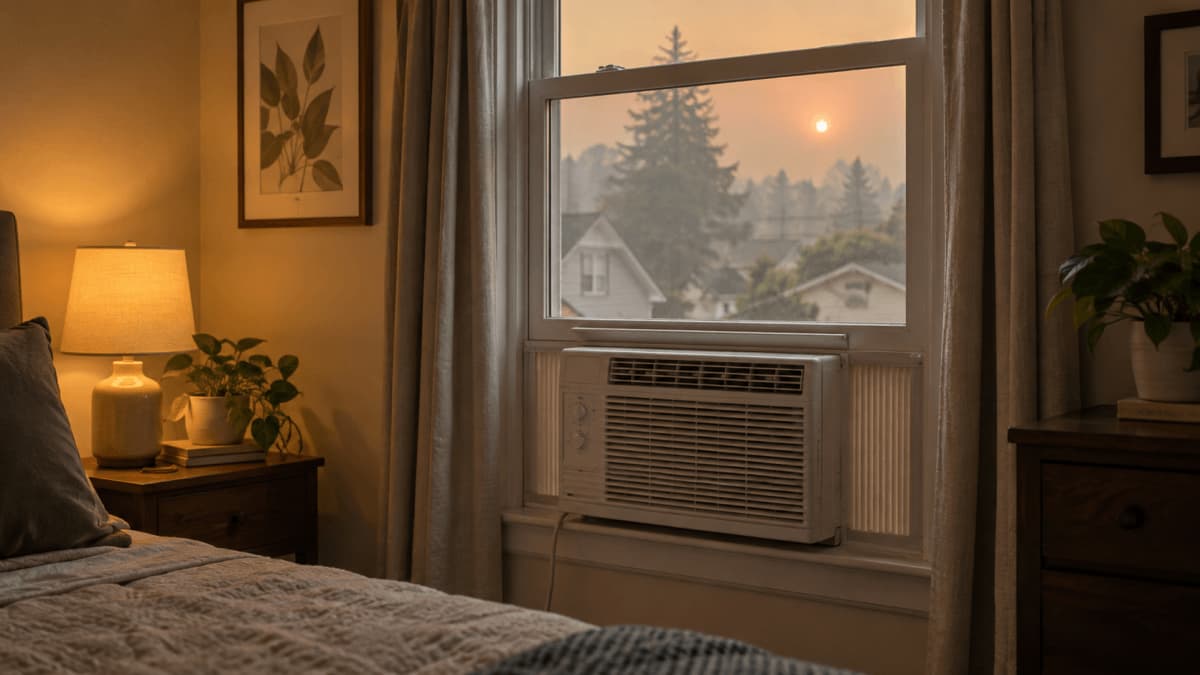
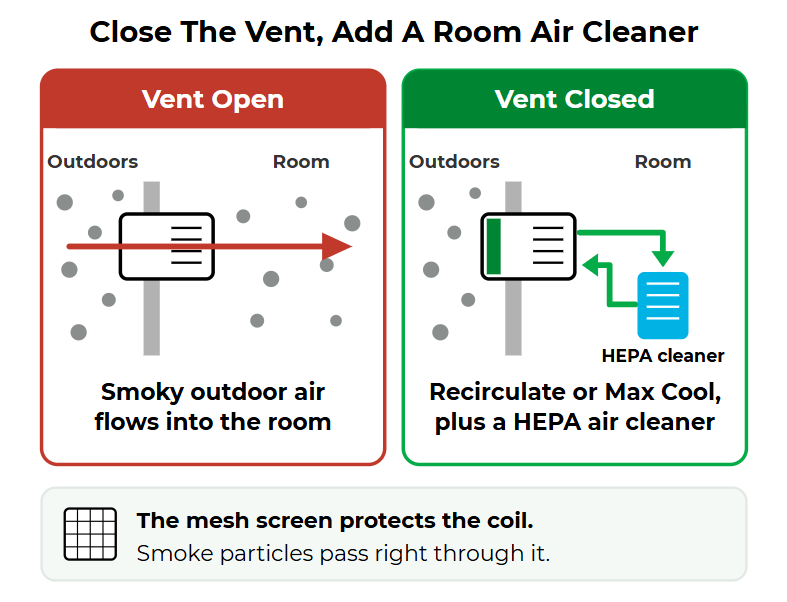
No. A window AC unit doesn't filter wildfire smoke. Its washable mesh screen keeps lint off the cooling coil, and the fine particles in smoke pass right through. During smoke, close the fresh air vent and run the unit on Recirculate or Max Cool. A portable HEPA air cleaner in the same room does the filtering.
Helps: vent closed, Recirculate or Max Cool, and foam tape sealing the window gaps.
Hurts: an open vent or the Exhaust setting, which both let unfiltered outdoor air into the room.
At AQI 100 and above: run a portable HEPA air cleaner in each occupied room, bedrooms first.
Not sure what your home needs next? Take the quick quiz below.
Have ductwork too? Switch the central system to MERV 13 and set the fan to On, after checking your manual for the size and rating. Filterbuy makes MERV 13 pleated filters in hundreds of standard sizes plus custom sizes, with fast and free 2-day delivery to most US states.
Cooling with window units? Answer a few quick questions to see which Filterbuy option fits your home.
By Michelle Wan, Brand Manager and Air Quality Writer at Filterbuy · Reviewed by David Clark, Licensed HVAC Technician · Published September 21, 2026 · Updated September 21, 2026
A window air conditioner doesn't filter wildfire smoke. Its washable screen keeps lint and hair off the cooling coil, and the fine particles in smoke pass right through it. What matters most is keeping the fresh air vent closed throughout the smoke event while a portable HEPA air cleaner in the same room does the filtering.
A window AC's filter is a washable mesh screen that protects the coil, not a fine-particle filter.
Keep the fresh air vent closed during smoke. Many manufacturers label that position Recirculate or Max Cool.
For wildfire smoke, AHAM recommends a smoke CADR equal to the room's square footage rather than two-thirds of it.
At AQI 100 and above, Filterbuy's action line, run a portable HEPA air cleaner in each occupied room, bedrooms first.
A window air conditioner, also called a room air conditioner, doesn't filter wildfire smoke in any meaningful way. What most people call its filter is a washable mesh or foam screen in front of the evaporator coil, there to keep lint and dust off the coil so the unit cools well. Wildfire smoke is mostly fine particles called PM2.5, which slip straight through a screen you can see daylight through.
At Filterbuy, we make pleated filters for furnaces and central systems, so this may sound odd coming from us: in a window unit, the filter slot isn't where the smoke problem gets solved. For mini-splits and swamp coolers, see do air conditioners filter wildfire smoke.
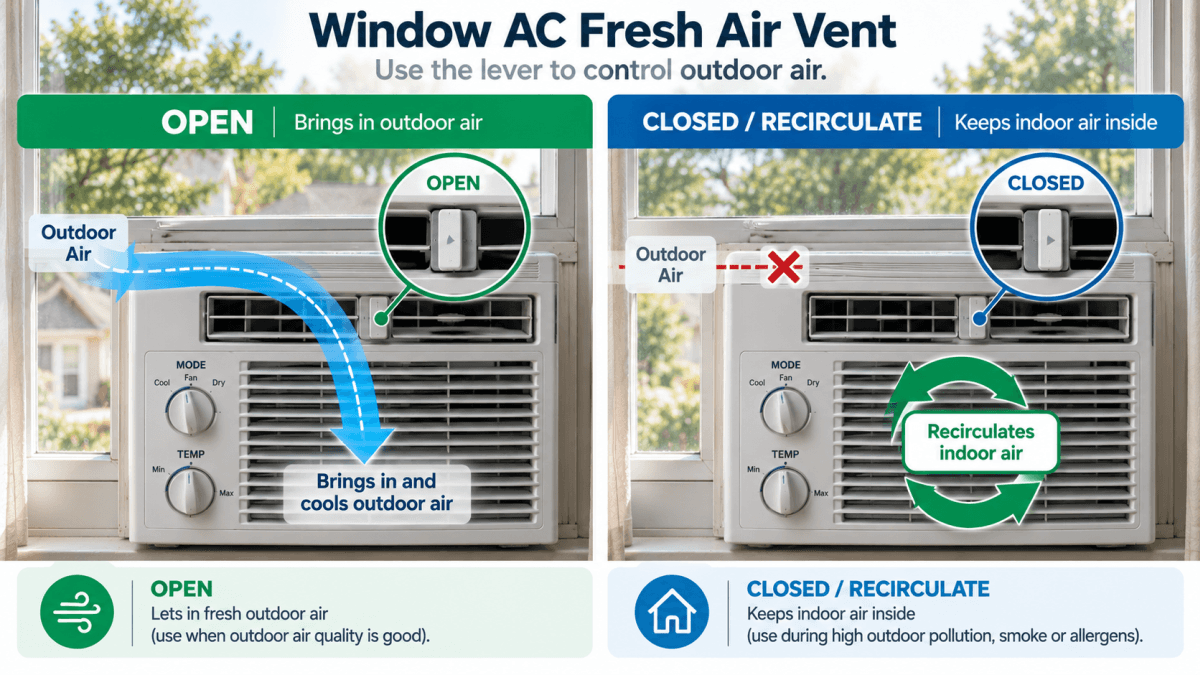
The setting that decides whether a window air conditioner helps or hurts during smoke is the fresh air vent. Not every unit has one, but on units that do, an open vent connects the outdoors to the air it blows into your room. During a smoke event that path carries PM2.5 indoors, so the vent should stay closed.
The control is usually a lever or slider on or behind the front panel, marked Vent or Fresh Air. On many units the closed position doubles as Max Cool, which also cools fastest. When we read EPA's guidance against those controls, that overlap stood out: the most efficient setting is also the one to use during smoke.
Guidance from the U.S. Environmental Protection Agency (EPA) for a window air conditioner with a fresh air option is to close the intake or run recirculate mode, or else turn the unit off (EPA, Create a Clean Room to Protect Indoor Air Quality During a Wildfire).
Filterbuy would go one step further. If the damper is stuck open, use a box fan and a portable air cleaner, and get the damper fixed before next season. A unit you can't seal is a hole in the wall with a compressor attached. The one exception is extreme heat, when staying cool has to come first.
EPA's clean-room guidance treats staying cool as its own step. If you can't stay cool at home, EPA says it may be best to seek shelter elsewhere, such as a public cleaner air shelter.
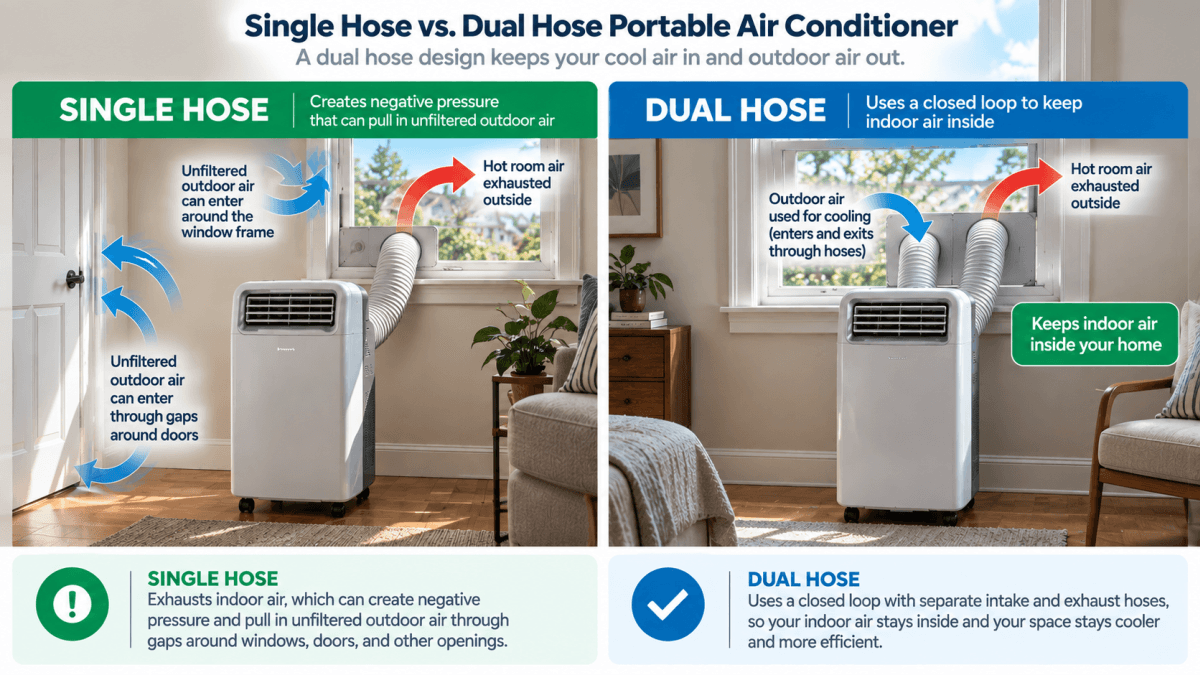
A single-hose portable air conditioner pushes room air out through the window hose, and the air that replaces it leaks in through gaps, unfiltered and straight from outdoors. That's why EPA advises using single-hose units sparingly in smoky conditions. A dual-hose unit pulls outdoor air in to cool its condenser and sends it back out, so the room isn't emptied. It's the better choice if its window kit is sealed with foam tape.
AQI 100 is Filterbuy's action line. It's the top of the Moderate band, and AirNow, the federal air quality site, starts the orange Unhealthy for Sensitive Groups range at 101. At 100 and above, check AirNow and your local air agency first. Then run MERV 13 in any central system, set its fan to On, put a portable HEPA air cleaner in each occupied room, and close the house up.
MERV 13 in any central system. If your home also has ductwork, switch its filter to MERV 13. That's the whole-home layer.
Thermostat fan to On. Auto filters only while the system heats or cools, and On filters all the time.
A portable HEPA air cleaner in each occupied room, bedrooms first. With only window units, these cleaners are your main defense. If you can buy just one, put it in the window-unit room you sleep in and keep the door shut to make it your cleaner-air room.
Close the house up. Shut windows and doors, and run the window unit on Recirculate or Max Cool with its vent closed. Foam-tape the gaps around it. Skip candles, frying, smoking, and vacuuming without a sealed HEPA vacuum, and reopen the vent once the AQI improves.
Filterbuy's wildfire smoke AQI guide covers every band, and our guide on how to keep wildfire smoke out of your house has the full seasonal routine.
Clean Air Delivery Rate, or CADR, tells you whether a portable air cleaner is big enough for a room. AHAM, the trade association behind the rating, uses two-thirds of a room's square footage for everyday particles but recommends a smoke CADR equal to the full square footage for wildfire smoke.
Multiply length by width and treat the result as your minimum. A 12 by 14 foot bedroom is 168 square feet, which puts the everyday minimum at a smoke CADR of 112. For wildfire smoke, AHAM's guidance raises that target to 168. That's the figure Filterbuy recommends, because a window-unit room has no whole-home filtration behind it.
| ROOM | FLOOR AREA | EVERYDAY SMOKE CADR (TWO-THIRDS) | WILDFIRE SMOKE CADR (AHAM) |
|---|---|---|---|
| 10 × 12 Bedroom | 120 sq ft | 80 | 120 |
| 12 × 14 Bedroom | 168 sq ft | 112 | 168 |
| 14 × 20 Living Room | 280 sq ft | 187 | 280 |
Before you buy, EPA advises choosing an air cleaner that doesn't produce ozone and points to the California Air Resources Board list of certified air cleaning devices. The lowest-ozone option on that list is a unit classed as Mechanical, which filters physically and gives off no ozone or ions. Skip ozone generators, and be wary of any unit sold on its ionizing stage. Both HEPA and pleated filters capture smoke particles, not the gases behind its smell.
During heavy smoke, EPA advises changing the air cleaner's filter sooner than the manufacturer recommends. For how to run the cleaner once it arrives, see running an air purifier during wildfire season.
For a central system during smoke, use MERV 13. That system is your whole-home layer since it moves the most air. It works alongside the room HEPA cleaners instead of replacing them. EPA points to MERV 13 or higher in a central system during smoky periods, with the fan set to On so it filters continuously.
Check your manual for the size and rating, the same fit check as always. During smoke, look at the filter often and replace it once it turns dark brown or black, which can be well before its normal interval, and keep spares on hand. Our comparison of MERV 13 and true HEPA explains how the two layers divide the work, and Filterbuy manufactures MERV 13 pleated air filters in hundreds of standard sizes plus custom sizes, with fast and free 2-day delivery to most US states.
Half of Northeast homes cool mainly with individual AC units.
Two-thirds of U.S. households rely mainly on central AC or a heat pump.
In the Northeast, though, 50% depend mainly on individual units such as window and wall models.
Source: 2020 Residential Energy Consumption Survey, U.S. Energy Information Administration.
Filterbuy's read: central-HVAC advice misses these homes, so this page starts at the window.
Indoor PM2.5 nearly tripled, even as Californians closed up.
The share of outdoor PM2.5 reaching indoors fell from 0.4 on normal days to 0.2 on wildfire days.
Even so, mean indoor PM2.5 nearly tripled.
Buildings with air conditioning or filtration let in less.
Source: 2021 study of more than 1,400 California buildings, Proceedings of the National Academy of Sciences, archived by NOAA.
Filterbuy's read: closing up cuts infiltration, and a room air cleaner reduces what still gets in.
In Seattle homes, a HEPA room air cleaner cut indoor PM2.5 by 48% to 78%.
Even with windows closed, indoor PM2.5 ran 33% to 76% of outdoor levels.
An auto-mode HEPA portable air cleaner brought it down 48% to 78%, adjusted for outdoor levels.
Source: University of Washington field study of seven Seattle homes during 2020 wildfire smoke.
Filterbuy's read: that's the gap the CADR sizing above is meant to narrow.
No. Its washable mesh screen protects the coil from lint and dust but lets wildfire PM2.5 through, so pair the unit with a room air cleaner.
Yes, on Recirculate or Max Cool, as long as the vent is closed and the window gap is sealed with foam tape.
No. The slot is built for the unit's mesh screen, not a pleated filter. Filterbuy's MERV 13 filters belong in a central system instead, with the size and rating confirmed in its manual.
Generally, a sealed window unit comes first and a dual-hose portable second. A single-hose portable ranks last because it pulls outdoor air in through gaps.
AQI (Air Quality Index): The 0 to 500 U.S. scale for outdoor air quality.
CADR (Clean Air Delivery Rate): AHAM's rating of how much filtered air a portable air cleaner delivers.
Fresh Air Vent: A damper on some window units that lets outdoor air in, usually labeled Vent or Fresh Air.
HEPA (High-Efficiency Particulate Air): A high-efficiency filter standard used in portable air cleaners, not in window units or standard HVAC slots.
MERV: Minimum Efficiency Reporting Value, the scale that rates HVAC filters on particle capture.
PM2.5: Airborne particles 2.5 micrometers or smaller, and the main component of wildfire smoke.
Portable Air Cleaner: A freestanding appliance that filters room air, also sold as an air purifier.
