
What Does an AQI of 150 Mean, and What Should You Do?
September 3, 2026
By Michelle Wan · Reviewed by David Clark, Licensed HVAC Technician · Published September 3, 2026 · Updated September 3, 2026
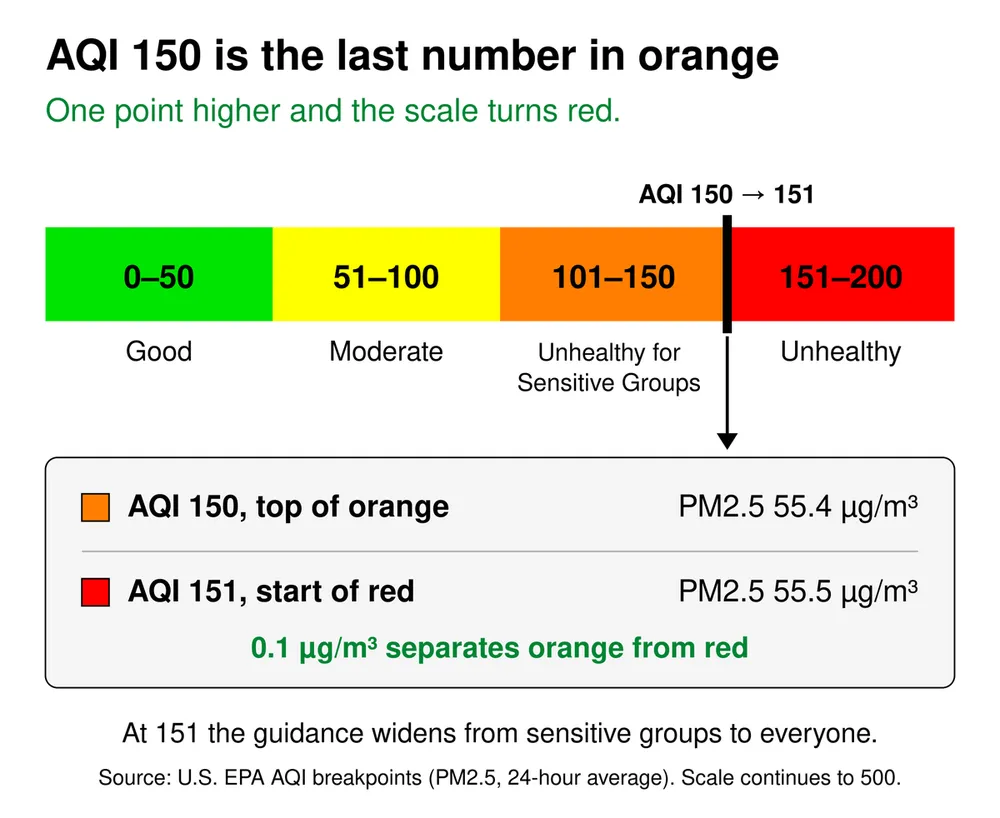
An AQI of 150 is the highest reading in the orange "Unhealthy for Sensitive Groups" band, which runs from 101 to 150. Add one point and you are at 151, where the scale turns red and the EPA's guidance widens from sensitive groups to everyone. The difference between the two is a tenth of a microgram of PM2.5, so it is worth treating a 150 the way you would treat a 155.
What to do indoors today:
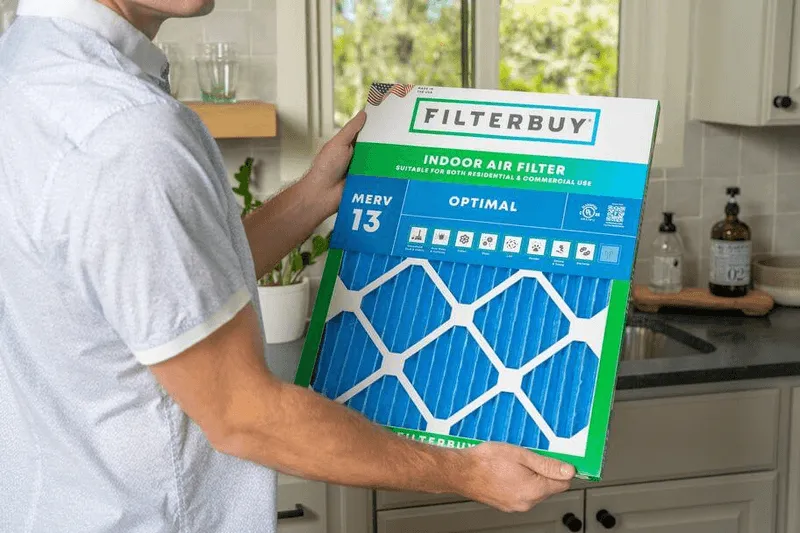
Put a MERV 13 filter in your central system. It captures microscopic particles, and it is the tier the EPA recommends during smoky periods.
Set the thermostat fan to ON. On AUTO the fan only runs while the system heats or cools, so the filter works part-time.
Run a portable HEPA cleaner in each occupied room, bedrooms first, with windows and doors closed.
Not sure what your system takes? Answer three quick questions and we will match you to your filter.
Prefer to browse? Shop Filterbuy air filters. 600+ standard and custom sizes, made in the USA and shipped factory-direct.
TL;DR
An AQI of 150 is the highest reading in the orange Unhealthy for Sensitive Groups category, which runs from 101 to 150 on the U.S. EPA’s Air Quality Index. Add one point and you reach 151, where the map turns red and the guidance widens from sensitive groups to everyone. That makes 150 the last number before the line, so the question worth asking is not what orange means but whether your 150 is steady or still climbing.
Key Takeaways
AQI 150 is the ceiling of orange. Unhealthy for Sensitive Groups spans 101–150. Red "Unhealthy" begins at 151.
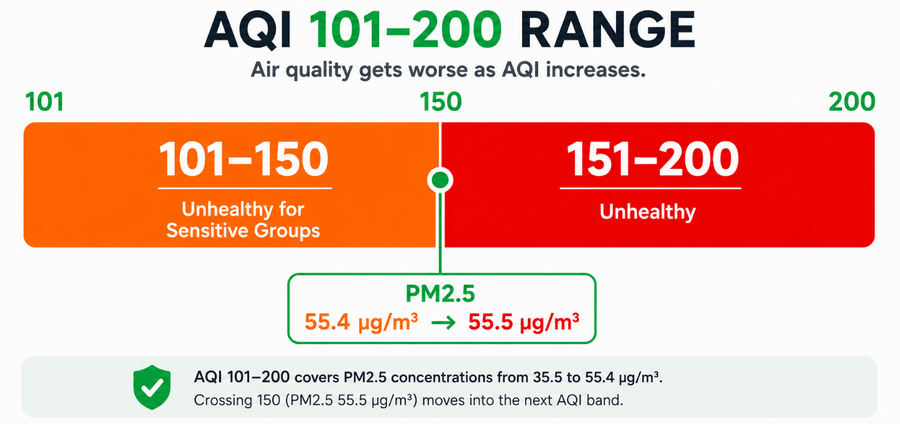
One-tenth of a microgram separates orange from red. A 24-hour average of 55.4 µg/m³ of PM2.5, the fine particles in smoke and haze, scores 150, while 55.5 µg/m³ scores 151, per the EPA’s published AQI breakpoints.
What to do today. If you have central HVAC, put an EPA-recommended MERV 13 filter in it and set the thermostat fan to ON. Either way, run a portable HEPA cleaner in each occupied room and close the house up. Filterbuy treats AQI 100 as the line where these start.
What Does An AQI Of 150 Mean?
An AQI of 150 means outdoor air has reached the top of the orange Unhealthy for Sensitive Groups band on the U.S. Air Quality Index, the EPA’s 0-to-500 daily health scale. Members of sensitive groups may experience health effects at this level, while the general public is less likely to be affected. AQI 150 is the highest reading that still counts as orange.
The scale runs green (0–50), yellow (51–100), orange (101–150), red (151–200), purple, then maroon. Orange is the first band where the EPA names particular groups rather than the public at large: people with heart or lung disease, older adults, children, and people with diabetes. Our guide to unhealthy for sensitive groups covers who belongs there; the AQI scale explained walks through every band.
Is An AQI Of 150 Bad?
An AQI of 150 is bad enough to act on, and I think it gets underestimated more often than any other number on the scale, because 150 sits at the ceiling of its category rather than the middle. Do the arithmetic and 150 and 155 are only about 10% apart in fine-particle concentration. One reads orange, the other red, and that color change is the part most people respond to.
I write about air quality for Filterbuy, a U.S. air filter manufacturer, and households react to colors rather than numbers. Nobody argues about a purple day; the danger announces itself. Orange is quieter. Weigh the mistakes: treating a 150 like a 155 costs a closed window and a filter you were replacing anyway, while the opposite error costs a child coughing at bedtime. Plan around the bigger one.
The practical rule: treat a 150 the way you would treat a 155. The air does not know where the EPA drew the line.
"The reading that worries me isn’t 200. It’s 150, the one people talk themselves out of."
— Michelle Wan, Brand Manager and Air Quality Writer, Filterbuy
What Pollution Level Does An AQI Of 150 Represent?
An AQI of 150 corresponds to an exact concentration that differs by pollutant: a 24-hour PM2.5 average of 55.4 µg/m³, or an 8-hour ozone average of 0.085 ppm. The table sets the orange ceiling beside the first step into red, from the EPA’s published breakpoint file.
Source: U.S. EPA published AQI breakpoints. PM2.5 values reflect the breakpoints updated May 6, 2024.
In 2024 the EPA lowered the annual PM2.5 standard from 12.0 to 9.0 µg/m³ and rescaled the bands, yet many AQI articles still quote the old figures.
Why Does One App Say 150 And Another Says 132?
Different sources report different AQI numbers for the same air because they cover different time windows. A daily AQI averages 24 hours, the NowCast weights the past 12, many apps show only the last 60 minutes, and a forecast predicts tomorrow. All can be correct at once, which is why two phones in one kitchen disagree by a whole category.
The real-time number on AirNow is the NowCast, and its weighting is useful. AirNow uses longer averages when air quality is stable and shorter ones when it is changing fast. A 150 during an arriving plume is a lagging number and the air is probably already worse; a 150 on a stagnant afternoon is closer to true. Check the same station twice an hour apart.
Pick one source and stay with it, which is why Filterbuy publishes a single live AQI map covering more than 750 U.S. cities instead of a scoreboard. Distance matters too: your reading comes from the nearest monitor, which may sit miles away.
Is It Safe To Go Outside When The AQI Is 150?
At an AQI of 150, going outside is generally fine for healthy adults but should be modified for anyone in a sensitive group. The EPA asks those groups to reduce prolonged or heavy exertion outdoors, a change in duration and intensity rather than a lockdown. A walk to the mailbox is fine; a two-hour soccer practice is what you shorten or reschedule.
What changes if the number crosses into red:
Source: adapted from U.S. EPA and AirNow AQI guidance for the Unhealthy for Sensitive Groups and Unhealthy categories.
One timing caveat. "Exercise in the morning" is ozone advice. On a smoke day it can be wrong: smoke often settles overnight in valleys and clears as the ground warms. AirNow names no time of day for smoke, so check, then go.
What Are The Health Effects Of A Full Day At AQI 150?
The health effects of an AQI of 150 depend far more on how long you are exposed than on the number itself. The EPA frames inhaled dose as concentration multiplied by breathing rate multiplied by time outdoors, which is why ten minutes at 150 is nothing like an eight-hour shift.
Across a full day, sensitive individuals commonly report coughing, chest discomfort, wheezing, shortness of breath, and unusual fatigue. The EPA notes people with heart disease can experience serious problems with no warning signs, and asks patients to follow their own clinician rather than a general guide. Most healthy adults notice nothing.
Symptoms outrank the app. If someone at home is feeling it, treat the air as worse than the number says, and talk to a qualified healthcare professional about anything involving breathing or a health condition.
What Should You Do At Home When The AQI Is 150?
Because a 150 sits one step from red, get ahead of the change. The EPA reports indoor concentrations of some pollutants can run two to five times higher than outdoor levels, and outdoor air is working in through every gap. Filterbuy treats AQI 100 as the line where these steps switch on; the EPA sets its category boundary at 101, and we act at the threshold instead.
If you have central HVAC, put an EPA-recommended MERV 13 filter in it. The EPA recommends MERV 13 or higher in a central system during smoky periods and notes most furnaces accommodate one without equipment problems, provided it is replaced often. Check the size as you would for any filter. Homes without ductwork have no filter slot; skip to step three.
Set the thermostat fan to ON. Central systems only. On AUTO the fan runs just while the system heats or cools, so the filter works part-time. On ON, household air keeps cycling.
Run a portable HEPA air cleaner in each occupied room, bedrooms first. This is Filterbuy’s recommendation, not the EPA’s, whose clean room guidance describes one room. Size each unit to a smoke CADR of about two-thirds of the room’s square footage, so a 300-square-foot bedroom wants roughly 200. Skip anything that produces ozone.
Close the house up. Windows and doors shut, and no new indoor pollution: no candles, frying, smoking, or vacuuming unless the machine is sealed.
Both layers, not one or the other. MERV 13 treats the whole house because the central blower moves far more air than any portable unit; a HEPA cleaner treats its room harder. With ducts, run both. Without them, the portable cleaners are your primary defense, and EPA research found a box fan paired with a MERV 13 filter reduces smoke indoors when a certified unit is out of reach: certified fan from 2012 or newer, never unattended, and a stopgap only.
Checking the filter. Smoke loads a filter far faster than household dust, so the calendar stops being useful. The EPA advises replacing it when it looks dirty, dark brown or black, often well before the normal interval. Keep spares on hand.
Check AirNow and your local air agency first; their guidance comes before ours.
Not sure what your system takes? Filterbuy makes 600+ standard and custom sizes, built in the USA and shipped factory-direct.
Supporting Statistics
Three findings from U.S. agencies sit behind the advice above, each checked against its primary source.
Frequently Asked Questions
Is AQI 150 orange or red?
AQI 150 is orange. Unhealthy for Sensitive Groups runs 101 to 150. Red, labeled Unhealthy, begins at 151.
What is the difference between AQI 150 and 151?
One-tenth of a microgram of PM2.5. A 24-hour average of 55.4 µg/m³ scores 150; 55.5 µg/m³ scores 151. The air barely moves, but the guidance widens at 151 to cover everyone.
Should I run an air purifier as well as changing the filter?
Both, if you have ducts. MERV 13 treats the whole house; a portable HEPA cleaner treats one room harder. Filterbuy recommends one in each occupied room, bedrooms first, sized to a smoke CADR of about two-thirds of the room’s square footage. Without central HVAC the portable cleaners are the primary defense.
How often should I change the filter while smoke is around?
Go by how it looks, not the calendar. The EPA advises replacing it when it appears dirty, dark brown or black, which during smoke can be well before the normal interval. Keep spares on hand.
About The Author And Reviewer
Michelle Wan is Brand Manager and Air Quality Writer at Filterbuy, where she translates pollutant science and EPA guidance into steps homeowners can act on, and appears in Filterbuy’s educational videos and social content. Working directly with Filterbuy’s U.S. manufacturing team across its Alabama, Florida, Pennsylvania, and Utah factories grounds her writing in how filters are actually built and used rather than in spec sheets. She holds a B.A. in Sociology from the University of California, Santa Cruz.
David Clark is a Licensed HVAC Technician and reviews Filterbuy’s technical air quality content for accuracy.
Filterbuy manufactures pleated HVAC air filters in the United States and sells them factory-direct in more than 600 standard sizes, plus custom sizes, in MERV 8, MERV 11 and MERV 13. Filterbuy also publishes a live U.S. Air Quality Index map covering more than 750 cities.
How this page is sourced. Every figure here was checked against a primary source (U.S. EPA, AirNow.gov, the CDC, or the American Lung Association) on the date shown at the top of the page, and each source is linked below. Where the evidence is uncertain or varies by home, the page says so rather than rounding it into a clean claim.
Sources
U.S. EPA: AQI breakpoints, Patient Exposure and the Air Quality Index, PM NowCast, Indoor Air Quality, Preparing for Smoke and Heat, Strategies to Reduce Exposure Indoors, Create a Clean Room, DIY Air Cleaner research, PM NAAQS reconsideration.
AirNow.gov: Using the Air Quality Index and When Smoke is in the Air.
CDC, Most Recent Asthma Data. American Lung Association, "State of the Air" 2026.
Glossary
AQI (Air Quality Index): The U.S. EPA’s 0-to-500 scale converting outdoor pollutant concentrations into a daily health rating across six color-coded categories.
Unhealthy for Sensitive Groups: The orange AQI category spanning 101 to 150, where sensitive groups may experience health effects and the general public is less likely to be affected.
NowCast: The EPA’s method for reporting a current-hour AQI, using a weighted average of the past 12 hours that leans on recent hours when conditions change fast.
PM2.5: Fine particulate matter 2.5 micrometers or smaller, the particles that make up most of wildfire smoke and haze.
MERV: Minimum Efficiency Reporting Value, the 1-to-16 scale for an HVAC filter’s particle capture. MERV 13 is the tier Filterbuy recommends for smoke.