Shop by
September 16, 2026
By Michelle Wan | Reviewed by David Clark, Licensed HVAC Technician
Published September 16, 2026 | Last updated September 16, 2026
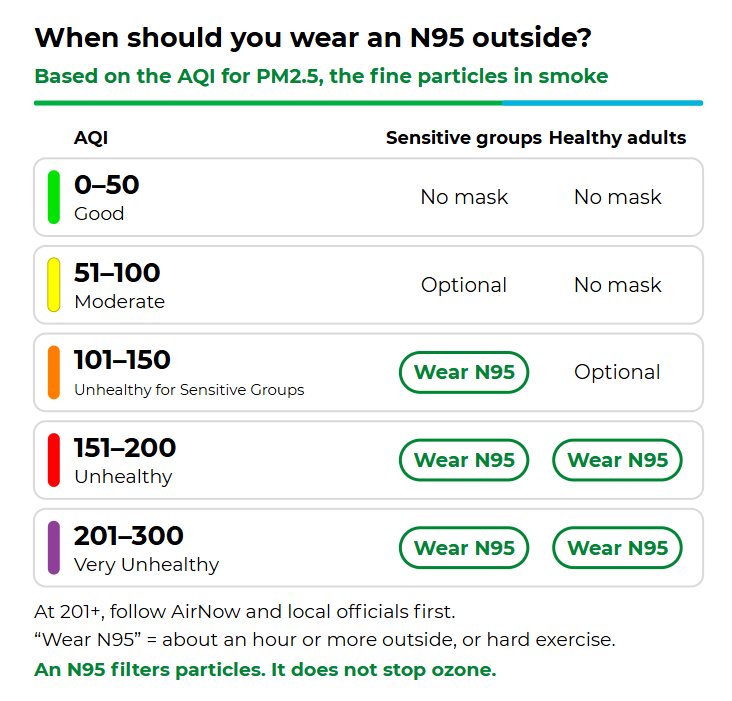
Sensitive groups should wear an N95 outside once the AQI for PM2.5 reaches 101. Healthy adults should wear one from 151 for extended time outdoors. At 201 and above, follow AirNow and local officials first. An N95 filters particles, not ozone, so check the main pollutant before you mask up.
A mask covers your time outside. Your home’s filter covers the hours inside, so take the quick quiz below to find your filter match.
Answer a few quick questions and we’ll match you to your perfect filter.
Healthy adults should wear a NIOSH-approved N95 for extended time outdoors once the Air Quality Index for PM2.5, the fine particles that make smoke visible, climbs past 150. Sensitive groups should start at 101. Filterbuy makes air filters, not masks. Our review of federal guidance and three state worker rules found no federal mask number, so these lines are our reading of both. A mask only helps when particles drive the reading.
If you are in a sensitive group, wear an N95 for extended outdoor time once the AQI reaches 101. Everyone else should follow at 151. At 201 and above, follow AirNow and local officials first, and limit time outside. Check the main pollutant first, since N95s trap smoke particles but cannot stop ozone gas.
No federal AQI number requires a mask. The only numeric lines come from state worker-safety rules.
Sensitive groups act one category earlier. That includes children, older adults, pregnant people, and anyone with heart or lung disease.
A respirator only helps with particles. An N95 or P100 filters PM2.5, the fine particles in smoke and haze, yet it does nothing for ozone.
A mask covers the minutes outside. MERV 13 filtration and HEPA cleaners cover the hours.
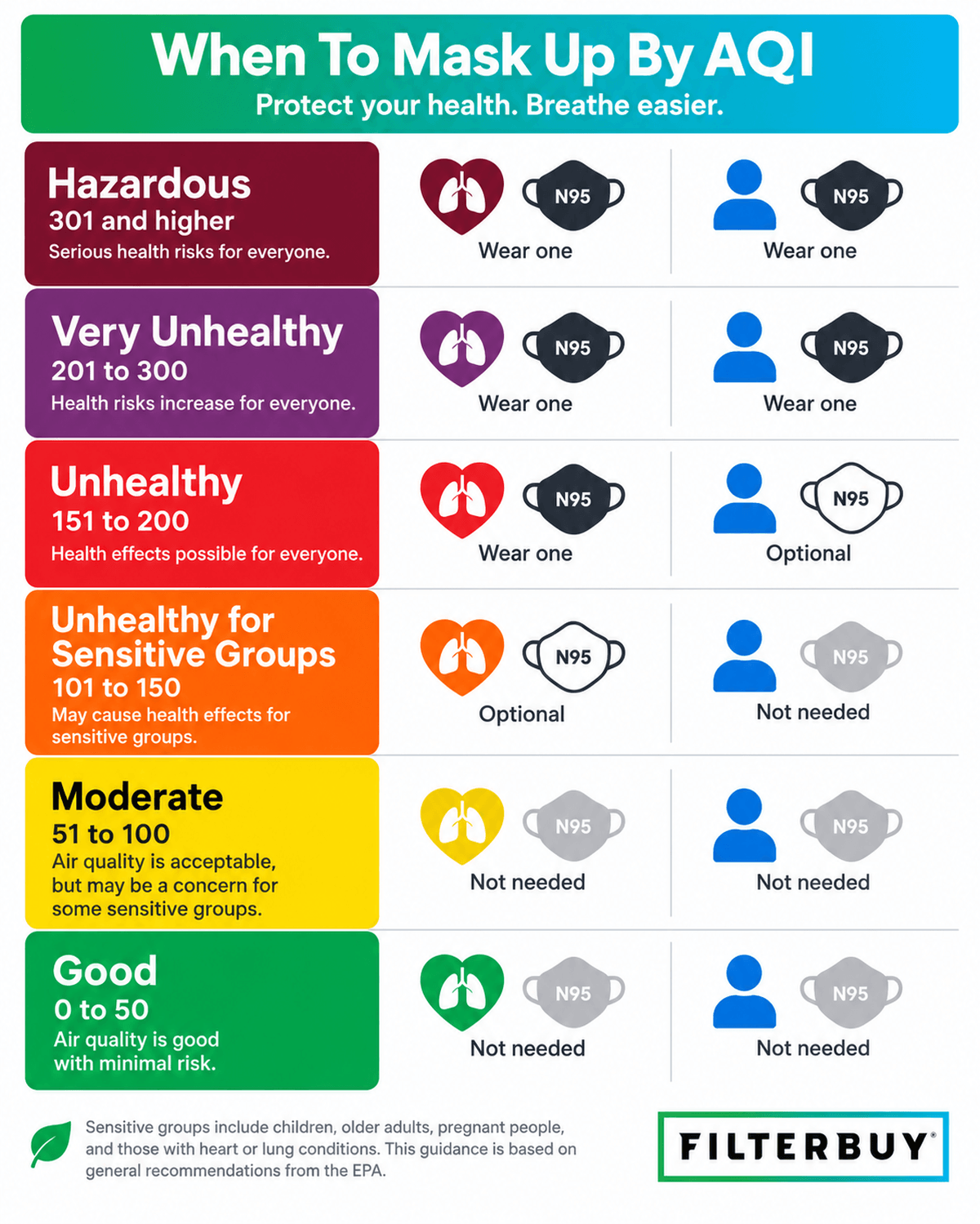
The right AQI for a mask depends on your health and your time outside. For PM2.5, sensitive groups should wear an N95 respirator from 101, and healthy adults should wear one from 151 for extended outdoor time. Once the AQI reaches 201, follow AirNow and local officials first, and wear one if you have to go out.
AirNow, the federal program that publishes the AQI, calls air unhealthy once it moves past the Moderate range. By "extended time," we mean about an hour or more in total, or any strenuous activity.
Category names and ranges follow the 2024 EPA update to the AQI for fine particles. The mask columns reflect Filterbuy's reading rather than a federal rule.
Filterbuy's action line sits at AQI 100, the top of the Moderate range, where we tell households to start the home steps.
For a faster answer, Table 2 turns the same guidance into six yes-or-no questions.
No federal agency publishes a single AQI number for public mask use. NIOSH advises an N95 or P100 when you must spend extended time outdoors in smoky air, and the only numeric respirator thresholds come from state worker-safety rules in California, Oregon, and Washington.
Several guides we reviewed say EPA sets a mask number, but its respirator guidance does not. CDC and NIOSH frame the decision around categories instead: go out when the air is Good or Moderate, and wear a well-fitted respirator once it reaches an unhealthy category that affects you.
In California, the Cal/OSHA wildfire smoke standard requires employers to supply respirators once the AQI for PM2.5 reaches 151 and to require them above 500. Under the Washington Department of Labor and Industries smoke rule and Oregon OSHA's wildfire smoke rules, employers act sooner, offering N95s at 35.5 µg/m³, which equals AQI 101.
The Filterbuy team compared the three rules and noticed that Oregon and Washington write theirs in micrograms, so their thresholds held steady when the upper AQI bands were recalculated in May 2024. Table 4 shows Filterbuy's old-versus-new calculation for the same smoke.
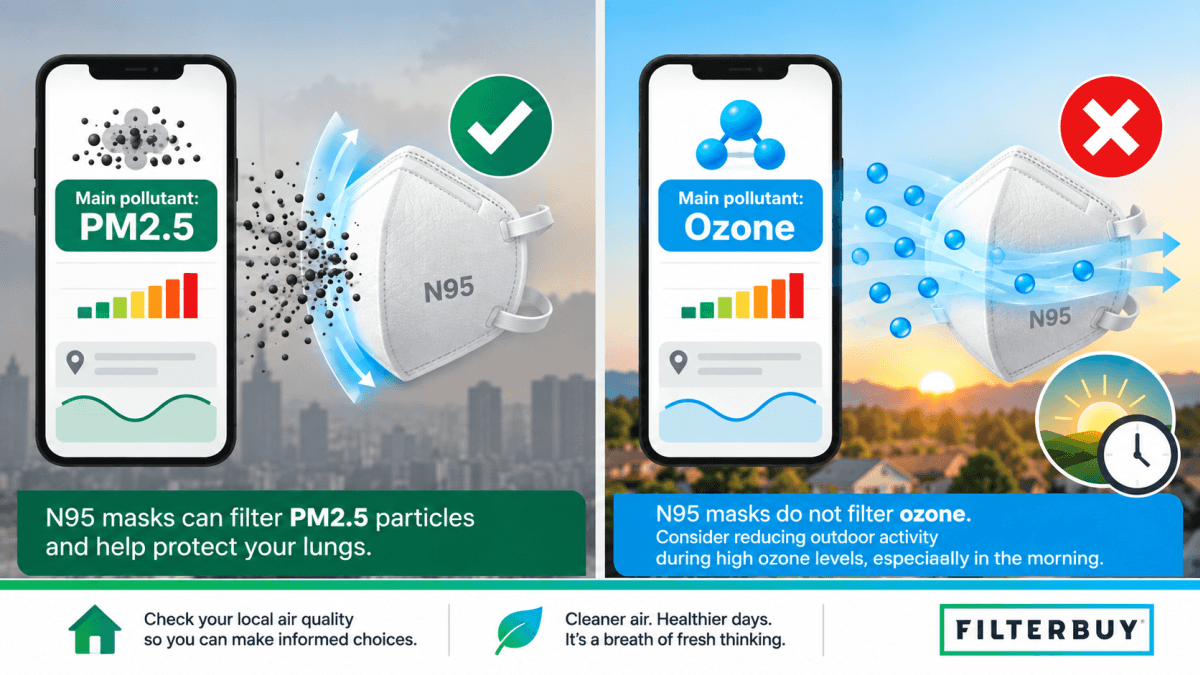
Whether a mask helps depends on the pollutant behind the AQI. Your AQI reflects the worst of several pollutants, and on hot summer afternoons that is often ground-level ozone. NIOSH states that N95 and P100 respirators filter particles only and do not stop gases, so when ozone drives the reading, cut back on exertion and time outside instead.
Filterbuy's pleated MERV 13 filters have the same limit as an N95. They capture particles but do nothing for ozone.
When you look up the AQI for your ZIP code, check the main pollutant listed beside the number. If it reads PM2.5 or PM10, a sealed N95 helps, and if it reads ozone, move outdoor exercise to the morning, when ozone runs lower.
Only NIOSH Approved respirators with a rating such as N95 or P100 carry U.S.-verified filtration for fine particles. Look for NIOSH and the rating printed on the respirator itself, plus two head straps. Surgical masks, cloth masks, one-strap dust masks, and bandanas do not seal to the face, so smoke flows around them.
KN95 respirators are certified to a Chinese standard rather than by NIOSH, so treat one as a backup at best.
N95 media and Filterbuy's pleated filter media both rely on an electrostatic charge to catch fine particles. The seal is what sets a respirator apart, which is why we put fit first. Compare ratings in our N95 vs. KN95 vs. P100 comparison and read how to get an N95 to seal against smoke.
AirNow's Unhealthy for Sensitive Groups category starts at 101, and CDC ties respirator use to the category that affects you. That puts people with heart or lung disease, children and teens, older adults, pregnant people, and outdoor workers one category ahead of everyone else. If you have asthma, COPD, or a heart condition, let your doctor set the specifics.
For young children and anyone with facial hair, a mask is a weaker tool, because neither can count on a reliable seal. The American Academy of Pediatrics wildfire guidance for parents says children 2 and older can wear one, but a correct fit is hard for younger kids. Children under 2 should not wear one. See who counts as a sensitive group.
Respirators also make breathing harder, so ask your doctor first if you are pregnant. A systematic review of N95 use during pregnancy found short-term use unlikely to pose risk, though longer use is unstudied. If you feel dizzy or short of breath, take the respirator off and move to cleaner air.
First, check AirNow and your local air agency for current advice. Then, at AQI 100, Filterbuy tells households to take four steps: put MERV 13 in the HVAC, set the fan to On, run a portable HEPA cleaner in each occupied room, and close up the house.
Put MERV 13 air filters in your size into the HVAC system as the whole-home layer. EPA's guidance on preparing a home for smoke recommends MERV 13 or higher during smoke events and notes that most furnaces and HVAC systems can accommodate MERV 13 without equipment problems when the filter is replaced often.
Set the thermostat fan from Auto to On. Auto filters only while the system heats or cools, and On filters continuously.
Run a portable HEPA air cleaner in each occupied room, bedrooms first. This room layer works alongside the whole-home filter.
Close windows and doors, and skip candles, frying, smoking, and vacuuming without a sealed unit while smoke is in.
Without ductwork, as in many apartments, portable HEPA air cleaners become the main defense. EPA suggests a smoke CADR of at least two-thirds of the room's floor area. A 300-square-foot bedroom, for example, needs about 200. The Association of Home Appliance Manufacturers (AHAM) two-thirds rule agrees and suggests a smoke CADR equal to the full floor area for wildfire smoke.
EPA advises against air cleaners that produce ozone, so skip ozone generators and ozone-emitting ionizers. Inspect your filter often during smoke, and replace it when it looks dark brown or black, which can be well before the usual interval. Keep spares on hand.
Filterbuy does not sell masks, and we build MERV 13 filters in our U.S. factories. EPA ranks respirators behind staying indoors and cleaning indoor air, and we agree. See what to do when the AQI tops 100, and track plumes on our live wildfire and smoke map.
The number: 152.3 million people, or 44% of the country, live where ozone or particle pollution earns an F.
The contrast: 61.5 million live where short-term particle spikes earn a failing grade.
Why it matters: Unhealthy ozone reached more people than in any of the last five reports, and respirators do not filter it.
Source: American Lung Association, State of the Air 2026 Key Findings
The number: NIOSH reports a well-fitted respirator cuts exposure by at least 10 times.
Why it matters: The seal sets the protection, so check both straps and the fit every time.
The number: A Stanford-led study in the Proceedings of the National Academy of Sciences found wildfires caused up to 25% of U.S. fine particle pollution in recent years.
The regional spike: In some Western regions, the share reached up to half.
Why it matters: Smoke is now a major share of what an N95 filters, so the thresholds on this page track PM2.5.
Source: Burke et al., The Changing Risk and Burden of Wildfire in the United States, PNAS (2021)
Most people do not. AQI 100 sits at the top of the Moderate range, so a mask is optional unless you are unusually sensitive or notice symptoms.
No household rule does. As a guide, sensitive groups should wear one outdoors from AQI 101, and healthy adults from 151 for extended time outside.
No. Respirators filter particles and cannot catch gases, so on high-ozone days, cut back on hard outdoor activity or move it earlier.
Children 2 and older can if it fits snugly, but approved models are not sized for young children.
Only as a backup. A KN95 is not NIOSH-approved, and its ear loops seal loosely. Oregon and Washington worker rules also leave it out.
AQI (Air Quality Index): EPA's color-coded index for outdoor air quality. Higher numbers mean more pollution.
AHAM: The Association of Home Appliance Manufacturers, which certifies air cleaner CADR ratings.
CADR (Clean Air Delivery Rate): How much filtered air a portable air cleaner delivers.
KN95: A respirator certified to a Chinese standard, not NIOSH Approved.
MERV 13: An ASHRAE 52.2 rating for HVAC air filters that capture fine particles such as smoke.
N95: A NIOSH-approved respirator rated to filter at least 95 percent of test particles.
NIOSH: The National Institute for Occupational Safety and Health, the federal agency that approves respirators.
Ozone: A gas that often drives summer AQI readings. Respirators do not filter it.
P100: A NIOSH rating for oil-resistant respirator filters that capture at least 99.97 percent of test particles.
PM2.5: Fine particles 2.5 micrometers or smaller, the main pollutant in wildfire smoke.
Sensitive Groups: People most affected by air pollution, such as children and anyone with heart or lung disease.
