
Sulfur Dioxide (SO2): Sources, Health Effects & Indoor Impact
July 29, 2026
Author: Michelle Wan, Brand Manager and Air Quality Writer | Reviewer: David Clark, Licensed HVAC Technician | Publish Date: July 29, 2026 | Updated: July 29, 2026
What Is Sulfur Dioxide (SO2), And Can An Air Filter Remove It?
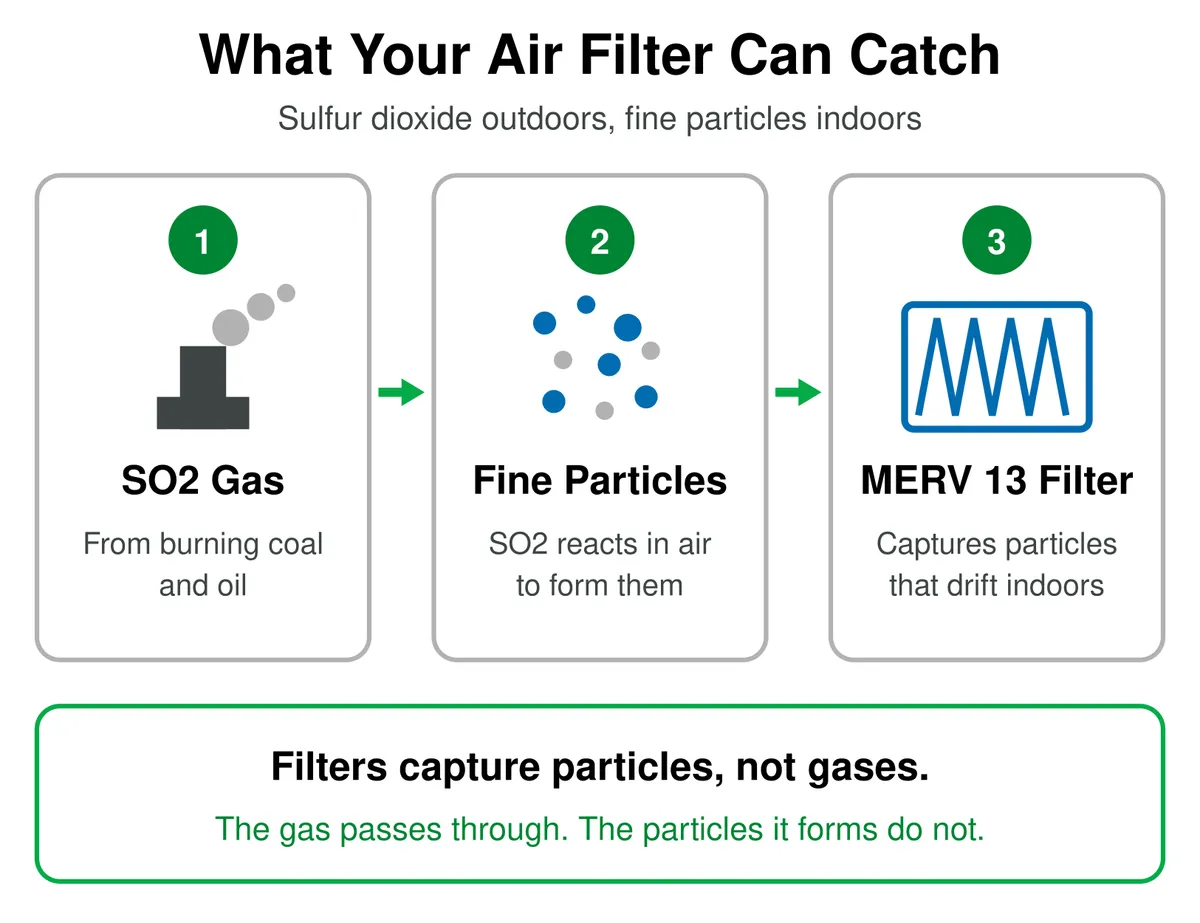
Sulfur dioxide is a colorless gas released when coal, oil, and other sulfur-containing fuels burn, and a pleated air filter does not capture it, because pleated filters capture particles rather than gases. What your filter does catch is what sulfur dioxide becomes. In the atmosphere, SO2 reacts to form fine sulfate particles, and those particles drift indoors through doors, windows, and your fresh-air intake. Filtering that particle load is where your MERV rating matters.
- MERV 8 captures larger debris, dust, and dust mites.
- MERV 11 captures finer particles like pet dander and mold spores.
- MERV 13 captures microscopic particles, our highest residential filtration.
Answer 3 quick questions and we will match you to the right MERV rating for your home.
Sulfur dioxide (SO2) is a colorless, sharp-smelling gas produced when sulfur-bearing fuel burns. It concentrates near power plants, refineries, smelters, ports, and active volcanoes, where it irritates airways and can set off asthma symptoms in minutes. Outdoor SO2 reaches your home in two chemically different forms, and a pleated filter captures only one of them.
Key Takeaways
Sulfur dioxide is a gas, and no MERV rating measures gas capture, so a MERV number cannot answer a question about SO2.
EPA's 1-hour primary standard is 75 parts per billion, set to protect people with asthma from effects after exposures as brief as five minutes.
Sulfur dioxide converts in the atmosphere into sulfate particles inside the PM2.5 size range, and high-efficiency pleated media does capture that fraction.
Closing windows and switching your system to recirculate reduces indoor sulfur dioxide gas faster than any filter can.
What Sulfur Dioxide Is
Sulfur dioxide is a colorless gas with a pungent odor that forms whenever fuel containing sulfur burns. The Agency for Toxic Substances and Disease Registry describes it as readily converted in air into sulfuric acid, sulfur trioxide, and sulfates. EPA uses SO2 as the indicator for the wider sulfur oxides family.
Two properties matter for a homeowner. SO2 is a gas rather than a particle, which governs what can remove it, and it is chemically unstable outdoors, so the sulfur you breathe near a source is not the sulfur fifty miles downwind. Indoors it behaves much like nitrogen dioxide, the other combustion gas with a short-term irritant standard.
Where Outdoor SO2 Comes From
Fossil fuel combustion at power plants and other industrial facilities produces the largest share of U.S. sulfur dioxide emissions, according to the EPA. Smaller contributors include metal smelting, oil refining, paper mills, volcanic activity, and ships and heavy equipment burning high-sulfur fuel.
The American Lung Association reports that people living or working near large sources receive the highest exposures. Clean Air Act programs cut emissions sharply, though not uniformly.
Source categories per the U.S. Environmental Protection Agency, Sulfur Dioxide Basics.
Quick Self-Check: Does Your Home Sit In A Higher SO2 Zone?
Sulfur dioxide is unusually local, and concentrations fall off sharply with distance. Any of these raises the odds that SO2 belongs on your radar:
You live within a few miles of a coal-fired power plant, oil refinery, paper mill, metal smelter, or working port.
Your home sits downwind of one under the prevailing wind direction, which matters more than distance.
You live in a valley or basin where temperature inversions trap air near the ground.
You live on Hawaii Island or downwind of it during an eruptive period.
Your county appears on EPA's list of areas designated nonattainment for the 1-hour standard.
Almost nobody knows that list exists. Readings behind a designation usually trace to a specific named facility rather than traffic.
What Sulfur Dioxide Does To Your Lungs
Sulfur dioxide irritates and narrows the airways. The American Lung Association reports wheezing, shortness of breath, and chest tightness, worst during exercise because harder breathing draws gas deeper into the lungs. A 2026 review in Toxics traces acute effects from airway irritation up to pulmonary edema, and notes that thresholds for long-term low-level exposure remain incompletely characterized.
Why Asthma Changes The Math
People with asthma respond faster and at lower concentrations, and EPA built the current standard around that group. EPA's 1-hour primary standard is 75 parts per billion, measured as the three-year average of annual 99th percentile daily maximum values. EPA set it in 2010 and retained it without revision in 2019, stating that it protects people with asthma against respiratory effects following exposures on the order of five minutes.
Read that timescale carefully. The regulatory concern is a five-minute plume rather than a bad day. Filter guidance, including ours, is written around ninety-day replacement cycles, and no schedule can respond to a plume that passes that fast. Sulfur dioxide is the clearest case we know of where the right response is behavioral first and mechanical second.
What Happens When SO2 Reaches Your Home
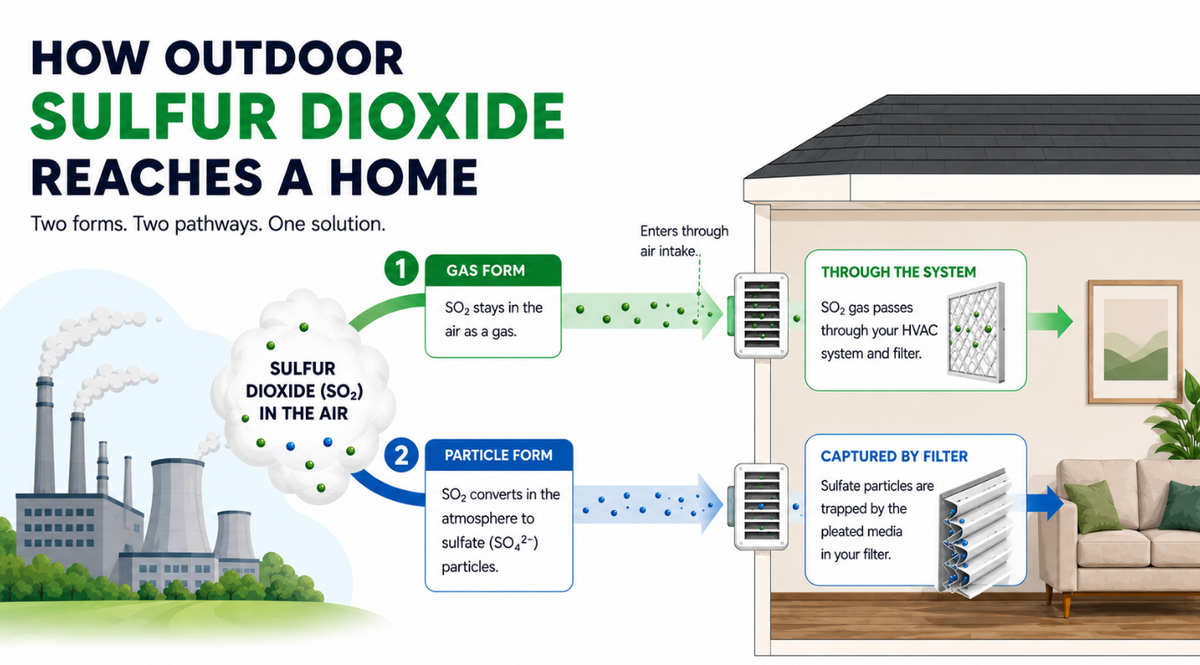
Outdoor sulfur dioxide arrives in two chemically different forms, and each calls for a different response. Homes have no meaningful indoor sources, so what you breathe indoors comes from outside.
Form one is the gas. It enters through open windows, doors, and ordinary gaps in a building envelope, and it passes through pleated filter media without being captured. What reduces it indoors is limiting how much gets in and letting the rest dissipate.
Form two is sulfate particles. EPA states that sulfur oxides react with other compounds in the atmosphere to form small particles that contribute to particulate matter pollution, and that cutting SO2 also cuts fine sulfate. Those particles fall inside the PM2.5 size range, which is what pleated media is built to capture. Our primer on what PM2.5 means and how it is measured has the detail.
Near a source during a short plume, most of your exposure is gas and filtration contributes little. Downwind, hours to days later, more of it has converted to sulfate and filtration contributes meaningfully. So the day your filter works hardest is often not the day of the event, and a downwind household can take its heaviest load a day or two after the smell clears.
What Filtration Can And Cannot Do
No MERV rating measures gas capture. MERV, or Minimum Efficiency Reporting Value, rates how efficiently a filter captures airborne particles across specified size ranges, so the number says nothing about sulfur dioxide gas. A MERV-based sulfur dioxide removal figure describes something the rating does not measure.
MERV rates particle capture efficiency only. No MERV value describes gas removal.
Activated carbon deserves a precise answer. Carbon adsorbs gases and odors, and carbon-based HVAC media is built for that alongside MERV 10-level particle capture. Residential carbon layers are not designed, tested, or rated for sulfur dioxide removal, and industrial SO2 scrubbers work at scales a furnace filter cannot approach. Treat carbon as odor control, not gas removal.
For the particle half of the problem, MERV 13 pleated filters capture a high share of fine particles in the PM2.5 range, where converted sulfate sits. Confirm your system's airflow tolerance first, and our explainer on how MERV ratings are measured covers the scale. Fit matters as much as rating, because gaps around the frame let air bypass the media entirely. Filterbuy builds more than 600 sizes and cuts custom dimensions in Talladega, Alabama.
Reducing Your Exposure On A High SO2 Day
1. Check the index. AirNow reports a U.S. Air Quality Index for sulfur dioxide, and our guide to what each AQI category means for your household explains the thresholds.
2. Close windows and exterior doors when the SO2 index climbs, and keep them closed through the event rather than airing out midway.
3. Switch your HVAC system to recirculate, and run the fan continuously so indoor air keeps passing through the filter.
4. Move exertion indoors, because harder breathing pulls gas deeper into the lungs.
5. If someone in the household has asthma, keep rescue medication accessible and follow their clinician's action plan.
6. Replace your filter on schedule, because a loaded filter restricts airflow and cleans less air per cycle.
One reassurance is worth stating plainly. An SO2 episode is usually a few-hour problem rather than a day's problem, because the gas disperses and reacts quickly, so the actions above resolve most of your exposure.
After manufacturing filters for over a decade and serving more than two million households, we have learned that being clear about what a filter cannot do builds more trust than overpromising what it can. Sulfur dioxide is a gas, and our pleated media captures particles. What we can help with is the sulfate fraction that gas becomes, and that is a real and worthwhile part of the problem.
— David Heacock, Founder and CEO, Filterbuy
Essential Resources
EPA's Sulfur Dioxide Basics overview explains how SO2 enters the air and why reducing it also cuts fine sulfate.
The American Lung Association's page on sulfur dioxide and the lungs details the respiratory symptoms SO2 produces and who is most exposed.
ATSDR's ToxFAQs fact sheet on sulfur dioxide covers its conversion into sulfuric acid and sulfates, though its cited standards predate the current 1-hour rule.
The U.S. Geological Survey's guide to volcanic gas hazards at Kilauea describes vog as SO2 gas mixed with sulfuric acid droplets and sulfates.
AirNow's AQI Basics explainer shows how the index reports sulfur dioxide alongside four other pollutants.
The Asthma and Allergy Foundation of America's guidance on air pollution and asthma sets out exertion limits and sheltering advice.
The 2026 Toxics review of sulfur dioxide toxicity by Stauffer and Tat synthesizes the acute and chronic evidence and its gaps.
Supporting Statistics
1. The Sulfur Dioxide Standard Targets Five-Minute Exposures. EPA retained its 1-hour primary standard of 75 parts per billion without revision in 2019 to protect people with asthma from five-minute exposures.
Source: Federal Register, EPA review of the primary NAAQS for sulfur oxides
2. Coal Generation Rose Again In 2025. U.S. coal-fired generation rose 13 percent in 2025 to 731 billion kilowatthours, supplying 17 percent of U.S. electricity, so SO2 emissions are not falling uniformly.
Source: U.S. Energy Information Administration, Short-Term Energy Outlook
3. The 2020 Marine Fuel Rule Cut Shipping Sulfur Sharply. Cutting the global cap on sulfur in ship fuel oil from 3.50 to 0.50 percent reduced shipping sulfur oxide emissions by roughly 70 percent.
Source: International Maritime Organization
Frequently Asked Questions
Glossary
Sulfur dioxide (SO2) is a colorless gas with a sharp, acrid odor, formed when fuel containing sulfur is burned. EPA regulates it as one of six criteria air pollutants and uses it as the indicator for the wider sulfur oxides (SOx) family.
Sulfate describes the particles and acid droplets sulfur dioxide converts into in the atmosphere. Sulfate particles fall within the PM2.5 size range.
PM2.5 means airborne particles 2.5 microns in diameter or smaller. This category includes fine sulfate, wildfire smoke, and combustion particles.
MERV stands for Minimum Efficiency Reporting Value, the 1 to 20 scale rating of how efficiently a filter captures airborne particles. MERV does not rate gas capture.
NAAQS are the National Ambient Air Quality Standards, the health-based outdoor air limits EPA sets under the Clean Air Act.
Parts per billion (ppb) is the concentration unit used for the sulfur dioxide standard. EPA's 1-hour primary standard is 75 ppb.
AQI (Air Quality Index) is EPA's 0 to 500 color-coded scale for reporting daily outdoor air quality, with a separate sub-index for sulfur dioxide.
HVAC stands for heating, ventilation, and air conditioning, the central system that circulates and filters air in most U.S. homes.
ATSDR is the Agency for Toxic Substances and Disease Registry, the federal public health agency that publishes toxicological profiles for hazardous substances including sulfur dioxide.
Hydrogen sulfide (H2S) is a separate sulfur gas with a rotten-egg odor, distinct from sulfur dioxide. Indoors, it commonly indicates a natural gas leak or a sewer issue rather than outdoor air pollution.
Vog is volcanic smog, a hazy mixture of sulfur dioxide gas with sulfuric acid droplets and sulfate compounds, produced most persistently in Hawaii by Kilauea.