Shop by
September 16, 2026
By Michelle Wan, Brand Manager and Air Quality Writer at Filterbuy | Reviewed by David Clark, Licensed HVAC Technician | Published: September 16, 2026 | Updated: September 16, 2026
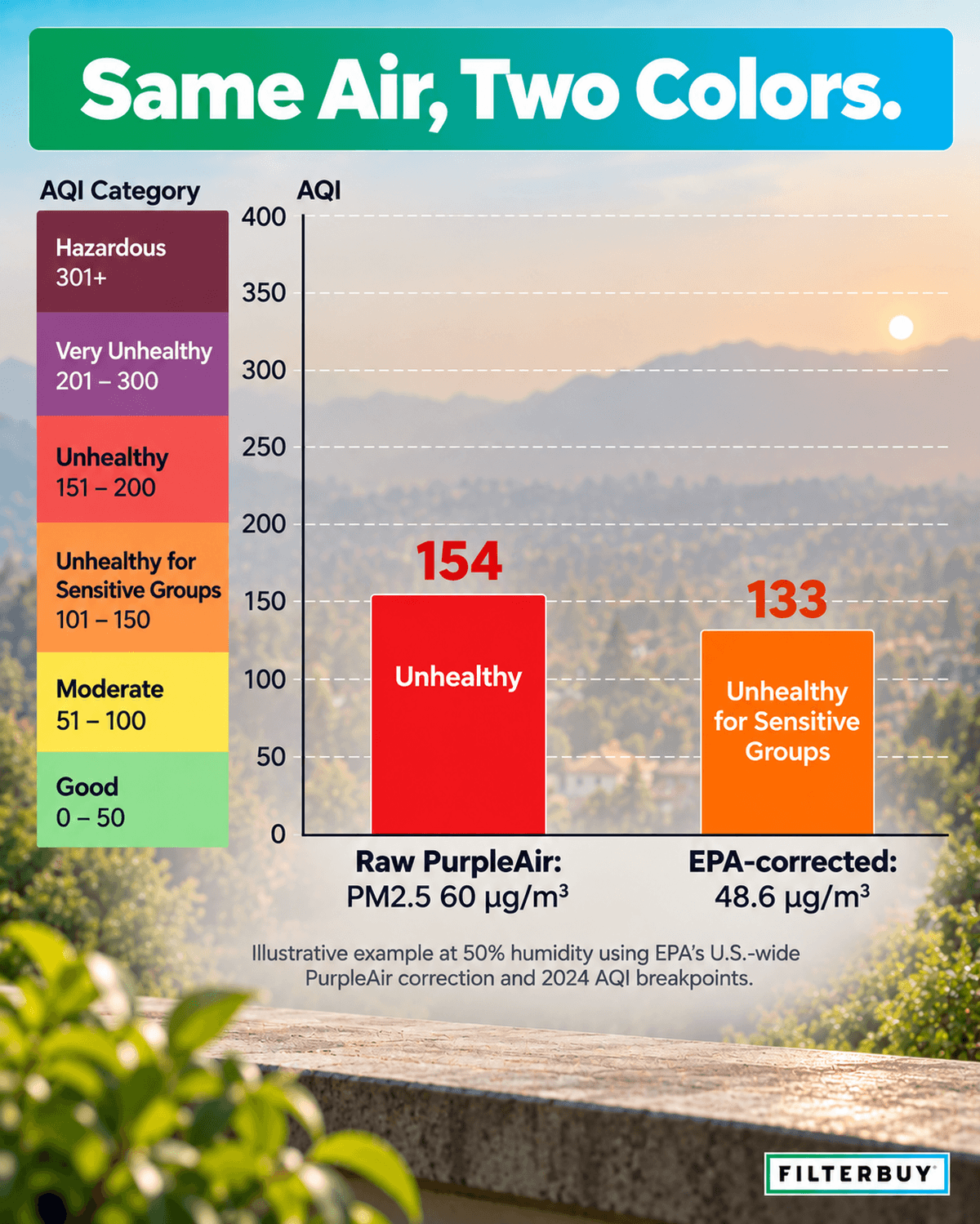
AirNow is more accurate at any single location because EPA builds it from regulatory-grade monitors. PurpleAir fills the gaps between those monitors, but in EPA-led testing its raw readings ran roughly 40% high on fine particles. Turn on the US EPA conversion, then let AirNow set the category and a nearby corrected sensor set the timing.
AirNow (EPA): Regulatory-grade monitors and the reference for official health guidance.
PurpleAir, raw: Dense local coverage, but readings run roughly 40% high.
PurpleAir, EPA-corrected: Close to official monitors in most conditions.
Filterbuy's action line is AQI 100. That's the point to put a MERV 13 filter in your HVAC, and the quiz below helps you find the right fit.
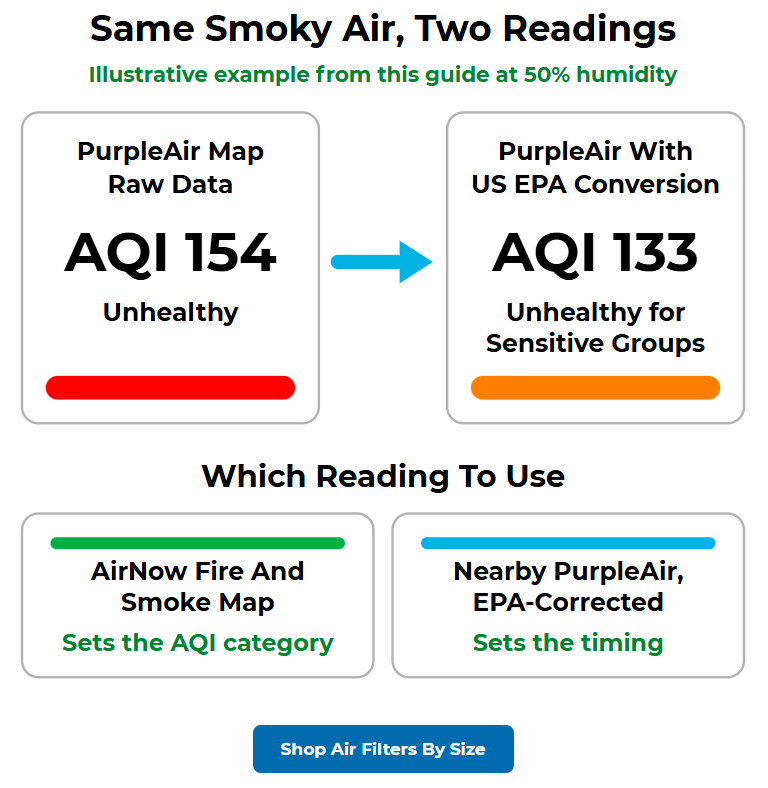
PurpleAir and AirNow disagree mainly because they measure air differently. EPA's AirNow builds its Air Quality Index (AQI) from government monitors using EPA-approved methods, while PurpleAir's low-cost laser sensors run roughly 40% high on fine particles until corrected. For health decisions, use the AirNow Fire and Smoke Map, which places corrected sensors beside official monitors. For block-level timing, check a nearby PurpleAir sensor with the US EPA conversion on.
In an EPA-led study, uncorrected PurpleAir sensors overestimated PM2.5 (fine particles) by about 40% across most of the U.S. (Barkjohn et al., 2021).
The PurpleAir map shows raw data by default, so turn on the "US EPA" conversion.
A 10-minute PurpleAir reading and an hourly AirNow NowCast can land in different AQI colors even when both work properly.
At any single location, AirNow is more accurate because its instruments meet federal reference or equivalent method (FRM/FEM) standards. PurpleAir wins on proximity, with thousands of sensors filling the gaps between monitors. Corrected PurpleAir data holds up: in EPA's 2021 testing, it hit the correct 24-hour AQI category about 91% of the time (Barkjohn et al., 2021).
At Filterbuy, we publish our own live AQI map, so we think carefully about which numbers to trust. Neither source is "wrong"; they simply answer different questions.
| Feature | AirNow (EPA) | PurpleAir, raw | PurpleAir, EPA-corrected |
|---|---|---|---|
| How it measures | Regulatory-grade FRM/FEM monitors | Two laser particle counters | Same, plus humidity and bias correction |
| Typical PM2.5 accuracy | Reference standard | Reads roughly 40% high | Close to monitors in most conditions |
| Coverage | Sparse, often miles apart | Dense in metro and fire-prone areas | Dense where sensors exist |
| Data checks | Preliminary quality checks | Raw, unvalidated readings | Readings dropped when the two lasers disagree |
| Best for | Official health guidance | Spotting local trends | Local health decisions during smoke |
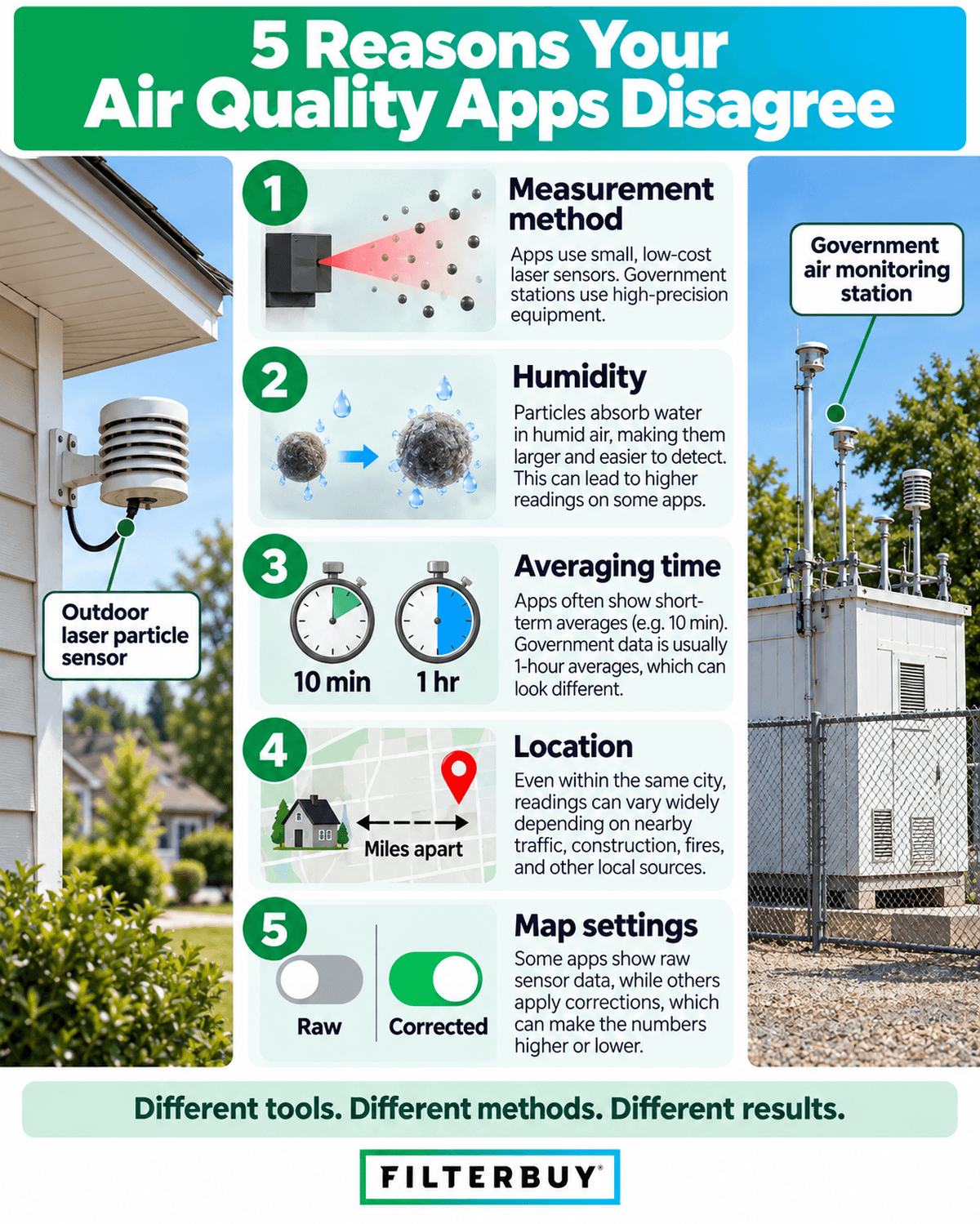
Six factors explain most of the gap between PurpleAir and AirNow: measurement method, humidity, averaging time, location, map settings, and the pollutant being measured.
Measurement method. PurpleAir sensors estimate mass from scattered laser light, while monitors measure mass more directly. Smoke and dust scatter light differently, so estimates drift.
Humidity. On damp days, particles absorb water and swell, so a laser sensor "sees" larger particles than are really there, which is why EPA's correction includes a humidity term.
Averaging time. PurpleAir can report a 10-minute average, while AirNow's current AQI uses the NowCast, a weighted average of recent hours. A brief smoke puff spikes the first and barely moves the second.
Location. A sensor beside a grill or busy road measures that spot, and in fire country the nearest official monitor can be 50 to 100 miles away (Barkjohn et al., 2022).
Map settings. By default, the PurpleAir map displays AQI from raw data, which alone can push a reading up a full color.
Pollutant. AirNow's AQI can be driven by ozone, which PurpleAir sensors don't measure, so check AirNow's listed pollutant.
A high PurpleAir reading usually means the map is showing uncorrected data, which runs roughly 40% above regulatory monitors. If correcting it doesn't close the gap, use the table below.
| What you see | Likely cause | What to do |
|---|---|---|
| Every nearby sensor reads well above AirNow | Uncorrected data | Switch the map's conversion to "US EPA" |
| One sensor reads far above its neighbors | Local source or a failing laser channel | Compare three or more nearby sensors |
| Sharp 10-minute spike, then back to normal | Short burst from traffic or a grill | Switch to a 1-hour or longer average |
| One sensor reads far below its neighbors | Sensor may be indoors or mislabeled | Use the Fire and Smoke Map (outdoor sensors only) |
| Two apps show similar PM2.5 but different colors | One app uses pre-2024 AQI breakpoints | Trust AirNow and update the other app |
| PurpleAir reads lower than AirNow in a dust storm | Laser sensors undercount coarse dust | Trust AirNow on dust days |
Filterbuy checked the breakpoint row. EPA tightened its PM2.5 breakpoints in 2024. Under the new scale, 10 µg/m³ scores AQI 53 (yellow), up from AQI 42 (green). The dust row surprises people: across 50 pollution events, corrected PurpleAir data underestimated PM2.5 five- to sixfold in dust (Jaffe et al., 2023).
The PurpleAir correction factor is an EPA formula that brings PurpleAir data in line with regulatory monitors. Under typical conditions, the U.S.-wide correction is: corrected PM2.5 = 0.524 × PurpleAir PM2.5 (CF=1 data) − 0.0862 × relative humidity + 5.75. In EPA's testing, it cut the typical error from 8 to 3 µg/m³ (Barkjohn et al., 2021).
Researching this guide, Filterbuy found a detail most explanations skip: the PurpleAir map and EPA's formula draw on different data channels, so hand math from the map can mislead.
For extreme smoke, EPA's extended U.S.-wide correction keeps the formula up to about 300 µg/m³ before shifting to a curved fit, and the Fire and Smoke Map applies it automatically.
We recommend the map's "US EPA" conversion because it matches AirNow.
During wildfire smoke, you don't have to choose. The AirNow Fire and Smoke Map combines official and temporary monitors with corrected sensors that fill the gaps in patchy smoke. Since 2020, the Fire and Smoke Map has corrected PurpleAir readings and dropped points where a sensor's two lasers disagree (EPA Air Sensor Toolbox).
Corrected data holds up in smoke: the original U.S.-wide equation matched monitors with a mean slope of 0.99, while EPA's newer map equation ran slightly low at 0.88 (Jaffe et al., 2023). That's one reason Filterbuy's action line sits at AQI 100, well before red. Our wildfire smoke AQI guide maps each level to action.
Rely on AirNow or the Fire and Smoke Map for health decisions and a nearby corrected PurpleAir sensor for hyperlocal timing. Filterbuy makes HVAC filters, not sensors, so our question is practical: what should you do with the number?
When readings disagree, correct the PurpleAir data first and compare nearby sources on the same time average. Check AirNow and your local air agency first, and follow their guidance. Filterbuy's action line is AQI 100: at that point, put a MERV 13 filter in your HVAC and run a portable HEPA air cleaner in each occupied room.
Turn on the US EPA conversion in the PurpleAir map's settings.
Open the AirNow Fire and Smoke Map.
Compare three or more nearby sensors.
Filterbuy's four steps at AQI 100 or higher:
Put a MERV 13 filter in your HVAC. It's the whole-home layer. EPA recommends a MERV 13 or higher filter during smoke events and notes that most furnaces and HVAC systems can use MERV 13 without equipment problems when the filter is replaced often. Find a Filterbuy MERV 13 filter in your size.
Set the thermostat fan to "On." "Auto" filters only while heating or cooling; "On" filters continuously.
Run a portable HEPA air cleaner in each occupied room, bedrooms first. That's Filterbuy's recommendation, beyond EPA's single clean room. EPA advises a smoke CADR of at least two-thirds of the room's square footage (a 300 sq ft bedroom needs roughly 200) and says to avoid cleaners that produce ozone. HEPA belongs in portable units, never your furnace (MERV 13 vs. HEPA).
Close the house up. Shut windows and doors and set the system to recirculate. Skip indoor pollution sources like candles or frying.
No central HVAC? In apartments and homes with window units, portable HEPA air cleaners are your main defense. Filterbuy's air quality alert checklist has more detail.
61.5 million people lived in counties with failing grades for short-term particle pollution spikes.
An estimated 11,415 deaths a year in the U.S. were attributed to long-term wildfire smoke PM2.5 (2007–2020).
55% to 60% of outdoor levels is typical for indoor PM2.5 during smoke, with windows closed and no air cleaner.
Range: 30% to 100%, depending on the home.
Source: EPA wildfire smoke guidance
Yes, once corrected. Raw readings run roughly 40% high, but EPA's correction brings them close to regulatory monitors except in dust storms.
Yes, on the Fire and Smoke Map after EPA corrects them. AirNow's official AQI reports still use regulatory monitors.
Usually because the PurpleAir map is showing raw data. Switch on the US EPA conversion and compare one-hour averages.
Use the AirNow Fire and Smoke Map, which pairs official monitors with corrected sensors.
Air Quality Index (AQI): A 0 to 500 color-coded scale translating pollutant levels into health guidance. EPA maintains it.
AirNow: The U.S. government's official air quality reporting program, led by EPA.
AirNow Fire and Smoke Map: An EPA and U.S. Forest Service map combining monitors, corrected sensors, fires, and smoke plumes.
PurpleAir: A company selling low-cost laser particle sensors with a public, crowdsourced map.
PM2.5: Fine particles 2.5 micrometers or smaller; the main AQI driver during wildfire smoke.
FRM/FEM: Federal Reference Method and Federal Equivalent Method, EPA-approved standards for regulatory monitors.
NowCast: EPA's weighted average of recent hours, used for current AQI.
PurpleAir correction factor (US EPA conversion): An EPA equation adjusting raw PurpleAir PM2.5 data for bias and humidity.
Relative humidity (RH): Moisture in the air; high RH inflates laser-sensor readings.
µg/m³: Micrograms per cubic meter.
Air Quality System (AQS): EPA's database of certified monitoring data. AirNow's real-time data is preliminary until certified.
MERV 13: A Minimum Efficiency Reporting Value filter rating. EPA recommends MERV 13 or higher during smoke.
