
Outdoor VOCs: Where They Come From And How They Get Into Your Home
July 29, 2026
Author: Michelle Wan, Brand Manager and Air Quality Writer | Reviewed By: David Clark, Licensed HVAC Technician | Published July 29, 2026 | Updated July 29, 2026
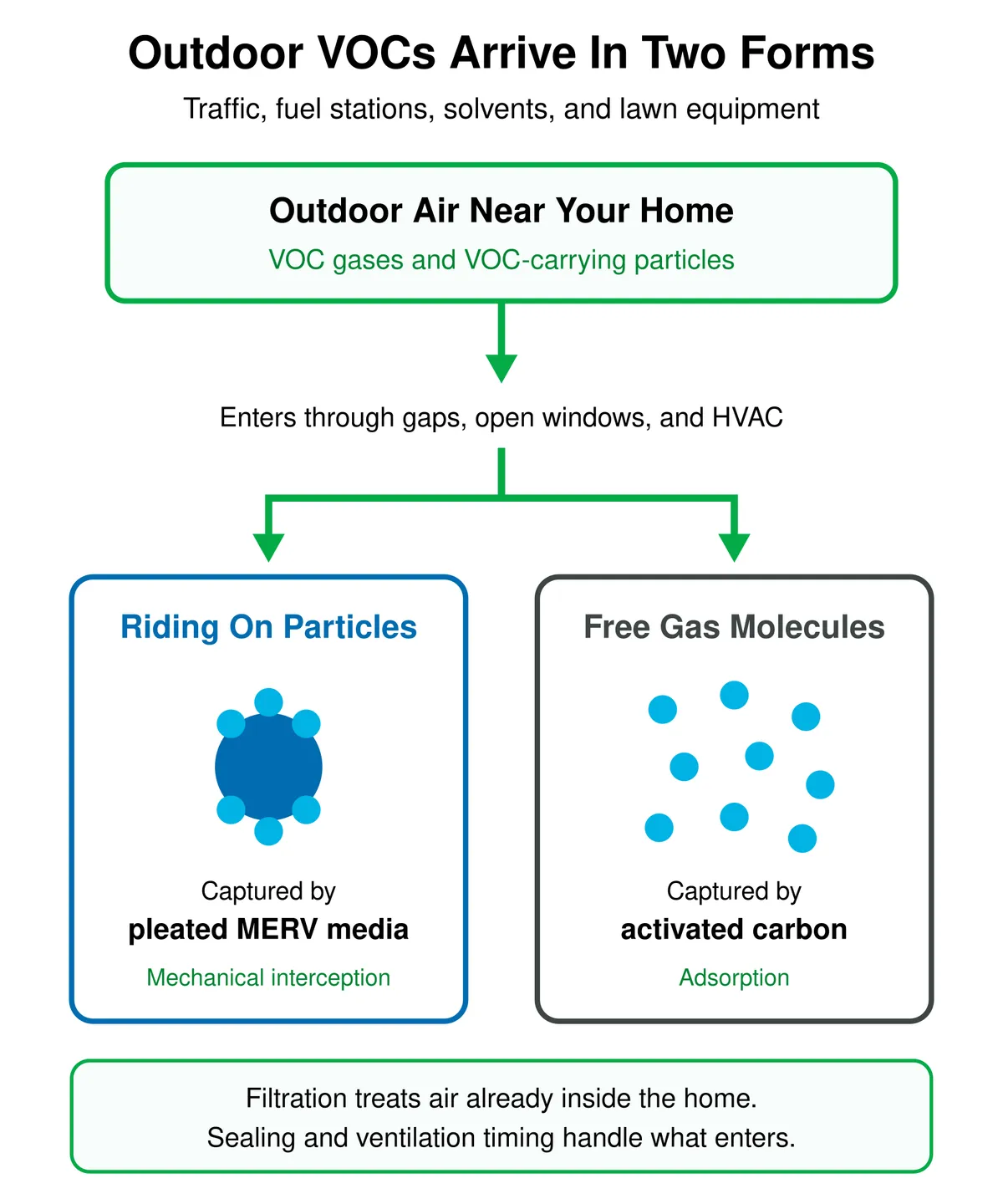
Outdoor VOCs come mostly from traffic exhaust, gas stations, industrial production, solvent-using businesses, and gas-powered lawn equipment, and they reach your rooms through envelope gaps, open windows, and mechanical systems such as outdoor air intakes and return ducts. They arrive in two states, and that split decides what a filter can do about them.
- Riding on particles. Pleated MERV media captures this share by mechanical interception.
- Free gas molecules. Activated carbon captures this share by adsorption.
The Air Quality Index reports five pollutants and VOCs are not among them, so a green reading tells you nothing about gases near your address. Take the quick match below and we will point you to the media that fits your home.
Answer a few quick questions and we will match you to your filter.
TL;DR
Outdoor volatile organic compounds reach your home from traffic exhaust, gasoline dispensing, solvent-using businesses, and gas-powered lawn equipment, entering through envelope gaps and mechanical systems. The U.S. Air Quality Index does not measure VOCs, so a favorable reading says nothing about gases near your address. Pleated media captures the share riding on particles, and activated carbon adsorbs the gas-phase share.
Key Takeaways
Motor vehicle exhaust and gasoline vapors are the most widespread outdoor VOC sources in residential areas, with benzene as the marker compound.
The Air Quality Index reports ozone, particle pollution, carbon monoxide, sulfur dioxide, and nitrogen dioxide. VOCs appear nowhere in it.
VOCs travel both as free gases and adsorbed onto particles, which makes filter performance against them partial rather than all or nothing.
Concentrations climb during weekday commutes and warm afternoons, so ventilation timing matters more than ventilation volume.
Which Outdoor Sources Release VOCs Near Your Home
Five source categories account for most outdoor VOCs in residential areas. These are motor vehicle exhaust, gasoline dispensing and storage, industrial production, solvent-using businesses such as dry cleaners and auto body shops, and gas-powered lawn equipment. The Environmental Protection Agency regulates these emissions chiefly because the compounds form ground-level ozone with nitrogen oxides in sunlight, not because of inhalation risk. A compound can therefore sit on the EPA exemption list and still matter once it crosses your threshold, as methylene chloride and perchloroethylene both do.
Proximity is stated qualitatively. Distances vary with wind speed, wind direction, terrain, and building layout.
Roadway pollutant concentrations run highest on or just downwind of a road and generally fall to background levels within 500 to 600 feet, per EPA, a distance shifted by sound walls, buildings, terrain, and wind. The Agency for Toxic Substances and Disease Registry adds two sources homeowners rarely consider, naming landfills holding benzene and leaking underground fuel tanks whose vapors migrate into nearby buildings. Tree canopies release isoprene and terpenes on hot afternoons, so a leafy street can register biogenic VOCs with no industry nearby.
How To Find Out Which Sources Sit Near You
You can map the sources around your address from a laptop in about ten minutes. The Toxics Release Inventory, an EPA database that accepts a ZIP code, returns facilities reporting chemical releases and the quantities sent to air. Satellite and street imagery shows gas stations, dry cleaners, auto body shops, and rail corridors within a few blocks, and your nose fills the last gap, because the compounds that matter most at residential distances have low odor thresholds. The inventory guides decisions even for renters, since a solvent-using business on the block tells you which hours to keep windows shut and a rail corridor behind you tells you whether carbon media belongs in your system or in a portable unit for the bedrooms.
Why The Air Quality Index Never Reports VOCs
The Air Quality Index tracks five pollutants regulated under the Clean Air Act, and VOCs are not among them. The index covers ground-level ozone, particle pollution, carbon monoxide, sulfur dioxide, and nitrogen dioxide, so a green reading on your weather app says nothing about benzene near a busy intersection.
Ozone works as an indirect signal at best. Because VOCs and nitrogen oxides combine in sunlight, a high ozone reading suggests precursors were present upwind hours earlier, a relationship the American Lung Association describes plainly. It measures a product rather than the ingredients, and it lags in both time and place.
How Outdoor VOCs Move From The Street Into Your Rooms
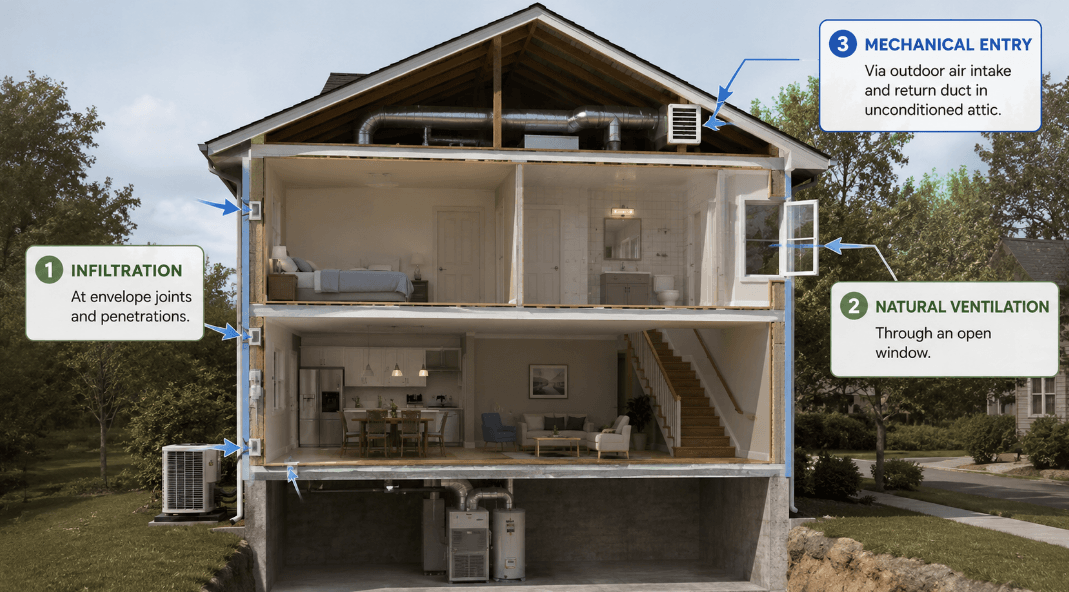
Outdoor gases follow the same three routes indoors that particles do, according to the Consumer Product Safety Commission: infiltration at joints and envelope penetrations, natural ventilation through open windows, and mechanical systems including outdoor air intakes and leaky return ducts. A pleated filter intercepts a particle mechanically, but a benzene molecule measures a fraction of a nanometer and passes through fiber media untouched. Sealing therefore does more against gas-phase infiltration than against particles, because cutting the volume of entering air is the only mechanical way to cut the gas load it carries. ENERGY STAR estimates the combined leaks in a typical envelope equal a window left open year-round. Our guide to how outdoor air quality events reach indoor spaces covers envelope leakage, duct pressure, and MERV selection during pollution events.
The homes where outdoor odors bother people most are rarely the draftiest on the street. They are the ones where return ductwork runs through an attic, a crawlspace, or an attached garage. A return under negative pressure draws in whatever surrounds it, and that one pathway can move more outdoor air than every window gap combined.
— David Clark, Licensed HVAC Technician
The Ozone Pathway That Creates VOCs Inside Your Home
Outdoor air is normally the major source of indoor ozone, according to Lawrence Berkeley National Laboratory researchers, and once inside it reacts with other VOCs, with semi-volatile compounds, and with materials such as carpeting to produce new VOCs and sub-micron particles. Indoor VOC levels can therefore rise on a high-ozone afternoon with no new source entering. Ozone-generating devices sold as air cleaners add to that chemistry.
What Your Filter Captures And What It Does Not
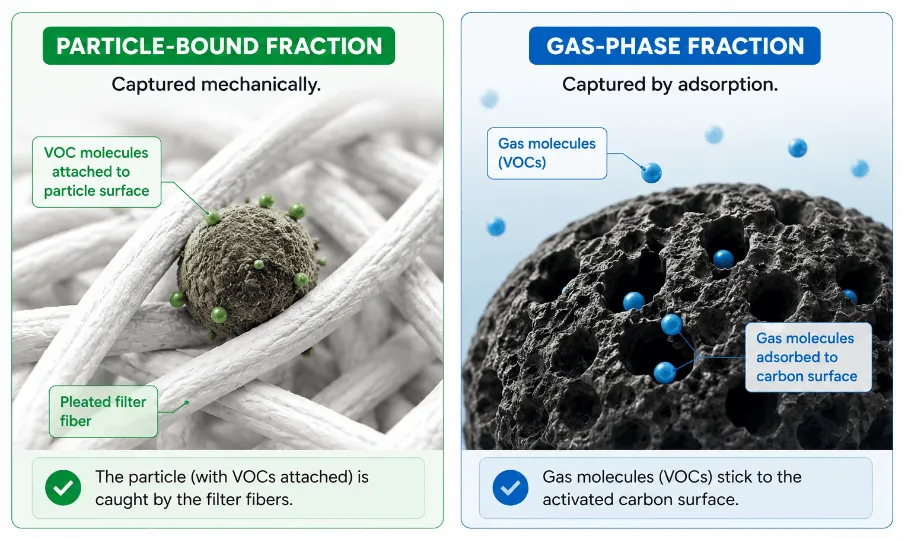
Filters capture the portion of VOCs attached to particles and leave the free gas-phase portion untouched. Berkeley Lab researchers note indoor VOCs are present partly as gaseous airborne chemicals and partly adsorbed onto airborne and settled particles, with semi-volatile compounds further toward the particle-bound end.
That split is where most published advice goes wrong. Saying filters remove VOCs oversells pleated media against a free gas molecule, and denying any benefit writes off the particle-bound fraction they do capture.
MERV 13 pleated filters intercept fine particles well, and every VOC molecule attached to one of those particles leaves the airstream with it, a process our explainer on what your filter does as air passes through it covers. Activated carbon captures the gas-phase fraction by adsorption, a surface process rather than a sieving one, and how adsorption works inside carbon media covers that mechanism. Our activated carbon Odor Eliminator filters pair carbon with pleated media, while carbon media, compared with traditional pleated filters, sets out when each earns its place.
Filterbuy guidance points carbon media at a narrower group than the wider market does, naming households near highways and industrial corridors alongside pet owners and smokers, because those homes carry a gas-phase load particulate media was not built to address.
Carbon pores holding gas molecules fill up, and once carbon saturates, odors return even though the filter still captures particles, so carbon needs replacing on a shorter cycle than pleated media.
Neither media type stops outdoor VOCs from entering, because filtration treats air already inside the home, which is why source proximity, sealing, and ventilation timing carry equal weight. Filters set against portable purifiers help if you are weighing whole-home against room-level treatment, and custom filter sizes cover systems standard dimensions do not fit.
Filtration treats air already inside the home. Neither media type prevents outdoor VOCs from entering.
Timing Your Ventilation Around Outdoor VOC Peaks
Ventilate outside local emission peaks rather than at a fixed hour. Traffic compounds peak during weekday commutes, gasoline vapors rise with temperature so warm afternoons run worse than cool mornings at the same station, and biogenic terpenes peak on hot, sunny growing-season afternoons. Near a traffic corridor that means opening up in late morning and late evening, staying closed during commute peaks, and skipping hot, sunny middays when photochemistry and gasoline evaporation run fastest. Ventilation still beats no ventilation in most homes, because indoor sources usually dominate exposure, and on smoke or advisory days particle guidance overrides VOC timing. Our guide to reducing indoor VOC sources room by room covers paints, furnishings, and stored fuels.
On days with wildfire smoke or an air quality advisory, particle guidance overrides VOC timing.
After manufacturing filters for over a decade and serving more than two million households, we have learned that people judge their air by what they can smell. Gas-phase compounds from outside are the part nobody sees coming, and matching the media to the compound matters more than chasing a higher number.
— David Heacock, Founder and CEO, Filterbuy
Where To Start In Your Own Home
Run the source inventory first, because it costs nothing and shapes every decision after. If a traffic corridor, a fuel station, or a solvent-using business turns up within a few blocks, gas-phase media belongs in your plan alongside particulate filtration, not instead of it. Filterbuy manufactures its pleated and carbon filters in Talladega, Alabama, in more than six hundred sizes plus custom dimensions.
Essential Resources
U.S. Environmental Protection Agency. Explains the regulatory definition of VOCs, the ozone-formation basis for outdoor regulation, and the exemption list.
Source: Technical Overview of Volatile Organic Compounds
U.S. Consumer Product Safety Commission. Describes infiltration, natural ventilation, mechanical ventilation, and the air exchange rate.
Source: The Inside Story: A Guide to Indoor Air Quality
Lawrence Berkeley National Laboratory Indoor Air Quality Scientific Findings Resource Bank. Covers VOC classification, the gas and particle-bound distribution, and indoor ozone chemistry.
Source: Introduction to VOCs
Agency for Toxic Substances and Disease Registry. Details benzene sources in outdoor air, exposure routes, and carcinogenicity classification.
Source: Benzene ToxFAQs
AirNow. Lists the five pollutants the U.S. AQI covers and explains how forecasts are issued.
Source: Using the Air Quality Index
American Lung Association. Explains how nitrogen oxides and VOCs react in sunlight to form ground-level ozone and names the emission sources involved.
Source: Ozone And What Makes Air Unhealthy
ENERGY STAR. Quantifies envelope leakage in typical homes and prioritizes air sealing work.
Source: Why Seal and Insulate
Supporting Statistics
Outdoor VOC sources accounted for between 5 percent and 81 percent of total personal exposure depending on the specific compound, with 66 percent to 78 percent of total exposure occurring indoors, across 310 households measured.
Source: Determinants of Personal, Indoor and Outdoor VOC Concentrations, National Institutes of Health.
Volatile chemical products including coatings, adhesives, cleaning agents, and personal care products now account for roughly half of fossil fuel VOC emissions in industrialized cities, rivaling vehicles as an urban pollution source.
Source: NOAA Findings On Volatile Chemical Products And Urban Air Pollution, National Oceanic and Atmospheric Administration.
Eighty-eight percent of U.S. households use air conditioning, and two-thirds rely on central air conditioning or a central heat pump as their main cooling equipment, placing a filter in the airstream of most American homes.
Source: Residential Energy Consumption Survey Air Conditioning Results, U.S. Energy Information Administration.
Frequently Asked Questions
Glossary
Volatile organic compound (VOC): Any of thousands of carbon-containing chemicals present mainly as gases at room temperature, excluding carbon dioxide and monoxide.
Semi-volatile organic compound (SVOC): A heavier subgroup of VOCs, including plasticizers and flame retardants, residing largely on particles and surfaces.
Benzene: A colorless, fast-evaporating liquid in gasoline, vehicle exhaust, and tobacco smoke, classified by federal agencies as a known human carcinogen.
Air Quality Index (AQI): The 0 to 500 U.S. scale for ozone, particle pollution, carbon monoxide, sulfur dioxide, and nitrogen dioxide. VOCs are not reported.
Ground-level ozone: A gas formed when VOCs and nitrogen oxides react in sunlight, and why the EPA regulates outdoor VOC emissions.
Infiltration: Unintended entry of outdoor air through joints, cracks, and envelope openings.
Air exchange rate: The rate outdoor air replaces indoor air, in changes per hour.
Adsorption: Gas molecules adhering to a material's surface, as in activated carbon, rather than being intercepted physically.
Activated carbon: Carbon processed for extensive internal surface area, used to adsorb gases pleated media cannot capture.
MERV: Minimum Efficiency Reporting Value, the standard scale for particle capture. MERV says nothing about gas-phase capture.