
How Industrial Air Pollution Affects Neighborhoods and Your Home
August 19, 2026
By Michelle Wan | Reviewed by David Clark, Licensed HVAC Technician | Published August 19, 2026 | Updated August 19, 2026
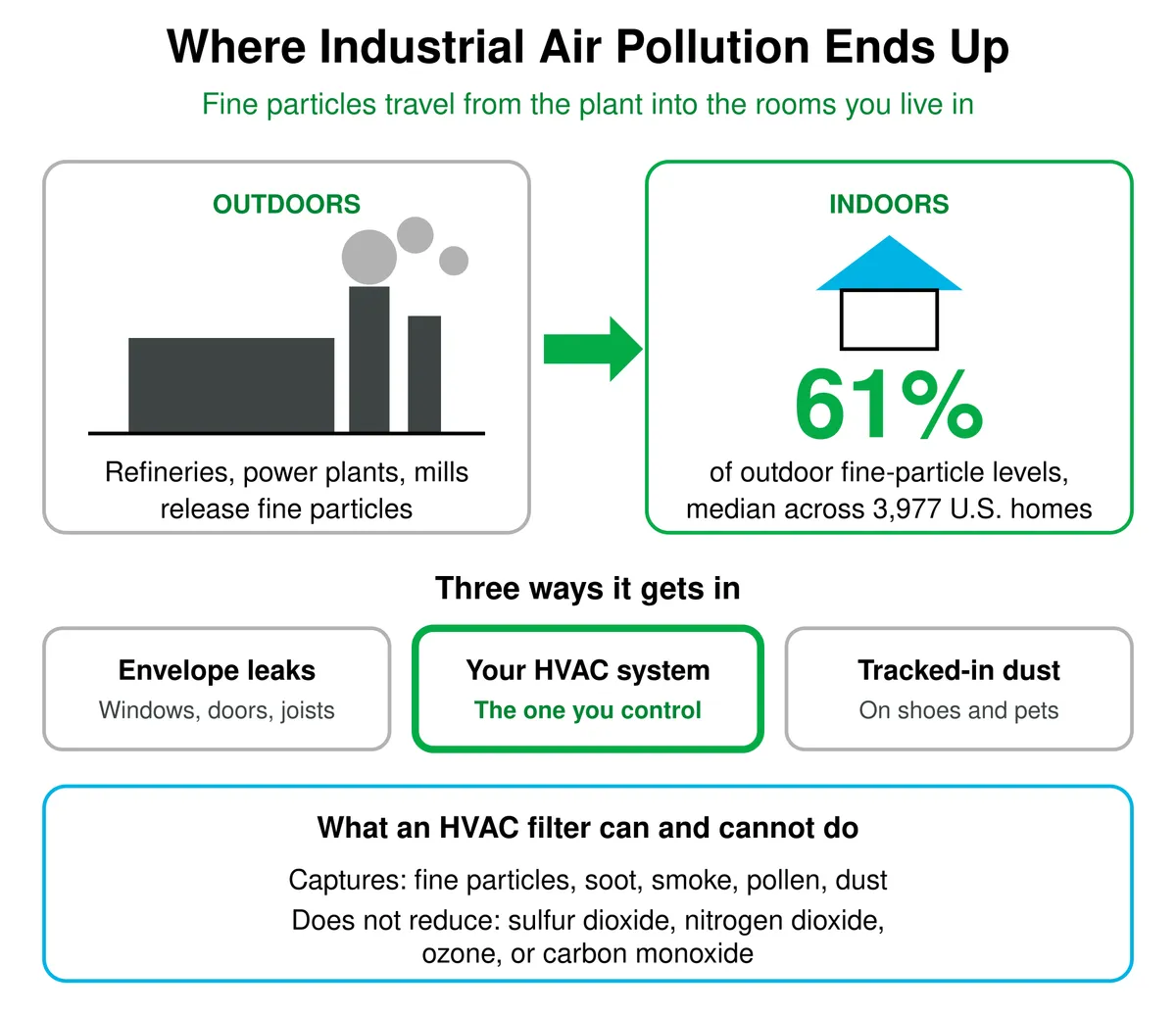
Refineries, power plants, and heavy manufacturing release fine particles that drift into surrounding neighborhoods and pass through your walls — across 3,977 U.S. homes, indoor fine-particle levels ran at a median of about 61% of outdoor levels. Wind direction often predicts what reaches a given house better than distance does.
You cannot change what a plant emits, but your HVAC filter is the one entry point you control. It captures particles — soot, smoke, pollen, and dust — and does not reduce gases like sulfur dioxide, nitrogen dioxide, ozone, or carbon monoxide.
Answer 3 quick questions and we'll match you to the right filter for your home.
Already know your size? Shop Filterbuy air filters →
TL;DR
Refineries, power plants, and heavy manufacturing release fine particles and gases that drift into surrounding neighborhoods, and they do not stop at your front door. Across nearly 4,000 U.S. homes, indoor fine-particle levels ran at roughly 61% of outdoor levels. You cannot change what a plant emits, but you can change how much of it stays in the air you breathe.
Key Takeaways
Fine particles travel farther than smells. Odor fades within a few hundred meters. PM2.5 carries kilometers downwind.
Wind direction matters as much as distance. Being downwind of a facility can matter more than being close to it.
A MERV 13 filter is the residential benchmark. Both the EPA and ASHRAE point to it as the residential minimum for air quality.
Filters have real limits. They capture particles, but they do nothing for sulfur dioxide, nitrogen dioxide, ozone, carbon monoxide, or radon.
What Counts As Industrial Air Pollution?
Industrial air pollution is the mix of particles and gases from facilities that burn fuel or process chemicals at scale, from refineries and power plants to steel mills, kilns, and incinerators. They report releases to the U.S. EPA's Toxics Release Inventory, which covers more than 21,000 sites nationwide.
TRI air releases fell 32% between 2014 and 2023, driven largely by cuts at coal- and oil-fired utilities. That is real progress, and it still says nothing about the air on your block.
Common industrial pollutants
Source: U.S. EPA Toxics Release Inventory and National Ambient Air Quality Standards program.
PM2.5 is the one that most reliably ends up indoors. For how the sizes compare, see how PM10 and PM2.5 differ.
How Far Does Industrial Air Pollution Actually Travel?
Concentrations fall off with distance, but not evenly. The steepest gradients appear within roughly 100 to 400 meters, though effects show up several kilometers out. Direction matters as much as proximity. One pilot study found that residents living downwind of a South Los Angeles oil and gas site, within 200 meters, had markedly lower lung-function readings than those upwind and farther out.
Our read: distance is the number homeowners fixate on, but direction better predicts what reaches a given house. Before counting the miles, find out which way the wind usually blows off the plant.
How Industrial Pollution Gets Into Your Home
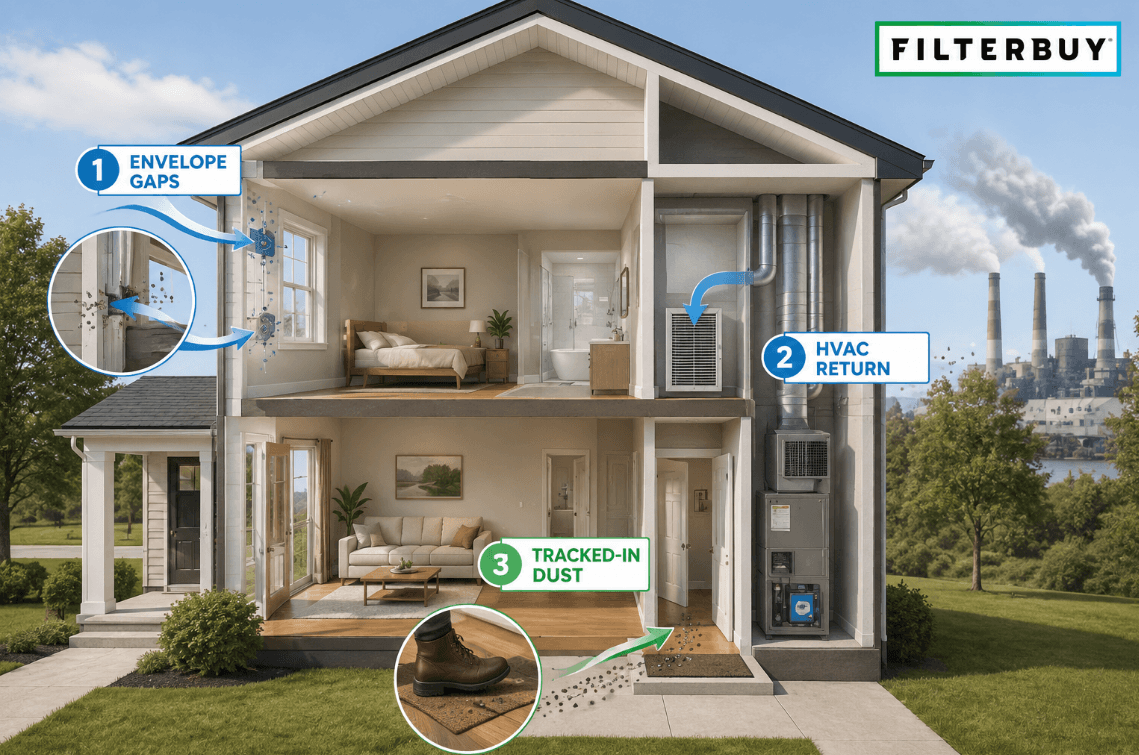
Outdoor particles get in through envelope leakage, open windows, and any HVAC system pulling in outside air. Researchers call this the infiltration factor, the share of outdoor PM2.5 that makes it inside and stays suspended. In residential studies it lands between 0.35 and 0.71.
A PNAS study covering 3,977 U.S. residences found indoor levels below outdoor levels in 92% of homes, median ratio 0.61.
Three pathways do most of the work:
Envelope leakage: outdoor air seeps in around windows, doors, and rim joists, and leakier homes let in more.
Your HVAC system: every cycle pulls household air across the filter, a liability with a cheap one and an asset with a good one.
Tracked-in dust: settled particles and metals ride indoors on shoes and pets.
The second pathway is the one you control. Your blower already moves the home's entire air volume through a single point several times an hour, so what sits there decides what stays airborne.
What Health Effects Are Linked To Living Near Industrial Facilities?
A 2025 evidence map covering 54 studies of communities near petroleum refineries, spanning 1977 to 2024 across 15 regions, linked proximity to higher risks of leukemia, asthma, bronchitis, respiratory symptoms, and greater healthcare use. Thirteen showed dose-response relationships with proximity or length of residence.
A meta-analysis of residents near petrochemical complexes found higher odds of cough (OR 1.35), wheezing (OR 1.28), and bronchitis (OR 1.26).
Two caveats belong with those numbers. They describe populations, not households, and proximity studies struggle to separate industrial emissions from the highways and rail lines usually alongside them. For specific concerns, see your physician, not a filter company.
That burden falls unevenly. Our review of unequal air pollution exposure across U.S. neighborhoods maps where industrial siting and housing policy overlap.
How To Find Out What's Actually Near You
Three free public tools answer that in about ten minutes.
EPA TRI Toxics Tracker: enter your address and it maps every TRI-reporting facility within 10 miles, with what each releases to air.
EPA Benzene Fenceline Monitoring Dashboard: if a refinery is nearby, this shows the benzene readings around its perimeter. Refineries must investigate and act above EPA's 9 µg/m³ action level. The fine print matters: EPA is explicit that this is not an ambient air standard, and the monitors can catch benzene drifting from nearby roads.
AirNow.gov: current conditions from EPA monitors. Pair it with the Filterbuy live AQI and smoke map and you can watch how your area trends across a season rather than a single day.
One regulatory detail shapes all of this. EPA set the annual PM2.5 health standard at 9.0 µg/m³ in February 2024, down from 12.0, and that revision is under reconsideration and litigation. Confirm its status before leaning on it. See our explainer on EPA NAAQS and what the federal standards cover for the background.
If Something Is Happening Right Now
Everything above deals with chronic exposure. A flare, an upset, or a sudden chemical smell is different, and so is the advice.
Treat symptoms as an emergency. If anyone at home has trouble breathing, chest tightness, or confusion, call 911 first.
Close up and recirculate. Shut windows and doors, close the outdoor-air damper, and set the fan to ON.
Write it down. Note the time, duration, wind direction, and smell. Dated notes are what agencies act on.
Report it. Non-emergency: use EPA's Report Environmental Violations form. For an immediate threat, EPA says to call 911 and then the National Response Center at 1-800-424-8802.
Check the record. The ECHO air facility search shows a plant's Clean Air Act compliance history quarter by quarter.
We sell filters, and we would still rather you file the report. A filter changes what is in your air tonight. A documented complaint is what changes what comes out of the stack.
What An HVAC Filter Can And Cannot Capture
An HVAC filter reduces particles: PM2.5, soot, smoke, pollen, and metal-bearing dust. It does nothing for sulfur dioxide, nitrogen dioxide, ozone, carbon monoxide, or radon, and only partly handles VOCs. This is the part most content oversells, so here is the version we give our customers.
Can a filter catch this?
MERV ratings measure particle capture only. Gases require carbon media, source control, or dedicated detection.
MERV rates how well a filter captures particles between 0.3 and 10 micrometers under ASHRAE Standard 52.2. If you are picking one for the first time, start with how MERV ratings work.
EPA's Guide to Air Cleaners in the Home states that MERV 13 and above must show at least 50% removal efficiency for the smallest particles tested, and advises going that high or higher if your system allows. It is blunt about the limit, too: most filters capture either particles or gases, not both.
“The pattern we hear from homeowners near industrial corridors is that they want one product to solve the whole problem. It does not work that way. Particles, gases, and carbon monoxide are three separate jobs, and only the first one belongs to a filter. Getting that straight is what actually changes someone’s indoor air.”
Michelle Wan, Brand Manager and Air Quality Writer, Filterbuy
Five Steps To Reduce Indoor Exposure If You Live Near Industrial Sources
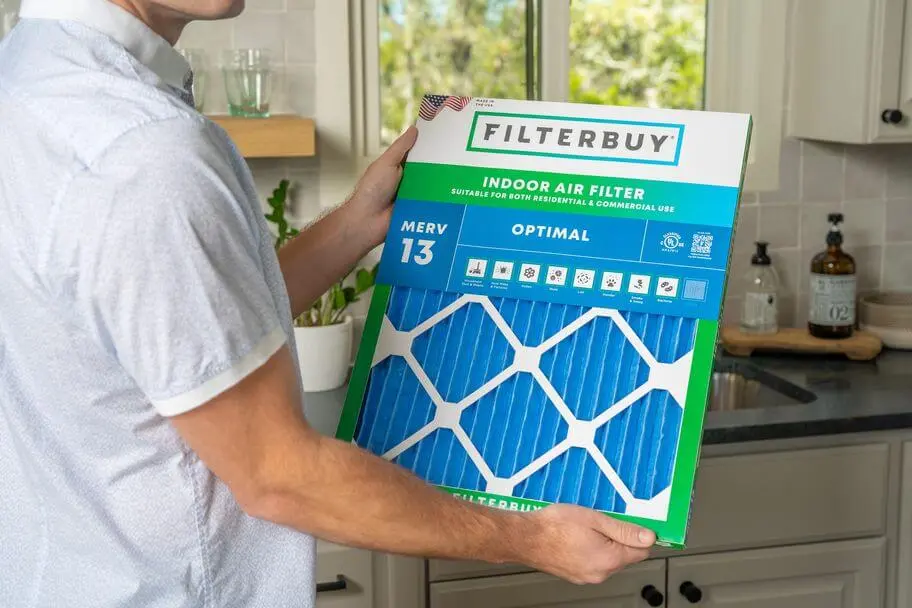
Move to MERV 13 if your system allows it. The single highest-leverage change you can make. Browse Filterbuy MERV 13 air filters by size, and confirm your airflow tolerance before switching.
Change it more often than the label says. Homes near heavy industry load filters faster than a standard schedule assumes. See how often to change your HVAC filter and consider air filter auto-delivery so it never slips.
Recirculate on bad-air days. Close the windows and dampers and run the fan continuously.
Add activated carbon if odors or VOCs are your problem. Particle filters do nothing for gases. Filterbuy Odor Eliminator carbon filters adsorb odors and some VOCs, though carbon has finite capacity, so replace them on schedule.
Layer a portable HEPA unit in the bedroom, where you breathe for more hours at a stretch than anywhere else. See how a portable air purifier compares to your HVAC filter.
Supporting Statistics
130 U.S. petroleum refineries were operating on January 1, 2026.
Why it matters: federal fenceline benzene monitoring covers every one.
Source: U.S. EIA, Refinery Capacity FAQ (January 2026)
109 million Americans lived in counties above a national air quality standard in 2024.
Why it matters: roughly one in three people. This is the outdoor baseline that gets indoors.
Source: U.S. EPA, Air Quality National Summary (February 2026)
75.9 million people breathe year-round particle pollution above the annual standard.
Where: 84 counties across 21 states.
Why it matters: these averages peak near highways, oil and gas extraction, power generation, and industry.
Source: American Lung Association, State of the Air 2026 (April 2026)
Frequently Asked Questions
How far from a factory is safe to live?
There is no single safe distance. Gradients are steepest within about 100 to 400 meters, but studies have found effects out at 5 kilometers. Wind direction, facility type, and local terrain all shift the answer for a given address.
Can I smell industrial air pollution?
Sometimes, though odor is an unreliable guide. PM2.5 and NO₂ are effectively odorless at ambient levels, while some of the strongest smells come from compounds present in tiny amounts.
Does closing my windows solve the problem?
It helps, but it does not seal the house. Outdoor particles still enter through envelope leakage, so closing up works best paired with continuous filtered circulation rather than on its own.
What if I rent and cannot change the filter?
You still have options. Ask the property manager which MERV rating the building uses and whether a higher one is possible at the next change. In the meantime, a portable air cleaner sized for the room you sleep in works independently of the building system.
Will an air purifier work better than my HVAC filter?
They do different jobs. A portable purifier cleans one room quickly, while your HVAC filter treats the whole house on every cycle. Near an industrial source, the strongest setup is both.
Glossary
PM2.5: Fine particulate matter 2.5 micrometers or smaller, fine enough to penetrate buildings and reach deep lung tissue.
MERV (Minimum Efficiency Reporting Value): A 1–16 scale rating how well a filter captures particles from 0.3 to 10 micrometers.
Infiltration factor: The share of outdoor particulate matter that gets inside and stays suspended.
Fenceline monitoring: Air sampling at a facility's property boundary. U.S. refineries must monitor perimeter benzene and act above 9 µg/m³.
NAAQS (National Ambient Air Quality Standards): EPA's outdoor air limits for six criteria pollutants, PM2.5 among them.
VOCs (Volatile Organic Compounds): Carbon-based gases that evaporate at room temperature. Benzene is one.
Filterbuy: A U.S. air filter manufacturer in Talladega, Alabama, making pleated MERV 8, 11, 13, and carbon filters in 600-plus sizes. Publisher of this guide.
About This Guide
Written by Michelle Wan for Filterbuy and reviewed for technical accuracy by David Clark, a licensed HVAC technician. Published and last updated August 19, 2026. Every statistic comes from peer-reviewed research or a federal dataset, linked at the claim and listed below. No figure here is Filterbuy proprietary data.
Sources
U.S. EPA, National Ambient Air Quality Standards (NAAQS) for PM
AirNow.gov, current air quality conditions
PNAS, Residential PM2.5 concentrations and infiltration factors across 3,977 U.S. homes
Environmental Research, Distance decay gradients around oil and gas facilities in Los Angeles
Health Effects of Living Near Petroleum and Biofuel Refineries: systematic evidence map (2025)
This article is for general education and is not medical advice. If you have health concerns related to air quality where you live, talk with a licensed physician.