
The Exceptional Events Rule: Why Some Smoke Days Don't Count
September 24, 2026
What Is the Exceptional Events Rule for Wildfire Smoke?
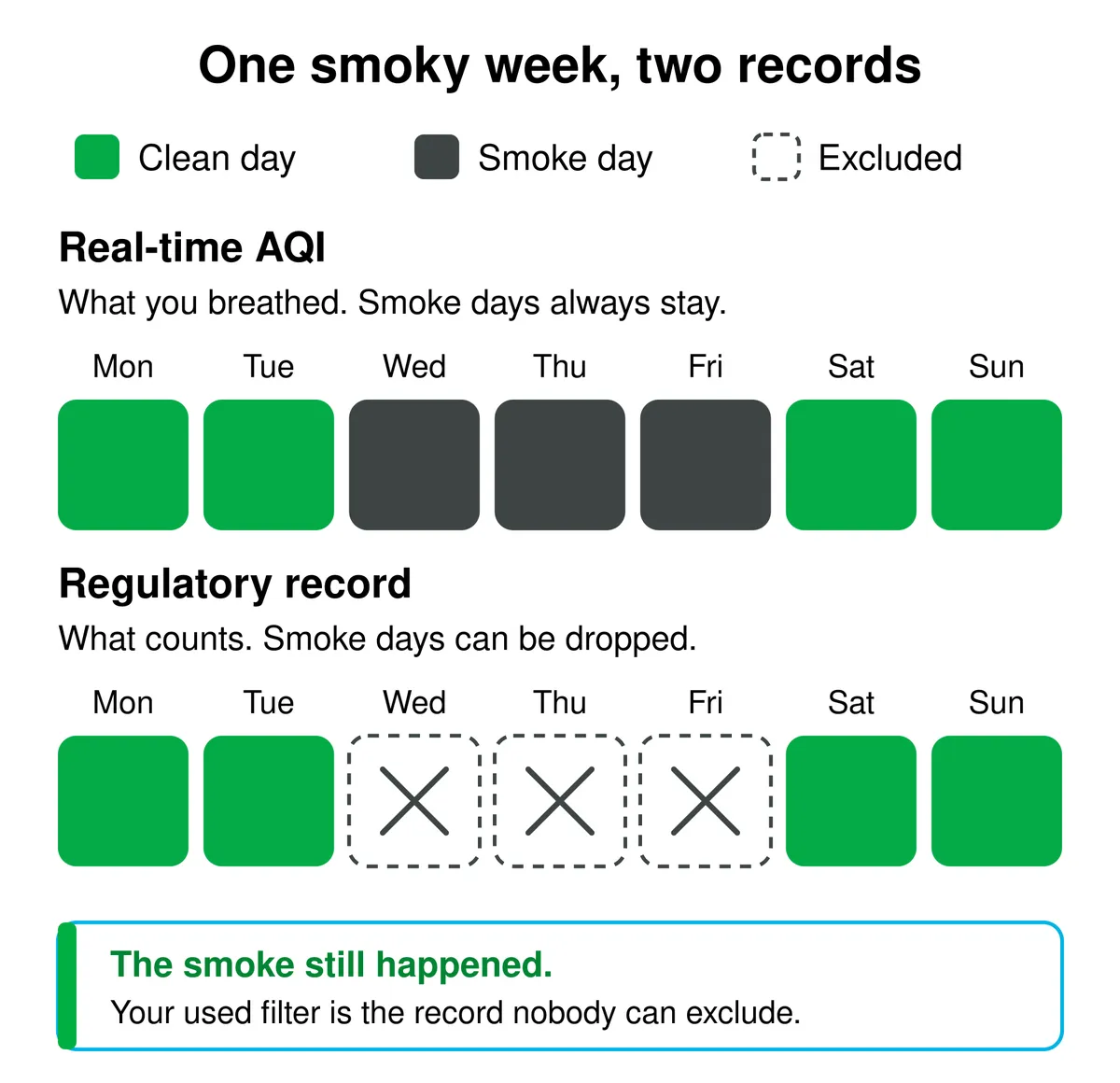
The Exceptional Events Rule is an EPA regulation that lets state, local, and Tribal air agencies ask the EPA to set aside wildfire-influenced air quality data when judging Clean Air Act compliance. Approved smoke days drop out of the official record, but real-time AQI readings stay as measured.
Exclusion is never automatic. It takes a formal demonstration, public comment, and EPA approval.
An excluded smoke day still happened, so the air inside your home is still yours to manage. Take the quick quiz below to find the right filter for your home.
Answer a few quick questions and we'll match you to the right filter for your home.
Already know your size? Shop Filterbuy air filters, made in the U.S. in standard and custom sizes.
TL;DR
The Exceptional Events Rule is an EPA regulation that lets state, local, and Tribal air agencies ask the EPA to set aside wildfire air quality data when it judges Clean Air Act compliance. Filterbuy, a U.S. air filter manufacturer, sees it this way: an excluded smoke day still happened and still reached people's lungs. Those days just don't count on the official record, which leaves the air inside your home in your hands.
Key Takeaways
The Exceptional Events Rule (40 CFR 50.14) lets air agencies exclude event-influenced monitor data from certain NAAQS decisions.
Exclusion is never automatic; it takes a formal demonstration, public comment, and EPA concurrence.
Excluded days leave the regulatory record, but real-time AQI readings stay as measured.
The EPA and Congress are both working on changes to the rule in 2026.
Why an Air Filter Maker Tracks This Rule
Filterbuy has manufactured air filters in the U.S. since 2013 and shipped millions into homes across the wildfire-prone West, from factories in Alabama, Florida, Pennsylvania, and Utah. Every fire season we see people treat the smoke smell as the problem when it's a sign the cleanup isn't finished. The Exceptional Events Rule creates a similar blind spot on paper. A smoke day can drop out of the compliance record and still show up in the pleats of an HVAC filter, which makes a used filter the one air quality record in a home that nobody can exclude.
What Is the Exceptional Events Rule?
EPA's Exceptional Events Rule is the regulation, authorized by Section 319(b) of the Clean Air Act, that decides when readings shaped by unusual or natural events, such as wildfires, can be left out of some National Ambient Air Quality Standards (NAAQS) decisions. When smoke is the cause, the process is often called wildfire data exclusion.
Congress added EPA exceptional events policy to the law in 2005, and the 2016 revisions to the Exceptional Events Rule cover every NAAQS. For background, see Filterbuy's guide to EPA air quality standards (NAAQS) explained.
Why Do Some Smoke Days Not Count Toward Compliance?
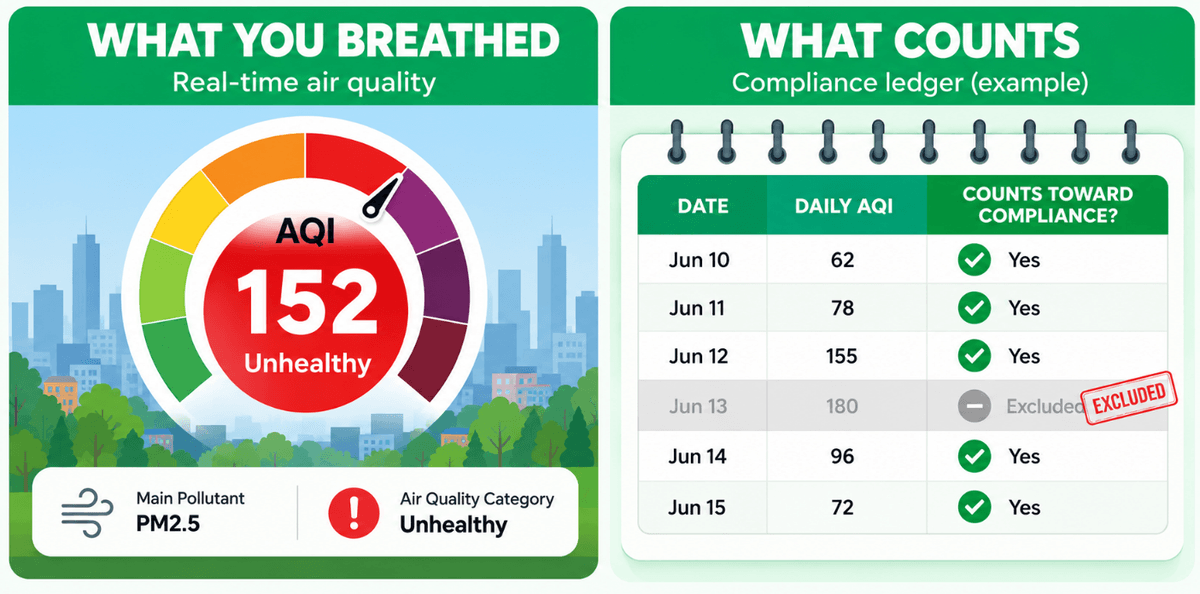
The EPA measures NAAQS compliance with a "design value," a statistic built from several years of monitor readings. Approved exceptional-event days come out before that number is calculated, so a county can meet the standard on paper even after days of heavy smoke. The result is two records of the same air:
Excluded readings stay in the EPA's Air Quality System, flagged; only the design value drops them.
Hence Filterbuy's rule of thumb: lean on the real-time record for health decisions, and leave the regulatory record to policy debates.
How often does the rule get used? A 2023 investigation by The California Newsroom, MuckRock and the Guardian tallied it:
Source: The California Newsroom, MuckRock and the Guardian (October 2023), covering 2016 to mid-2023. Not an official EPA tally.
What Qualifies as an Exceptional Event?
A wildfire burning on wildland counts as a natural event, and prescribed fires are eligible too. Stagnant air, inversions, heat, drought, and permit violations never qualify, and the EPA only steps in when an exclusion would change a regulatory decision. Beyond that, an air agency has to show the EPA four things:
A clear causal link between the event and the exceedance, backed by historical data
Not reasonably controllable or preventable
A natural event, or human activity unlikely to recur there
Procedural steps met, including flagging and public comment
How Does a State Exclude Wildfire Smoke Data?
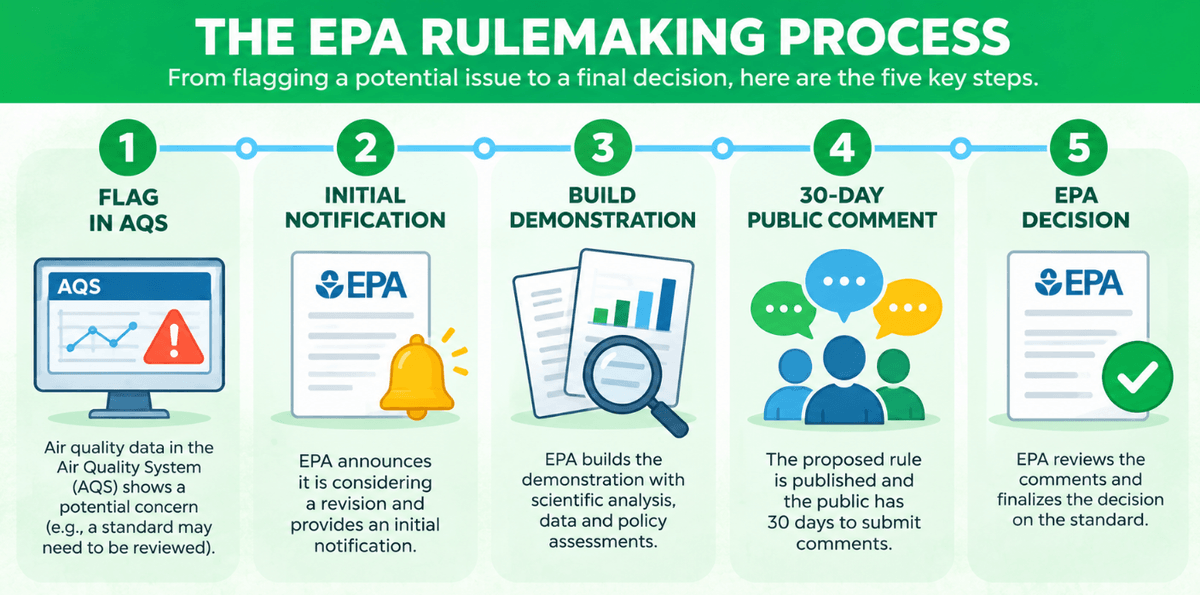
A state wins an air quality data exclusion by filing an evidence package, known as an exceptional events demonstration, and earning EPA approval. The EPA aims to answer a state's initial notice within 60 days and decide within 12 months, so the process can run a year or more.
Flag the data. Affected readings get a "Request Exclusion" code in the EPA's Air Quality System (AQS), the only flag the EPA can act on.
Consult the EPA regional office on what evidence it needs.
Build the demonstration, usually by pairing satellite smoke imagery with air-mass trajectories. Borderline events need more proof.
Open a 30-day public comment period.
Wait for the EPA's decision. Only approved data drop out of the design value.
A real example. In February 2025, North Carolina's Division of Air Quality submitted a demonstration for two monitors in Mecklenburg and Davidson counties. Both sat at a design value of 9.2 µg/m³, just over the 9.0 standard, after four multi-day bursts of Canadian smoke in June and July 2023. Without that smoke, the state said, none of its monitors would have exceeded it.
Why Is the Exceptional Events Rule Contested?
State air agencies argue that excluding smoke days protects communities from penalties for fires they can't control. Aaron Szabo, who leads the EPA's Office of Air and Radiation, has pointed to states' "frustrations with being penalized for emissions that are out of their control."
Researchers see a cost. A team at Resources for the Future, a Washington, D.C., think tank, argued that smoke is driving a growing divergence between actual and regulatory air quality. The RFF team also reports that prescribed burns are rarely nominated for exclusion.
Where Filterbuy lands: we take no side on the rule itself, but we advise filtering through every smoke day, whether or not it ends up counting.
What Is Changing in 2026?
No final revision had been published as of September 23, 2026, but the rule is moving. The EPA ordered a rewrite it expects to finish in 2026, released new tools, and faces an Inspector General audit. The House passed H.R. 6387, and S. 5045 cleared committee unanimously. A D.C. Circuit ruling keeping the 9.0 µg/m³ standard raises the stakes.
Status as of September 23, 2026.
What Does This Mean for Your City's Official Record and Your Home?
An "attainment" label describes legal standing; it can't tell you whether it's safe to open the windows today. At Filterbuy, we're air obsessed, so we point homeowners to the real-time record, and Filterbuy's guide to wildfire smoke and the AQI explains each level.
When smoke rolls in, four steps protect your home:
Check live conditions on the AirNow Fire and Smoke Map or Filterbuy's live wildfire and smoke map, plus how to read one.
Seal up and recirculate by closing windows and doors and switching your thermostat fan from "Auto" to "On."
Upgrade your filter. EPA recommends a MERV 13 or higher filter during smoke if your system can handle it. Filterbuy makes MERV 8, 11, and 13 filters in standard and custom sizes, so an upgrade fits the existing slot. See the best MERV filter for wildfire smoke and what MERV rating to use for high AQI.
Check and change filters often. Smoke loads a filter fast, so look at it every few days and swap it once it turns gray or smells smoky. When the air clears, follow Filterbuy's guide to cleaning the air in your house after wildfire smoke.
Filterbuy's Michelle Wan put it this way in our MERV 8 vs. MERV 11 guide: "The question we get most is whether MERV 13 will hurt the system. In a modern home, almost never. What actually hurts systems is the filter nobody remembered to change."
Shop Filterbuy MERV 13 filters for smoke protection
How to Check Whether Smoke Days Were Excluded Where You Live
No public list shows every smoke day dropped from your county's record; even the EPA's submissions table says it isn't complete. The goal is to compare your county's two records. The Filterbuy team built a five-step check from free public tools:
See the full count. Enter your ZIP code in the American Lung Association's State of the Air report card, which counts excluded days.
Look up a specific date on the historical AirNow Fire and Smoke Map.
Find the paperwork by searching your state air agency's site for "exceptional events demonstration."
Weigh in during the 30-day comment period. North Carolina's ran from November 20 to December 20, 2024.
Keep your own record. Filterbuy already recommends writing the install date on your filter frame, so note each smoke day too. A filter that turns gray after one smoky week documents the exposure.
Supporting Statistics
145 million Americans lived where fine particles reached Unhealthy or worse on the AQI at least once in 2022–2024, per the American Lung Association's "State of the Air" 2026, which counts excluded smoke days.
More than 43% of U.S. primary PM2.5 emissions come from wildfires and prescribed fires, per EPA's wildland fire tiering guidance.
Americans spend about 90% of their time indoors, and EPA research confirms wildfire smoke gets in.
Frequently Asked Questions
Does the Exceptional Events Rule change AQI readings?
No. AirNow still shows what monitors measured. Exclusion only changes the design values the EPA uses to judge NAAQS compliance.
Can a state exclude any bad air day?
No. The state has to prove the event drove the exceedance and was beyond its reasonable control, and routine pollution never qualifies.
Does smoke from Canadian wildfires qualify?
Yes. North Carolina's 2025 demonstration centered on Canadian wildfire smoke from 2023. See our guide to Canadian wildfire smoke in the U.S.
Are prescribed burns covered?
Yes, though the process is demanding, and the EPA rewrite and S. 5045 both aim to simplify it.
How can I tell if smoke days were excluded where I live?
Start with the Lung Association's ZIP-code report card, then search your state air agency's site for exceptional events demonstrations, as the check above explains.
Glossary
Sources
EPA, Treatment of Air Quality Monitoring Data Influenced by Exceptional Events
Federal Register, Treatment of Data Influenced by Exceptional Events (81 FR 68216, 2016)
EPA, PM2.5 Wildland Fire Exceptional Events Tiering Document (2024)
EPA Office of Inspector General audit notification, March 2026
Krupnick et al., Environmental Science & Technology (2025), via Resources for the Future
The California Newsroom, MuckRock and the Guardian, via CapRadio (2023)
Sen. Merkley press release on EPW committee passage, September 16, 2026
Harvard Environmental and Energy Law Program on the PM2.5 ruling
EPA, Exceptional Events Submissions Table (2016 Rule)
American Lung Association, State of the Air (ZIP code report cards)