
Air Quality Rules for Outdoor Workers: State Thresholds and Requirements
September 22, 2026
What Air Quality Rules Protect Outdoor Workers?
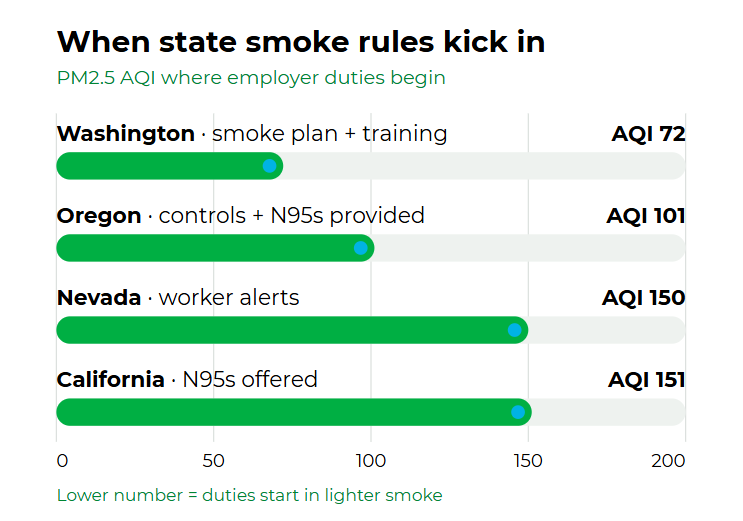
There is no federal wildfire smoke standard, so four states set their own rules for outdoor work. Each one starts at a different AQI for fine particles (PM2.5):
Washington: smoke plan and training at AQI 72 (20.5 µg/m³).
Oregon: controls and N95s at AQI 101 (35.5 µg/m³).
Nevada: worker alerts at AQI 150.
California: N95s offered at AQI 151 (55.5 µg/m³).
Closed, filtered buildings are exempt, but no state sets a minimum filter rating. For job trailers and break rooms, the EPA recommends MERV 13, which captures microscopic particles.
Answer 3 quick questions and we'll match you to the right filter.
TL;DR
There is no federal wildfire smoke standard, so the rules come from the states. California, Oregon, and Washington require training and N95s once fine-particle pollution (PM2.5) passes a set level, and Nevada's law took effect January 1, 2026. Mandatory respirator use starts only in very heavy smoke. Closed indoor spaces are generally exempt, though no state says how well their filters must work. Once the AQI tops 100, Filterbuy recommends MERV 13 in any HVAC system, plus a HEPA air purifier in each room. MERV 13 is the rating EPA recommends for smoke events.
Key Takeaways
California's standard kicks in at a PM2.5 AQI of 151, when employers must offer N95s for voluntary use.
Oregon's rule starts at 35.5 µg/m³ of PM2.5 (AQI 101) and makes N95-type respirators mandatory at 200.9 µg/m³.
Washington acts earliest, requiring a written smoke plan and worker training before exposure reaches 20.5 µg/m³ (AQI 72).
Nevada requires alerts to outdoor workers at a smoke AQI of 150, with detailed rules pending.
The filtered-air gap: California, Oregon, and Washington exempt closed buildings and vehicles, yet none sets a minimum filter rating, so the filter decides how much smoke indoor air still carries.
Which States Have Air Quality Rules for Outdoor Workers?
Four states regulate outdoor work in wildfire smoke: California, Oregon, Washington, and Nevada. The U.S. Occupational Safety and Health Administration (federal OSHA) has no enforceable smoke standard, so employers elsewhere answer to its General Duty Clause. If they require respirators, OSHA's respiratory protection standard (29 CFR 1910.134) applies as well.
Every state rule is built around PM2.5, the fine particles in wildfire smoke, measured by the EPA's Air Quality Index (AQI) or in micrograms per cubic meter (µg/m³).
As a U.S. filter maker, Filterbuy also asks: how much smoke does the filtered air behind the indoor exemption actually catch?
What AQI Levels Trigger Employer Requirements?
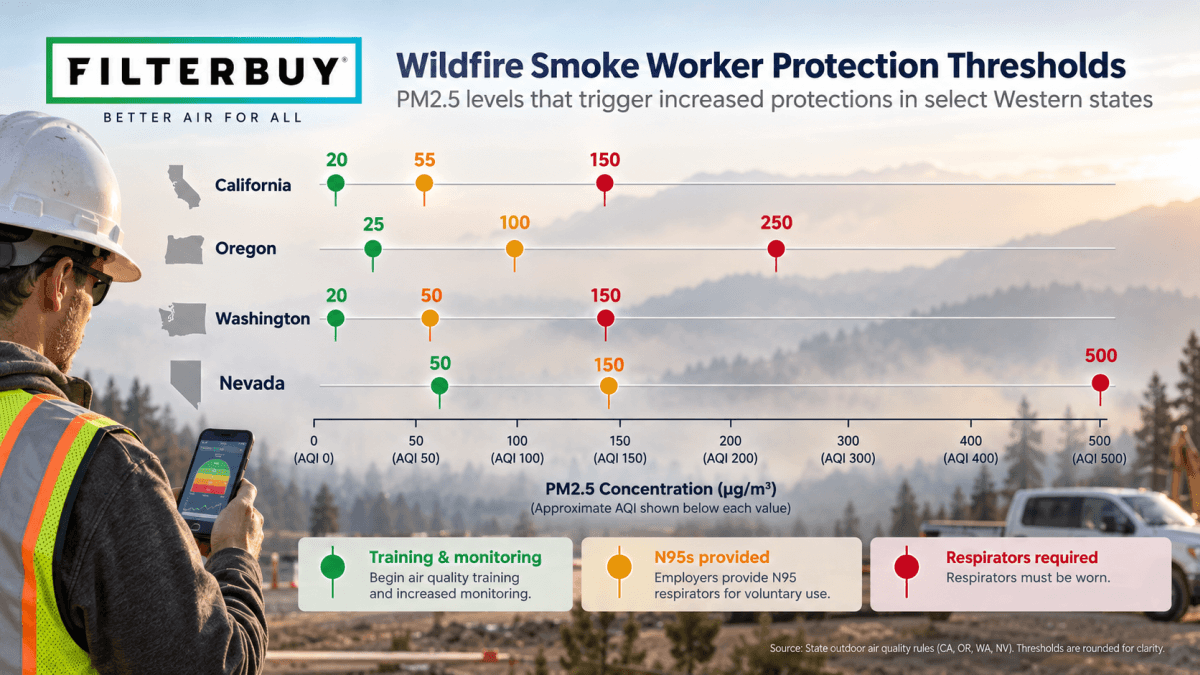
This crosswalk lines up every state's triggers in PM2.5 concentration and AQI.
*Printed as AQI 251 in Oregon's rule (pre-2024 AQI scale); the µg/m³ value governs. Full respiratory programs with medical evaluations and fit testing apply above AQI 500 in California and at 500.4 µg/m³ in Oregon and Washington. Nevada values come from January 2026 draft regulations. Filterbuy checked every value against current agency rule text on September 21, 2026.
California's first trigger, 55.5 µg/m³, is about 2.7 times Washington's 20.5 µg/m³, so one smoky morning can trigger duties in Washington but not California.
Compare by µg/m³, not AQI. The EPA revised its PM2.5 AQI breakpoints in May 2024, and Oregon's rule still prints the older values. See what a Hazardous AQI reading means.
What to Do When the AQI Is Over 100
Start with official guidance. Check AirNow and your local air agency, and follow any stay-inside or evacuation orders. Filterbuy's action line is any AQI over 100, where the Unhealthy for Sensitive Groups category begins. We then recommend:
If the building has an HVAC system, switch to an EPA-recommended MERV 13 filter. EPA notes most systems handle it when the filter is replaced often.
Set the thermostat fan to On, so the system filters continuously instead of only while heating or cooling.
Run a HEPA air purifier in each room, bedrooms first. EPA's sizing rule is a smoke CADR of at least two-thirds of the room's square footage, so a 300 sq ft bedroom needs about 200. Skip ozone-producing purifiers, which EPA advises against.
Close up the building and avoid candles, frying, smoking, or vacuuming without a sealed unit.
No HVAC system? HEPA air purifiers in each room are your main defense, not a backup.
What Does Cal/OSHA's Wildfire Smoke Standard Require?
California's Protection from Wildfire Smoke standard (Title 8, Section 5141.1) applies once the current AQI for PM2.5 reaches 151 and smoke exposure is expected. Cal/OSHA then requires employers to:
Check the AQI for PM2.5 at the start of each shift and periodically after that.
Tell workers the AQI and protections available, and let them report symptoms without reprisal.
Train employees on the standard's Appendix B.
Use engineering controls first, such as filtered enclosures or vehicles, then move or reschedule work.
Provide NIOSH-approved respirators, such as N95s, for voluntary use, and encourage workers to wear them.
Filtered, closed buildings and vehicles are exempt. The rule also skips wildland firefighters and anyone exposed for an hour or less per shift. Cal/OSHA posted draft revisions to the standard in May 2025, but until they're adopted, the AQI 151 trigger stands.
How Do Oregon's and Washington's Rules Differ?
Oregon OSHA's rule (OAR 437-002-1081) has been in effect since July 2022, starts at 35.5 µg/m³ (AQI 101), and names portable HEPA purifiers as an acceptable control. At 200.9 µg/m³, N95-type respirators become mandatory, though a simplified Appendix A program can replace medical evaluations and fit tests up to 500.4 µg/m³.
Washington's Department of Labor & Industries (L&I) rule took effect in January 2024 and starts at 20.5 µg/m³ (AQI 72), with a written smoke response plan and annual training required first. At 250.5 µg/m³, anyone with serious symptoms must be moved to clean air, such as a room with adequate HEPA filtration.
What Do Nevada's Law and Federal OSHA Require?
Nevada Senate Bill 260 took effect January 1, 2026. It requires employers with more than 10 employees to alert outdoor workers when the smoke AQI reaches 150. Mines and commercial trucking are excluded, as are emergency services. The Division of Industrial Relations (DIR) released draft regulations in January 2026 proposing voluntary N95s at AQI 150 and a halt to critical outdoor tasks at AQI 500. As of September 2026, they were not final.
Elsewhere, federal OSHA can still cite serious recognized hazards under the General Duty Clause.
When Are Respirators Required for Smoke Work?
In lighter smoke, N95s are voluntary and need no medical evaluation or fit test. Once they're required, by rule or company policy, a full respiratory protection program applies, covering a written program, medical evaluations, fit testing, and training.
At any level, the respirator must be approved by NIOSH, the National Institute for Occupational Safety and Health. KN95s and surgical or cloth masks don't qualify. See Filterbuy's guide to choosing and fitting an N95 for wildfire smoke.
What Counts as "Filtered Air" for the Indoor Exemption?
California and Oregon exempt closed buildings with mechanically filtered air. Washington exempts closed buildings outright, and all three exempt closed vehicles with cabin air filters. None sets a minimum filter rating, and Washington L&I confirms it has no building filtration requirement. That matters, because a lint-grade fiberglass filter lets most smoke through, so a job trailer can qualify on paper and still fill with smoke.
“We’ve made air filters in our own U.S. plants since 2013, so we read these rules as a filter maker. Each spells out when a mask is required. None says what the filter in a break trailer must catch.”
On a jobsite, Filterbuy would close the gap this way:
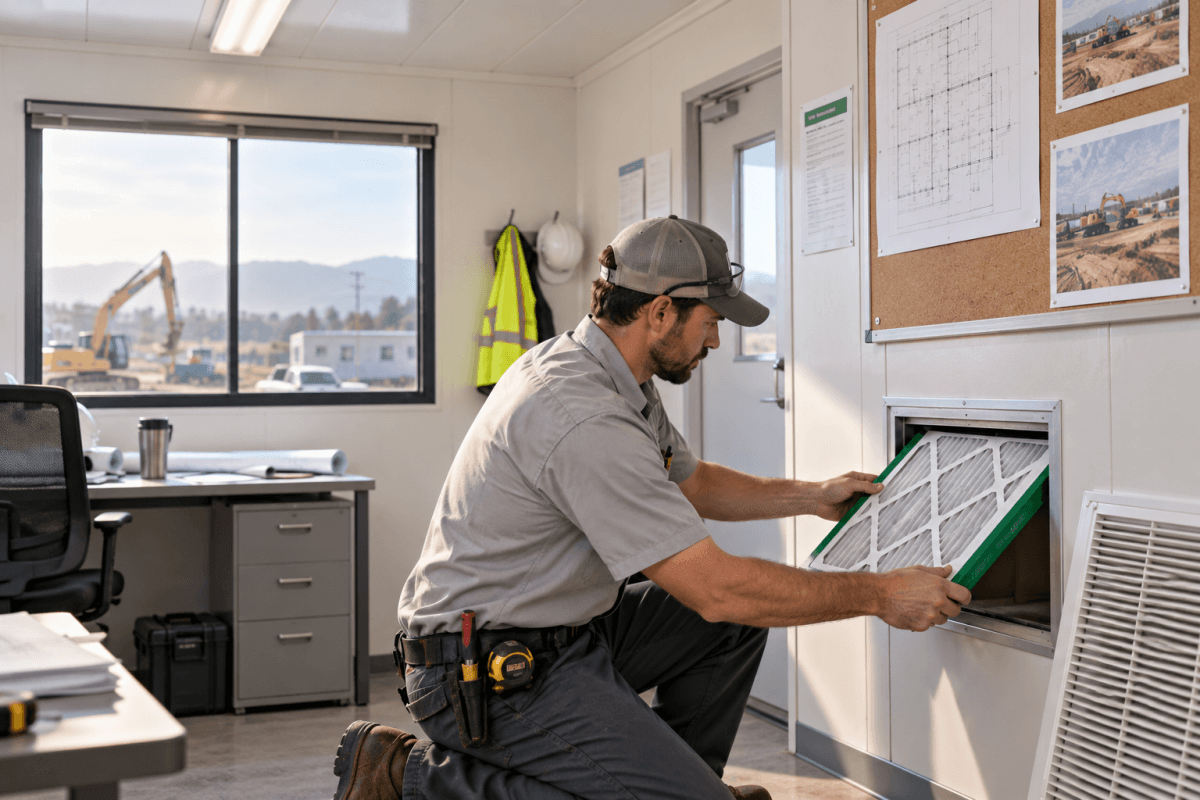
Before fire season, put MERV 13 air filters in trailer and break room HVAC. Match the exact size, or order Filterbuy custom sizes, so no air slips around the frame.
Check them often during smoke and replace them when they look dark brown or black, which EPA notes can be well before the normal interval. Keep spares on hand.
Keep cabin air filters in crew trucks on schedule, since the vehicle exemption assumes the filter works.
See Filterbuy's guides to the best MERV filter for wildfire smoke and MERV 13 vs. HEPA for wildfire smoke.
Smoke-Day Checklist for Construction and Outdoor Crews
Before each shift, check your local AQI now or open Filterbuy's live AQI maps for California, Oregon, Washington, and Nevada.
Compare the reading to your state's trigger, then tell the crew.
Move heavy work to cleaner hours and open filtered break spaces.
Hand out N95s at the voluntary-use trigger, and log readings as you recheck.
What If Your Employer Is Not Following the Rules?
Speaking up is protected. California, Oregon, and Washington all prohibit retaliation for reporting smoke hazards or symptoms.
Note the date, time, reading, and missing protections, then raise it with a supervisor.
In California, call Cal/OSHA at 833-579-0927 on weekdays or file a confidential complaint. Retaliation is illegal, even for refusing unsafe work in evacuation zones.
In Oregon, file with Oregon OSHA online or by phone, and ask to keep your name confidential.
In Washington, call L&I at 1-800-423-7233 or report a safety hazard online. You can stay anonymous.
Supporting Statistics
32.9% of U.S. workers have regular outdoor exposure. BLS, 2022
For construction laborers and roofers, it is 100%.
17% more asthma ER visits than expected occurred on 2023 smoke days. CDC MMWR, 2023
The excess was most common among working-age adults, 18–64.
55%–60% of outdoor PM2.5 typically remains indoors during smoke events, even with windows and doors closed, when no air purifier runs. U.S. EPA
That is why Filterbuy pairs MERV 13 in the HVAC with a HEPA air purifier in each room.
Frequently Asked Questions
Do the rules cover delivery drivers?
Only partly. The vehicle exemption requires closed windows and a working cabin filter, and Oregon and Washington exclude buses and light rail that open their doors often. Frequent-stop routes are often covered.
Does the AQI on my phone count for compliance?
Usually, if it shows government data, such as the AirNow Fire and Smoke Map. Employer-owned sensors face extra accuracy rules.
Is there an AQI where outdoor work must stop?
No state bans all outdoor work at a set AQI. Nevada's draft rules would stop critical outdoor tasks at AQI 500, while other states answer heavier smoke with stricter respirator rules.
Does my employer have to pay for N95s?
Yes. Oregon and Washington require no-cost respirators, and California requires employers to provide them.
Glossary of Key Terms
Ready for smoke season? Check your local AQI now, then stock Filterbuy's American-made MERV 13 air filters in your exact size. Managing several sites? Filterbuy Business ships your exact sizes on schedule