Shop by
September 14, 2026

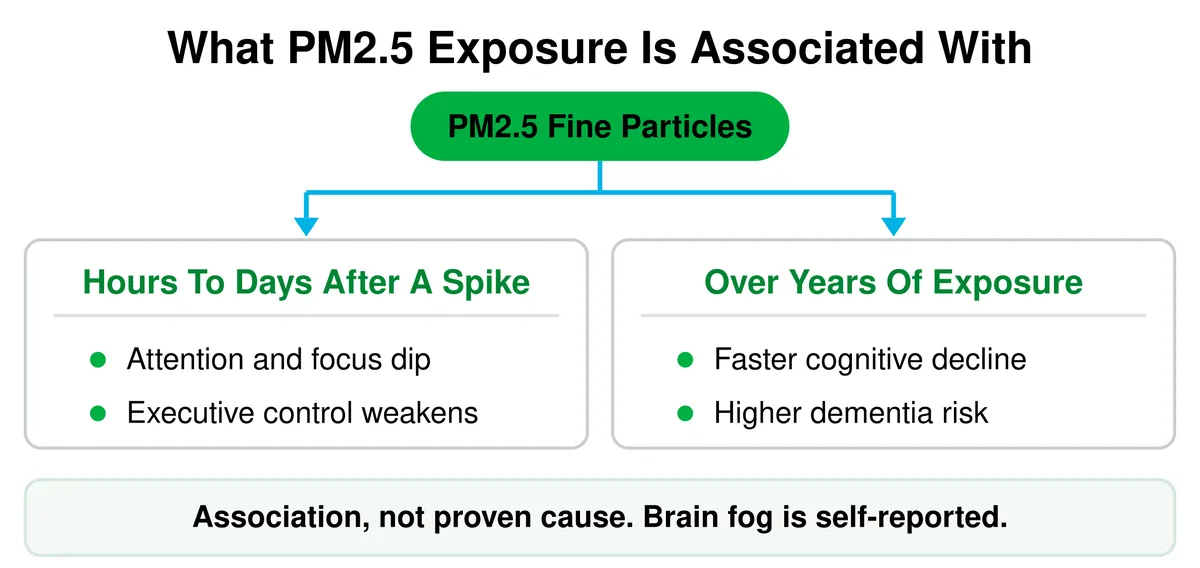
Air pollution is linked to slower reaction time and weaker focus within hours of a spike, and to higher rates of cognitive decline over years. The research supports association rather than proven cause, and brain fog is a self-reported experience, not a diagnosis.
Fine particulate matter, or PM2.5, is the pollutant most consistently implicated, and EPA reports most exposure happens indoors, where some pollutant levels run 2 to 5 times higher than outdoors. That makes indoor particle levels the part of your exposure you can act on, and the match quiz below points you to the filter that fits your system.
Answer 3 quick questions and we will match you to the filter that fits your system.
Air pollution is linked to measurable dips in attention, reaction time, and executive function within hours to days of a spike, and to higher rates of cognitive decline over years. The research supports association rather than proven cause, and brain fog describes how people feel rather than a diagnosis. Fine particulate matter, or PM2.5, is the pollutant most consistently implicated, and because most exposure happens indoors, indoor particle levels are the part a household can change.
Controlled exposure studies have associated short-term PM2.5 with reduced selective attention and weaker executive control hours after exposure ended.
An NIH-funded study of more than 27,000 US adults tied higher PM2.5 exposure to increased dementia risk, with agriculture and wildfire smoke the strongest sources.
EPA reports Americans spend roughly 90 percent of their time indoors, where some pollutants run 2 to 5 times higher than typical outdoor levels.
EPA reports a true high efficiency central system filter rated MERV 13 to 16 can reduce indoor particle concentrations by as much as 95 percent.
The honest answer is correlate, though the caveat matters. Brain fog is something people report feeling, not a diagnosis, so no study measures it. Researchers measure cognitive test scores, brain imaging changes, and dementia incidence, and across all three, air pollution turns up as an association rather than a proven cause.
That distinction changes what the evidence can be used for. Controlled trials catch a real change after a known dose, but only in a small group over hours. Population cohorts follow tens of thousands of people for decades, and cannot separate air quality from everything else that varies by address. Each covers the other's weakness, which is why researchers take the association seriously, and why neither licenses the claim that a hazy afternoon caused your bad day at a desk.
Short-term PM2.5 exposure has been associated with reduced selective attention and impaired executive control. In a randomized experiment published in Nature Communications in 2025, healthy adults showed measurable reductions in selective attention and emotion discrimination four hours after a one-hour exposure, while spatial working memory held steady.
Studies outside the lab agree. A longitudinal study of 90 young adults in Environment International found worse Stroop test performance after elevated PM2.5 three days earlier, alongside EEG changes consistent with weaker executive control.
None of these are dramatic. They describe a slight slowing of higher-order processing, the kind of thing someone notices as losing focus or feeling a step behind. It shows up clearly across a group and stays almost impossible to pin down in one person.
Long-term exposure to fine particulate matter is associated with faster cognitive decline and higher dementia incidence. The 2024 Lancet Commission lists air pollution among 14 modifiable risk factors, and the American Lung Association names impaired cognitive functioning and increased risk of Alzheimer's disease and other dementias among the documented effects of long-term particle exposure.
The largest US work comes from an NIH-funded team at the University of Michigan, which tracked more than 27,000 adults aged 50 and over from 1992 to 2016. Higher PM2.5 exposure was associated with increased dementia risk, and of nine sources examined, agriculture and wildfire smoke carried the strongest signal. If the relationship proves causal, the researchers estimated as many as 188,000 dementia cases a year could be attributable to PM2.5.
Filterbuy manufactures and sells air filters, so we have an obvious stake in research linking air pollution to health. That is why this page separates what each claim is supported by from what it does not establish, rather than flattening it into one headline.
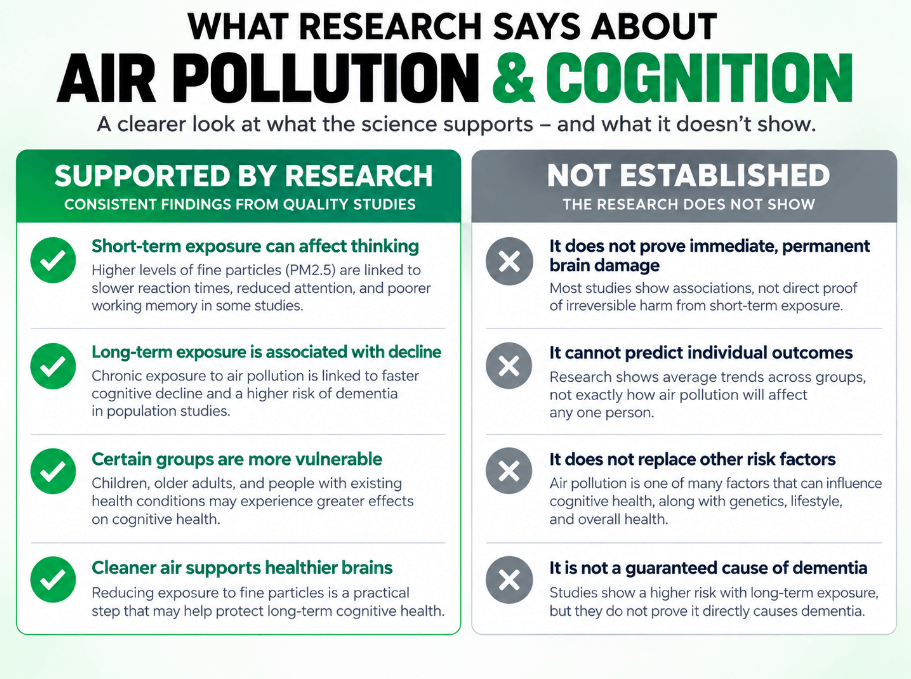
Two rows of that table point at smoke. The reason is the particle. Wildfire smoke is mostly PM2.5, the same fine particulate running through the cognitive research, arriving in short intense episodes that push concentrations well above baseline. It travels hundreds of miles, so households far from any fire sit under multi-day spikes.
Filtration advice for a smoke event differs from ordinary-day advice for that reason, and Filterbuy covers it in a guide to the best MERV rating for wildfire smoke and a comparison of MERV 13 filtration against portable HEPA cleaners.
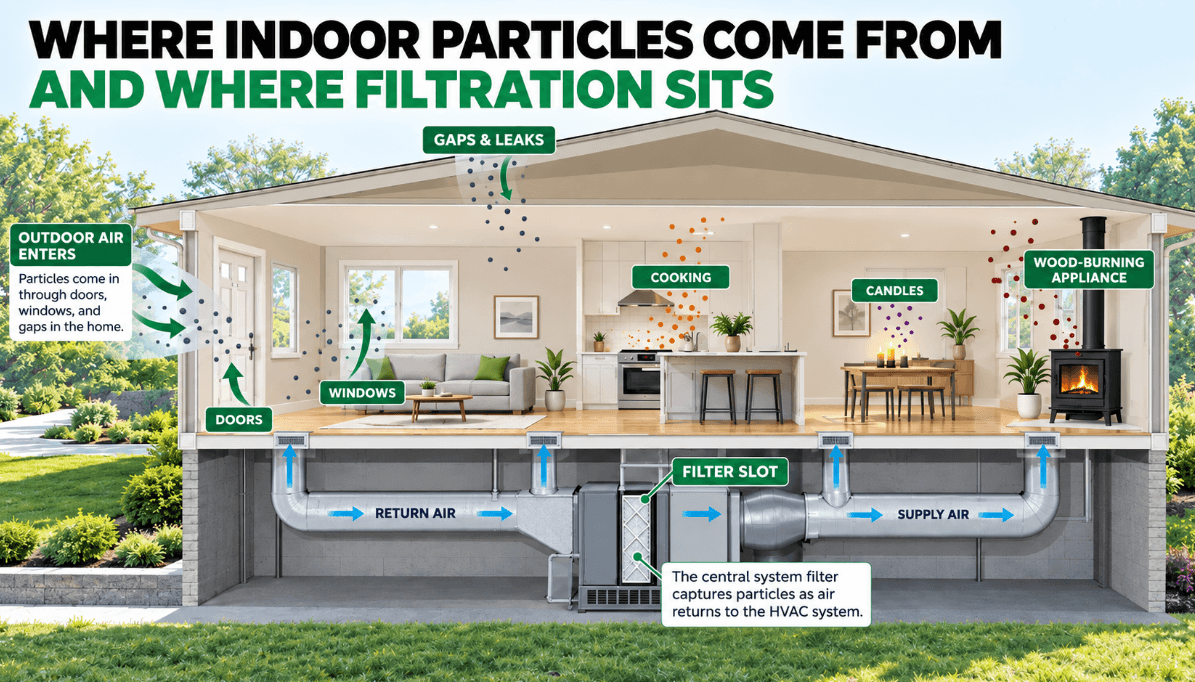
EPA reports that Americans spend roughly 90 percent of their time indoors, where concentrations of some pollutants run 2 to 5 times higher than outdoors. Outdoor particles come in through doors, windows, ventilation, and gaps, and indoor activity adds more on top. Most exposure therefore happens inside a building.
EPA lists headaches, dizziness, and fatigue among the effects associated with indoor air pollutants generally, attributing them to the category rather than one pollutant. Those symptoms overlap almost exactly with what people call brain fog, which is part of why the two get run together. For the outdoor half, Filterbuy covers what each AQI range means and what PM2.5 is and how it maps to the index.
No test will tell you whether air quality is behind a foggy afternoon, and anyone offering one is overreaching. What you can do is check whether your worst days track with anything measurable. Log these for two or three weeks, and remember a match is not proof of cause.
Write down the day, not the diagnosis. Mark which days felt worst, then look up your local AQI for those dates afterward, because checking the reading first changes what you notice.
Watch the building, not the weather. EPA describes sick building syndrome as symptoms that ease after leaving a building and return on going back. If your fog lifts at a different address, the building is a candidate. If it follows you, it is not.
Note what happened indoors in the hour before. A gas range, a lit candle, a wood stove, or an aerosol spray all raise indoor particle levels. If the pattern sits with those rather than outdoor readings, the fix is source control and ventilation, not a filter upgrade.
Rule out the ordinary explanations. Sleep, medication changes, alcohol, and stress account for far more foggy days than air quality, and each is easier to test.
If nothing lines up, air quality is probably not your variable. That is a useful answer, and one most pages here will not give you.
What you generate indoors and what your system filters out set most of your particle level, and outdoor air getting in during a spike does the rest. EPA quantifies the filtration side in its indoor air filtration guidance, and those figures describe particle capture, not any health outcome.
Figures are EPA particle-reduction figures for indoor air. They describe particle capture only and are not claims about any health or cognitive outcome.
A filter only works on air that reaches it, so Filterbuy's MERV 13 air filters are part of this rather than all of it. A few habits cover the rest.
Cut sources first, using the list above. This matters most during a smoke event, when the house is sealed.
Close up during spikes. Shut windows and doors and close outdoor intakes.
Replace the filter when it looks dirty, which in a smoke event comes well ahead of schedule.
None of this treats cognitive symptoms, and Filterbuy will not suggest otherwise. A filter lowers the concentration of particles in the air moving through it, and that is the whole of what Filterbuy claims for it. Anyone with persistent brain fog should see a clinician.
Everything above follows rules Filterbuy applies to this subject. Any figure from the EPA, the NIH, the American Lung Association, or a named study is attributed to that body, not presented as ours. Anything the research calls an association is called an association here, not a cause. Any claim about a filter stops at particle capture, because that is what the testing measures.
Filterbuy has manufactured pleated air filters in the United States since 2012, on the back of a family business that began in the 1950s. None of that tells us anything about cognition. It tells us what filter media does to particles, and where the two meet we point at the researchers, not at ourselves.
These figures come from US public health and research bodies. None measures brain fog directly, and none is a claim about filters.
7.4 million Americans age 65 and older are living with Alzheimer's in 2026.
The Alzheimer's Association Facts and Figures report projects that could reach 13.8 million by 2060. At that scale, a risk factor accounting for even a small share of cases carries real weight, and that is the context the Lancet Commission figure sits in.
Asthma-related emergency department visits ran 17 percent higher than expected across 19 wildfire smoke days.
CDC measured this across 4,317 emergency departments between April 30 and August 4, 2023, counting a smoke day as an AQI of 101 or above. Smoke produces measurable effects hundreds of miles from the fire.
Decision-making performance fell on six of nine measures when indoor carbon dioxide rose from 600 to 1,000 parts per million.
In a blinded chamber study at Lawrence Berkeley National Laboratory, 22 participants were tested at three concentrations, and seven of nine measures fell at 2,500 parts per million. It tested carbon dioxide rather than particulates, so it says nothing about PM2.5, but it is direct evidence that indoor air composition moves cognitive performance.
Michelle Wan, Brand Manager and Air Quality Writer at Filterbuy, wrote this guide. David Clark, a licensed HVAC technician, reviewed it for filtration and equipment accuracy.
Filterbuy is a second-generation, family-owned American filter manufacturer and sells the products discussed here, disclosed so readers can weigh it. Nothing here is medical advice, and the page will be updated when the research or EPA guidance changes.
Can air pollution really cause brain fog?
Research ties air pollution to reduced attention and executive function in the short term, and to cognitive decline over the long term. It does not establish that pollution causes brain fog in any specific person, and brain fog is not a diagnosis studies can measure directly.
How quickly can polluted air affect concentration?
One controlled experiment measured reductions in selective attention four hours after a one-hour exposure. Studies using personal monitors have found associations at lags of a few days rather than minutes.
Will an air filter fix brain fog?
No. No filter has been shown to change cognitive test scores or dementia rates. Higher efficiency filtration reduces the particles circulating indoors, which EPA puts at up to 95 percent for a MERV 13 to 16 central system filter.
Are the short-term effects permanent?
The changes measured in short-term exposure studies were temporary and assessed within hours. The concern about permanence sits with long-term cumulative exposure, which is a separate body of evidence.
Air Quality Index (AQI). The EPA scale from 0 to 500 for daily outdoor air quality. Values above 100 are treated as unhealthy, first for sensitive groups: children, older adults, and people with heart or lung conditions.
Brain fog. A non-clinical term for slowed thinking and poor concentration. It is a self-reported experience, not a medical diagnosis.
Executive function. Attention control, working memory, and task switching, commonly measured in this research with the Stroop color-word test.
HEPA. High Efficiency Particulate Air, roughly equivalent to MERV 17 through 20. Used in portable air cleaners, not standard HVAC filter slots.
Lancet Commission on dementia. A standing expert panel reviewing the evidence on dementia prevention. Its 2024 report identified 14 modifiable risk factors.
MERV. Minimum Efficiency Reporting Value, the ASHRAE 52.2 scale from 1 to 20 rating how well a filter captures particles.
PM2.5. Fine particulate matter 2.5 micrometers in diameter or smaller, small enough to reach deep lung tissue and pass into the bloodstream.
