
Air Purification Filters For A Cleaner, Healthier Home
August 27, 2026
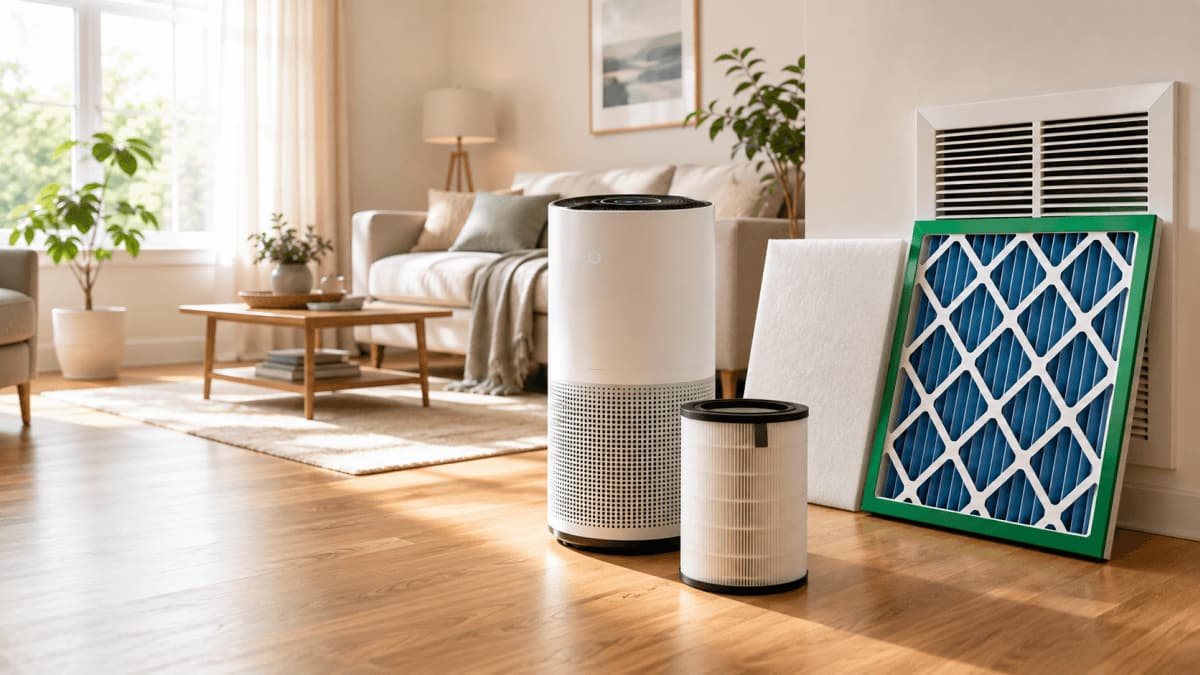
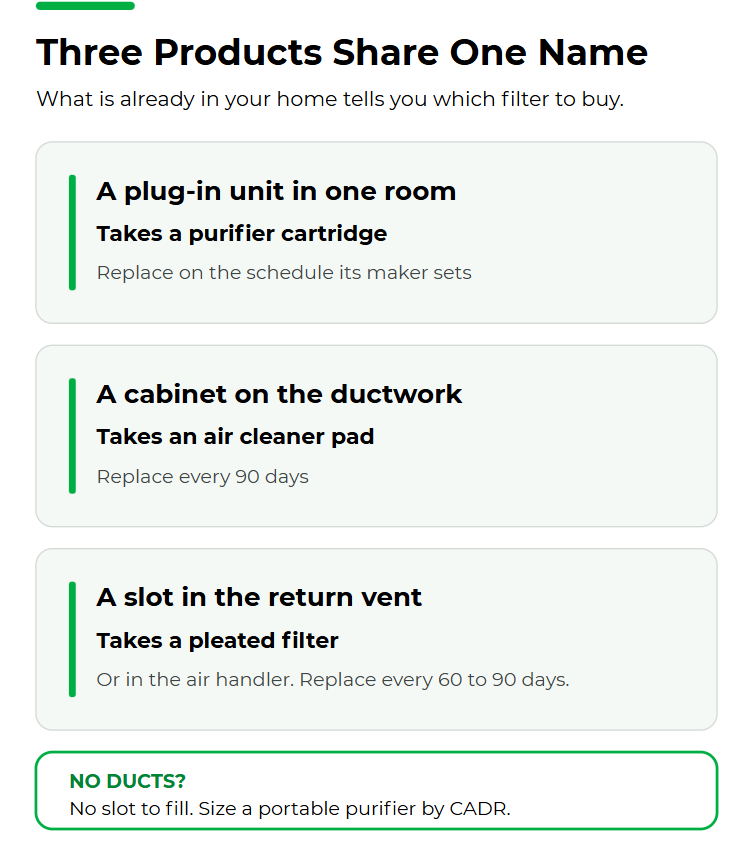
Three different products are sold as air purification filters, and the equipment already in your home decides which one you need. A plug-in unit in one room takes a purifier cartridge, a cabinet on your ductwork takes an air cleaner pad, and a slot in the return vent takes a pleated filter.
Purifier cartridge: for a portable unit, sized by clean air delivery rate at roughly 65 cfm per 100 square feet.
Air cleaner pad: for a cabinet-style air cleaner mounted on the ductwork, replaced every 90 days.
Pleated filter: for the filter slot or air handler, rated by MERV and replaced every 60 to 90 days.
The last two are rated by MERV, and the EPA points homeowners toward MERV 13 or the highest rating the system accepts. Not sure what you have? Take the quick match quiz below.
Answer a few quick questions and we will match you to the right filter.
Already know the size you need?
TL;DR
Three different products get sold under the name air purification filters, and they are not interchangeable. Portable purifiers take cartridges sized to a single room. Whole-house air cleaners take media pads that mount on your HVAC system. Pleated furnace filters slide into the filter slot. The EPA recommends a furnace or HVAC filter rated at least MERV 13, or as high as your system will take.
Key Takeaways
Three products share the name air purification filters: purifier cartridges, air cleaner pads, and pleated HVAC filters.
The EPA recommends a furnace or HVAC filter rated at least MERV 13, and filters at that level must show at least 50 percent removal efficiency for the smallest particles tested.
Furnace and HVAC filters clean your air only while the system runs, which the EPA puts at under 25 percent of the time in season.
Size a portable air purifier by clean air delivery rate, allowing roughly 65 cfm per 100 square feet of room area.
Homes without ducts have no filter slot to upgrade, so a portable purifier becomes the whole strategy.
The EPA advises avoiding any air cleaner that intentionally produces ozone, because ozone is a lung irritant.
What Are Air Purification Filters?
Air purification filters are replaceable media that capture airborne particles, and sometimes gases, as air passes through a purifier, an air cleaner, or a central HVAC system. The EPA splits home air cleaning into two families. Portable air cleaners, also called air purifiers, handle one room at a time. Central furnace and HVAC filters treat the whole house at once.
Most product pages skip what comes next. Filters are usually built to capture either particles or gases rather than both, which is why many purifiers stack a particle filter behind a carbon one. Nothing removes every pollutant, and the EPA is clear in its Guide to Air Cleaners in the Home that filtration supplements source control and ventilation rather than replacing either.
One rule applies across all three products. Every filter needs replacing on a schedule, because a dirty, overloaded filter quietly stops doing its job.
Which Air Purification Filter Do You Actually Need?
The simplest way to choose is to match the filter to equipment you already own. A plug-in unit in the bedroom takes a purifier cartridge built for that exact model and rated by clean air delivery rate. A boxy cabinet on the ductwork beside the furnace takes an air cleaner pad. A slot in the return vent or air handler takes a pleated filter. The last two are both rated by MERV, and both treat the whole house.
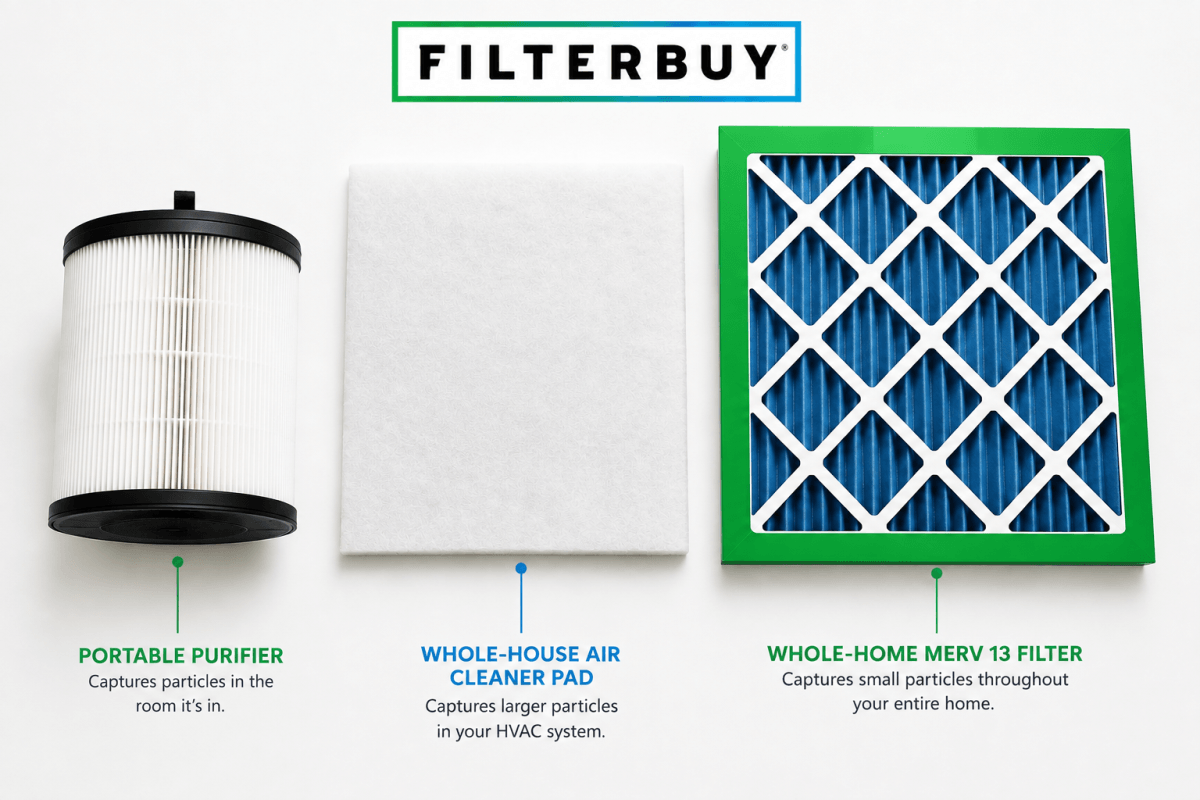
Filterbuy manufactures two of those three, which is why we can be direct about how they differ. Both whole-house options run on the schedule of your HVAC system. Pleated filters last 60 to 90 days, and replacement air cleaner pads for Dynamic and Respicaire cabinets carry a 90-day interval. Purifier cartridges follow whatever interval your unit manufacturer sets.
“Most people do not need a better filter. They need the right one. Once someone tells me what the equipment in their house actually looks like, the decision takes about ten seconds.”
There is a timing difference here that almost nobody explains at the shelf. Whole-house filtration only happens while the blower is moving air, and the EPA estimates that HVAC systems run less than 25 percent of the time in season. A portable purifier keeps working for as long as you leave it on. That makes the two complements rather than rivals. A MERV 13 filter covers the house on every cycle, and a right-sized purifier covers the bedroom through the hours in between.
What Does A MERV 13 Rating Mean For Home Air Purification?
MERV, short for Minimum Efficiency Reporting Value, rates how effectively a filter captures particles from the air moving through it. The EPA notes that MERV rests on a national consensus standard, while the Filter Performance Rating and Microparticle Performance Rating numbers printed on competing packaging are proprietary. Anything rated MERV 13 or higher has to demonstrate at least 50 percent removal efficiency for the smallest particles tested.
The EPA also settles the question homeowners worry about most. Most furnaces and HVAC systems will take a MERV 13 filter without running into equipment problems, as long as it gets replaced on schedule. An HVAC technician can confirm the highest rating your particular system accepts, and our guide to MERV ratings walks through the full scale.
Filterbuy builds pleated filters in MERV 8 and MERV 11 as well as the MERV 13 air filters the EPA points toward, along with Odor Eliminator carbon filters for cooking, pet, and smoke odors. Every one is made in the USA across more than 600 sizes, with custom sizes cut to order.
How Do You Size A Portable Air Purifier For A Room?
Size a portable air purifier by its clean air delivery rate, or CADR, a rating developed by the Association of Home Appliance Manufacturers. CADR measures how much contaminant-free air a unit delivers per minute, so a higher number means faster cleaning across a larger space. The EPA publishes minimum figures by room size, and they scale in a straight line at roughly 65 cfm for every 100 square feet. A 200-square-foot room needs 130 cfm, and a 600-square-foot room needs 390 cfm, both assuming an 8-foot ceiling.
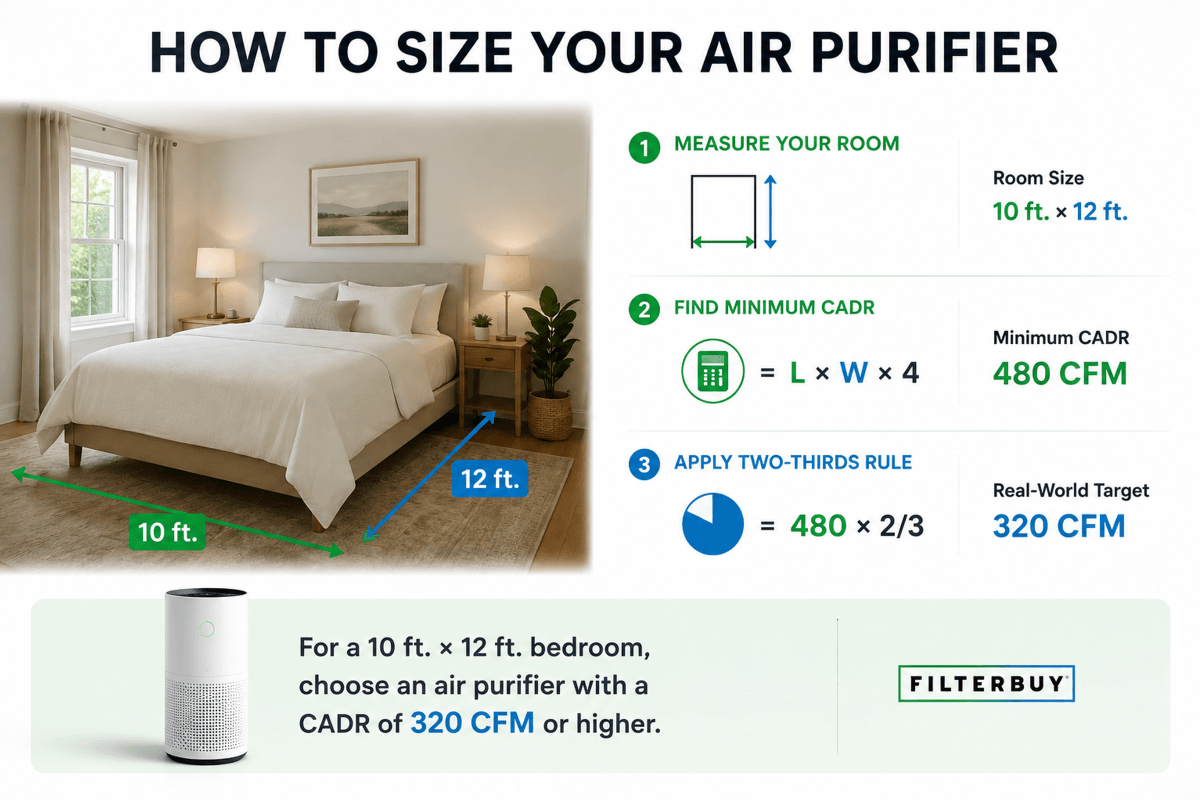
AHAM adds one more rule worth memorizing before smoke season. Look for a tobacco smoke CADR of at least two-thirds your room area in square feet, since tobacco smoke stands in for the smallest particles on the label. A 120-square-foot bedroom needs a CADR of 80 or higher. AHAM publishes a directory of certified room air cleaners with lab-verified figures you can check before buying.
What If Your Home Has No Ducts?
No ducted system means no filter slot to upgrade, and at that point a portable purifier stops being a supplement. It becomes the entire strategy. Nearly every page on this topic assumes a furnace with a filter slot, and millions of American homes simply do not have one.
Half of Northeast households run window, wall, mini split, or portable units as primary cooling, per U.S. Energy Information Administration data.
Apartments have the lowest air conditioning usage of any housing type, 80 to 85 percent against 90 percent for single-family homes.
The EPA notes those units filter only enough to keep themselves clean.
What changes in practice:
Ignore MERV. No slot to rate.
Size by CADR for the rooms you occupy most.
Budget one unit per room rather than one large unit for the house.
Check the model against the CARB list first, because electronic units are common here.
Which Air Purification Technologies Should You Avoid?
Avoid any air cleaner that intentionally produces ozone. The EPA is direct about this, and so are we. Ozone irritates the lungs and can bring on chest pain, coughing, shortness of breath, and throat irritation, and it can make asthma worse. No federal agency has approved these devices for use in occupied spaces.
Watch the label, not the marketing. The EPA notes that electrostatic precipitators, ionizers, uncoated UV lamps, and plasma air cleaners can all emit ozone, and vendors sometimes call it "energized oxygen," a practice documented in its assessment of ozone generators sold as air cleaners. California requires every portable air cleaner sold there to be certified, and the list of CARB-certified air cleaning devices labels each model mechanical or electronic, mechanical meaning physical filtration only.
Mechanical filtration sidesteps the question entirely. A pleated filter, a media pad, or a purifier cartridge captures particles physically, with no chemistry and no byproducts. Every filter Filterbuy makes works that way, by choice.
How Often Should You Replace Air Purification Filters?
Replace air purification filters on a schedule rather than by how they look. The EPA notes that manufacturers typically recommend replacement every 60 to 90 days, and that a heavily soiled filter is a signal to move faster next time. Pleated filters sit inside that window, air cleaner pads run on 90 days, and purifier cartridges follow the unit manufacturer. Pets, smoke, and construction dust shorten all of it.
If the calendar is the hard part, an air filter subscription from Filterbuy handles it. You pick the interval and save 5 percent per order.
Why Buy Air Purification Replacement Filters From Filterbuy?
Filterbuy is a family-owned American manufacturer that has been building pleated air filters since 2013, with plants in Alabama, Florida, Pennsylvania, and Utah. We sell direct, so the filter that arrives at your door came off our own line.
For whole-house air cleaners, Filterbuy makes replacement pads for Dynamic and Respicaire polarized-media units in 29 sizes. Each is rated MERV 13, pairs pleated media with a carbon center, carries a 90-day interval, and is made in the USA. In-stock pads ship in 24 hours.
Filterbuy is bringing its own line of portable air purifier replacement filters to market later this year, built in our own American plants. Until they land, shop Filterbuy air filters for the whole-house side of your setup.
Supporting Statistics
Three federal and national sources support the guidance above.
Two-thirds of U.S. homes use central air conditioning or a central heat pump as their main cooling equipment.
Source: 2020 Residential Energy Consumption Survey, U.S. EIA. Sample: 18,496 households.
Why it matters: Most homes need a MERV-rated filter first. The rest are covered in the ducts section above.
Indoor levels of some pollutants run 2 to 5 times higher than outdoors, and Americans spend about 90 percent of their time indoors.
Source: Report on the Environment, U.S. EPA.
Why it matters: Filtration targets the air you breathe nearly all day. The same page lists ozone from some air cleaners as a pollutant of concern.
About 76 million people live in U.S. counties that failed for year-round particle pollution.
Source: State of the Air 2026 key findings, American Lung Association. Data years: 2022 to 2024.
Why it matters: Fine particles are what MERV 13 media and a high smoke CADR are rated to capture.
Frequently Asked Questions
Do Air Purification Filters Get Rid Of Mold?
No. Portable air cleaners and HVAC filters do not address the cause of mold or musty odors, according to the EPA. Mold grows out of a moisture problem, so solving it means finding the water and cleaning up what grew. A filter may catch some mold particles and cut the odor, but it will not fix the cause.
Can I Put A HEPA Filter In My Furnace?
Generally no. HEPA media is dense enough to restrict airflow in residential ductwork, which is why it lives in portable units that have fans of their own. For central systems, the EPA points homeowners to MERV 13, or the highest rating the fan and slot will accept.
Do Air Purification Filters Help During Wildfire Smoke Season?
Yes, when they are rated for fine particles. Smoke is dominated by fine particulate matter, or PM2.5, so a MERV 13 filter and a unit with a strong tobacco smoke CADR both help. Keep windows closed during smoke events.
Does A Ductless Mini Split Filter The Air In My Home?
Only lightly. The EPA notes that wall-mounted ductless units and window air conditioners are built for temperature control rather than filtration, and their screens mostly exist to keep the equipment itself clean. Treat mini split filtration as a bonus, and handle real air cleaning with a rated filter or a properly sized purifier.
Glossary
Air cleaner pad: replacement media for a cabinet-style air cleaner on HVAC ductwork.
MERV: Minimum Efficiency Reporting Value, the national consensus rating for particle capture.
CADR: clean air delivery rate, an AHAM rating of a portable unit's contaminant-free air output in cubic feet per minute.
HEPA: high-efficiency particulate air, a designation used in many portable purifiers to reach a high CADR.
PM2.5: fine particulate matter 2.5 micrometers and smaller, the size of greatest health concern.
Ozone: a three-atom oxygen gas that irritates the lungs, produced by some air cleaning devices.