
MERV 8 vs MERV 11: Which Air Filter Is Right for Your Home?
June 25, 2026
MERV 8 vs MERV 11: What's the Difference?
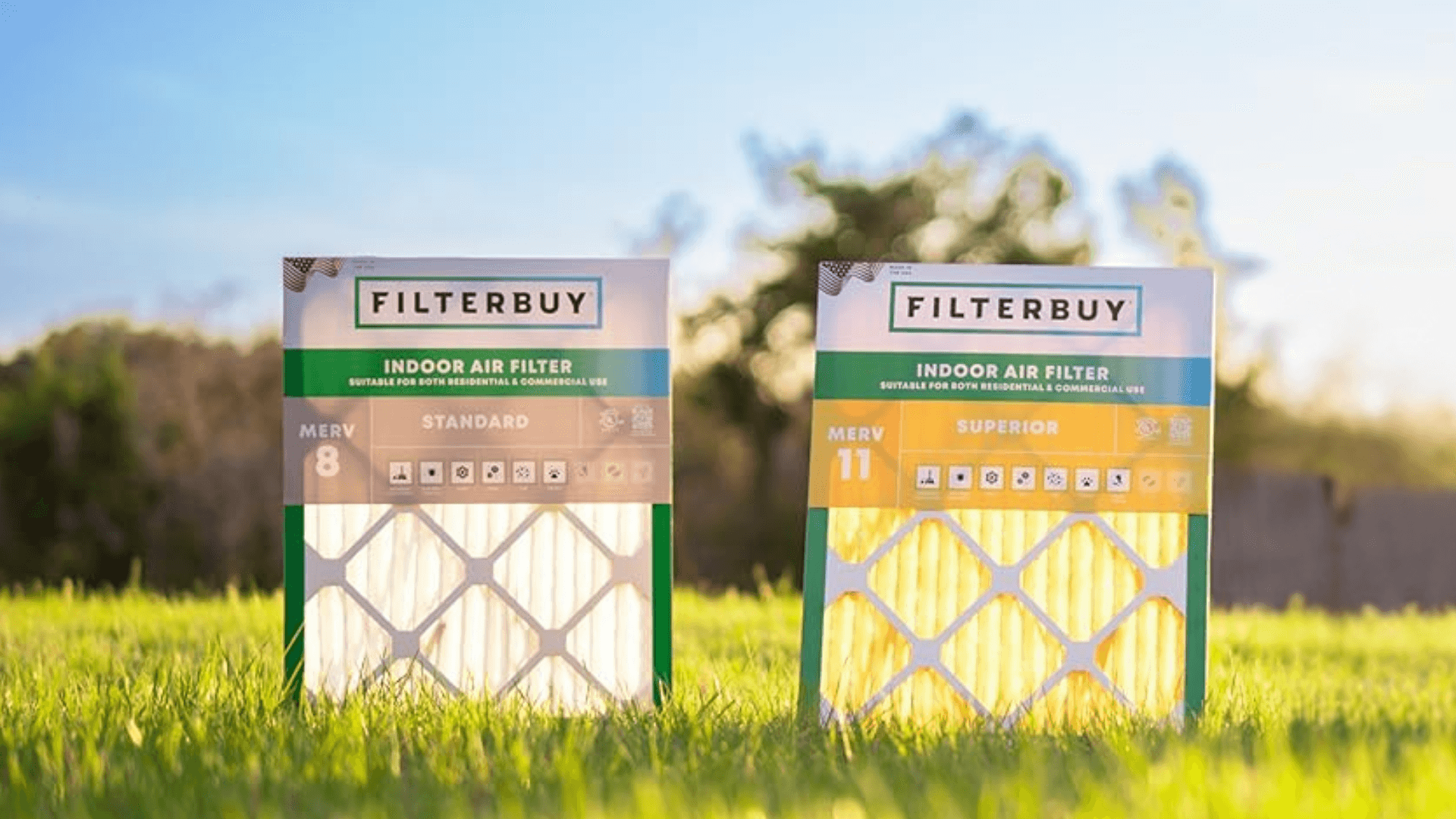
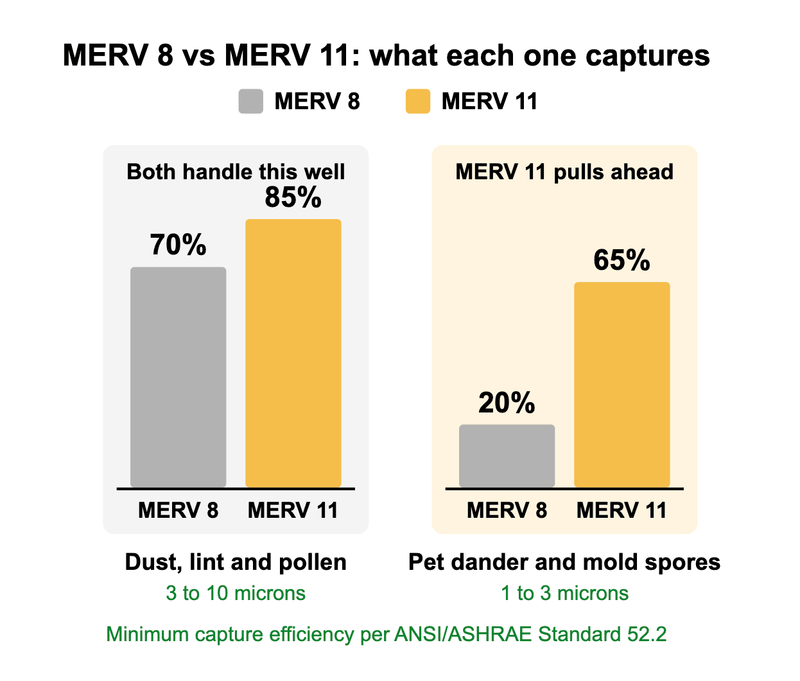
MERV 8 and MERV 11 both capture everyday dust, lint and pollen. They separate on finer particles like pet dander and mold spores, where MERV 11 captures at least 65% and MERV 8 captures at least 20%. Both fit a standard residential system, so this is a choice, not a risk.
MERV 8 captures larger debris: household dust, lint, carpet fibers, pollen and dust mite debris. At least 70% from 3 to 10 microns.
MERV 11 captures all of that plus finer particles: pet dander, mold spores and fine dust. At least 85% from 3 to 10 microns and at least 65% from 1 to 3 microns.
The cost gap is small. On a 20x25x1 12-pack, MERV 11 runs $9.41 a filter against $6.66 for MERV 8.
Capture minimums per ANSI/ASHRAE Standard 52.2. Filterbuy pricing as of August 2026.
Already know which rating you want? Get it factory-direct in your size.
Not sure which one fits your home? Answer 3 quick questions and we'll match you to your filter.
TL;DR
MERV 8 and MERV 11 are both safe for standard residential HVAC systems. A MERV 8 filter captures at least 70% of particles in the 3–10 micron range, which covers dust, lint, and pollen. A MERV 11 filter captures at least 85% of that same range, and it adds at least 65% of the 1–3 micron particles where pet dander and mold spores live. Choose MERV 11 if you have pets, allergies, or asthma.
Key Takeaways
The real gap sits in the 1–3 micron band, where MERV 11 captures at least 65% and MERV 8 only 20%.
Both ratings handle pollen. Whole grains run 10 to 100 microns, well above either filter's tested range, so MERV 11's real edge is the fragmented pollen that stays airborne.
Depth affects air flow more than the rating does. Our lab measures a 4-inch MERV 11 at 0.08 in. w.g. against 0.10 for a 1-inch MERV 8.
The American College of Allergy, Asthma & Immunology recommends MERV 11 to 13 for whole-house filtration.
MERV 11 is not too restrictive for most homes. Verify your maximum static pressure if your system predates 2000.
A loose MERV 11 underperforms a snug MERV 8, because a half-inch gap around the frame lets air bypass the media entirely and costs 20% to 30% of a filter's effectiveness.
Why We Publish Our Test Data
Filterbuy makes both of the filters on this page. That's a conflict of interest, and you should know it before you read another line.
It's also why this page can do something most comparison guides can't. We have the airflow resistance numbers from our own lab, measured for every rating at every depth, so you don't have to take our word for the tradeoff. You can look at it.
We've been building pleated filters in the U.S. since 2013, and these figures come from testing more than two million of them. Where the data doesn't flatter us, we left it alone.
What Is a MERV Rating, and What Do the Numbers Mean?
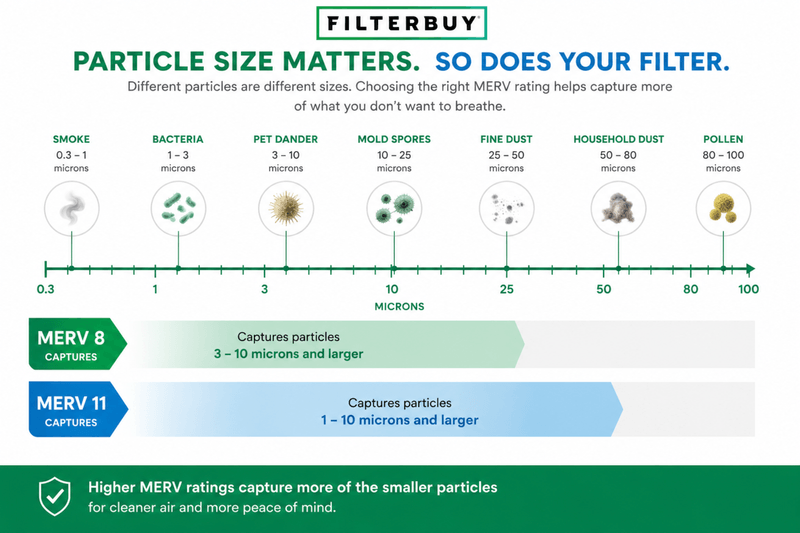
MERV stands for Minimum Efficiency Reporting Value. It's the air filter rating standard set by ASHRAE Standard 52.2, and it scores how well a filter catches particles on a 1-to-16 scale. Higher numbers catch smaller particles.
Pay attention to that first word. A MERV rating is a filter's worst result across six test cycles, not its average. It tells you the floor, not the ceiling.
Here's how the test works. It measures twelve particle sizes and groups them into three bands:
0.3 to 1.0 microns: smoke and bacteria
1.0 to 3.0 microns: pet dander and mold spores
3.0 to 10.0 microns: household dust, lint, and pollen fragments
The filter's rating is whichever of those three scores is lowest. That's why an efficiency percentage means almost nothing unless someone tells you what size particle it's catching.
One more thing worth knowing. The EPA points out that MERV comes from a national consensus standard, while the FPR and MPR numbers you see on retail packaging are each brand's own invention.
What changed and why:
Cut the E1/E2/E3 labels. They're the standard's internal jargon, and the paragraph never uses them again. The reader has to hold three meaningless codes in memory for no payoff. The micron ranges are the actual information.
Turned the three bands into a list. Three parallel facts in a row is exactly what a list is for, and prose was forcing you to re-read to keep them straight.
Moved "0.3 to 10 microns" out of the opening sentence. It was doing double duty there, since the band list covers the same ground more usefully. The first sentence is now clean enough to skim.
"The word minimum is doing real work" is a writerly move that asks the reader to figure out what work. "Pay attention to that first word" points them at it directly, and the italic on worst does the emphasis.
"Proprietary to individual brands" became "each brand's own invention," which is blunter and carries the implication you actually want the reader to take away.
Table 1: Residential MERV Filter Ratings (ANSI/ASHRAE 52.2-2017)
Minimums per ANSI/ASHRAE Standard 52.2. "No minimum" means the standard sets no requirement in that band, not that the filter captures nothing there.
→ See the full scale: MERV ratings explained.
MERV 8 vs MERV 11: Side-by-Side Comparison
A MERV 11 filter captures meaningfully more fine particulate than a MERV 8 filter, at a small cost in airflow resistance. Here is where the two diverge.
Table 2: MERV 8 vs MERV 11
ASHRAE minimums per Standard 52.2. Pressure drop measured at 1,000 CFM by Filterbuy. Pricing as of August 2026.
What Does a MERV 8 Filter Capture?
A MERV 8 filter captures at least 70% of particles in the 3–10 micron range and at least 20% in the 1–3 micron range under ANSI/ASHRAE 52.2. In practice that covers household dust, lint, carpet fibers, pollen, dust mite debris, and the larger mold spores.
MERV 8 is the rating most residential systems were engineered around, and it still does two jobs well. It keeps the visible material out of your air, and it protects the coil and blower from debris. We sell a great many of them to households that genuinely do not need more.
A MERV 8 filter is the right choice when nobody in the home has allergies or asthma, when there are no shedding pets, or when an older system runs on a single small return.
→ Shop Filterbuy MERV 8 air filters.
What Does a MERV 11 Filter Capture?
A MERV 11 filter captures at least 85% of particles in the 3–10 micron range and at least 65% in the 1–3 micron range under ANSI/ASHRAE 52.2. That 1–3 micron band is the real upgrade over MERV 8, which only has to capture 20% of it.
Pet dander, mold spores, fine dust, auto emissions, and fragmented pollen all live in that range. Whole pollen grains are much larger, 10 to 100 microns, and both filters catch them easily. What MERV 11 adds is the broken-down pollen and the dander that stays suspended longest.
The American College of Allergy, Asthma & Immunology reaches the same conclusion, calling a disposable MERV 11 to 13 filter the most cost-efficient choice for whole-house filtration.
A MERV 11 filter is the right choice when someone in the home has allergies or asthma, when you have shedding pets, or when you live in a city or a dusty region.
→ Shop Filterbuy MERV 11 air filters for dander and allergens.
MERV 8 vs MERV 11 Pressure Drop: Is MERV 11 Too Restrictive?
MERV 11 filters make it a little harder for air to move through than MERV 8 does. In most homes, that difference is too small to notice. We can tell you exactly how small because we test what we build, and the numbers below come from our own lab, not off a spec sheet.
The measure is called pressure drop, and it's a straightforward idea: how hard your blower has to pull to get air through the filter. It's measured in inches of water gauge, written as in. w.g. Think of it the way you'd think of drinking through a straw. A wider straw takes almost no effort, a narrow one takes more, and at some point the drink stops coming.
Your system has a budget for that effort. Most residential systems are built to stay under 0.50 in. w.g. total, and here's the part people miss: the filter isn't the only thing spending it. Your ductwork and coil are drawing on the same 0.50, and the filter only gets what's left over.
Table 3: Filterbuy Measured Initial Pressure Drop at 1,000 CFM
Initial pressure drop in inches of water gauge at 1,000 CFM. Filterbuy testing laboratory data from more than 2 million filters manufactured.
The row people don't expect is the last one. A 4-inch MERV 11 filter is easier for your system to pull air through than a 1-inch MERV 8. The higher rating breathes better, at 0.08 against 0.10.
That sounds backwards until you see why. A thick filter has far more pleated material packed inside it than a thin one, so the same amount of air spreads across more surface and squeezes through less. Depth beats rating. Which means that if someone tells you your home can't handle MERV 11, the answer is usually a deeper filter slot, not a weaker filter.
The second finding is the one we'd print on a sticker if we could. A filter gets harder to breathe through as it fills with dust. Leave one in for eight months and it strains your system far more than its rating ever would. When people call us about weak airflow and blame the MERV number, it's almost always the calendar instead. The EPA lands in the same place, recommending the highest-rated filter your system and filter slot can take, changed on schedule.
The question we get most is whether MERV 13 will hurt the system. In a modern home, almost never. What actually hurts systems is the filter nobody remembered to change. I would rather you run MERV 11 on a real schedule than MERV 13 for eight months.
Michelle Wan, Brand Manager and Air Quality Writer, Filterbuy
MERV 8 vs MERV 10: What's the Difference?
MERV 10 sits between 8 and 11, leaning closer to 11. It catches at least half of the mid-size particles like pet dander and mold spores, and at least 85% of the big stuff like dust and pollen.
We don't make one, and our own numbers explain why. In a standard 1-inch filter, the entire airflow difference between MERV 8 and MERV 11 is 0.05 in. w.g. Splitting that in half gets you a filter that catches less than MERV 11 in exchange for an airflow saving your system would never notice. There's no real win in the middle.
The MERV 10 filters you do find are usually commercial stock, or a brand's own MPR or FPR number loosely translated into a MERV equivalent. If you want better filtration than MERV 8 without paying for it in airflow, go to MERV 11.
MERV 8 vs MERV 11 vs MERV 13: How the Three Compare
MERV 13 catches at least half of the finest particles, the 0.3 to 1 micron range where smoke and bacteria live, plus 85% of the mid-size band and 90% of the large one. It's the only common residential rating that's required to catch anything in that finest range at all, which is why the EPA recommends it for any system that can take one.
Table 4: MERV 8 vs MERV 11 vs MERV 13
ASHRAE minimums per Standard 52.2. Pressure drop in in. w.g. at 1,000 CFM, Filterbuy laboratory data.
MERV 8 vs MERV 13 is the widest gap of the three comparisons, a substantial jump in both filtration and resistance. MERV 13 earns its place in a wildfire region or an asthma household, and depth softens the tradeoff there too: a 20x25x4 MERV 13 measures 0.11 in. w.g., close to a 20x25x1 MERV 8.
→ Full MERV 8 vs MERV 11 vs MERV 13 breakdown · Shop Filterbuy MERV 13 air filters
What Neither MERV 8 Nor MERV 11 Will Do
Neither one removes gases. MERV measures particle capture and nothing else, so cooking odors, pet smells, paint fumes, and other VOCs pass straight through both. Gases need activated carbon, and that's a different product, not a higher number.
Radon and carbon monoxide are outside the reach of any filter, too. Those are detection and ventilation problems. A CO alarm isn't optional in any home.
There's also a limit nobody prints on the box. Your filter only cleans the air while your system is running, and in most homes that's less than a quarter of the time during heating and cooling season, as the EPA points out. The rest of the time it does nothing. Worth knowing before you spend more on a rating, because running your fan longer may buy you more clean air than a better filter would.
We'd rather tell you this plainly than have you feel misled later. If odors are the real complaint, carbon media solves it and a MERV upgrade won't. That's why we sell the Odor Eliminator as its own line instead of folding carbon into a higher number.
So Which MERV Filter Should You Buy?
Choose MERV 8 if nobody in the home has allergies or asthma and there are no shedding pets. Get the MERV 11 if you have pets, allergies, asthma, or dusty air, which describes most of the homes we ship to. Buy MERV 13 if you live in a wildfire region or manage asthma and your system has the static pressure headroom for it.
If you are unsure of the right size, start with our how to measure your air filter guide, then set up your auto-delivery so the next one arrives before you need it.
Coming from a filter manufacturer, that last part may sound self-serving, but it is the advice we would give either way. Whichever rating you pick matters less than changing it on time.
Supporting Statistics
Three findings from federal and public-health sources sit behind the guidance above. The second is the reason Filterbuy pushes MERV 11 harder than most homeowners expect a filter company to.
Americans spend approximately 90% of their time indoors, where concentrations of some pollutants are often 2 to 5 times higher than typical outdoor levels. The same EPA assessment names pet dander, dust mites, and mold among established asthma triggers, the same 1–3 micron particles where MERV 11 separates from MERV 8. U.S. Environmental Protection Agency, Report on the Environment
Dog and cat allergens are present in almost all U.S. homes, including homes without pets. NIEHS scientists found more than 50% of U.S. households have a dog, cat, or both, and nationwide surveys detected pet allergens nearly everywhere, because dander travels on clothing. Having no pet does not mean having no dander. National Institute of Environmental Health Sciences, NIH
28 million people in the United States have asthma, making it one of the most common and costly chronic diseases in the country, and one whose triggers are largely airborne. Asthma and Allergy Foundation of America
Frequently Asked Questions
What Is the Difference Between MERV 8 and MERV 11 Air Filters?
The difference is capture in the 1–3 micron range. Under ANSI/ASHRAE 52.2, a MERV 8 filter must capture at least 20% of that band, while a MERV 11 filter must capture at least 65%. Pet dander and mold spores are the particles that live there.
Is MERV 11 Too Restrictive for a Residential Hvac System?
MERV 11 is not too restrictive for the large majority of residential systems. Filterbuy measures a 20x25x1 MERV 11 at 0.15 in. w.g. against 0.10 for MERV 8, a 0.05 difference within a typical 0.50 in. w.g. budget. Systems that struggle usually have undersized returns or an overdue filter.
Will a MERV 11 Filter Reduce Air Flow in My System?
The MERV 8 vs MERV 11 air flow difference is small, roughly 0.05 in. w.g. in a 20x25x1 filter. Two other factors matter more. Depth is one, since our 4-inch MERV 11 measures 0.08 in. w.g. against 0.15 for the 1-inch version. Age is the other, since a loaded filter restricts more than a clean one at any rating.
Where Can I Buy MERV 8 and MERV 11 Air Filters?
Filterbuy manufactures pleated MERV 8, MERV 11, and MERV 13 air filters in the United States and ships them factory-direct in more than 600 standard sizes, plus custom dimensions for non-standard returns. Every batch is tested to ANSI/ASHRAE Standard 52.2.
Do MERV 8 or MERV 11 Filters Remove Odors or Gases?
No. MERV rates particle capture only, so cooking odors, pet smells, and VOCs pass through both a MERV 8 and a MERV 11 filter unchanged. Odor control requires activated carbon media, which is a separate product rather than a higher MERV number. Neither rating affects radon or carbon monoxide.
Does a Higher MERV Rating Help if My Filter Does Not Fit Tightly?
No. Air that slips around the frame is unfiltered regardless of the rating, and a half-inch gap can cost 20% to 30% of a filter's effectiveness. A snug MERV 8 will outperform a loose MERV 11. Measure the slot opening rather than the old filter, and check the edges by hand after installing.
Which Is Better for Allergies, MERV 8 or MERV 11?
MERV 11 is better for allergies, and the American College of Allergy, Asthma & Immunology recommends MERV 11 to 13. Airborne triggers such as dander, mold spores, and fragmented pollen fall in the 1–3 micron range, where MERV 11 captures at least 65% versus 20% for MERV 8.
Why Homeowners Choose Filterbuy
We have manufactured pleated air filters in the United States since 2013 and we ship them factory-direct, which is what lets us test every batch to ANSI/ASHRAE 52.2 and publish what we find. More than 600 sizes are available, along with custom dimensions for non-standard returns, and we have never used fiberglass.
Find your filter size · Set up auto-delivery
Glossary
MERV (Minimum Efficiency Reporting Value) : The air filter rating standard defined by ASHRAE Standard 52.2, scoring particle capture from 0.3 to 10 microns on a 1-to-16 scale.
ASHRAE : The American Society of Heating, Refrigerating and Air-Conditioning Engineers, which created and maintains the MERV rating system.
E1, E2, E3 : The three particle-size groups behind a MERV rating: E1 is 0.3–1.0 microns, E2 is 1.0–3.0, E3 is 3.0–10.0. The rating is the lowest group score.
Filterbuy : A U.S. air filter manufacturer, founded 2013, that produces pleated MERV 8, MERV 11, MERV 13, and activated-carbon Odor Eliminator filters in more than 600 sizes and tests every batch to ANSI/ASHRAE Standard 52.2.
Filter bypass : Air that travels around a filter frame instead of through the media. Bypassed air is unfiltered no matter what the filter is rated, which is why fit determines how much of a rating you actually get.
VOCs (volatile organic compounds) : Gases released by paints, cleaners, furnishings, and cooking. Pleated MERV filters do not capture gases; activated carbon media does.
Micron : One millionth of a meter. A human hair is roughly 70 microns across; the particles MERV rates are 0.3 to 10 microns.
Pressure drop : The airflow resistance a filter adds to an HVAC system, in inches of water gauge (in. w.g.).
External static pressure (E.S.P.) : Total airflow resistance across a system's ductwork and filter, typically capped at 0.50 in. w.g. on residential equipment.