How to Install a Furnace Filter: Location, Arrow Direction, and Size
June 26, 2026
How to Install a Furnace Filter
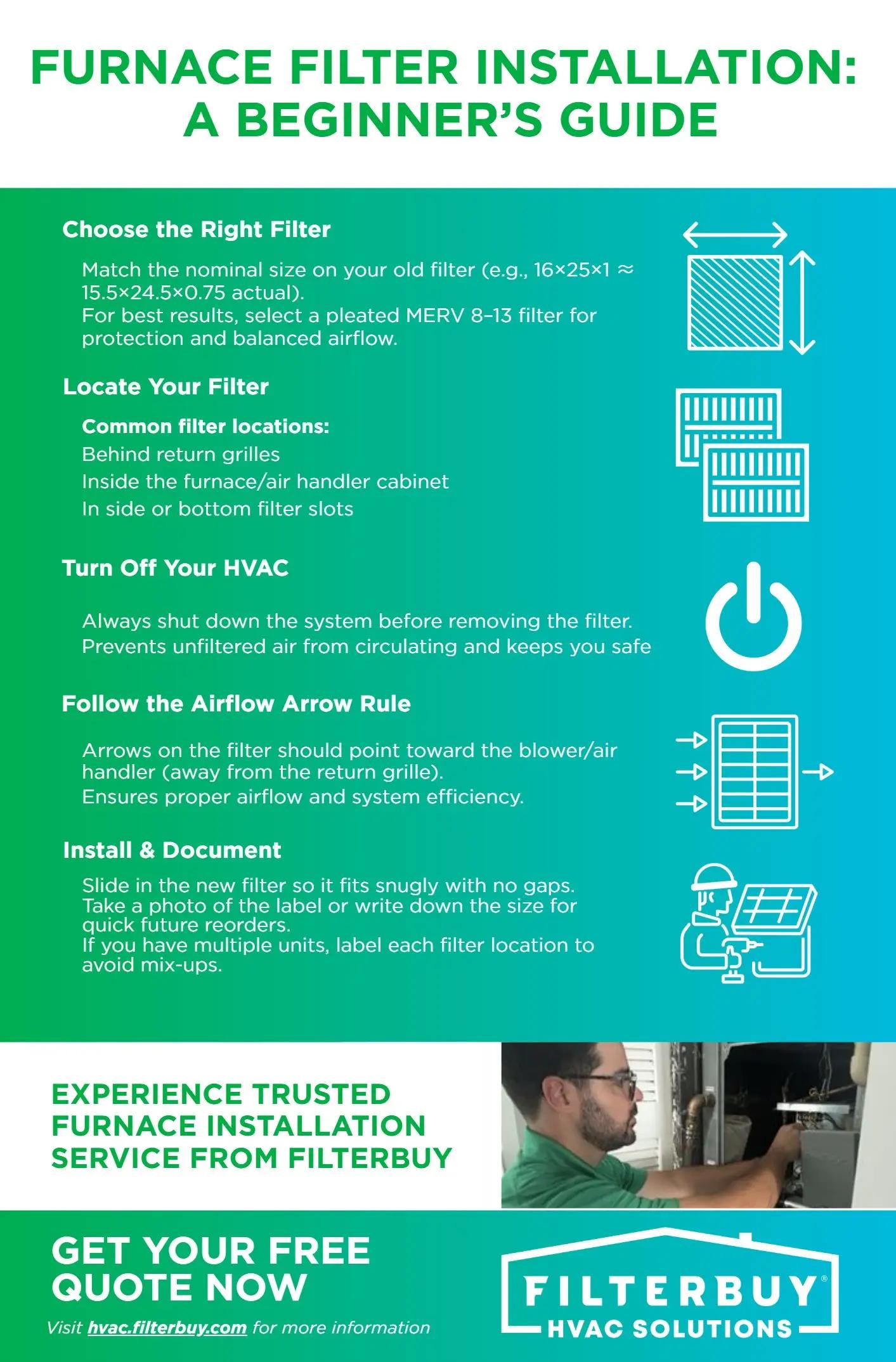
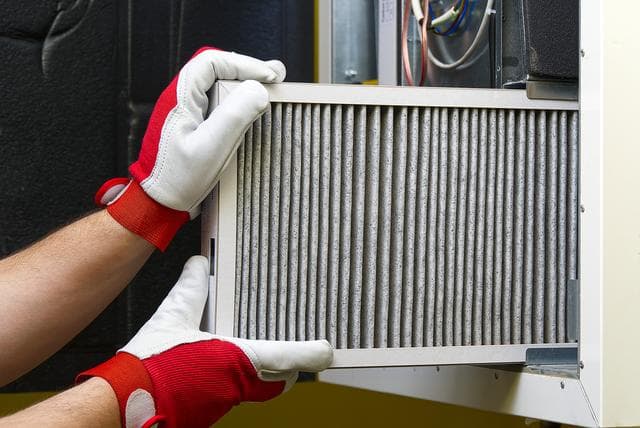
Turn off your system, remove the old filter, and slide the new one in with the airflow arrow pointing toward the blower. It should fit snugly, with no gaps around the edges.
Buy the same size printed on your old filter's frame, like 16×25×1. The whole job takes under five minutes.
Need a new filter? Answer a few quick questions and we'll match you to the right one.
TL;DR
Installing a furnace filter takes about five minutes and no tools. Shut the system off, slide the old filter out, and slide the new one into the same slot with the airflow arrow pointing toward the blower, never back toward the room. It should sit flush with no gaps, because air bypasses a loose filter rather than passing through it.
Key Takeaways
The airflow arrow always points toward the blower, away from the room. Only the compass direction changes between layouts.
A furnace filter sits on the return side: behind a return grille, in the furnace cabinet, or in a media cabinet ahead of the air handler.
Nominal size is not actual size. A 16×25×1 filter measures about 15.5 × 24.5 × 0.75 inches. Order by the nominal number.
A quarter-inch gap is enough to matter. Air takes the easiest path, so a loose filter gets bypassed. Filterbuy cuts 600+ sizes plus custom.
A backward filter never trips an alarm. It runs quietly for months while static pressure climbs, which is why it goes unnoticed.
Where Is the Furnace Filter Located?
A furnace filter sits behind a large return air grille, inside the furnace or air handler cabinet, or in a media cabinet between the return duct and the equipment. What those three share is the return side, the path pulling air out of your rooms. No residential system filters on the supply side, and the U.S. Department of Energy puts filters along the return duct too.
Where To Look, By System Location
More than one return grille usually means more than one filter: DOE Building America guidance puts it at the return plenum when the equipment is reachable, and behind every return grille when it is not. Found none at all? Measure the empty rack and order to that size. Our guide to where the furnace filter is located covers the rest.
Which Way Does the Furnace Filter Arrow Point?
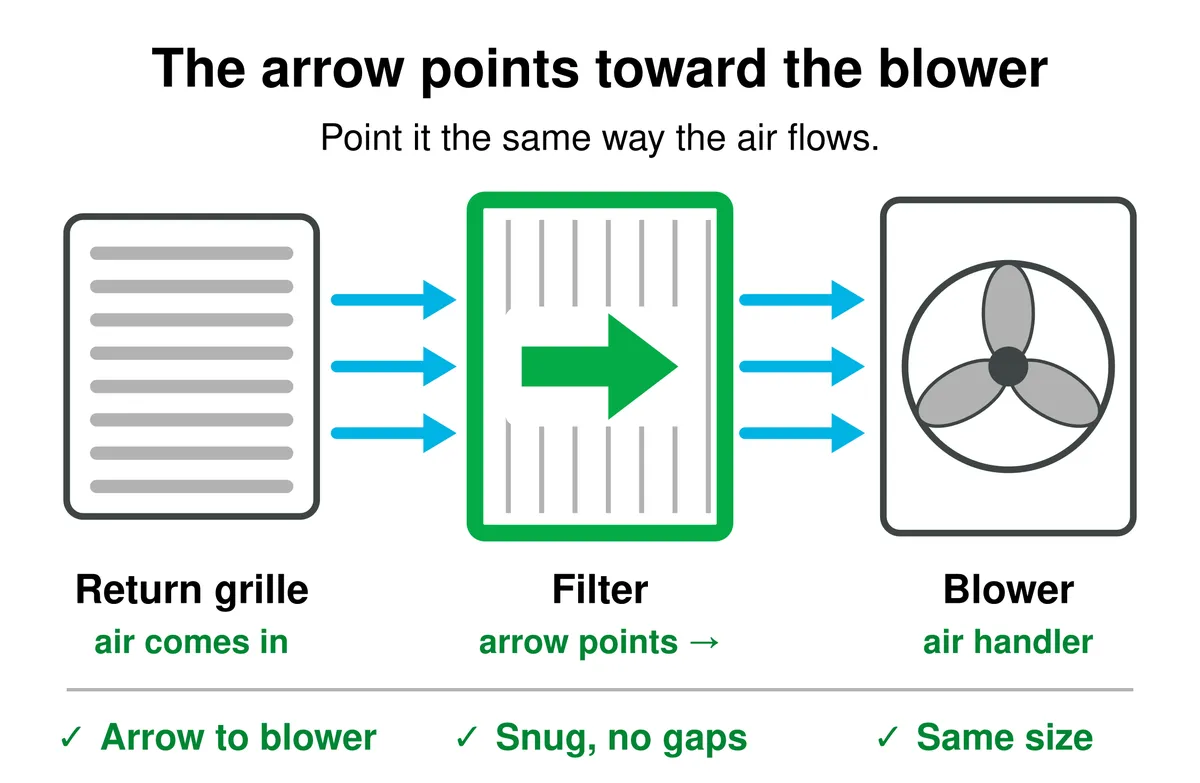
The airflow arrow on a furnace filter's frame always points toward the blower, the direction air travels as it leaves your rooms. It never points back at the return grille, and the rule holds in every configuration: upflow, downflow, horizontal, and wall, floor or ceiling returns.
The rule: the arrow points the way the air is going, away from the room and into the equipment.
The shortcut “point it at the furnace” falls apart under a ceiling return with the air handler in the attic. Follow the air. The DOE Building America Solution Center states it the same way: align the filter so the arrow points toward the HVAC equipment. See also which way the furnace filter arrow points.
“We print that arrow on our own line. After a decade of printing it, I can tell you the arrow was never the confusing part. Knowing which way the air moves is.” Michelle Wan, Brand Manager and Air Quality Writer, Filterbuy
Arrow Direction By Furnace Type
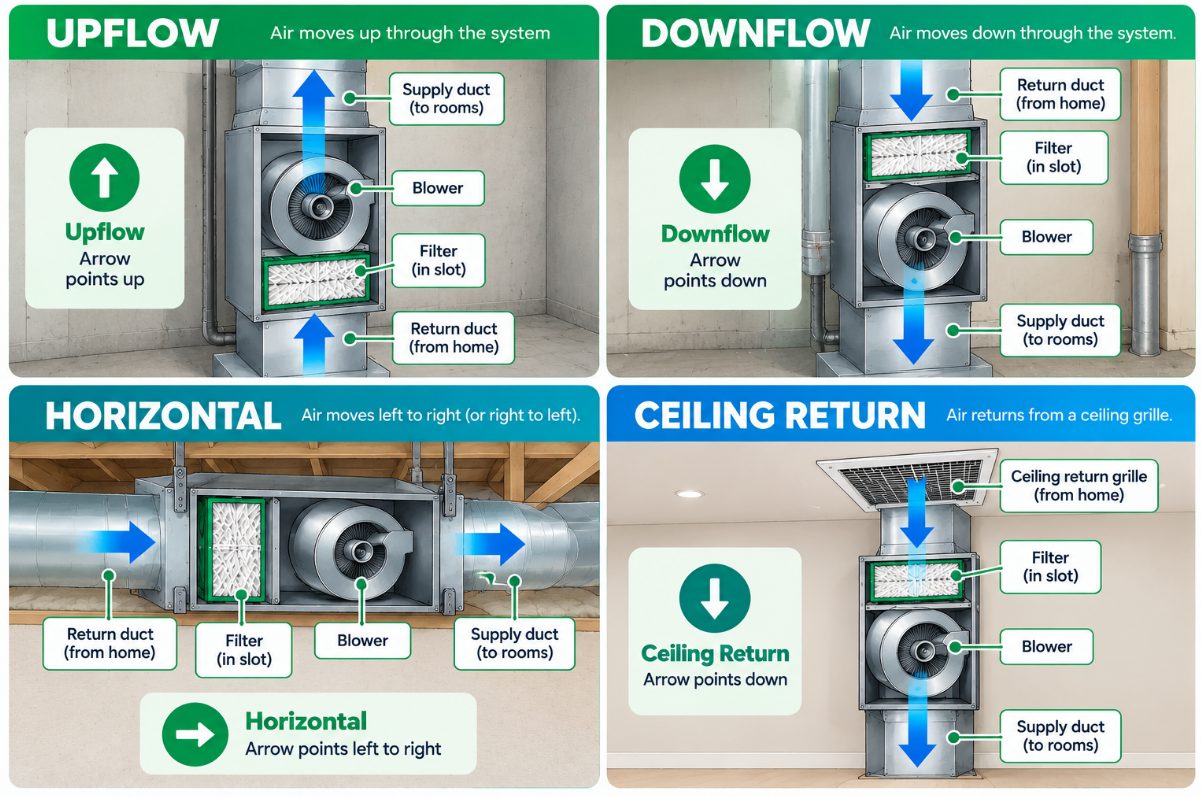
Horizontal furnace filter direction trips people up because the arrow ends up sideways, but nothing changes. Air still enters at the return end, and the arrow still points into the unit.
What If The Filter Has No Arrow?
Face the open pleated side toward the return air, the reinforced side toward the blower. Filterbuy lays dual wire backing over the media to stop the pleats collapsing, which makes the reinforced face the downstream face by design.
How To Check That You Got It Right
The dust test. The gray face of the old filter faced the return air, and the arrow points away from it. If it points at the dirty side, it was backward.
The tissue test. With the blower running, hold a tissue to the grille. At a return it pulls flat; at a supply it blows away.
Mark the cabinet. Draw an arrow on the sheet metal beside the slot. Filterbuy HVAC Solutions technicians do this on service calls.
What A Backward Filter Costs You
A reversed filter drives air into the dense face of the media first, raising resistance it was never built to create. Filterbuy measures a 20×25×1 at 1000 CFM at 0.10" w.g. for MERV 8 and 0.22" for MERV 13, published in the MERV pressure drop chart. Reversed, they go up. A gap costs more still: Lawrence Berkeley National Laboratory modeled a loose slot at roughly 10% of airflow bypassing the media, a large gap at about 25%.
“A filter that does not fill its rack is doing less than the homeowner thinks. Air will always take the gap over the media.” David Clark, Licensed HVAC Technician and President, Filterbuy HVAC Solutions
Sizing And Fit
Use the nominal size printed on the old filter's frame, three numbers such as 16×25×1. Nominal is a label, not a measurement: that filter comes off the line at about 15.5 × 24.5 × 0.75 inches, undersized so it slides in without binding. If it is gone, measure the slot and round to the nearest inch; our air filter size chart lists actual beside nominal. A true fraction like 22.25 means a custom slot, so order a custom air filter rather than forcing a near fit. The EPA puts it plainly: a filter must fit snugly, without leaking air around it or being bent to fit.
How Do You Install a Furnace Filter, Step by Step?
Turn off the system at the thermostat or service switch, so the blower cannot start while the compartment is open.
Remove the old filter, but photograph the frame first: one picture captures the size and the arrow, the two things people get wrong and cannot recover afterwards. Slide it out flat, then bag it.
Unwrap the new filter correctly. Plastic off, cardboard frame on. The wire backing is sharp.
Slide it in, arrow toward the blower. It should sit flush, with no gaps and no bowing.
Close up and test. Seat the cover tightly, but never tape or caulk it: you need it open in 60 days.
Write the date on the frame. The reminder lives where you will next be standing.
A whistle afterward means air forcing through a gap. Reseat it, then set a reminder: ENERGY STAR advises checking monthly and changing at minimum every three months, or set up filter auto-delivery and stop tracking it.
What Goes Wrong After the Filter Is In
Problems right after a change come down to seating or sizing rather than the filter itself.
MERV Selection
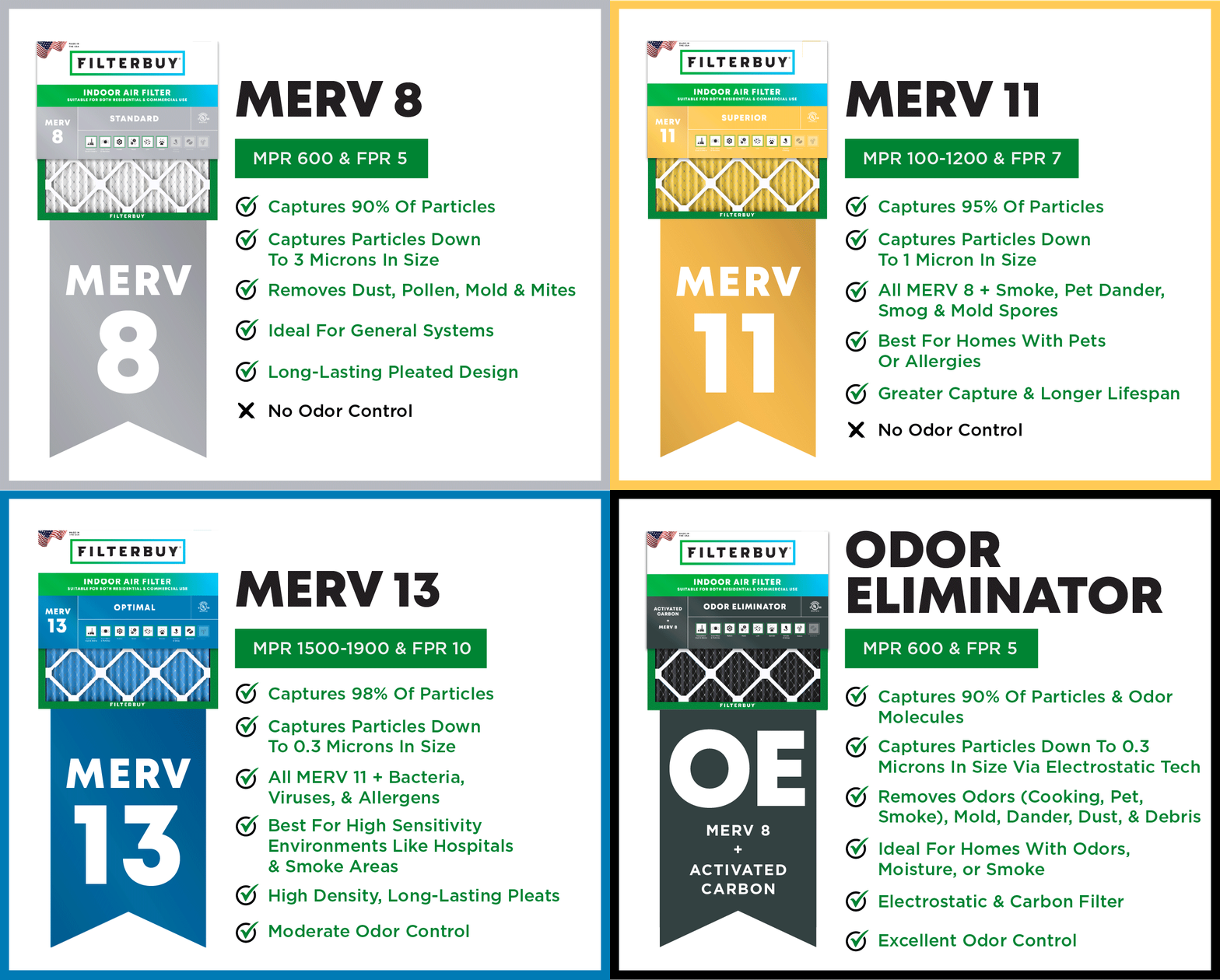
MERV rates how well a filter captures particles from 0.3 to 10 microns, under ASHRAE Standard 52.2. The EPA recommends at least MERV 13, or as high as your fan and slot allow. On pre-1995 equipment that may be more than your blower can pull, so compare MERV 8, 11, and 13 ratings before upgrading.
If you have avoided MERV 13 fearing it would choke your system, check your slot depth first. In Filterbuy's lab a 20×25×4 MERV 13 measures 0.11" w.g. at 1000 CFM, less than a 20×25×1 MERV 11 at 0.15". Depth buys surface area, and surface area buys airflow.
What Are the Most Common Installation Mistakes?
Installing the filter backward: the most frequent error, and silent.
Buying on nominal size without checking fit: too small leaves gaps, too large buckles.
Washing a pleated disposable: the media breaks down and filtration drops.
Forgetting the second filter in a downflow V-rack: replace both, arrows the same way.
Running with no filter while waiting on a delivery: a loaded old filter beats none. The DOE notes obstructed airflow lets dirt reach the coil.
Calling A Pro
Call a technician when the problem is the housing rather than the filter: a damaged slot cover, no rack at all, a unit you cannot reach safely, or a move to a 4-inch media cabinet. Call too when a fresh filter does not fix whistling, short cycling or an iced coil.
Supporting Statistics
1. Improper installation can raise a home's heating and cooling energy use by roughly 30%.
NIST studied seven common installation faults, restricted airflow among them, and found most surveyed equipment running below rated efficiency. Filter orientation was not one of the seven, so read this as evidence that installation details carry a measurable cost.
Source: NIST, Underperforming? Energy Efficiency of HVAC Equipment Suffers Due to Poor Installation
Supports: When Should You Call an HVAC Pro?
2. The filter alone accounts for 20–50% of a residential system's total pressure drop.
Residential systems run efficiently only at or below 0.4–0.5 inches w.c. of static pressure, so one filter rated 0.25 in. w.c. eats half that budget.
Source: U.S. DOE, Building America Solution Center (PNNL), High-MERV Filters
Supports: Which MERV Rating Should You Install?
3. A furnace filter only cleans air while the system runs, usually under 25% of the time.
Filters clean air only while the system runs, so air slipping around a loose one comes out of an already small supply.
Source: U.S. EPA, Guide to Air Cleaners in the Home
Supports: What Size Furnace Filter Do I Need?
Frequently Asked Questions
Which way does the arrow point on a horizontal furnace filter?
Sideways, into the body of the unit. If the return is on the left and the supply plenum on the right, the arrow points right.
Where is the furnace filter located?
Behind a large return air grille, in the furnace or air handler cabinet, or in a media cabinet ahead of the equipment. Always on the return side.
How do I know if my filter was installed backward?
The gray face of the old filter faced the return air, and its arrow should point away from it. Filterbuy prints that arrow on every filter it makes.
How long can I run my furnace without a filter?
Don't. Unfiltered air coats the blower wheel, heat exchanger and coil, and can void warranties. Leave the old filter in until the replacement arrives.
Find Your Exact Filterbuy Filter
Find your exact air filter size (600+ sizes)
Set up filter auto-delivery (arrives when due)
Glossary
Airflow arrow: The arrow on a filter's frame showing which way air travels through the media. It points toward the blower.
MERV: Minimum Efficiency Reporting Value, the ASHRAE 52.2 scale rating particle capture from 1 to 16. Filterbuy makes MERV 8, 11 and 13 in every standard size.
Nominal size: The rounded size printed on a filter frame; actual dimensions run a quarter to a half inch smaller.